Tag: Agriculture

  • Sundarbans: Not a blade of grass grew

    Sundarbans: Not a blade of grass grew

    Photo: Urvashi Sarkar

    Published in People’s Archive of Rural India. 10 September, 2019

    South 24 Parganas, West Bengal: Kajal Lata Biswas is still haunted by memories of the cyclone. Though it’s been 10 years since Aila hit the Sundarbans, she still clearly recalls May 25, 2009.

    It was just before noon. “The [Kalindi] river water rushed into the village and flooded all the houses,” says Kajal Lata. She was at a relative’s house in Kumirmari village that day, around seven kilometres from her own village, Gobindakati. “Some 40-50 of us took shelter in a boat where we stayed the whole day and night. We watched trees, boats, cattle and paddy being swept away. At night, we could not see a thing. Even the matchsticks were soaked. We could see only when lightning flashed across the sky.”

    Sitting outside her house and cleaning fish for lunch, 48-year-old Kajal Lata, a farmer, continues, “That night can never be forgotten. There wasn’t a drop of drinking water. Somehow, I collected a few raindrops in a plastic bag, which I used to wet the lips of my two daughters and niece, who were very thirsty.” Her voice shakes with the memory.

    The next morning, they used a boat to to reach their village. Then waded through flood water to reach home. “Tanushree, my elder daughter, then 17, almost drowned where the water was very high. Luckily, she grabbed her aunt’s saree pallu which had come loose,” Kajal Lata says, her eyes relaying the fear she felt.

    In May 2019, her fear returned with cyclone Fani, its arrival coinciding with the wedding of her younger daughter, 25-year-old Anushree.

    Kajal Lata Biswas, cleaning fish outside her house in Gobindakati village, recalls the terror of approaching cyclones; paddy is stored in these huts in her village, and the crop has taken a hit

    The wedding was fixed for May 6. Loudspeaker announcements about Fani by the panchayat and on radio by the government had started a few days earlier. “Imagine our plight and fear,” Kajal Lata says. “We were terrified that winds and rain would destroy all the preparations. There was some rain in the days before the wedding. But thankfully, the cyclone did not affect our village,” she adds, clearly relieved.

    On May 2, the India Meteorological Department had issued a warning about Fani hitting Andhra Pradesh, Odisha (which turned out to be the worst affected) and West Bengal. Talking about Fani, Prafulla Mondal, an 80-year-old farmer and former teacher in Rajat Jubilee village, raises his voice a few notches: “Fani missed the Sundarbans very narrowly. The winds whistled by us. If it had hit our village, we would have been destroyed, along with our houses and land…”

    As both Mondal and Kajal Lata know only too well, cyclones are common in the Sundarbans. The Disaster Management and Civil Defence Department of the West Bengal government categorises both South and 24 North Parganas districts as ‘very high damage risk zones’ due to cyclones.

    Mondal’s village is in Gosaba block of South 24 Parganas district, and Kajal Lata’s village is in North 24 Parganas district’s Hingalganj block. Both are among the 19 blocks which comprise the Indian Sundarbans in West Bengal – 6 blocks in North 24 Parganas and 13 in South 24 Parganas.

    Spread across India and Bangladesh, the Sundarbans is a vast delta with perhaps the largest contiguous mangrove forest in the world – covering around 10,200 square kilometres. “The Sundarbans region is one of the richest ecosystems in the world…” says a 2014 report by the World Bank titled Building Resilience for the Sustainable Development of the Sundarbans. “The entire mangrove forest region is known for its exceptional biodiversity, including numerous threatened species such as the Royal Bengal tiger, estuarine crocodile, Indian python, and several species of river dolphin. It is home to more than 10 per cent of mammal and 25 percent of bird species found in India.”

    The Indian Sundarbans – roughly 4,200 square kilometres – is also home to nearly 4.5 million people, many of whom live on the edge, struggling with meagre livelihoods, a harsh terrain and weather extremes.

    Though the region has not seen a major cyclone after Aila, it remains severely vulnerable. A 2006 report by the Indian Institute of Technology, Kharagpur, done for the West Bengal government’s Department of Disaster Management, notes that the state experienced 71 cyclonic storms from the years 1891 to 2004.  In that period, South 24 Pargana district’s Gosaba was the most affected block, with six severe cyclones and 19 cyclones.

    n Rajat Jubilee village, 80-year-old Prafulla Mondal has weathered many storms, but his family is now struggling with erratic weather changes

    Prafulla can thus recall cyclones even before Aila. “I cannot forget the 1998 cyclone [described as West Bengal’s ‘most intense storm’ since Independence, stronger even than Aila, which was a ‘severe cyclonic storm’] with its strong and violent winds. Before that too, I can remember the cyclone of 1988,” he says.

    But even given this stormy past, cyclonic depressions (a tropical weather disturbance at sea, in the range of 31- 60 kilometres an hour, below the range of a cyclonic storm of 62-82 kilometres) have increased 2.5 times in the last 10 years in the lower Gangetic delta (where the Sundarbans are located), notes Dr. Abhijit Mitra, a Kolkata-based oceanographer, in a 2019 book titled Mangrove Forests in India. Exploring  Ecosystem Services. “This means that cyclones occur more frequently,” he says.

    Various other studies show that the incidence of cyclones has increased in the Bay of Bengal, alongside the Sundarbans. One study published in 2015 in the Diversity journal puts the increase at 26 per cent between 1881 and 2001. And using available data from 1877 to 2005 on cyclones in the Bay of Bengal during May, October and November, a 2007 study shows that the frequency of severe cyclonic storms here has registered significant increasing trends in past 129 years during these intense cyclonic months

    In part, this is attributed to the increase in sea surface temperature (notes, among others, a paper in the Journal of Earth Science & Climate Change). These temperatures rose in the Indian Sundarbans at 0.5 degrees Celsius per decade from 1980 through 2007 – higher than the globally observed warming rate of 0.06° C per decade.

    There have been several catastrophic fallouts. “While the Sundarbans last experienced a major cyclone in 2009,” says Prof. Sugata Hazra of the School of Oceanographic Studies at Jadavpur University, Kolkata, “the region has suffered because of repeated inundation and embankment failure owing to subsequent cyclones in the northern Bay of Bengal.”

    Rising sea levels and sea surface temperatures, among several other shifts, are threatening the Sundarbans

    Embankments, the World Bank report notes, “play a key role in the Sundarbans as systems of defense against cyclonic storms and sea level rise. The people and the productivity of their holdings are under increased threat from deltaic subsidence, sea level rise, and increased cyclone intensity as climate change and the decay of a 19th century 3,500-kilometer system of embankments take their toll…”

    A 2011 World Wildlife Fund paper says that the relative mean sea level for 2002-2009 measured at the Sagar island observatory, Sundarbans, rose at the rate of 12 mm per year or at the rate of 8 mm per year for 25 years.

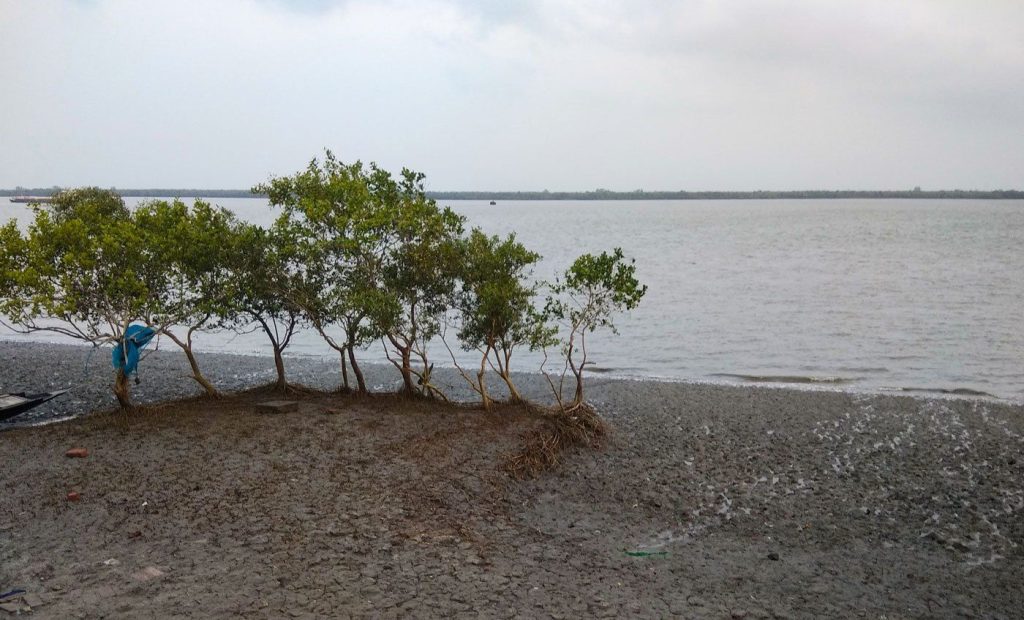
    The warming and related sea level rise is also adverse affecting mangroves. These forests help protect coastal areas from cyclones and erosion, act as breeding ground for fish and other species, and are also the habitat of the Bengal Tiger. A 2010 paper by Jadavpur University’s School of Oceanographic Studies, titled Temporal Change Detection (2001-2008) Study of Sundarban notes that the rise in sea level and cyclones seriously affect the health of Sundarban’s mangrove forests by reducing the forest cover.

    Arjun Mondal a fisherman from Rajat Jubilee village, was acutely aware of the importance of mangroves to the Sundarbans. He worked with an NGO, the Sundarbans Rural Development Society. “Everyone has heard of climate change, but how is it affecting us? We need to know more about this,” he told me in May 2019.

    On June 29, 2019, Arjun was carried away by a tiger while hunting for crabs in the Pirkhali forest. While humans have for long been attacked by tigers in the Sundarbans, the increasing reports of attacks are at least partially due to the erosion of forest land caused by rising sea levels, bringing tigers in closer contact with inhabited villages.

    With the battering of the region by cyclones, water salinity levels have also risen, especially in the central Sundarbans, where Gosaba is located. “…the ecosystem is being adversely impacted by significant increases in salinity due, in part, to sea level rise as well as reductions in freshwater flows to the delta,” notes the World Bank report.

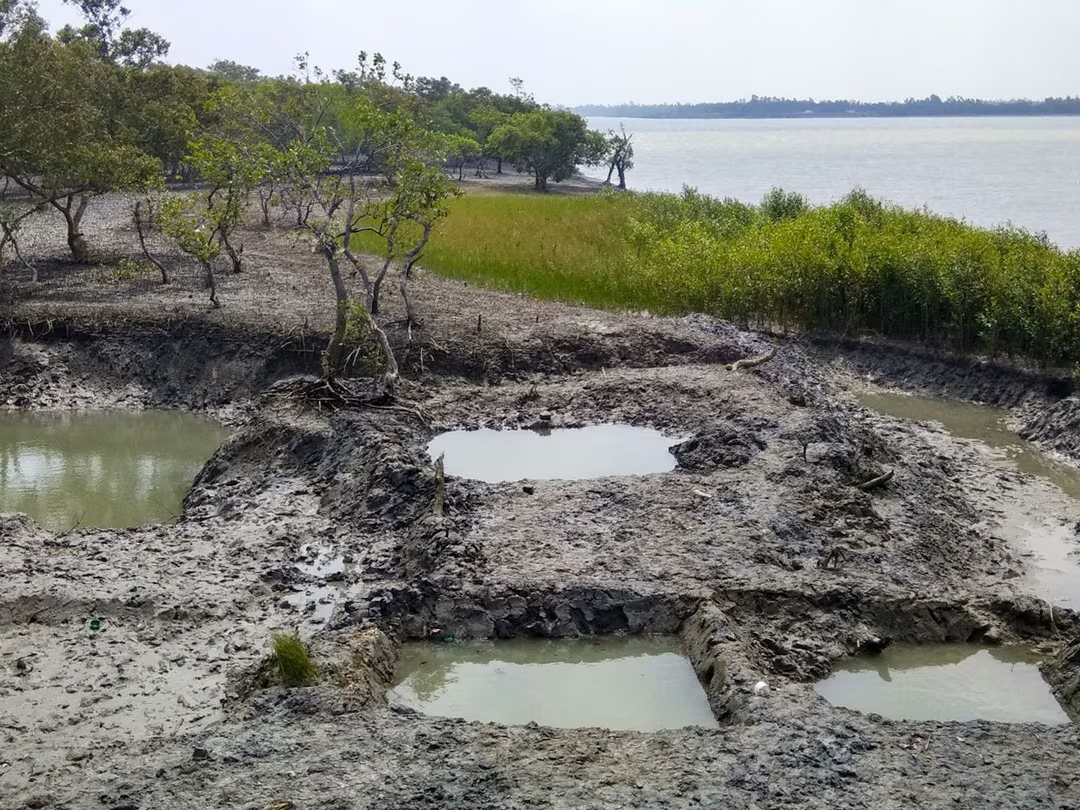
    The extensive embankments in the Sundarbans, crucial to farming and controlling soil salinity, are steadily being eroded by the rising sea levels

    A research paper co-authored by Dr. Mitra describes the Sundarbans as ‘hypersaline’. “Water salinity has increased due to rising sea levels in the central part of Sundarbans. This is clearly linked to climate change,” says Dr Mitra.

    Other researchers have noted that the siltation of the Bidyadhari river, which prevents fresh water flows from the Himalayas to the central and eastern Sundarbans. Researchers have attributed the siltation in part to land reclamation, cultivation, dumping of sewage sludge and fisheries waste. The building of the Farakka Barrage in 1975 (on the Ganga, in West Bengal’s Murshidabad district) also contributed to the increasing salinity of the central Sundarbans.

    The Mondal family in Rajat Jubilee knows the effects of the high salinity – they had no rice to sell for three years after Aila. Their annual income of Rs. 10, 000- 12,000 from selling rice was wiped out. “With rice cultivation gone, entire villages emptied out as men left to hunt for work, to Tamil Nadu, Karnataka, Gujarat and Maharashtra, where they joined factories or construction sites as labourers,” Prafulla recalls.

    Across the state, Aila affected more than 2 lakh hectares of cropped area and over 6 million people, and it killed 137  and destroyed over 1 million houses .  “There was nobody in my village who did not suffer losses,” Prafulla says. “My house and crops were destroyed. I lost 14 goats and could not cultivate paddy for three years. Everything had to be rebuilt from scratch. Those were hard years. I took up carpentry and odd jobs to make a living.”

    After Aila intensified salinity, Kajal Lata’s family too had to sell six bighas of their 23 bighas (7.6 acres) of land. “Not a blade of grass grew for two years because the soil was so salty. Not even rice could grow. Slowly, vegetables like mustard, cabbage, cauliflower and gourds are growing again, enough for our consumption, but not enough to sell,” she says.  “We also had a pond which produced different fish like shol, magur, rui and we could earn Rs. 25,000-30,000 a year by selling these. But after Aila, the water became entirely salty, so there is barely any fish.”

    Mangroves are critical to the ecosystem of the Sundarbans, but they too are slowly thinning out

    The soil degradation – including high salinity and high alkalinity – caused by Aila resulted in poor paddy growth across much of North and South 24 Pargana, notes a 2016 paper in the Journal of Experimental Biology and Agricultural Sciences. A study in the journal shows that to grow paddy again, phosphate and potash-based fertiliser had to be used above the recommended levels.

    “After Aila, fertiliser use has increased. Only then we are able to get the required yield,” says Prabir Mondal, Prafulla’s 48-year-old son. “It isn’t healthy to eat, but we still need to eat it. I remember the rice we ate as children. You could eat it as it is. Now, even when eaten with vegetables, something feels amiss.”

    His father owns 13 bighas (4.29 acres) of land which produces 8-9 bastas of rice per bigha – one basta equals 60 kilos. “The cost of planting, cutting and lifting the rice plus fertiliser costs means that we earn very little over what we have spent,” says Prabir.

    Paddy production across the Sundarbans, a 2018 research article observes, fell by half after Aila – from 64-80 quintal to 32-40 quintals per 1.6 hectares. Though paddy production has now stabilised to pre-Aila levels, says Prabir, his family and others in his village remain completely dependent on rainfall from June to September.

    And that rainfall has become unreliable. “The accelerated sea level rise,” says Prof. Hazra, “and the delayed arrival and deficiency of monsoon, are impacts of climate change in the long run.”

    High rainfall exceeding 100 millimetres a day is occurring more often in the last two decades over the northern Bay of Bengal (where the Sundarbans is located), says ongoing research at the School of Oceanographic Studies, Kolkata. At the same time, in the sowing season, Prof. Hazra says, the monsoon has often fallen short, as it did this year – till September 4, around 307 millimetres short in South 24 Parganas and nearly 157 mm less in North 24 Parganas.

    It’s not just this year – a shortfall  or excess rain has been recurring in the Sundarbans for some years. The normal June to September monsoon rain in South 24 Parganas is 1552.6 mm. The monsoon data for 2012-2017 the district indicates that rainfall was deficient in four out of six years, with major lows in 2017 (1173.3 mm) and  2012 (1130.4 mm).

    In the North 24 Parganas, the opposite has happened: excess rainfall. The normal June to September rainfall here is 1172.8 mm. The monsoon data for 2012-2017  shows that rainfall was excess in four out of these six years with the highest in 2015 – 1428 mm.

    “The real trouble is the untimely rain,” says Kajal Lata. “In February this year, there was plenty of rain, almost like monsoon. Even the elders said they could not recall a time when it rained so much in February.” Her family depends on paddy for an income, sown in June-July and harvested in November-December. “The paddy growth depends entirely on rainfall. If there is no rain, the rice will not grow.”

    Since the last four or five years, she says, it’s been raining in her village in November-December, in addition to the monsoon months. While some showers during these months usually occur here, their intensity can harm the paddy harvest. “Either there is no rain when required or it rains excessively out of season. This is destroying the harvest. Every year we think this time there won’t be excessive [unseasonal] rain. But it rains so much and the crop is completely destroyed. That is why we have the saying, ‘Aashay morey chaasa’ [‘Hope kills the farmer’].”

    In Rajat Jubilee village, Prabir Mondal is also worried. “Through June and July, there was no rainfall [in my village]. Some paddy leaves dried up. Thankfully, rain has arrived [in August]. But will it be enough? What if it rains too much and the crop drowns?”

    As a healthcare practitioner (he has a BA degree in alternative medicine), Prabir says his patients also increasingly complain of the heat. “Many now suffer from heat stroke. It can hit at any time and can be fatal,” he explains.

    Land temperatures in the Sundarbans are also increasing, besides the rising sea surface temperatures. From 180 days in a year when the temperature was 32 degrees Celsius or higher here in 1960, the number of such days increased to 188 in 2017, show data on an interactive portal of the New York Times on climate and global warming. This could become 213 to 258 days by the end of the century.

    Buffeted repeatedly by the growing heat, cyclones, erratic rain, salinity, vanishing mangroves and more, the residents of the Sundarbans live in a near-constant state of uncertainty. Prafulla Mondal, witness of several storms and cyclones, wonders: “Who knows what will come next?”

    Read the original article: https://ruralindiaonline.org/articles/sundarbans-not-a-blade-of-grass-grew…/
  • ‘Maach (fishing) and chaash (cultivation) brought us to Sundarbans’

    Published in People’s Archive of Rural India. 10 April 2017

    The year was 1949. Jiban Krishna Poddar, 14 years old, fled from his home in Barisal district to West Bengal, along with his parents and grandmother. The Noakhali riots of 1946 had sparked off waves of migration which would continue for many years. Two years after their flight, the family made their way to the Sundarbans.

    Now over 80 and seated in the verandah of his home on a rainy evening, he reminisces about the journey that brought him to Krishnadaspur village in Patharpratima block, the place he calls home: “There was violence, so we had to leave. My mother, Usha Rani Poddar, packed all our belongings into 14 bags. We reached Khulna city [then in East Bengal] by ship. A train took us to Benapole.  We hid our money and ornaments in clothes and belongings.”

    Jiban recalls that the family was taken to a refugee camp in Nadia district of West Bengal, where they lived for 11 months with more than 20,000 others. The refugees were asked to settle in Dandakaranya (the forested Bastar region of central India), the Andaman islands or the Sundarbans in West Bengal.

    “My father, Sarat Chandra Poddar, chose the Sundarbans,” Jiban says. “He wanted to own and farm land. Maach and chaash (Bengali for fish and agriculture) were the two main attractions. He felt that the Dandakaranya and Andamans were uninhabited jungles where it would have been difficult to live.”

    Jiban’s family was among the 150 families that left from Howrah for the Sundarbans by ship. They came to Mathurapur block where the Indian government asked them to clear the jungles for agriculture. “When we began farming, it was difficult. The area was 60 per cent water and 40 per cent jungle. The drinking water was not clean and many people died of cholera. The doctor would come once in 15 days. There was a famine and we had to suffer great hunger.”

    Jiban’s father got a job in a government office where his task was to operate a hand fan for other employees. His mother kept buffaloes and sold milk and eggs.

    The family was eventually allotted 10 bighas of land (one bigha is around one-third of an acre in West Bengal) in Krishnadaspur village, where they began cultivating rice. After saving some money, they bought more land and built a house in the village, which now has a population of 2,653 (2011 Census).

    Jiban lives with his wife and 11 children, and retired as postmaster of the village post office around 2010. Priyaranjan Das, 64, who retired from the village post office as a peon, also traces his origins to East Bengal. He arrived from Noakhali with his parents in the early 1950s, when he was two years old. “We would boil stems and eat them since there was no food.  There would be severe outbreaks of cholera, causing many people to leave. But we stayed on,” he remembers.

    Many other families came to the Sundarbans from different parts of West Bengal, the Chota Nagpur Plateau and Odisha after 1765, when the East India Company acquired the civil administration in Bengal. Amites Mukhopadhyay ( Living with Disasters: Communities and Development in the Indian Sundarbans ) and Annu Jalais ( People and Tigers: An Anthropological Study of the Sundarbans of West Bengal, India ) write that the colonial rulers, interested in increasing their revenues, hired labourers from different parts of the subcontinent to reclaim and cultivate land.

    Robi Mondal of the Tagore Society for Rural Development, a non-governmental organisation that works in the Sundarbans, says: “The floods and famine in Medinipur, the 1947 Partition of Bengal and the 1971 Bangladesh war of independence caused a further exodus of people, and many of them landed up in Sundarbans.”

    Another round of migration took place around 1905, when Scottish businessman  Daniel Hamilton was working towards rural reconstruction through a cooperative movement in the islands of Gosaba block. He leased out land to labourers for cultivation. Many of the descendants of the migrants still live in Gosaba, and remember his contribution to the development of the Sundarbans.

    Eighty-year-old Revati Singh, who lives in Jotirampur village, is originally from Ranchi. His grandfather, Anandmai Singh, came to Gosaba in 1907, during Hamilton’s cooperative movement. “He arrived in Canning block by tram. They would probably have walked from there to Gosaba, which is currently more than 12 hours on foot. Later, Hamilton built small boat launches to transport them.”

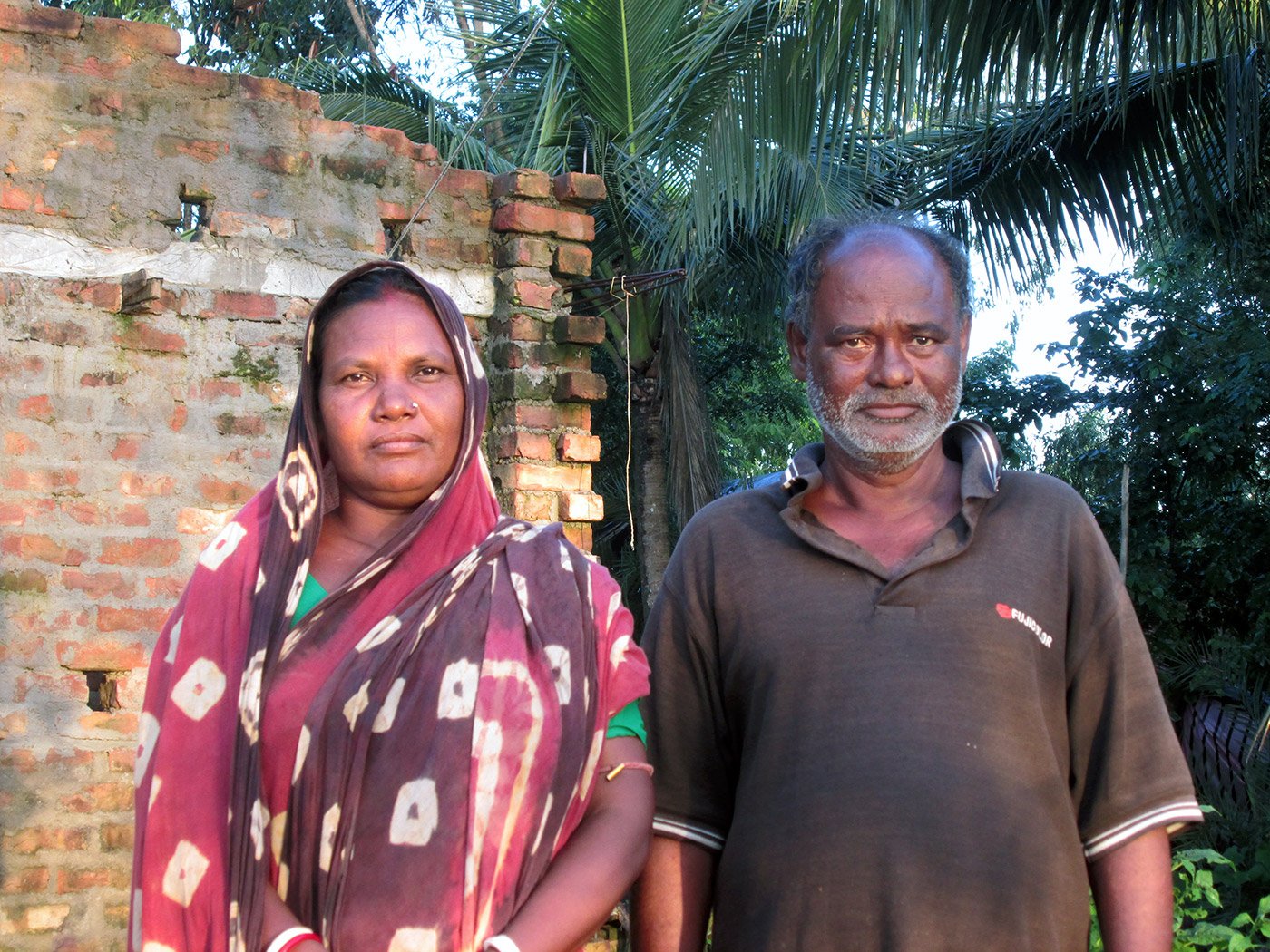
    a man and a woman
    Lakhan and Sandhya Sardar. Lakhan’s grandfather migrated from Ranchi to Gosaba in the early 1900s
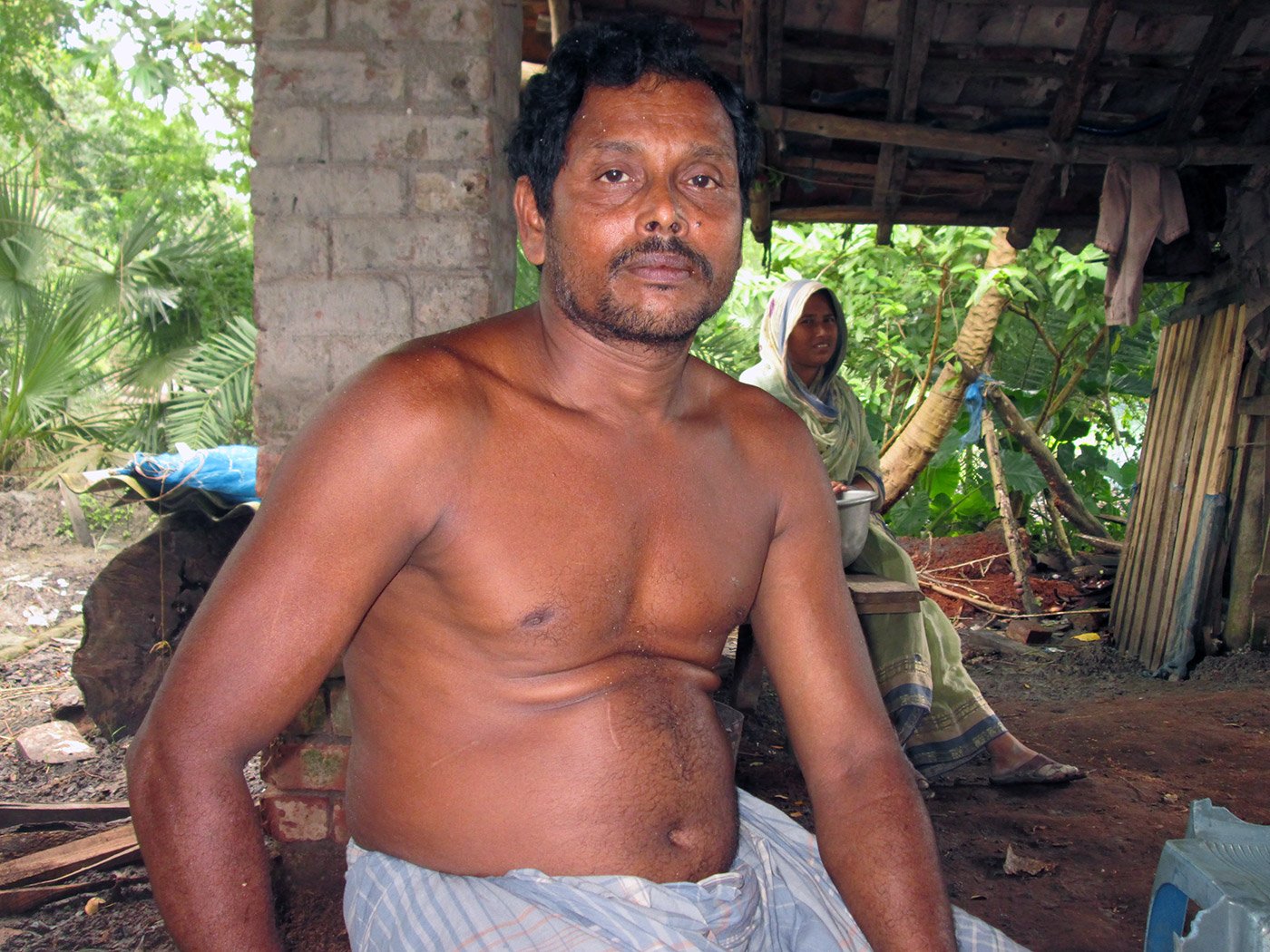
    a man whose ancestors migrated

    Mohammed Molhor Sheikh’s great grandfather arrived in the Sundarbans from Midnapore some 150 years ago

    Revati has heard that the population at the time was small, and there were recurring attacks by tigers and crocodiles, and no clean drinking water. Has the situation changed? “Fewer tigers attack now,” he says. “There were no jobs then, and even now getting work is a problem. I used to cultivate rice but stopped because the river would overflow into the fields.” Revati’s three sons have informal jobs.

    Lakhan Sardar, whose grandfather Bhagal Sardar also migrated from Ranchi to be a part of the cooperative movement, remembers that on Hamilton’s invitation, renowned poet and writer Rabindranath Tagore visited Gosaba in 1932.

    A large section of the population of the Sundarbans is from the Medinipur area of West Bengal. Frequent flood and famine in Medinipur drove inhabitants to the Sundarbans to work as labourers or cultivators of land. Jyotirmoy Mondal from Jotirampur village recalls that his grandparents walked from Medinipur to the Sundarbans before the onset of Hamilton’s cooperative movement. “Grandfather became a night watchman and eventually died of fever.  My grandmother, Digambari Mondal, would guard people’s buffaloes for a living, cultivate rice and sell ghee.”

    Mohammed Molhor Sheikh cuts wood for a living in Arampur village in Gosaba. His great grandfather came with two brothers from Medinipur to the Sundarbans, 150 years ago. “We heard stories of how they would chase tigers with iron rods flaming with fire. We also heard how they would frequently suffer flood and famine and the destruction of their rice fields.”

    Another wave of migration from Medinipur occurred during the severe 1943 famine in West Bengal.  Seventy-one-year-old Haripriya Kar’s husband’s family migrated to Gosaba during this period. The village Jotirampur, where she lives, is named after Jotiram Kar, her father-in-law.  “Jotiram and Khetramohan were brothers who came from Medinipur to Gosaba, bringing 27 families with them. These families cleared the surrounding forests and settled down,” she says.

    Haripriya’s house is cast in darkness as she speaks. The electricity was cut a few hours ago. Livelihood options here are few, it is difficult to get medical help, and connectivity with roads and transport is a huge hurdle. Still, the descendants of the original settlers of the Sundarbans do not have it as hard as their ancestors did. The struggle for a better life continues, even as they recollect the hardships and deprivations of the past.

    Photos: Urvashi Sarkar

    Read the original article: https://ruralindiaonline.org/articles/maach-and-chaash-brought-us-to-sundarbans/

  • Trade-Offs

    Photo: INDRANIL MUKHERJEE / AFP / GETTY IMAGES

    Published in Caravan Magazine. 1 February 2016

    On 15 December 2015, representatives of the 164 member states of the World Trade Organisation gathered in Nairobi for a ministerial conference—a biennial gathering, and the group’s highest decision-making forum. This was the tenth such meeting in the history of the organisation, which was founded in 1995 to arbitrate in matters of international commerce and to progressively lower trade barriers—such as import tariffs and domestic subsidies—in pursuit of an open global market. Writing in the Financial Times before the conference, Michael Froman, the United States’ top representative on trade policy, expressed his conviction that the meeting would “mark the end of an era.” It was time, he argued, “for the world to free itself of the strictures of Doha.”

    Froman was referring to the Doha Development Agenda, the WTO’s current round of trade negotiations, which commenced in 2001 and is yet to be concluded. The Doha round aims at major reform of the international trading system through lowering barriers and revising trade rules, and also, as the round was originally pitched, at improving the trading prospects of developing countries—which form a majority of the WTO’s members, and argue that the current global trading regime is tilted steeply against them. The Doha round has had a mixed record on that latter goal, but, particularly in giving developing countries more room for manoeuvre in negotiations and pushing developed countries to acknowledge their protectionist policies, it has given developing countries hope. But, developing countries complain, it has also forced them to compromise on domestic interests in areas including agriculture, services and intellectual property regulation, to the benefit of their developed counterparts.

    Negotiations of the Doha round have been fraught from the start. For India, a consistently contentious point has been opposition from developed countries to its agricultural and food subsidies, which, according to figures it submitted to the WTO in 2014, amounted to about $51 billion in the 2010 financial year. According to the Organisation for Economic Cooperation and Development, a coalition of primarily developed countries, the United States paid over $95 billion in agricultural subsidies in 2014, and the European Union over $125 billion that same year, to comparatively richer and smaller agricultural populations. Matters came to a head at the WTO’s ninth ministerial conference, in Bali in late 2013, after developed countries challenged India’s practice of buying grain at guaranteed minimum prices to maintain public stockpiles of food, and also other provisions of its National Food Security Act. To allow talks on other issues to move forward, India assented to a temporary clause which allowed it to continue its subsidies, and which promised that a permanent agreement on the issue would be negotiated in the near future. That was no real victory, since it committed India to not expanding its agricultural subsidies in the interim, and did not rule out legal action against it on charges of distorting trade.

    Speaking in Delhi before the Nairobi conference, Nirmala Sitharaman, India’s trade minister and chief negotiator at the meeting, told reporters that she would insist on pursuing the promised permanent solution, and that “the spirit of Bali should be respected.” When she reached Nairobi, Sitharaman also made it clear that India would be seeking a reaffirmation of all the agreements reached thus far under the Doha round. The tenth ministerial conference of the WTO, then, looked set for yet more confrontation between developed and developing states, with India, as a leader of the latter block, on the front lines—a recurring pattern throughout the WTO’s 20-year history.

    As the gathering unfolded, many developed countries refused to reaffirm the Doha round. The conference’s final declaration, which was repeatedly revised until all participants agreed to sign it, stated frankly that while “many Members reaffirm the Doha Development Agenda … Other Members do not.” Since WTO negotiations operate on the basis of unanimity and a principle often encapsulated as “nothing is agreed until everything is agreed,” the dispute imperils the entirety of the many years’ worth of negotiations under the Doha round. Sitharaman tweeted afterwards that she was “utterly disappointed that the unanimous reaffirmation of DDA hasn’t happened,” but won little sympathy back home, where many media commentators and civil society groups took her acceptance of the equivocal final statement as a capitulation.

    The Nairobi meeting served as a reminder of India’s increasingly difficult position within the WTO, where it faces a dizzying matrix of national interests and international pressures. Since the country joined the organisation, upon its founding in 1995, India’s participation in the global economy has multiplied manyfold, increasing its stake in the WTO’s trading, regulatory and negotiating mechanisms. Much else has changed over that time too, not least India’s position in the diplomatic world—particularly with its growing alignment with the United States. The net result of these changes has been a weakening of India’s stance in the organisation, which in recent years has caused it to yield to a rising number of WTO policies detrimental to its domestic interests. The history of how India got here offers insight on just where the country stands within the organisation now, and what its options might be going forward.

    India has long been ambivalent about the modern international trading regime. In 1947, it was one of 23 founding signatories of the General Agreement on Tariffs and Trade, a framework of rules established by the Allied powers, with an intent similar to that of the WTO. Signing the GATT was a move away from India’s pre-Independence isolation from the global trading system, but, for the most part, the country continued on its post-colonial economic path of self-reliance and import substitution. A 2009 paper from the Centre for International Trade and Development at Jawaharlal Nehru University notes, “Indeed, joining the GATT was definitely not a reflection of India’s visible faith in the neoliberal multi-lateral trading system.”

    The first seven rounds of talks held under the GATT were limited to negotiating tariff reductions. But things changed in 1986, with the inauguration of the eighth and final GATT negotiation round, in Uruguay. Over 120 countries had signed on to the GATT by then, and the Uruguay round was to be a great bargain between the developed and the developing world. Developed countries promised to reduce barriers to imports from the developing world, and, in exchange, developing countries accepted several new trade agreements—including ones on intellectual property, services and agriculture—which bolstered the interests of developed economies. When the round closed, in 1994, it vastly increased the scope and complexity of global trade provisions.

    The Uruguay round overlapped with India’s economic liberalisation in the early 1990s, which brought down many of the barriers that might have insulated the country from its effects. In 1995, with developed countries in particular concurring that the expanded rules required a more comprehensive organisation for enforcing them, the WTO was formed. India, though reluctantly, joined the new body, which offered access to regulated international markets, and promised to compel developed countries to reduce domestic subsidies that impeded imports from the developing world. Also, crucially, participation in the WTO allowed developing countries to bargain collectively with developed ones, using the force of numbers to balance out yawning imbalances in power, and to avoid coercive bilateral treaties.

    India’s initial years in the organisation were characterised by cautious efforts to gain more international market access for its products, alongside opposition to subsidies in developed countries. The country’s interests aligned with those of other developing states, and India emerged as a leader of negotiating coalitions of developing countries, such as the G33. In 1999, India’s then minister of trade, Murasoli Maran, played a crucial role in stalling the opening of a new round of WTO negotiations that developing countries feared would further disadvantage them.

    Meanwhile, India confronted the domestic implications of WTO policies—most prominently, then as now, in agriculture. The Uruguay round brought agricultural trade under a global system for the first time, and committed WTO members to easing their markets open to international competition by reducing tariffs and subsidies for agricultural products. This threatened numerous policies—including guaranteed pricing and public stockpiling of food—that the Indian government sees as checks against the fluctuations of price and supply inherent in an open market, and hence crucial to avoiding famine and protecting agricultural livelihoods at a time of rural distress and high rates of suicide among farmers.

    Until 2005, India maintained its protests against the demands of the developed countries, and against the expansion of the WTO’s purview. But following that, it backed down on a number of issues. Biswajit Dhar, a professor of economics at Jawaharlal Nehru University, told me over email that “India was proactively raising issues of food security and rural livelihoods, protection of traditional knowledge, increased market access in services until 2007–08, but has gone strangely silent since.” At Nairobi, India was vocal in defending its food and agricultural subsidies, but not much else.

    At home, too, India has bowed to more WTO policies since 2005, with grim consequences. The country’s ongoing implementation of the TRIPS Agreement, an accord on intellectual property negotiated during the Uruguay round, threatens its thriving production of generic drugs, which has drastically brought down prices of life-saving medicines across much of the developing world. The country’s struggling textile manufacturers face additional difficulty as a result of diminished export subsidies, as does its sugar industry. The implementation of the GATS, an agreement on liberalising services—including education, health, water, energy, communications and sanitation—promises to have far-reaching consequences for many public goods.

    Many commentators and researchers have linked India’s milder position in the WTO to its growing closeness with the United States. That diplomatic shift has manifested itself in numerous bilateral agreements, including a deal for cooperation on India’s use of nuclear power for civil purposes, the framework for which was approved in 2005. In 2014, the two countries came to an agreement to resolve several disputes pending from the talks at Bali, including India’s opposition to WTO-stipulated rules on trade facilitation—that is, customs and border procedures.

    Still, India’s softened temperament is baffling. If anything, its negotiating power in the WTO should be greater now than it has been in the past. Certainly, India’s delegations at WTO talks today are better informed and more capable than in the past. A former foreign secretary I interviewed, who asked to remain anonymous, said that “during the Uruguay round, we did not properly examine how it would affect our domestic policy. We did not study the implications.” Since then, he told me, “some NGOs had played an important role in demystifying the initial agreements,” particularly on services. India’s history of leading the developing countries’ cause allows it the privilege of mobilising considerable collective power when it chooses to, and the defence of the Doha round offers a potent rallying cry. In Nairobi, the Indian delegation could have tried to assemble a defiant front. Strangely, it did not.

    In the long run, any dilution of India’s commitment to multilateral deal-making is risky, as bilateral negotiations would leave it with significantly less leverage than it could muster in the WTO. This is partly why even many of the most vocal detractors of the WTO do not think it is in the best interests of developing countries such as India to quit the organisation. The evidence from recent trading deals the United States has sealed outside the WTO framework—the Trade in Services Agreement, which involves 50 countries, including the members of the European Union; and the Trans-Pacific Partnership, which brings together 12 states along the Pacific Rim—is that these push for much greater liberalisation than anything passable in the WTO for now.

    Meanwhile, India would do well to hold on jealously to what strength it has in the WTO, especially as developed countries continue pushing to extend the organisation’s reach into areas such as government procurement, labour practices and environmental safeguards. The South Centre, a Canada-based research group, has warned that if these issues “are brought into the WTO, and WTO principles are applied to them, developing countries will be at a disadvantage and lose a great deal of their economic sovereignty.” Yet India, by softening on matters such as the TRIPS Agreement, and by failing to block prevarication on the Doha round at Nairobi, is losing its stature among developing nations, and is eroding their tradition of standing together. In an article published shortly after the Nairobi conference, the former finance secretary SP Shukla wrote, “It would have been impossible to ignore India in Nairobi if it had stood courageously to defend its rights and those of developing countries.” His verdict was that “developing countries chose not to exercise their legal rights,” and that “India chose not to mobilise developing countries.” If the country’s history in the WTO teaches us anything, it is that strength in numbers alongside other developing countries is its best tool for defending its interests. The government would do well to understand that.

    Read the original article: https://caravanmagazine.in/perspectives/trade-offs-india-weakening-stance-wto

Urvashi Sarkar – 2026 – All rights reserved.

web things by Studio Goncharov