Tag: fishing

  • Hunting for crabs in the shadow of the Bengal tiger

    Hunting for crabs in the shadow of the Bengal tiger

    The fisherwomen of Sundarbans wandering into dangerous territory

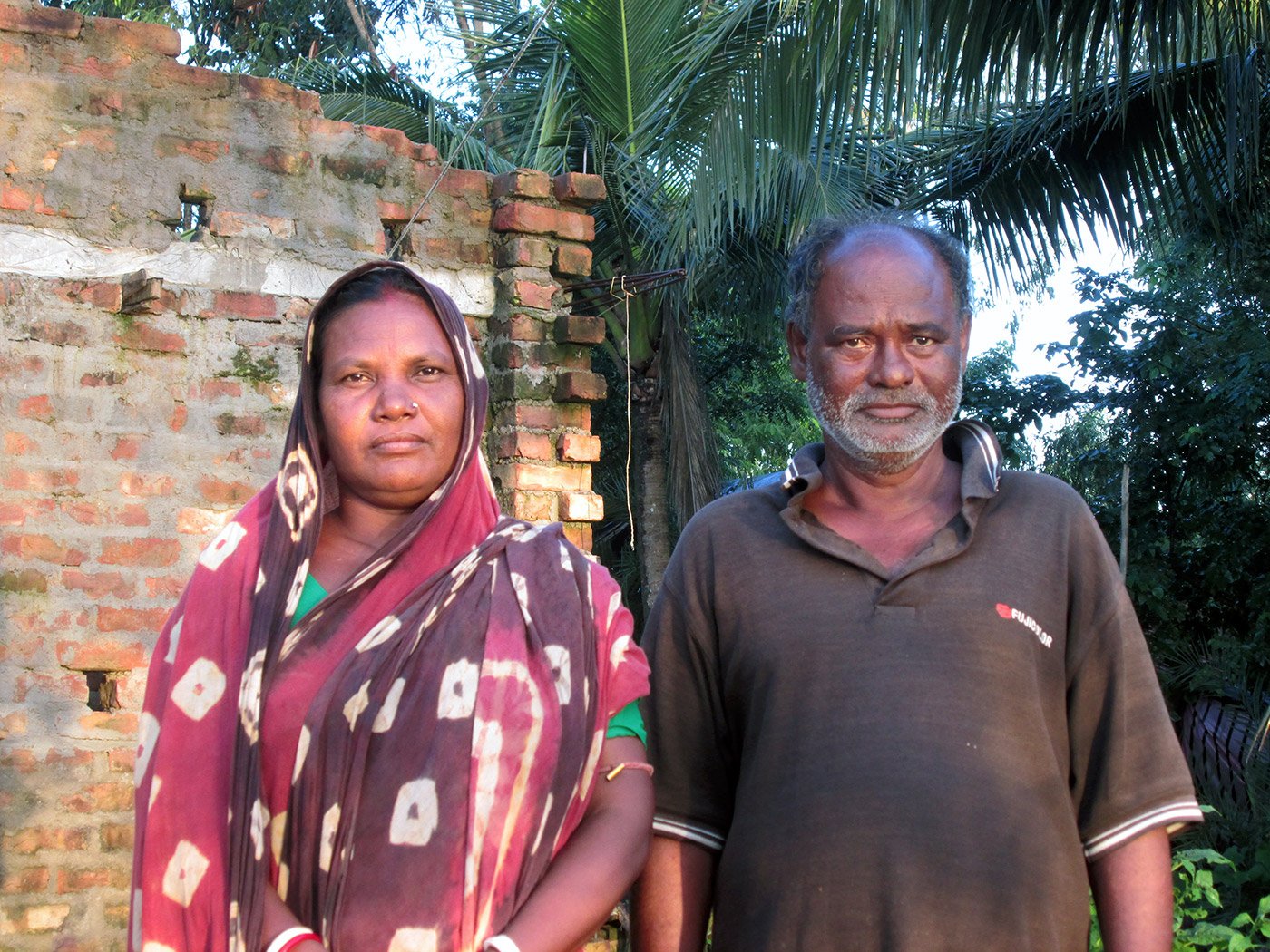
    “How do I describe my fear? My heart races in terror. My thoughts are always on when I will escape back to open spaces,” says 41-year-old crab hunter and fisherwoman Parul Haldar, about the cold fear she feels during the days that she searches for crabs to catch in the dense mangrove forests of the Sundarbans. During the crab-hunting season, she rows a boat up and down the rivulets and creeks through the mangrove forest, always in a state of high alert for lurking tigers.

    Now directing her wooden boat down the Garal river, Parul, a resident of Luxbagan village, squints in the direction of the criss-cross net fence beyond which lies the Marichjhapi forest. It was in this forest, near her village in the Gosaba block of the South 24 Parganas district, that Parul’s husband, Ishar Ronojit Haldar, was killed by a tiger seven years ago.

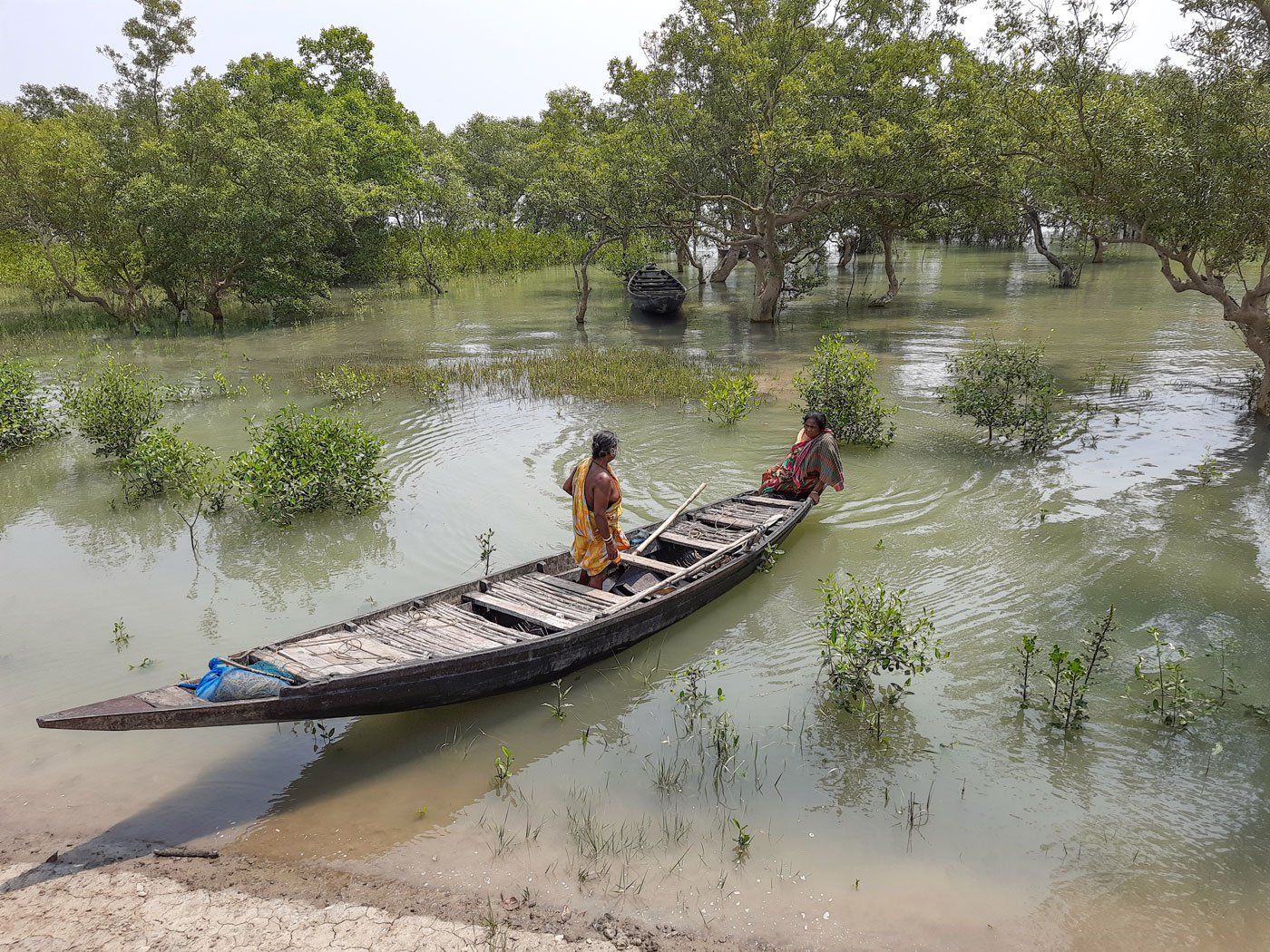
    She rests the oars on the edges of the boat in which she and her mother Lokhi Mondal, 56, are out on a scorching summer day. Like her daughter, Lokhi is a fisherwoman too.

    Parul was only 13 years old when she married Ishar. Her marital family was poor, but they had never gone into the forest to fish or catch crabs. “I convinced him to come and brought him to the jungle,” she recalls. “Seventeen years later, he died in the jungle.”

    Parul lapses into silence at the memory. Ishar was 45 when he died, leaving Parul to raise their four daughters.

    Parul and Lokhi pull the heavy oars again, sweating. The women steer the boat a safe distance away from the mangrove forest, now closed for fishing. Fishing activities in the mangrove forest are closed for three months, from April to June, to allow regeneration of fish. When the fishing season is paused, Parul usually sells fish from her pond for a living.
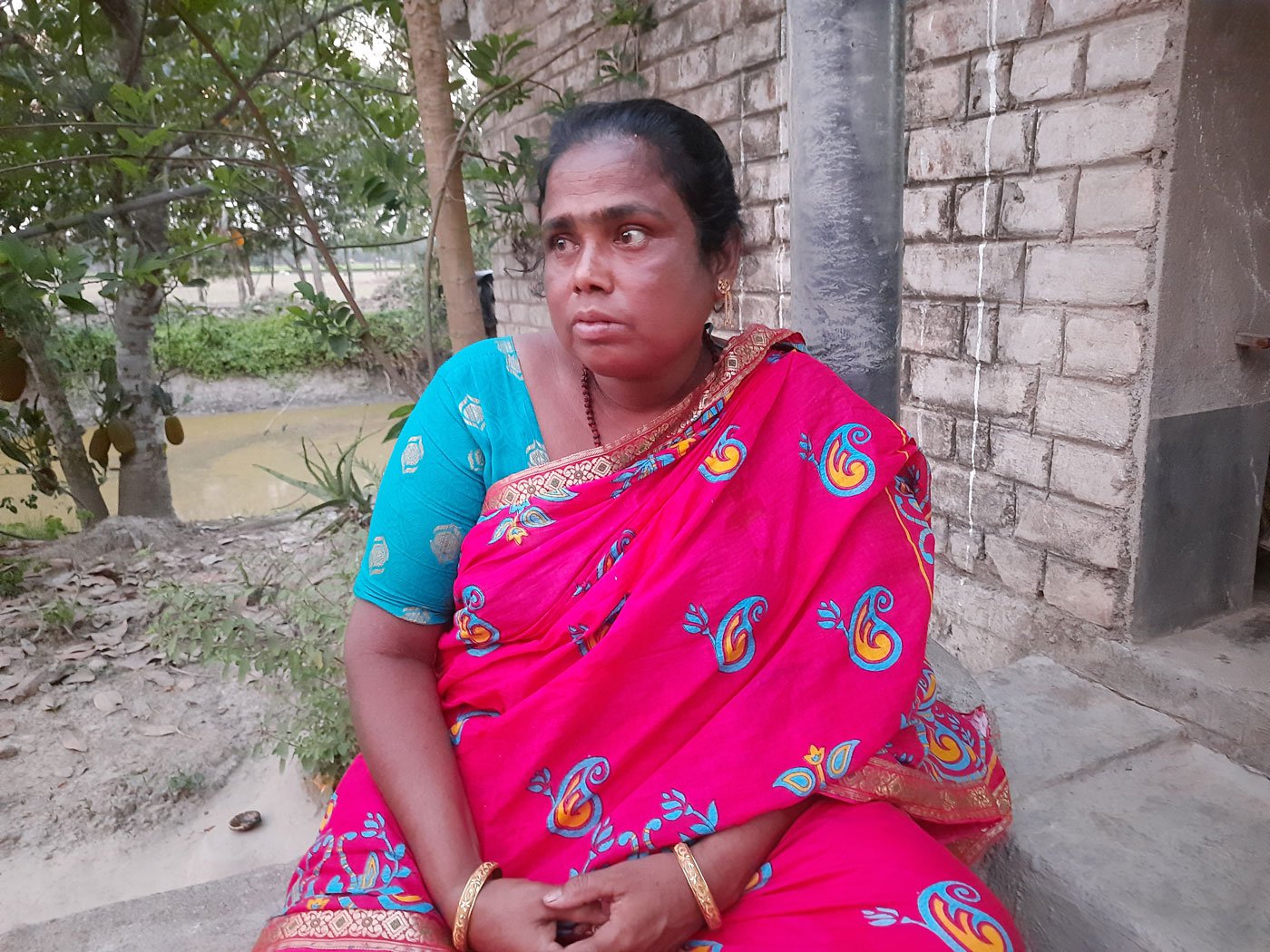
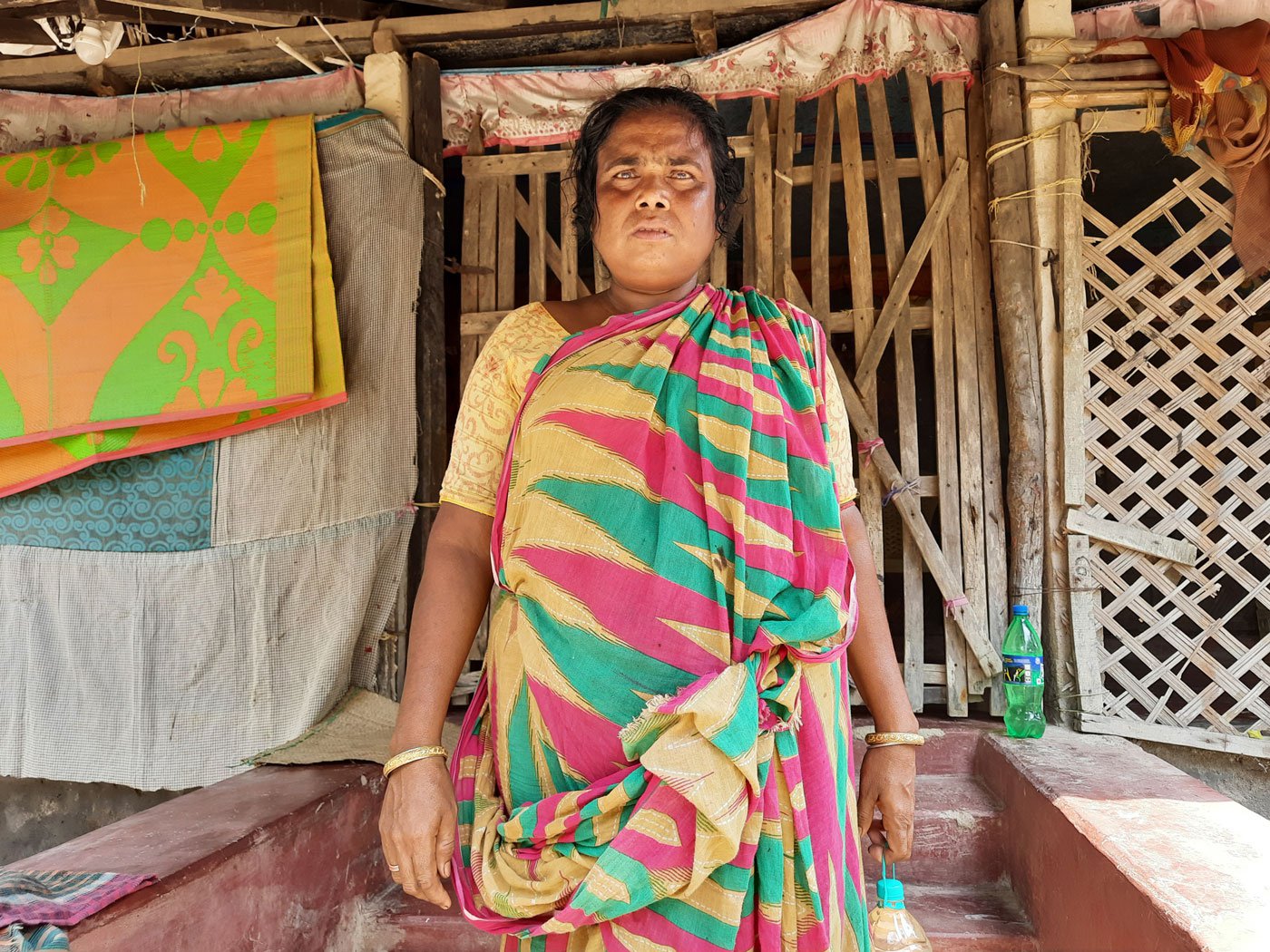
    Left: Parul Haldar recalls the death of her husband, Ishar Haldar.

    PHOTO • URVASHI SARKAR

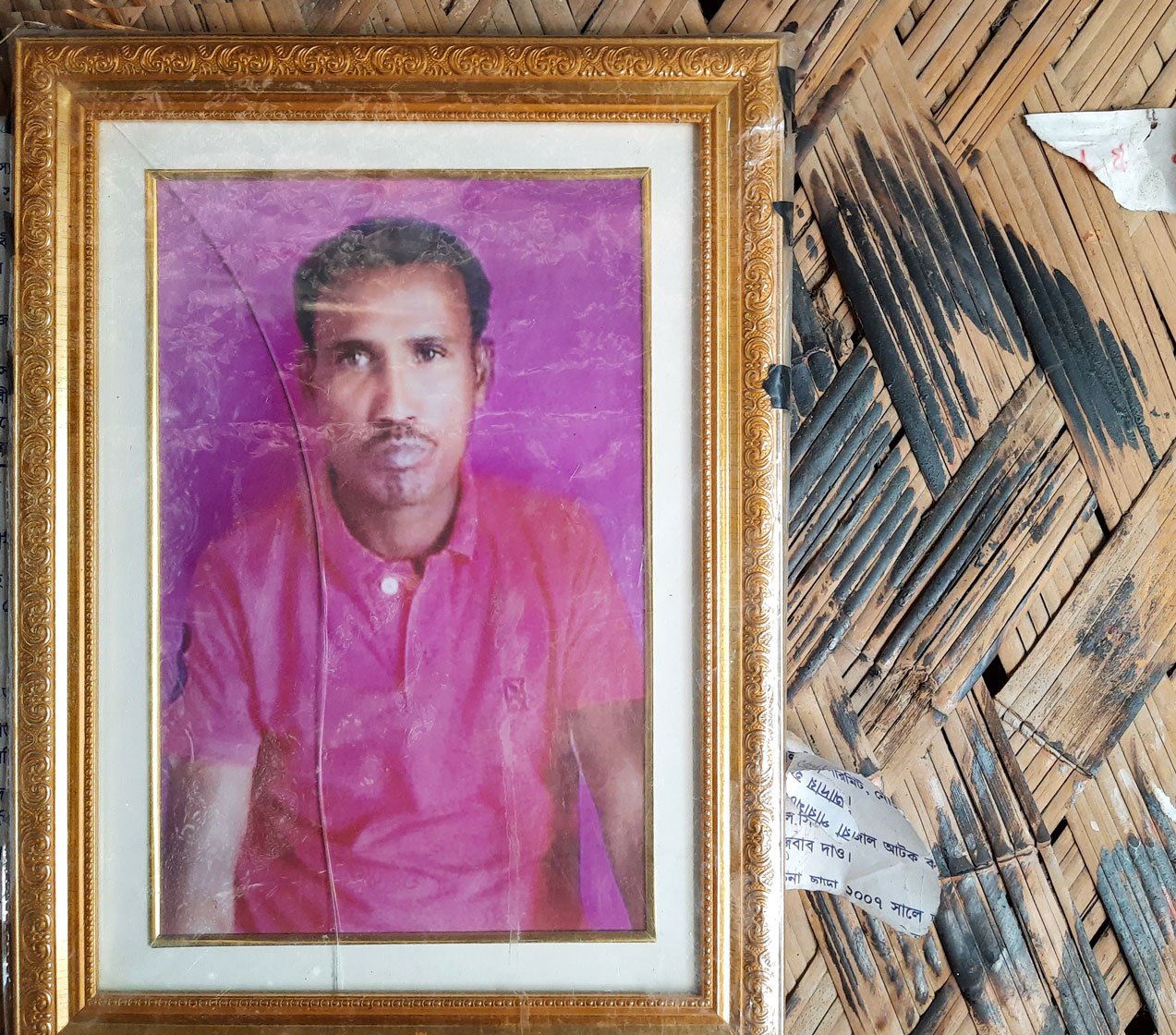
    Right: A picture of Ishar Ronojit Haldar who was killed by a tiger in 2016

    PHOTO • URVASHI SARKAR

    Left: Parul Haldar recalls the death of her husband, Ishar Haldar. Right: A picture of Ishar Ronojit Haldar who was killed by a tiger in 2016
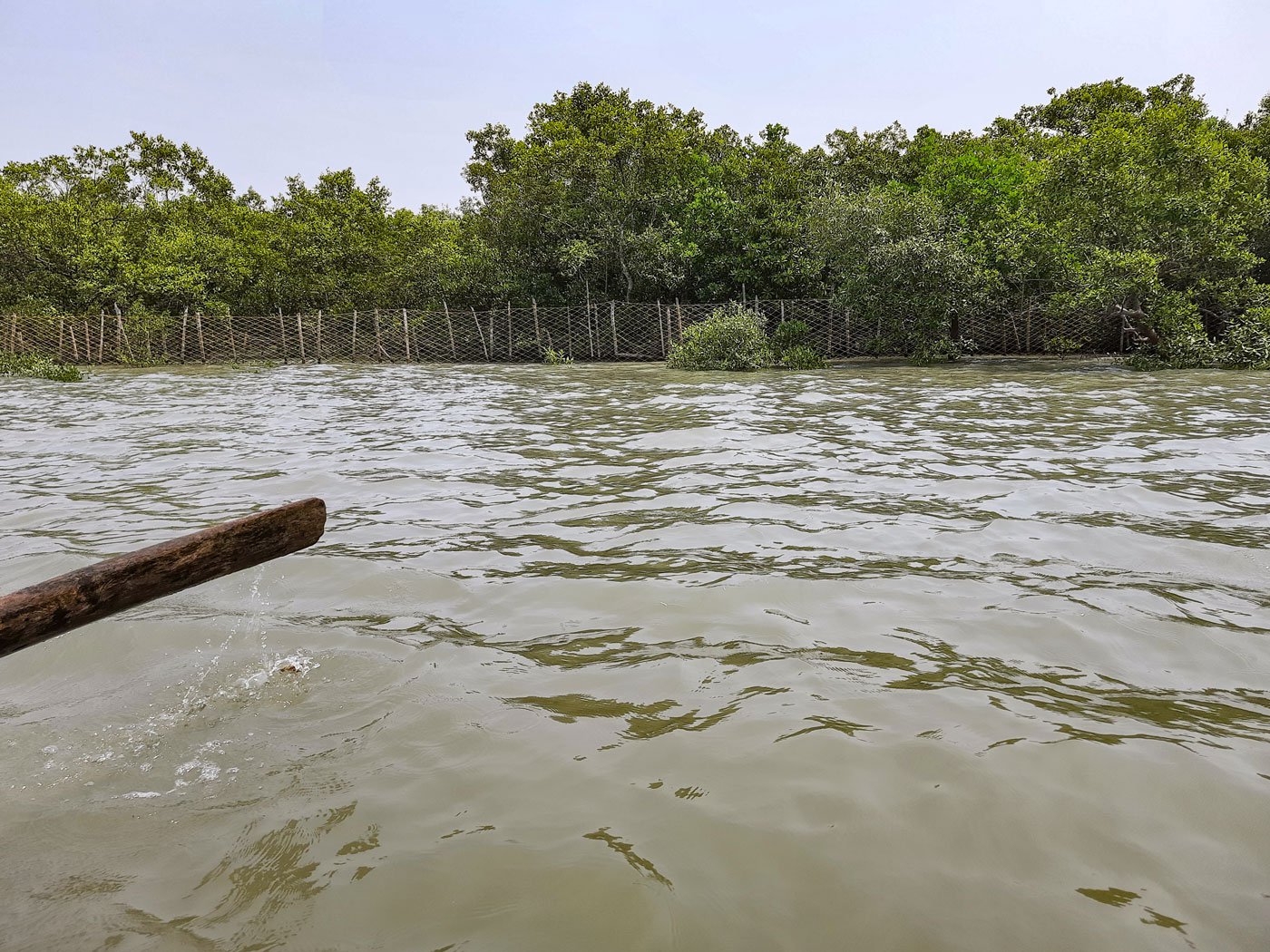
    Left: A cross netted fence, beyond which lie the Marichjhapi forests in South 24 Parganas district.

    PHOTO • URVASHI SARKAR

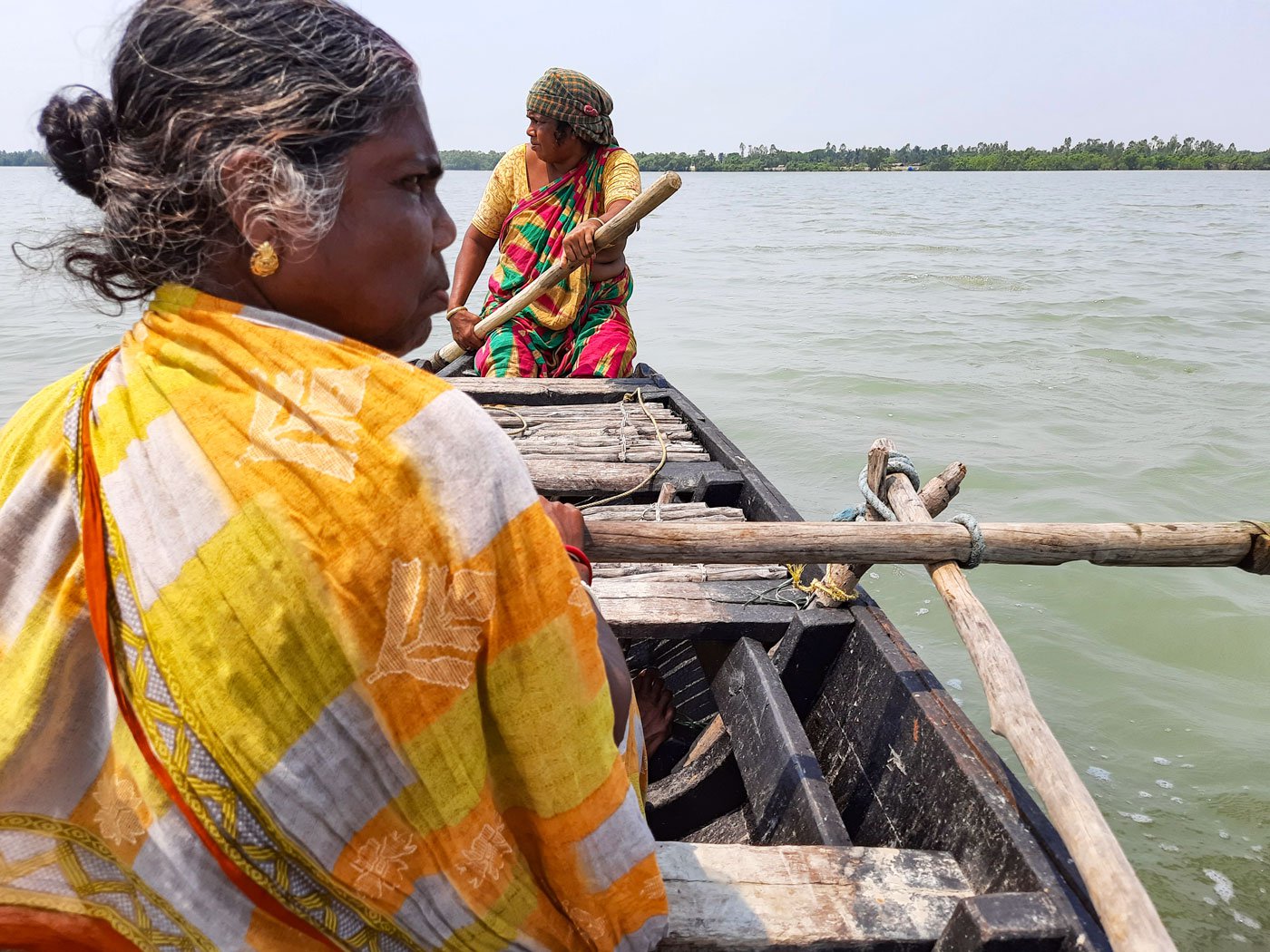
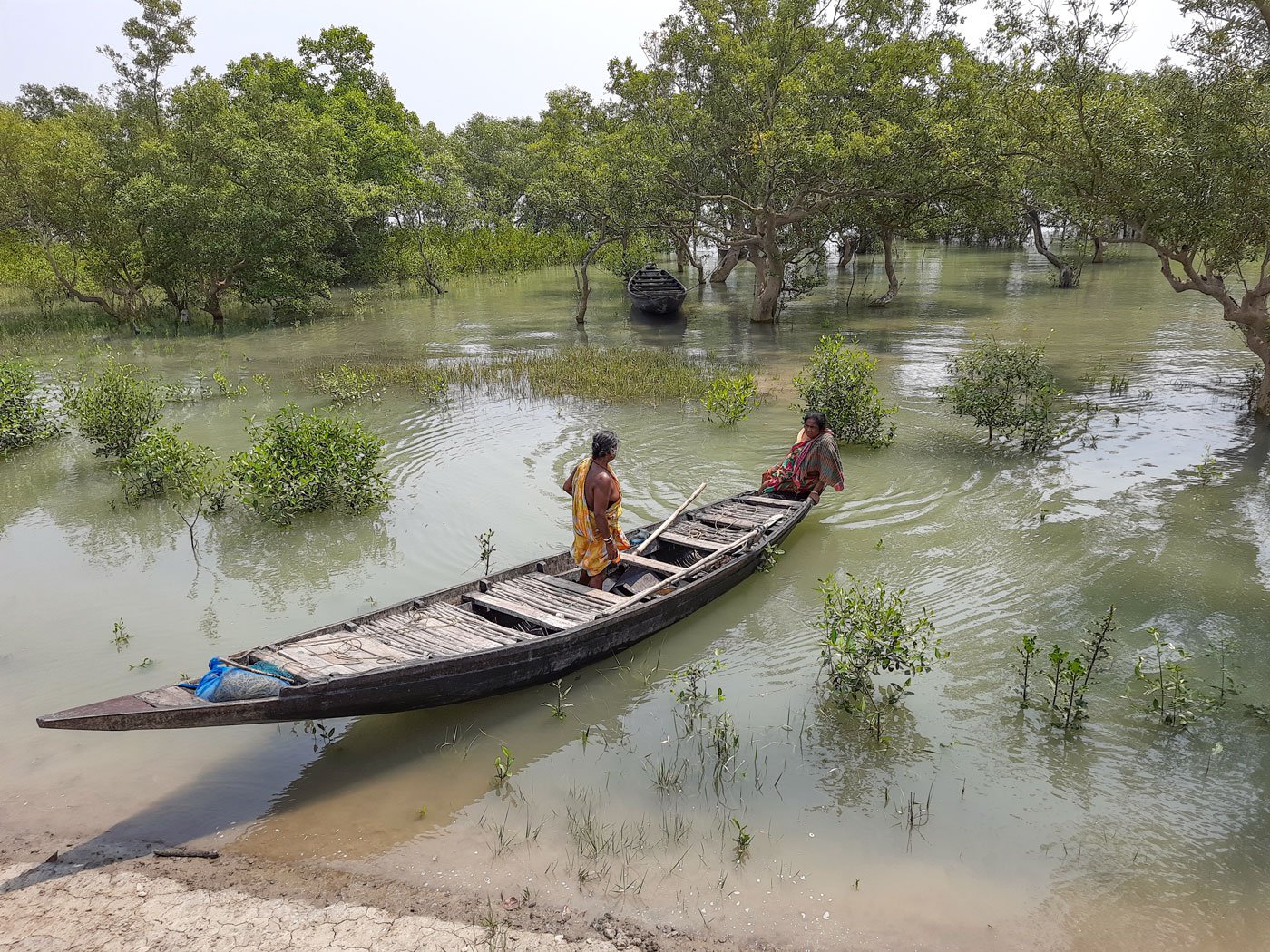
    Right: Parul (background) learned fishing from her mother and Lokhi (yellow sari foreground) learned it from her father

    PHOTO • URVASHI SARKAR

    Left: A cross netted fence, beyond which lie the Marichjhapi forests in South 24 Parganas district. Right: Parul (background) learned fishing from her mother and Lokhi (yellow sari foreground) learned it from her father

    “Many accidents are happening,” Parul says, referring to attacks by the Bengal tigers in the Sundarbans, the only mangrove forest in the world inhabited by tigers. “Too many people are entering the forest and accidents are increasing. This is another reason why forest authorities are not allowing us to enter the forest.”

    Tiger-related deaths are not uncommon in the Sundarbans, especially during the fishing season.  The government reported only 12 deaths in the Sundarbans Tiger Reserve Between 2018 and January 2023, but actual numbers may be higher, with local residents reporting more instances of attacks.

    According to the government’s Status of Tigers Report, the Sundarbans was home to 100 tigers in 2022 , compared to 88 in 2018.

    *****

    Parul has been fishing since she was 23 years old, having learnt how to fish from her mother.

    Lokhi started fishing when she was only seven years old, accompanying her father to the forest. Her husband Santosh Mondal, 64 fought off a tiger in 2016 and managed to return home alive.

    “He had a knife in his hand and fought the tiger. But after that incident, his courage broke, and he refused to go to the forest any more,” says Lokhi. She, however, did not stop. Once her husband stopped going, she began to make the journey into the forest with Parul and her son-in-law, Ishar, who later died.

    “I don’t have the courage to go to the jungle with anyone else. Nor do I allow Parul to go alone. As long as I am alive, I will accompany her,” she says. “Only your own blood can protect you in the jungle.”
    As the number of crabs decrease, Parul and Lokhi have to venture deeper into the mangrove forests to find them
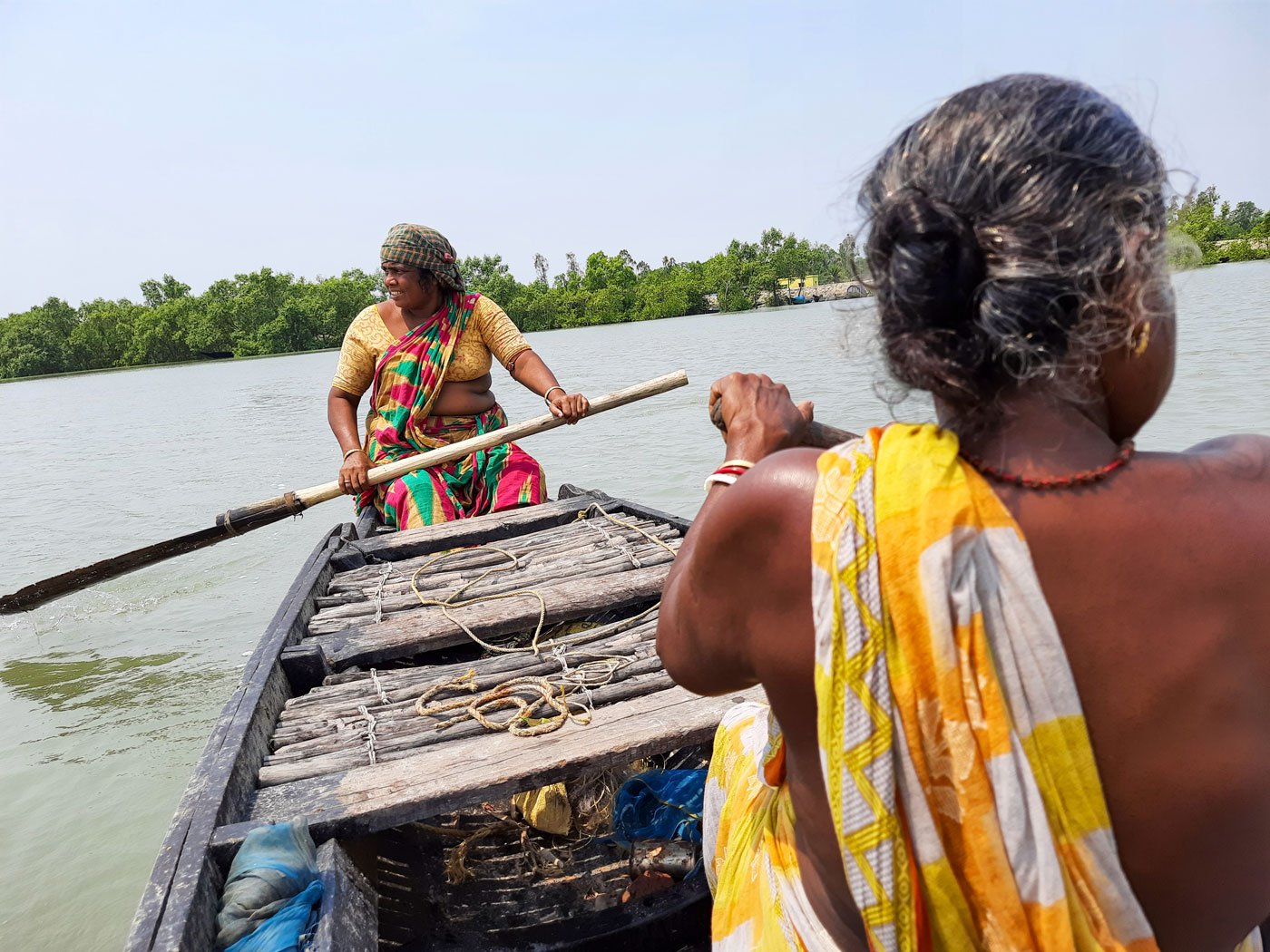
    PHOTO • URVASHI SARKAR

    As the number of crabs decrease, Parul and Lokhi have to venture deeper into the mangrove forests to find them

    Parul and Lokhi rowing across the River Garal

    PHOTO • URVASHI SARKAR

    Parul and Lokhi rowing across the River Garal

    The two women row in tandem, without needing to converse. Once the crab hunting season starts, they will need to obtain passes from the forest department and rent a boat to take to the forest.

    Parul pays Rs. 50 per day in rent. Usually, they are joined by a third woman. The three women must stay in the forest for at least 10 days. “We sleep and eat in the boat and cook our meals on it. We carry rice and dal, drinking water in drums and a small stove. We do not leave the boat under any circumstances, not even to go to the toilet,” Parul says. The rising incidence of tiger attacks, she says, are the main reason.

    “Tigers now even climb on to the boats and take human beings away. My own husband was attacked in a boat.”

    For the ten days that they are out fishing, the women live on the boats even in  the rain. “The crabs are in one corner of the boat, the humans in another, and the cooking in a third corner,” Lokhi adds.
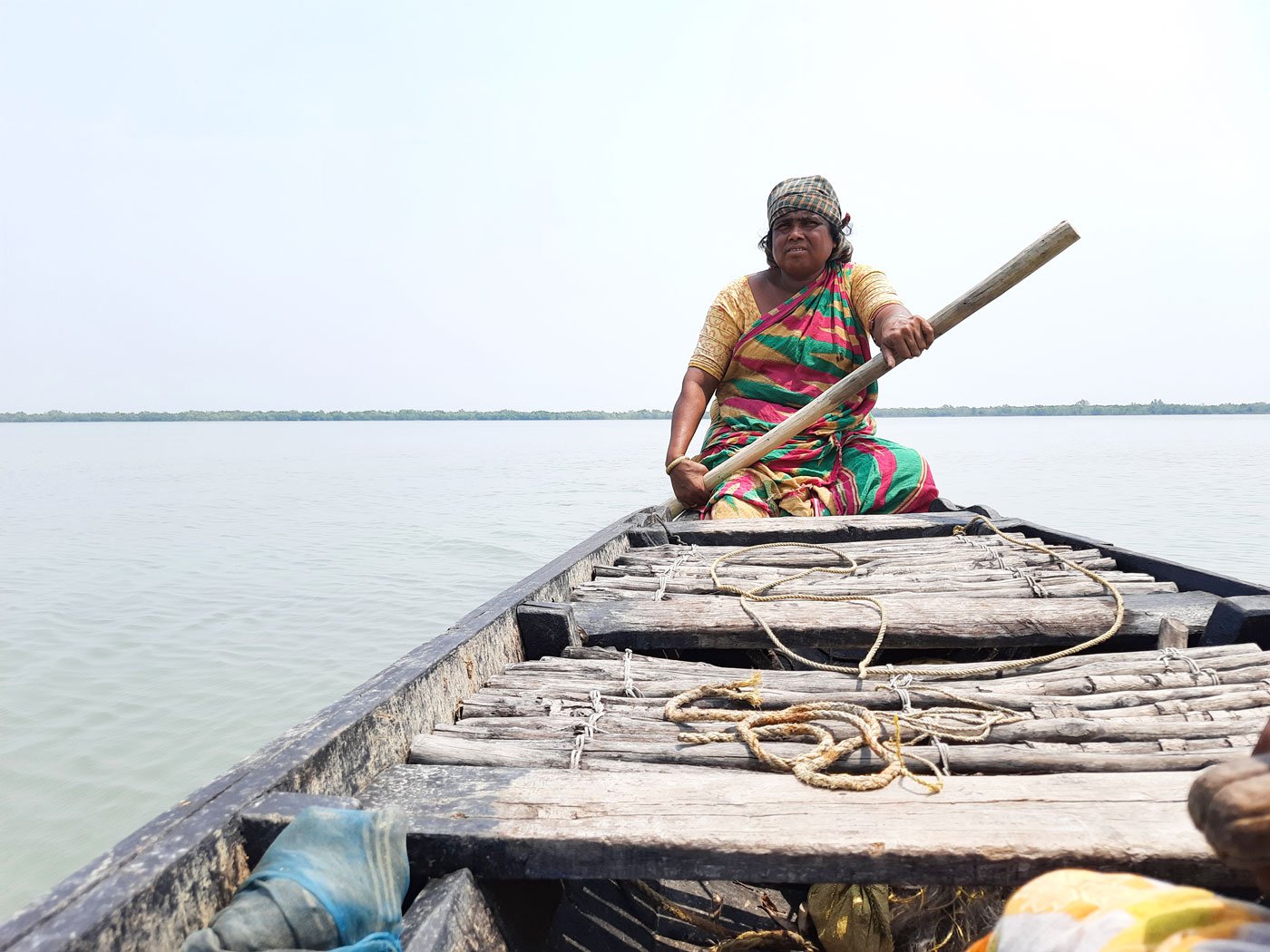
    "We do not leave the boat under any circumstances, not even to go to the toilet,” says Parul

    PHOTO • URVASHI SARKAR

    “We do not leave the boat under any circumstances, not even to go to the toilet,” says Parul
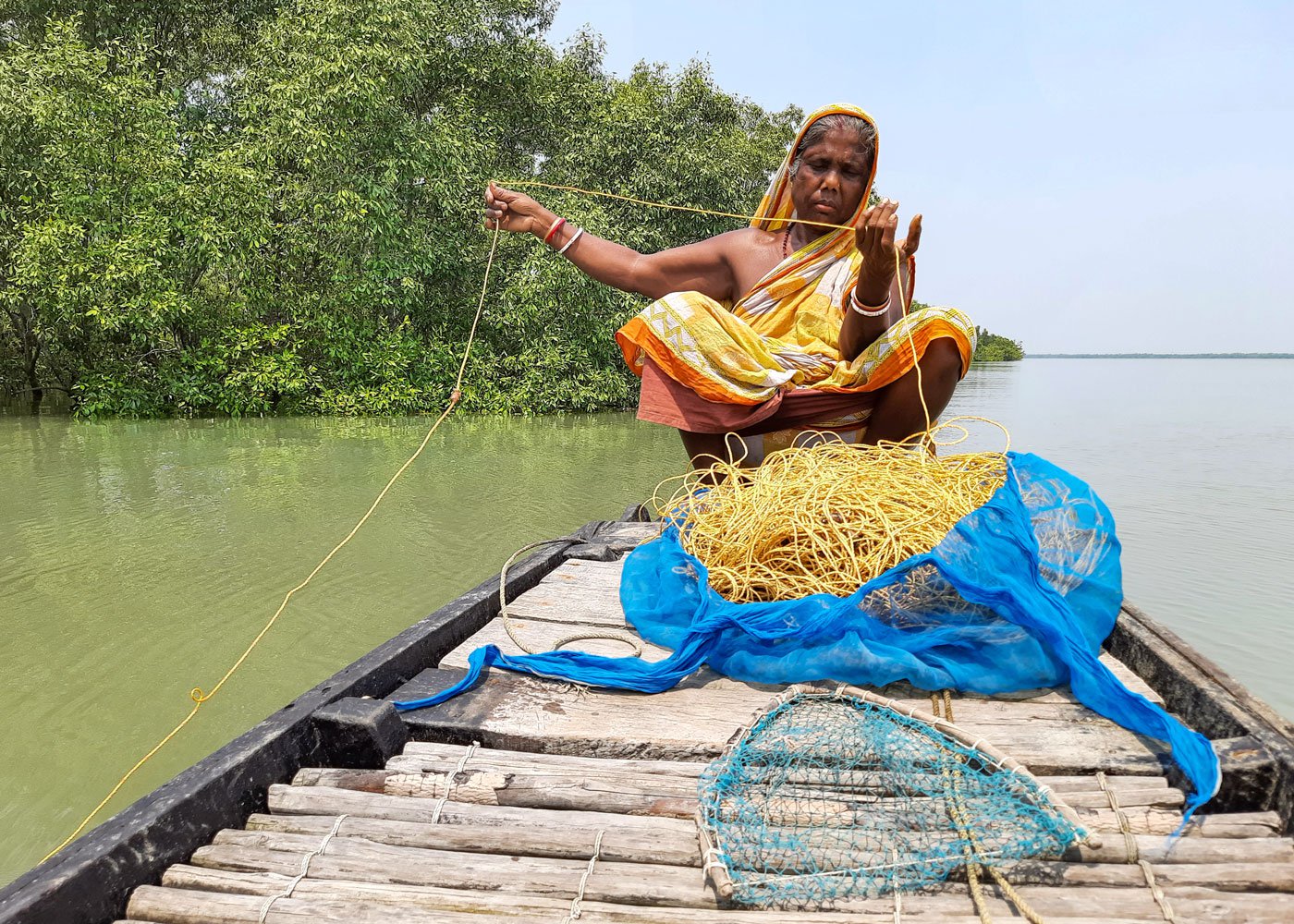
    Lokhi Mondal demonstrating how to unfurl fishing nets to catch crabs

    PHOTO • URVASHI SARKAR

    Lokhi Mondal demonstrating how to unfurl fishing nets to catch crabs

    Like their male counterparts who frequent the jungles, women are also vulnerable to attacks by tigers while out fishing. However, there are no estimates of how many women have been killed in the Sundarbans, considered a hotspot for man-animal conflict.

    “Most of the recorded deaths are of men. Women too are attacked by tigers but the data hasn’t been collected. Women go to the forests, of course, but in fewer numbers compared to men,” says Pradeep Chatterjee, convenor of the National Platform For Small-Scale Fish Workers. Proximity to the forest is an important factor. Women whose villages are located a good distance away from the forest tend not to go. They also undertake the journey only when enough other women are making the trip too.

    In Parul and Lokhi’s village of Luxbagan, whose population was 4,504 according to the Census 2011 including  approximately 48 percent women, nearly every household has women who go to the Marichjhapi forest, just 5 km from the village.

    The good prices that crabs fetch are also a major draw for this high-risk work. “Selling fish doesn’t earn me much. Crabs fetch the main income. I can earn anything between Rs. 300-500 daily when I go to the forest,” Parul says. The bigger crabs fetch Rs. 400-600 a kg while the smaller ones go for Rs. 60-80 per kg. The combined catch of three women on a trip can be anything between 20-40 kg.

    *****

    Apart from the risk posed by tigers, the other big challenge faced by crab-catchers in the Sunderbans is the dwindling catch. “More people are coming to the jungle to catch crabs. Earlier crabs would be in plenty, now we have to work harder to find them,” says Parul.

    As the number of crabs shrink, fisherwomen are forced to go deeper into the forests where the risk of being attacked by a tiger increases.

    Chatterjee said the fisher-people of the region have begun to venture deep into the mangrove forests to find an adequate quantity of fish or crabs and there they are coming into confrontations with tigers. “Forest authorities only focus on tiger conservation. But if the fish don’t survive, tigers won’t survive either,” Chatterjee says. “Human-wildlife conflict can reduce if the fish in the rivers increases.”

    After returning from the river, Parul busies herself in making lunch. She cooks  fish that she has caught from her pond, boils the rice and stirs sugar into a mango chutney.

    She doesn’t like eating crabs, she says. Her mother Lokhi joins the conversation. “Neither me nor my daughter eat crabs,” she says. Asked why, she doesn’t provide details, but mentions “accidents”, a reference to her son-in-law Ishar’s death.
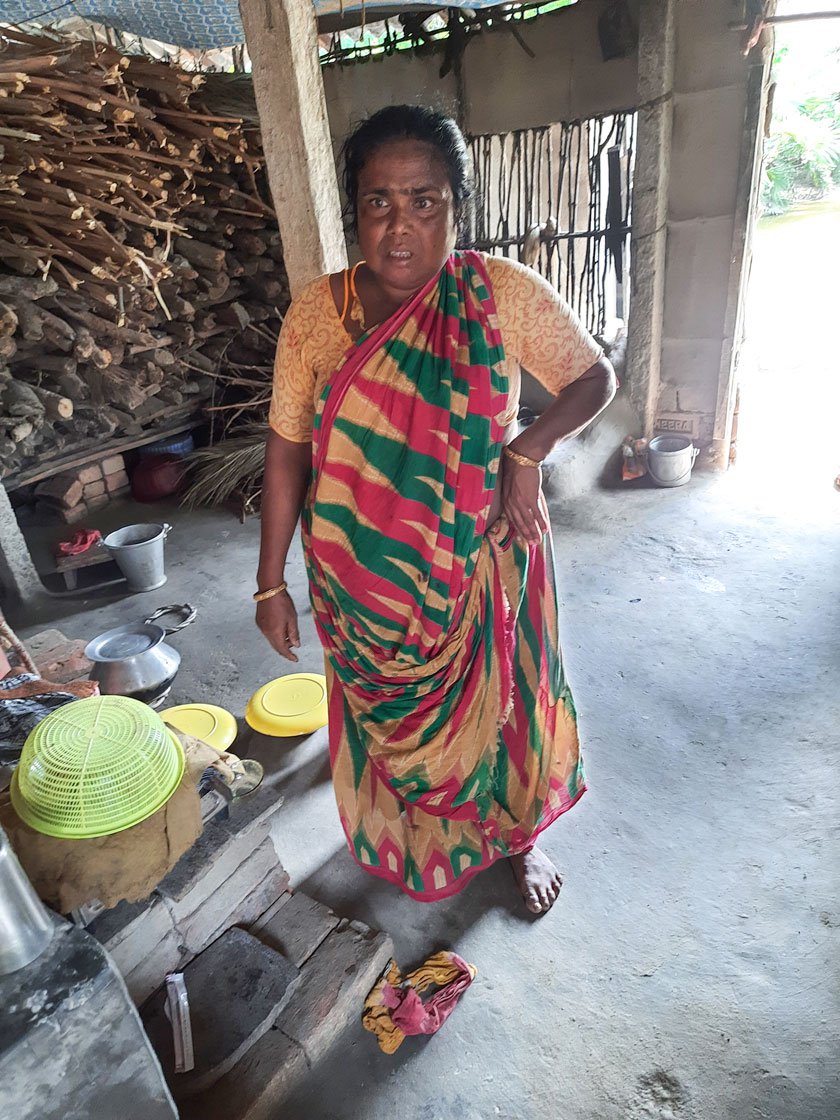
    Parul at home in her village Luxbagan, South 24 Parganas. None of her daughters work in the forest

    PHOTO • URVASHI SARKAR

    Parul at home in her village Luxbagan, South 24 Parganas. None of her daughters work in the forest

    PHOTO • URVASHI SARKAR

    Parul at home in her village Luxbagan, South 24 Parganas. None of her daughters work in the forest

    None of Parul’s four daughters, Pushpita, Paromita, Papiya, and Papri, works in the forest. Pushpita and Papiya work at people’s houses in other districts of West Bengal while Paromita works for a private company in Bengaluru. The youngest, Papri, 13, stays in a hostel near Luxbagan but is sickly. “Papri had typhoid and malaria, so I had to spend Rs. 13,000 on her treatment. I also pay for her hostel fees of Rs. 2,000 each month,” Parul says.

    Parul herself is unwell. She has chest pains and cannot go fishing or crab hunting this year. She now lives with her daughter Paromita Mistry, in Bengaluru.

    “A doctor in Kolkata asked me to do MRI scans that cost Rs. 40,000. I do not have so much money,” she says. She decided to travel to the southern city and live with her  daughter and son-in-law, who both work for private companies. Parul also consulted a doctor in Bengaluru, who prescribed rest and medicines for six months.

    “I think the pains in my chest started due to the fear I constantly feel, especially when I go to the forest. My husband was killed by a tiger, and my father too was attacked. That is what caused the chest pains,” she says.
  • ‘Maach (fishing) and chaash (cultivation) brought us to Sundarbans’

    Published in People’s Archive of Rural India. 10 April 2017

    The year was 1949. Jiban Krishna Poddar, 14 years old, fled from his home in Barisal district to West Bengal, along with his parents and grandmother. The Noakhali riots of 1946 had sparked off waves of migration which would continue for many years. Two years after their flight, the family made their way to the Sundarbans.

    Now over 80 and seated in the verandah of his home on a rainy evening, he reminisces about the journey that brought him to Krishnadaspur village in Patharpratima block, the place he calls home: “There was violence, so we had to leave. My mother, Usha Rani Poddar, packed all our belongings into 14 bags. We reached Khulna city [then in East Bengal] by ship. A train took us to Benapole.  We hid our money and ornaments in clothes and belongings.”

    Jiban recalls that the family was taken to a refugee camp in Nadia district of West Bengal, where they lived for 11 months with more than 20,000 others. The refugees were asked to settle in Dandakaranya (the forested Bastar region of central India), the Andaman islands or the Sundarbans in West Bengal.

    “My father, Sarat Chandra Poddar, chose the Sundarbans,” Jiban says. “He wanted to own and farm land. Maach and chaash (Bengali for fish and agriculture) were the two main attractions. He felt that the Dandakaranya and Andamans were uninhabited jungles where it would have been difficult to live.”

    Jiban’s family was among the 150 families that left from Howrah for the Sundarbans by ship. They came to Mathurapur block where the Indian government asked them to clear the jungles for agriculture. “When we began farming, it was difficult. The area was 60 per cent water and 40 per cent jungle. The drinking water was not clean and many people died of cholera. The doctor would come once in 15 days. There was a famine and we had to suffer great hunger.”

    Jiban’s father got a job in a government office where his task was to operate a hand fan for other employees. His mother kept buffaloes and sold milk and eggs.

    The family was eventually allotted 10 bighas of land (one bigha is around one-third of an acre in West Bengal) in Krishnadaspur village, where they began cultivating rice. After saving some money, they bought more land and built a house in the village, which now has a population of 2,653 (2011 Census).

    Jiban lives with his wife and 11 children, and retired as postmaster of the village post office around 2010. Priyaranjan Das, 64, who retired from the village post office as a peon, also traces his origins to East Bengal. He arrived from Noakhali with his parents in the early 1950s, when he was two years old. “We would boil stems and eat them since there was no food.  There would be severe outbreaks of cholera, causing many people to leave. But we stayed on,” he remembers.

    Many other families came to the Sundarbans from different parts of West Bengal, the Chota Nagpur Plateau and Odisha after 1765, when the East India Company acquired the civil administration in Bengal. Amites Mukhopadhyay ( Living with Disasters: Communities and Development in the Indian Sundarbans ) and Annu Jalais ( People and Tigers: An Anthropological Study of the Sundarbans of West Bengal, India ) write that the colonial rulers, interested in increasing their revenues, hired labourers from different parts of the subcontinent to reclaim and cultivate land.

    Robi Mondal of the Tagore Society for Rural Development, a non-governmental organisation that works in the Sundarbans, says: “The floods and famine in Medinipur, the 1947 Partition of Bengal and the 1971 Bangladesh war of independence caused a further exodus of people, and many of them landed up in Sundarbans.”

    Another round of migration took place around 1905, when Scottish businessman  Daniel Hamilton was working towards rural reconstruction through a cooperative movement in the islands of Gosaba block. He leased out land to labourers for cultivation. Many of the descendants of the migrants still live in Gosaba, and remember his contribution to the development of the Sundarbans.

    Eighty-year-old Revati Singh, who lives in Jotirampur village, is originally from Ranchi. His grandfather, Anandmai Singh, came to Gosaba in 1907, during Hamilton’s cooperative movement. “He arrived in Canning block by tram. They would probably have walked from there to Gosaba, which is currently more than 12 hours on foot. Later, Hamilton built small boat launches to transport them.”

    a man and a woman
    Lakhan and Sandhya Sardar. Lakhan’s grandfather migrated from Ranchi to Gosaba in the early 1900s
    a man whose ancestors migrated

    Mohammed Molhor Sheikh’s great grandfather arrived in the Sundarbans from Midnapore some 150 years ago

    Revati has heard that the population at the time was small, and there were recurring attacks by tigers and crocodiles, and no clean drinking water. Has the situation changed? “Fewer tigers attack now,” he says. “There were no jobs then, and even now getting work is a problem. I used to cultivate rice but stopped because the river would overflow into the fields.” Revati’s three sons have informal jobs.

    Lakhan Sardar, whose grandfather Bhagal Sardar also migrated from Ranchi to be a part of the cooperative movement, remembers that on Hamilton’s invitation, renowned poet and writer Rabindranath Tagore visited Gosaba in 1932.

    A large section of the population of the Sundarbans is from the Medinipur area of West Bengal. Frequent flood and famine in Medinipur drove inhabitants to the Sundarbans to work as labourers or cultivators of land. Jyotirmoy Mondal from Jotirampur village recalls that his grandparents walked from Medinipur to the Sundarbans before the onset of Hamilton’s cooperative movement. “Grandfather became a night watchman and eventually died of fever.  My grandmother, Digambari Mondal, would guard people’s buffaloes for a living, cultivate rice and sell ghee.”

    Mohammed Molhor Sheikh cuts wood for a living in Arampur village in Gosaba. His great grandfather came with two brothers from Medinipur to the Sundarbans, 150 years ago. “We heard stories of how they would chase tigers with iron rods flaming with fire. We also heard how they would frequently suffer flood and famine and the destruction of their rice fields.”

    Another wave of migration from Medinipur occurred during the severe 1943 famine in West Bengal.  Seventy-one-year-old Haripriya Kar’s husband’s family migrated to Gosaba during this period. The village Jotirampur, where she lives, is named after Jotiram Kar, her father-in-law.  “Jotiram and Khetramohan were brothers who came from Medinipur to Gosaba, bringing 27 families with them. These families cleared the surrounding forests and settled down,” she says.

    Haripriya’s house is cast in darkness as she speaks. The electricity was cut a few hours ago. Livelihood options here are few, it is difficult to get medical help, and connectivity with roads and transport is a huge hurdle. Still, the descendants of the original settlers of the Sundarbans do not have it as hard as their ancestors did. The struggle for a better life continues, even as they recollect the hardships and deprivations of the past.

    Photos: Urvashi Sarkar

    Read the original article: https://ruralindiaonline.org/articles/maach-and-chaash-brought-us-to-sundarbans/

  • From river to plate: the journey of the Sundarbans tiger prawn

    Published in People’s Archive of Rural India. 11 January 2017

    Purnima Mistry walks out of the Raimangal river with her fishing net, water swirling around her waist. She has been swimming near the riverbank for half-an-hour, dragging the net behind her in search of tiger prawn seedlings.

    On the riverbank, she sorts the contents of the net, separating the seedlings from weeds, twigs and other fish. Her saree and plait are beginning to dry under the hot sun. But Purnima has to get back to the river again. “I have to collect enough tiger prawn seedlings so that I can sell them. It will take another 2-3 hours,” she says.

    Squatting on the muddy bank to sort the catch, Purnima talks about the long hours she spends in saline waters and mud, which cause skin infections and itches.  “Look how difficult our jobs are,” she says. “This is how the people of Sundarbans live and eat.”

    Purnima started doing this work two years ago to support her family, which includes two daughters and a son. Her husband is afraid of water and cannot go fishing, which is the most common occupation here. So he grows vegetables for sale at home.

    Watch video: Purnima Mistry trawls through the Raimangal river to catch enough seedlings to sell

    Is she afraid of encountering crocodiles and tigers – both common in some parts of the Sundarbans?  “Sometimes, I am scared of crocodiles; they have attacked people in this village,” Purnima says. “The tigers do not come to here because a security net near the forest keeps them away.”

    Purnima lives in Jogesganj, a village of 7,000-plus people and houses scattered along the banks of the Raimangal river in Hingalganj block of West Bengal. Many of the women and children in Jogesganj, like in the rest of the Sundarbans, work as seedling collectors. This supplements their household incomes from the sale of fish and crabs, and of forest products such as honey and wood.

    State government data [from 2009] shows that poverty drives more than 2 lakh people – of the 44 lakhs who live in the Sundarbans – to collect tiger prawn seedlings.

    Shoma Mondal of Hemnagar village says this work is mostly done by women. “Men go after bigger catch like crabs, which fetch better returns [and for which they hire boats in groups]. Gathering seedlings becomes the women’s task, and in very poor houses, even children [do this work]. The returns are poor but there are no other options. At least one woman from every household in the village does this work.  We cannot do much agriculture, because for much of the year the soil and water are saline, except in the monsoons, when we cultivate rice.”

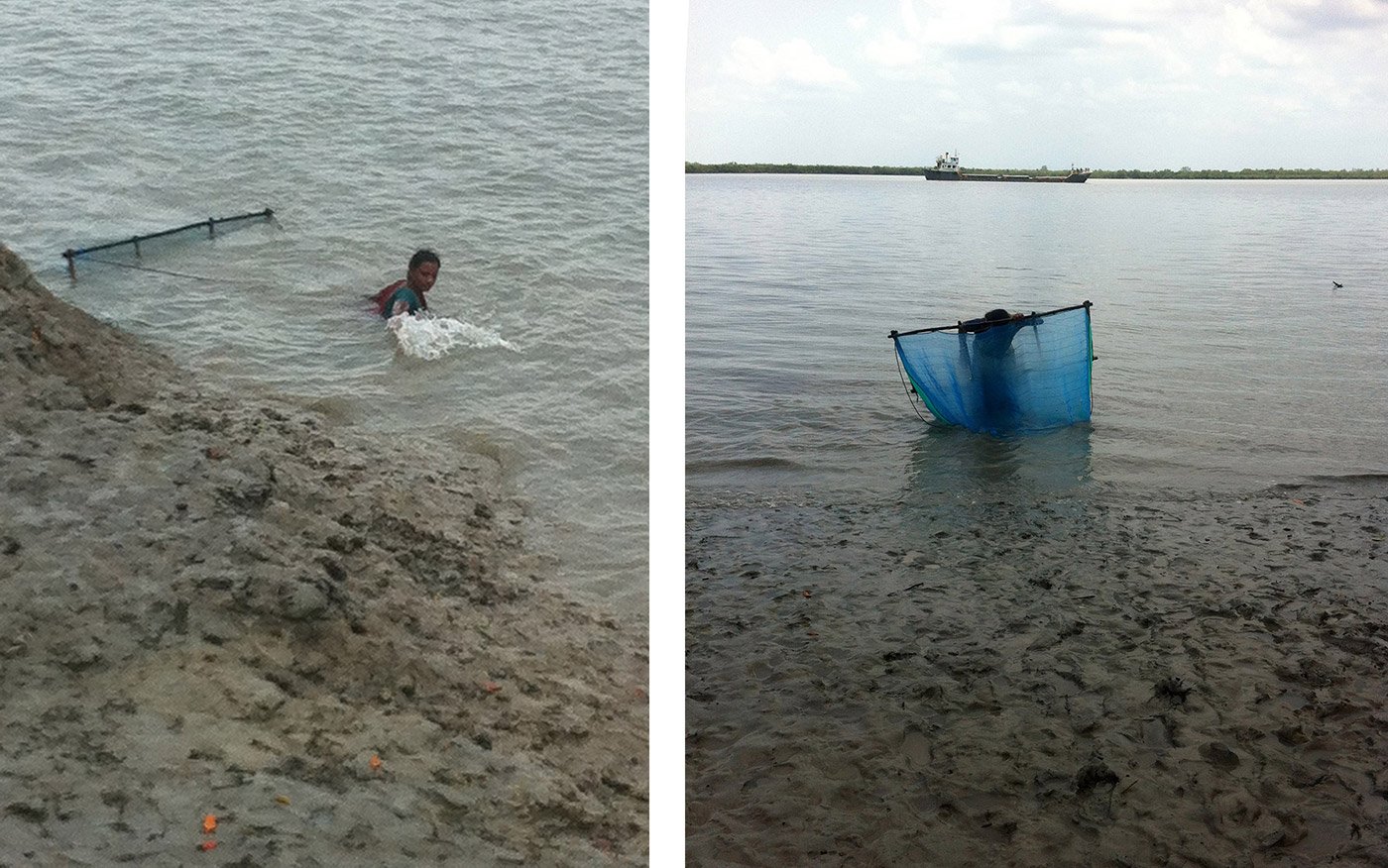
    Left: The people who collect tiger prawn seedlings spend close to five hours in the water to get a sufficient catch. Right: A woman drags her net into the river at low tide, which is the best time to gather the seedlings
    Left: The people who collect tiger prawn seedlings spend close to five hours in the water to get a sufficient catch. Right: A woman drags her net into the river at low tide, which is the best time to gather the seedlings

    Shoma goes to the river almost every day at low tide in search of seedlings. Low tides are the best for a good catch – but they occur at different times. So Shoma sometimes goes to the river at midnight or at 4 a.m. “When it is pitch dark, we are unable to see if there are crocodiles or other wild animals nearby. In the daylight, at least we can see them and move away.”

    The earnings of seedling collectors like Purnima and Shoma vary according to the season. “During winter, which is peak season, we get Rs. 300 per 1,000 seedlings,” she says. “At other times, the prices can drop to Rs. 100 and even sink as low as Rs. 60.”

    On good days, the catch reaches 2,000 seedlings, but this is only a few times a year. Most other times, Shoma only manages to net 200-500 seedlings. “It’s enough money to go to the market [in Hemnagar] and buy essentials [like rice and pulses], but nothing more,” she says.

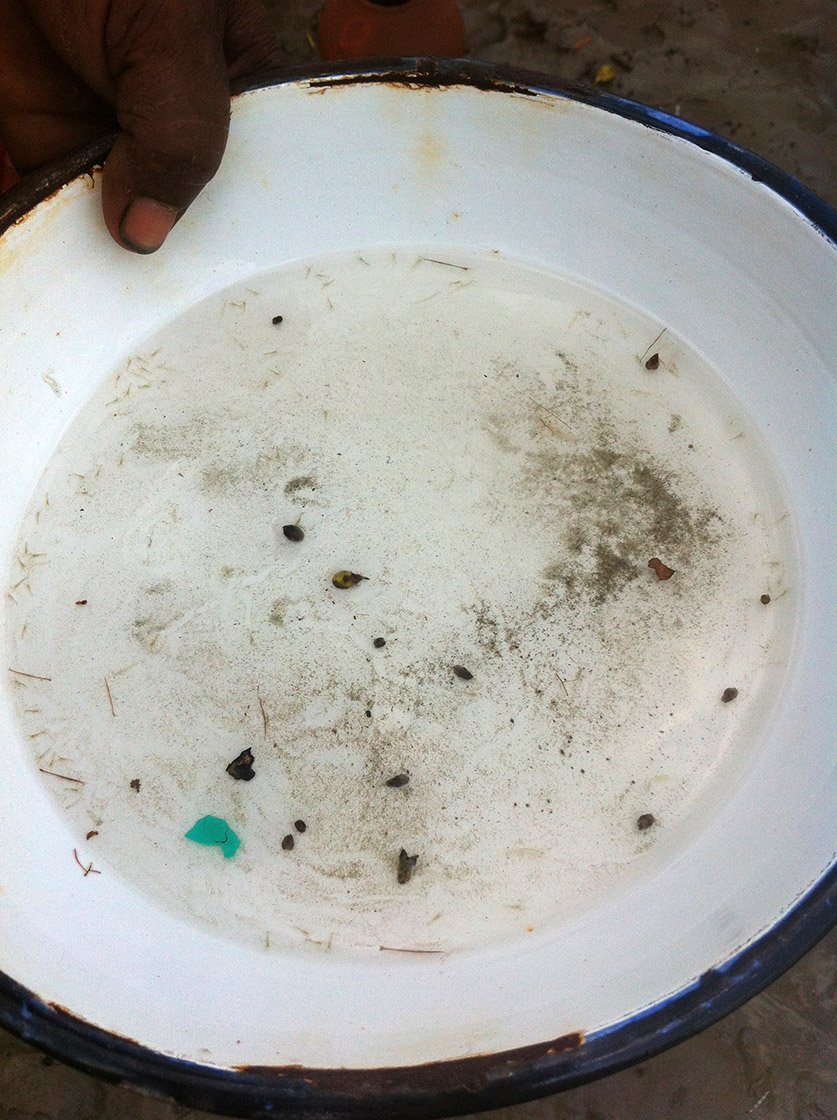
    Tiger prawn seedlings are tiny, almost like strands of hair. Their price is fixed per 1,000 seedlings
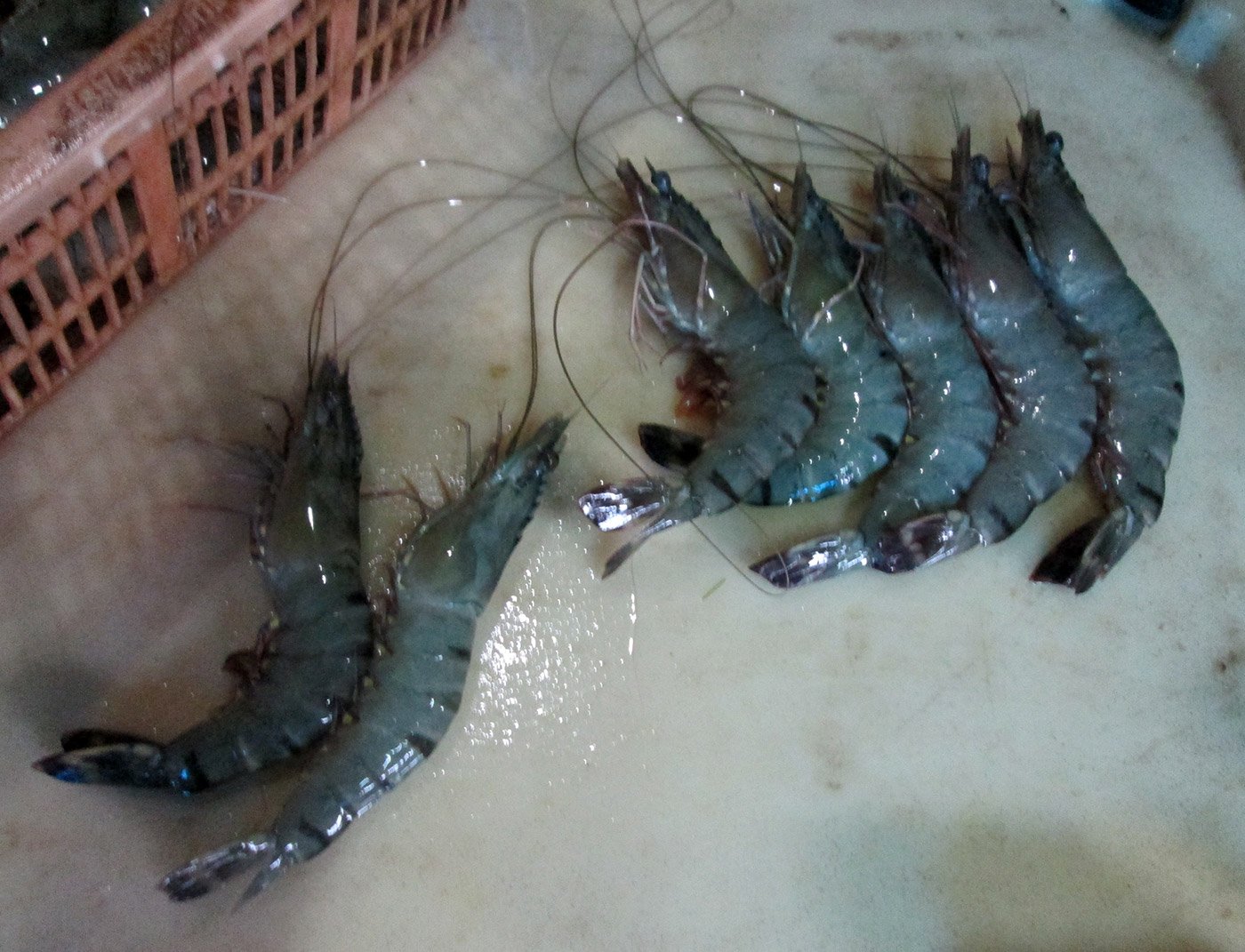
    After cultivation in brackish water enclosures in South 24 Parganas district, the seedlings grow in size

    During the winter months, from December to February, Shoma goes to Erode district in Tamil Nadu to work in a garments factory, where she stitches curtains and pillow covers. Although winter can bring the highest rates for the seedlings, many women try to not work in the biting cold river waters. Shoma’s husband Soumen Mondol works full-time in the same factory in Erode. She earns between Rs. 200-500 daily, he earns a little more.  Their five-year-old daughter stays back in the village with her grandmother.

    The methods of collecting prawn seedlings have been criticised by environmentalists as well as the state’s Forest Department. The nets trap many other fish species besides the seedlings. But the women usually discard the other fish, which can deplete those species.  The dragging of nets causes soil erosion and weakens embankments meant to prevent rivers from overflowing.

    Purnima however does not throw away the other fish. She has a pond near her home, where she harvests these species. “Those who do not have ponds have to throw away the remaining fish,” she explains, as she continues to sort the seedlings on the Raimangal riverbank.

    Although the tiger prawn trade rests on the labour of the women in these villages, they are paid the least along the chain. After the seedlings are collected, men take over the profitable part of the trade.

    Typically, middlemen visit the villages to purchase the seedlings from the women and sell it for cultivation in bheries. These are large artificial enclosures for brackish water aquaculture in Canning, Jibantala, Sarberia and other locations in the South 24 Parganas district. Here, the seedlings are cultivated for at least three months during which they grow in size.  Then they are sold in the wholesale markets of Canning, Barasat and Dhamakhali , and sent onward for export – often by men on motorbikes who carry the seedlings in plastic bags full of water.

    After cultivation in brackish water enclosures in South 24 Parganas district, the seedlings grow in size
    After cultivation in brackish water enclosures in South 24 Parganas district, the seedlings grow in size

    Full-grown tiger prawns fetch attractive prices in the wholesale markets. Tarun Mondal, a wholesaler in the Canning fish market, says his main income comes from tiger prawns.  “It is good business. We buy them at a rate of Rs. 380-880 per kilo from the bheries, and we sell them for Rs. 400-900 [per kilo, depending on size]. Our profit margin is Rs. 10- 20 [per kilo]. Most of our supply is from the Sunderbans, from blocks such as Basanti and Gosaba. We sell them to agents who work for bigger companies that ultimately export them.”

    India’s seafood exports were valued at $4.68 billion in 2015-16 ; shrimps constitute almost 70 per cent of these exports and are mostly exported to Japan, China and the United States. Tiger prawns, also known as black tiger shrimps, are an important part of shrimp exports. West Bengal is one of India’s largest shrimp producers and exporters of seafood.

    Seedling collectors like Shoma and Purnima though see only a fraction of this money. The women are unable to demand higher prices because the agents determine their rates and control the trade. “In addition to the price of seedlings, the middleman gives us an annual deposit [of Rs. 200-500 per person], which we don’t have to return, ” Shoma says. “The deposit forces us to sell only to him, and nobody else. We women are unable to gather in large numbers and bargain.” But it is the labour of workers like Shoma and Purnima that sustains the wholesale and export markets in tiger prawns, and brings these expensive delicacies to upscale plates in India and around the world.

    Photos: Urvashi Sarkar

    Read the original article: https://ruralindiaonline.org/articles/from-river-to-plate-the-journey-of-the-sundarbans-tiger-prawn/

  • A right to fish, a fight to live

    Published in People’s Archive of Rural India. 12 March 2015

    A tall and lean fisherwoman with a strong face stares at the evening sun fading into the still waters running through Kultali, an island in the Sunderbans forest; Anima Mandal is angry. She hasn’t eaten since
    morning.

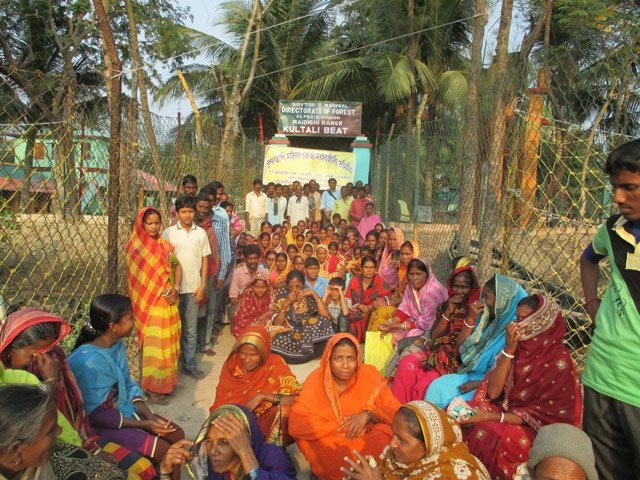
    She was there for a meeting that the Kultali Forest Range beat officer had fixed for 2 pm on February 14, 2015 at the forest range compound in a corner of Kultali, across a river. Nearly 50 women, and a few men, had turned up for this crucial meeting to make two pressing demands – the return of their confiscated fishing canoes (dongas) and for the women to be recognized as traditional small-scale fishworkers, with a right to fish for their livelihood.

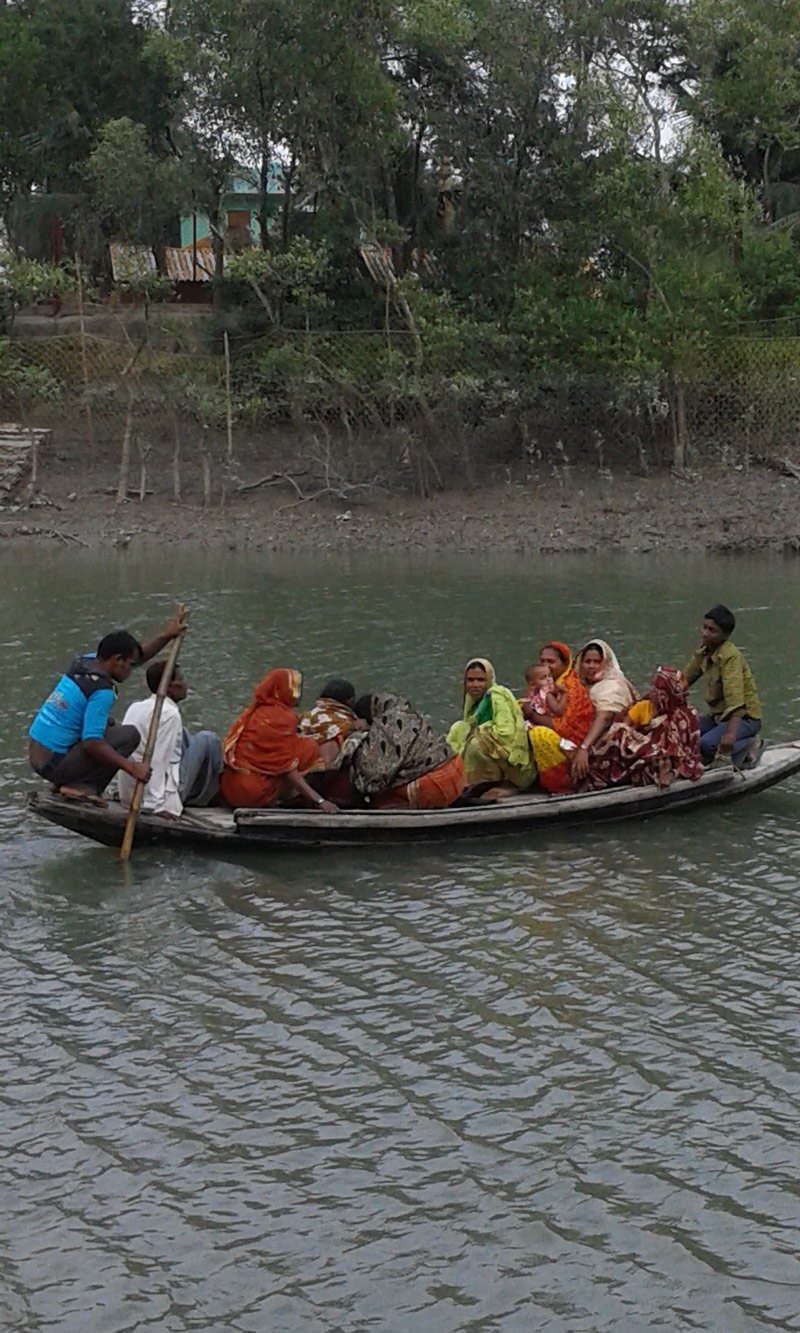
    The women, organized under the Kultali Mahila Donga Matsyajibi Samity, had travelled a long way from Madhya Gurguria village – on foot, on cycles fitted with wooden planks and by boat – to make it to their appointment.

    It is already past 5 pm. A number of women begin tracing their steps back towards a dinghy headed homeward: some hurry back to feed and care for the children they’ve left at home and others return home for fear of husbands who could turn violent. Anima and a few others choose to stay back at Kultali and represent the group, determined to get a response from the Forest Department.

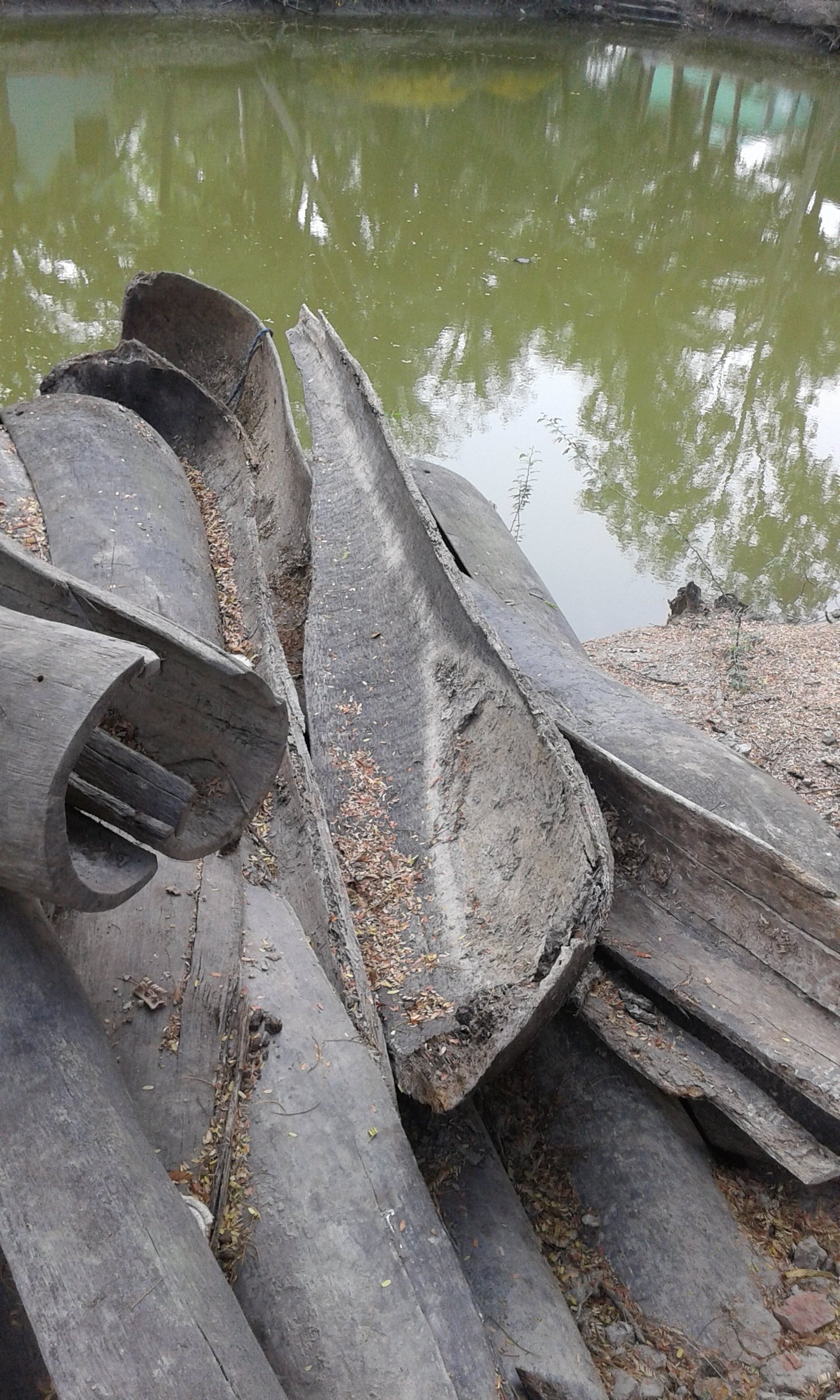
    They walk around the compound, to the edge of a murky green pond, where their confiscated canoes of palm trunk lie stacked. The women are appalled; debris and wood bits from the canoes have started to peel off and mingle with the water. “Our canoes have been broken into pieces and thrown into the water. There must be lakhs of rupees (floating) in this river, ” says Geeta Sahu, a fisherwoman speaking softly. Her indignation, however, is unmistakable, shared by the workers standing beside her, still waiting.

    Sole Means

    The conversation among the waiting crowd turns to input costs: the cost of palm trunks from which the canoes are dug out, the labour cost for chiseling, and the cost for coal-tar coating maintenance, all amounting to about Rs 5,000. Almost every confiscation necessitates this princely expenditure on their part, to build a canoe from scratch. “It can take at least two or three months to gather such a sum. Wooden boats, permitted by the Forest Department, are too expensive to afford,” explains Beena Bag, one of the fisherwomen.

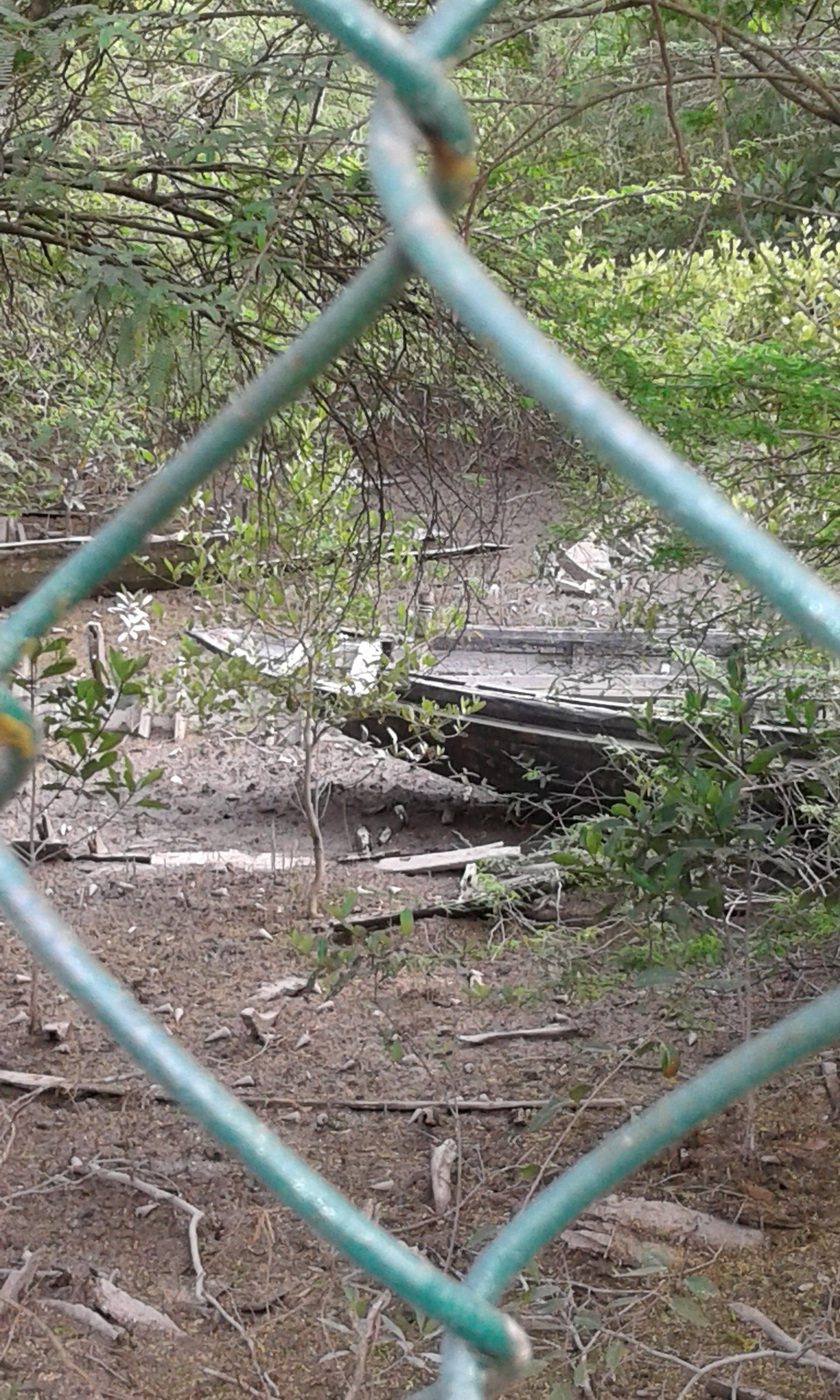
    They walk down some distance and spot a couple of confiscated dinghies, still sturdy, poking out through a mass of trees. The canoes and dinghies are the fishworkers’ only means to catch crab and fish, their sole means to earn a living. By now Anima is fuming: “Why confiscate the canoes and hurt us in the stomach? We don’t earn salaries, you know. This is not Calcutta city, where each month people earn something to be deposited in the bank. Nobody is going to hand me a bag of vegetables to cook. Life is different here.”

    Slice of Life

    Indeed, life is starkly different in the Sunderbans. For Anima, and other fisherwomen like her, the day begins at 3 am. After housework, they take their canoes into the rivers. To make a catch, they wade into cold, chest-level water. Once they have caught the fish, they return home to cook and feed their children. Crab and fish depots are the next stop. The women come here to sell their catch with hope and no guarantees to make a little money. On days there are earnings, they are funneled into immediate household expenses, fishing input costs (if any), and savings for the less fortunate days in the week. Many of the communities here are landless second or third generation fishworkers, entirely dependent on fishing for their survival. And so, what they earn will determine what they buy at the market.

    No Avenues

    Anima was 10 or 12 when she got married. She recently lost her husband to a stroke. “There is no decent hospital here. Even pregnant women need to travel for two hours to Joynagar, where there are hospitals,” she exclaims, frustrated. The number of men in the Sunderbans has declined over time, mainly due to migration for better livelihoods; most move to cities as construction workers or get involved in tiger killings for the profit.

    The women are also bitter about having no stake in the proposed tourism projects in the Sunderbans. “Why won’t they involve us in the tourism projects? It will give us better jobs and a better quality of life. Nobody seems to wants to (positively) engage with us. For instance, the big boats catch fish and crab just like we do, but it is us that the Forest Department goes after.”

    Certified Catch

    If life is not hard enough, the Forest Department’s confiscation of their canoes has ensured that it becomes even harder. The reason cited is that since the canoes do not have a boat license certificate (BLC), granted by the Forest Department, they are therefore not authorised to ply in the Sunderbans; Kultali is part of Sunderbans reserve forest area, preventing the fishworkers from catching crab on their own land, unless they have a BLCs.

    The BLC regime has several problems including a non-transferable nature, the possession of BLCs by those who are no longer fishworkers, a thriving black market, and the non-issuance of fresh licenses. A study on the Sunderbans fishers by the International Collective in Support of Fishworkers (ICSF) outlines these problems in detail. To deter fishworkers, the Forest Department uses methods such as seizing fishing nets; the women complained of receiving threats that glass bits would be mixed into with the riverbank sand, to prevent them from going (as they walk barefoot) to fish.

    “The denial of the community rights of the forest dependent fisherwomen to fish in the forest waters is a violation of the FRA,” says Pradip Chatterjee, President of the Dakshinbanga Matsyajibi Forum. The Forest Rights Act (FRA) is meant to secure the access rights of forest-dwelling people, including sustainable use and conservation of the biodiversity of their home grounds.

    He notes that despite repeated calls, the West Bengal government is yet to notify the FRA in the North and South 24 Parganas Districts: “The failure to notify the Act has resulted in the denial of livelihood rights to forest-dependent people including fishers, wild honey collectors, drywood collectors, and shell collectors (among others), leading to consequent conflicts with the Forest Department.” Implementing the FRA would allow fishworkers to catch crab without BLCs.

    Hope and a victory

    The beat officer enters the scene a little past 6 pm. He speaks with the women of the Mahila Donga Samity
    and members of the Dakshin Matsyajibi Forum. The officer states that the canoes have been confiscated because of their alleged use for poaching. Episodes of poaching involving canoes have been sporadic, the
    women argue, the entire fishing community should not be penalised.

    They promise to act as informers for the Forest Department during instances of poaching, but insist on their right to continue using canoes for fishing. The beat officer agrees not to seize canoes for the next three months, during which time the movements of the canoes will be supervised. He also agrees to take up the issue of the rights of forest-dependent fisher communities with higher authorities.

    When he voices a grouse about the government having to pay compensation when there are deaths caused by fishworkers venturing into tiger territory, he is reminded that fishworkers do not voluntarily venture into tiger territory, but because it is a question of their livelihood.

    By the time discussions conclude, night has already set in. The women are happy to have this victory, even if temporary. They pile into a dinghy that takes them into the dark waters of the Sunderbans. Anima gazes at the still waters and towards home.

    Read the original article: https://ruralindiaonline.org/articles/a-right-to-fish-a-fight-to-live/

Urvashi Sarkar – 2026 – All rights reserved.

web things by Studio Goncharov