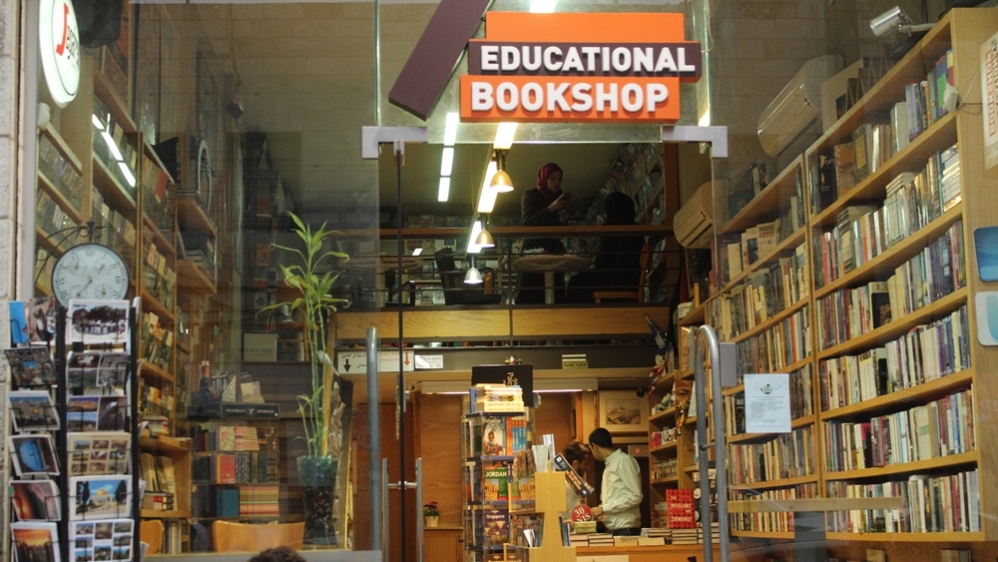
Jerusalem – On Jerusalem’s busy Salah Eddin Street, where cafes, grocery stores, money exchange centres and jewellery shops proliferate the landscape, a prominent board at number 22 announces itself as the Educational Bookshop.
Shortly ahead, across the road, is another bookstore and cafe, also titled the Educational Bookshop. Both belong to the Jerusalem-based Muna family; the first sells Arabic books and stationery while the latter sells English books. “The bookshop started with one bookseller: my father. Now we are six brothers who read, recommend and sell books,” said Mahmoud Muna, manager of the English bookshop.
Upon entering the English bookstore, a shelf stocked with books by noted Palestinian academic Edward Said catches the eye. The presence of Said at the entrance is significant since it was his family who originally owned the Arabic bookshop.
Muna traces the connection: “The Edward Said family had bookstores in East and West Jerusalem. They ran the Palestine Educational Bookshop on Salah Eddin Street, where they sold stationery and books,” Muna told Al Jazeera.
The shop changed hands a few times. When Muna’s father, Ahmed, bought and established it in 1984, he dropped Palestine from the title, since it was illegal then to have the word ‘Palestine’ in the title of an entity or the Palestinian flag. Therefore, the name was changed to The Educational Bookshop.
Photo: Urvashi Sarkar. The mission of the bookstore is to reinforce the Palestinian culture and identity, says Muna
The history of both bookshops is a reflection of the reading preferences of Jerusalem’s inhabitants, both locals and tourists, over the years. During the 1980s and early 1990s, the Arabic bookstore stocked mostly books in Arabic on politics, history, poetry, literature and fiction, and some English books on tourism.
A turning point came in 1994-95, when, according to Muna, many Palestinians stopped reading. “Palestinians had been reading about the supposed light at the end of the tunnel, promoted by nationalist Palestinian writers who wrote about how the peace process would bring freedom,” recalls Muna.
But after the 1993 Oslo Agreement, things changed. “It turned out to be lies, and people stopped trusting books. Consequently, the bookstore also suffered.”
Muna characterises the post-Oslo years as a time when Jerusalem received an influx of international NGO workers, diplomats and journalists. “Jerusalem’s newcomers sought to understand Palestine and the Middle East better and wanted English books. We made a conscious decision to increase our English selection.”
Therefore, Imad Muna, the eldest of the Muna brothers in charge, decided to increase the English selection of the store.
Muna still remembers the ripples created by the publication of Said’s Peace and its Discontents, published in 1996. “It was the first book to criticise the Palestinian Authority [PA], exposing the peace process and Oslo. We sold hundreds of copies in English and Arabic to Palestinians and foreigners. The PA banned it, but we could sell it since being in Jerusalem we are not under the PA.”
The history of both bookshops is a reflection of reading preferences of Jerusalem’s inhabitants, both locals and tourists [Courtsey of the Muna Family/Al Jazeera]
The bookstore expanded on Said’s collection, also stocking books by Israeli historians like Ilan Pappe and Avi Shlaim, who were critical of the Israeli narrative. Realising that there was a big market for English books, in 2007-08, a new bookstore was established with only English books, along with a cafe and a literary-cultural space called the Jerusalem Literary Salon.
“We also witnessed a revival of Arabic readership during this period to which the Arabic bookstore catered.”
‘The bookshop started with one bookseller: my father. Now we are six brothers who all read, recommend and sell books,’ says Mahmoud Muna [Courtesy of the Muna Family/Al Jazeera]
Muna reflected on the need to present the Palestinian story in English. “There were no proper English bookstores in Jerusalem, and the only English books were in Israeli bookshops which portrayed the Israeli viewpoint. British and American authors with orientalist perspectives were writing about Israel and there was very little on the Palestinian viewpoint. This, however, changed in the 90s.”
The English Educational Bookshop was the first of its kind in Palestine. “This was the first bookstore that sold books in English by Palestinians and about the Palestinian viewpoint,” he says.
Central to the identity of the two bookstores is their location in Jerusalem. “We want to reinforce the notion of Jerusalem as the Palestinian capital. We may expand to other areas, but our main area of functioning needs to be Jerusalem,” Muna says, acknowledging that a Jerusalem location renders it inaccessible to many Palestinians who face restrictions on entering Jerusalem.
The English bookstore also hosts cultural and literary events, such as readings, screenings, exhibitions and talks. The bookshop, according to Muna, plays a role in the larger spectrum of cultural resistance and it is being viewed as reinforcing Palestinian culture and identity.
“The Palestinians have been stripped of their rights, political representation and freedom. The last thing we have is our culture – the last wall of resistance, which Israel will find very hard to break down. The mission of the bookshop is to reinforce Palestinian culture and identity.”
The English bookstore hosts cultural and literary events, such as readings, screenings, exhibitions and talks [Courtesy of the Educational Bookshop/Al Jazeera]
The store has about 1,500 titles encompassing history, fiction, politics, poetry and even cookery. “These are serious books, not propaganda. We sell books on Palestine written in different parts of the world.”
The bookshop has titles from across the Middle East. Muna says: “This is not a Palestine-Israeli conflict; it was and is an Arab-Israeli conflict.”
The operations of the bookshop are not without hurdles, with the delivery and clearances of books often delayed. “Our books come from the US, UK, India, France, Germany, Jordan, Egypt and Spain and pass through Israeli security,” he said.
“The Israelis pick on titles. They do not like books such as the Ethnic Cleansing of Palestine by Ilan Pappe or Jeff Halper’s book on Israeli manufacture and sales of arms. They also do not like books on Hamas, or with provocative covers. The delivery of such books is delayed by two or three weeks. But since there is no censorship law over English books, no books are confiscated.”
Books from Syria, Lebanon and Iran cannot come directly. Instead, they are routed through Jordan.
Muna recalls when Mordechai Vanunu, who had revealed Israeli nuclear secrets, was kidnapped twice from the store. “When the Israeli army come, they create a scene. Once a man was shot outside, and our CCTV cameras recorded it.” According to Muna, the Israeli forces closed the shop for hours and wanted to take the camera. The lawyer, however, convinced them to take only the footage.
They took the phones of customers and deleted pictures. “Sometimes, they spray chemical skunk gas in our neighbourhood, and the foul odours enter our store, too. We do not know if we are being targeted.”
On the positive side, Muna points out that there has been a renewal of Palestinian Arab readership. He describes the current readership as fiction preferring, predominantly female, and in the 17-22 age bracket.
“The older generation consumed mostly history and politics. The new readers like books on romance and sexuality. I want them to read more serious, classic stuff: Books on Palestinian history, Arab nationalism, Arab communism, and the great literature of the Arab world.”
“They [young readers] use social media and ask us about books we don’t know of. As a bookseller, this ought to be disconcerting, but it makes me happy.”
Nabi Saleh – Palestinian Janna Jihad Ayyad, who turned 10 this month, counts herself among the youngest journalists in the world.
A resident of the village of Nabi Saleh in the occupied West Bank, Janna, along with many other local children, regularly participates in demonstrations against the Israeli occupation. She began making videos of what was happening in her village when she was only seven.
While there are no journalists in Janna’s family, her uncle, Bilal Tamimi, is a photographer who has documented the violence of Israeli soldiers in Nabi Saleh. Janna was partly inspired by him.
“I talk about what is happening,” Janna said. “I see an occupation, soldiers, cannons and police. They do a lot of things to make us go from our land.”
The deaths of two men in her village – her cousin, Mustafa Tamimi, and another uncle, Rushdie Tamimi – served as a trigger for her to begin documenting everything that was happening in Nabi Saleh. Mustafa was killed by a gas canister and Rushdie was fatally shot in his kidney.
Since then, Janna has expanded her work, travelling with her family and using her mother’s iPhone to shoot videos in Jerusalem, Hebron, Nablus and Jordan. Her videos show everything from people being detained at checkpoints, protest marches and violence against Palestinian children.
As a child, she feels she has an advantage over adult reporters: “The soldiers catch the big journalists and take their cameras.”
On Facebook, Janna describes herself as a news personality, and has attracted more than 22,000 followers. Her page includes several videos of her participating in demonstrations and confronting Israeli soldiers. Her reports are delivered in both Arabic and English.
“My camera is my gun,” Janna explains. “The camera is stronger than the gun … I can send my message to small people, and they can send it to others.”
Her mother, Nawal Tamimi, says she is both scared for and proud of her young daughter.
“I am proud of my daughter because as a child, she tells her message to the world. She shares her fears, what she feels, and the problems of attending school,” Nawal told Al Jazeera.
“But I am scared for her, when the army comes in the middle of the night and tear-gases our house, and we wake up in smoke … They attack our people who demonstrate against the settlers and the Israeli occupation.”
Janna’s uncle, Bilal, says it has been difficult to accept Janna’s work. “She should be playing and studying, but in our life it’s not a choice,” he told Al Jazeera, noting that the family has a history of activism dating back to 1948. “We must teach our children to not accept humiliation and not be cowards. We are under occupation. We cannot teach our children silence; they must fight for their freedom.”
When she gets older, Janna says she would like to work for CNN or Fox News because “they do not talk about Palestine, and I want to make reports on Palestine”.
Asked what an ideal world would look like to her, Janna, for once, responds like a 10-year-old: “I want it to be pink.”
On 15 December 2015, representatives of the 164 member states of the World Trade Organisation gathered in Nairobi for a ministerial conference—a biennial gathering, and the group’s highest decision-making forum. This was the tenth such meeting in the history of the organisation, which was founded in 1995 to arbitrate in matters of international commerce and to progressively lower trade barriers—such as import tariffs and domestic subsidies—in pursuit of an open global market. Writing in the Financial Times before the conference, Michael Froman, the United States’ top representative on trade policy, expressed his conviction that the meeting would “mark the end of an era.” It was time, he argued, “for the world to free itself of the strictures of Doha.”
Froman was referring to the Doha Development Agenda, the WTO’s current round of trade negotiations, which commenced in 2001 and is yet to be concluded. The Doha round aims at major reform of the international trading system through lowering barriers and revising trade rules, and also, as the round was originally pitched, at improving the trading prospects of developing countries—which form a majority of the WTO’s members, and argue that the current global trading regime is tilted steeply against them. The Doha round has had a mixed record on that latter goal, but, particularly in giving developing countries more room for manoeuvre in negotiations and pushing developed countries to acknowledge their protectionist policies, it has given developing countries hope. But, developing countries complain, it has also forced them to compromise on domestic interests in areas including agriculture, services and intellectual property regulation, to the benefit of their developed counterparts.
Negotiations of the Doha round have been fraught from the start. For India, a consistently contentious point has been opposition from developed countries to its agricultural and food subsidies, which, according to figures it submitted to the WTO in 2014, amounted to about $51 billion in the 2010 financial year. According to the Organisation for Economic Cooperation and Development, a coalition of primarily developed countries, the United States paid over $95 billion in agricultural subsidies in 2014, and the European Union over $125 billion that same year, to comparatively richer and smaller agricultural populations. Matters came to a head at the WTO’s ninth ministerial conference, in Bali in late 2013, after developed countries challenged India’s practice of buying grain at guaranteed minimum prices to maintain public stockpiles of food, and also other provisions of its National Food Security Act. To allow talks on other issues to move forward, India assented to a temporary clause which allowed it to continue its subsidies, and which promised that a permanent agreement on the issue would be negotiated in the near future. That was no real victory, since it committed India to not expanding its agricultural subsidies in the interim, and did not rule out legal action against it on charges of distorting trade.
Speaking in Delhi before the Nairobi conference, Nirmala Sitharaman, India’s trade minister and chief negotiator at the meeting, told reporters that she would insist on pursuing the promised permanent solution, and that “the spirit of Bali should be respected.” When she reached Nairobi, Sitharaman also made it clear that India would be seeking a reaffirmation of all the agreements reached thus far under the Doha round. The tenth ministerial conference of the WTO, then, looked set for yet more confrontation between developed and developing states, with India, as a leader of the latter block, on the front lines—a recurring pattern throughout the WTO’s 20-year history.
As the gathering unfolded, many developed countries refused to reaffirm the Doha round. The conference’s final declaration, which was repeatedly revised until all participants agreed to sign it, stated frankly that while “many Members reaffirm the Doha Development Agenda … Other Members do not.” Since WTO negotiations operate on the basis of unanimity and a principle often encapsulated as “nothing is agreed until everything is agreed,” the dispute imperils the entirety of the many years’ worth of negotiations under the Doha round. Sitharaman tweeted afterwards that she was “utterly disappointed that the unanimous reaffirmation of DDA hasn’t happened,” but won little sympathy back home, where many media commentators and civil society groups took her acceptance of the equivocal final statement as a capitulation.
The Nairobi meeting served as a reminder of India’s increasingly difficult position within the WTO, where it faces a dizzying matrix of national interests and international pressures. Since the country joined the organisation, upon its founding in 1995, India’s participation in the global economy has multiplied manyfold, increasing its stake in the WTO’s trading, regulatory and negotiating mechanisms. Much else has changed over that time too, not least India’s position in the diplomatic world—particularly with its growing alignment with the United States. The net result of these changes has been a weakening of India’s stance in the organisation, which in recent years has caused it to yield to a rising number of WTO policies detrimental to its domestic interests. The history of how India got here offers insight on just where the country stands within the organisation now, and what its options might be going forward.
India has long been ambivalent about the modern international trading regime. In 1947, it was one of 23 founding signatories of the General Agreement on Tariffs and Trade, a framework of rules established by the Allied powers, with an intent similar to that of the WTO. Signing the GATT was a move away from India’s pre-Independence isolation from the global trading system, but, for the most part, the country continued on its post-colonial economic path of self-reliance and import substitution. A 2009 paper from the Centre for International Trade and Development at Jawaharlal Nehru University notes, “Indeed, joining the GATT was definitely not a reflection of India’s visible faith in the neoliberal multi-lateral trading system.”
The first seven rounds of talks held under the GATT were limited to negotiating tariff reductions. But things changed in 1986, with the inauguration of the eighth and final GATT negotiation round, in Uruguay. Over 120 countries had signed on to the GATT by then, and the Uruguay round was to be a great bargain between the developed and the developing world. Developed countries promised to reduce barriers to imports from the developing world, and, in exchange, developing countries accepted several new trade agreements—including ones on intellectual property, services and agriculture—which bolstered the interests of developed economies. When the round closed, in 1994, it vastly increased the scope and complexity of global trade provisions.
The Uruguay round overlapped with India’s economic liberalisation in the early 1990s, which brought down many of the barriers that might have insulated the country from its effects. In 1995, with developed countries in particular concurring that the expanded rules required a more comprehensive organisation for enforcing them, the WTO was formed. India, though reluctantly, joined the new body, which offered access to regulated international markets, and promised to compel developed countries to reduce domestic subsidies that impeded imports from the developing world. Also, crucially, participation in the WTO allowed developing countries to bargain collectively with developed ones, using the force of numbers to balance out yawning imbalances in power, and to avoid coercive bilateral treaties.
India’s initial years in the organisation were characterised by cautious efforts to gain more international market access for its products, alongside opposition to subsidies in developed countries. The country’s interests aligned with those of other developing states, and India emerged as a leader of negotiating coalitions of developing countries, such as the G33. In 1999, India’s then minister of trade, Murasoli Maran, played a crucial role in stalling the opening of a new round of WTO negotiations that developing countries feared would further disadvantage them.
Meanwhile, India confronted the domestic implications of WTO policies—most prominently, then as now, in agriculture. The Uruguay round brought agricultural trade under a global system for the first time, and committed WTO members to easing their markets open to international competition by reducing tariffs and subsidies for agricultural products. This threatened numerous policies—including guaranteed pricing and public stockpiling of food—that the Indian government sees as checks against the fluctuations of price and supply inherent in an open market, and hence crucial to avoiding famine and protecting agricultural livelihoods at a time of rural distress and high rates of suicide among farmers.
Until 2005, India maintained its protests against the demands of the developed countries, and against the expansion of the WTO’s purview. But following that, it backed down on a number of issues. Biswajit Dhar, a professor of economics at Jawaharlal Nehru University, told me over email that “India was proactively raising issues of food security and rural livelihoods, protection of traditional knowledge, increased market access in services until 2007–08, but has gone strangely silent since.” At Nairobi, India was vocal in defending its food and agricultural subsidies, but not much else.
At home, too, India has bowed to more WTO policies since 2005, with grim consequences. The country’s ongoing implementation of the TRIPS Agreement, an accord on intellectual property negotiated during the Uruguay round, threatens its thriving production of generic drugs, which has drastically brought down prices of life-saving medicines across much of the developing world. The country’s struggling textile manufacturers face additional difficulty as a result of diminished export subsidies, as does its sugar industry. The implementation of the GATS, an agreement on liberalising services—including education, health, water, energy, communications and sanitation—promises to have far-reaching consequences for many public goods.
Many commentators and researchers have linked India’s milder position in the WTO to its growing closeness with the United States. That diplomatic shift has manifested itself in numerous bilateral agreements, including a deal for cooperation on India’s use of nuclear power for civil purposes, the framework for which was approved in 2005. In 2014, the two countries came to an agreement to resolve several disputes pending from the talks at Bali, including India’s opposition to WTO-stipulated rules on trade facilitation—that is, customs and border procedures.
Still, India’s softened temperament is baffling. If anything, its negotiating power in the WTO should be greater now than it has been in the past. Certainly, India’s delegations at WTO talks today are better informed and more capable than in the past. A former foreign secretary I interviewed, who asked to remain anonymous, said that “during the Uruguay round, we did not properly examine how it would affect our domestic policy. We did not study the implications.” Since then, he told me, “some NGOs had played an important role in demystifying the initial agreements,” particularly on services. India’s history of leading the developing countries’ cause allows it the privilege of mobilising considerable collective power when it chooses to, and the defence of the Doha round offers a potent rallying cry. In Nairobi, the Indian delegation could have tried to assemble a defiant front. Strangely, it did not.
In the long run, any dilution of India’s commitment to multilateral deal-making is risky, as bilateral negotiations would leave it with significantly less leverage than it could muster in the WTO. This is partly why even many of the most vocal detractors of the WTO do not think it is in the best interests of developing countries such as India to quit the organisation. The evidence from recent trading deals the United States has sealed outside the WTO framework—the Trade in Services Agreement, which involves 50 countries, including the members of the European Union; and the Trans-Pacific Partnership, which brings together 12 states along the Pacific Rim—is that these push for much greater liberalisation than anything passable in the WTO for now.
Meanwhile, India would do well to hold on jealously to what strength it has in the WTO, especially as developed countries continue pushing to extend the organisation’s reach into areas such as government procurement, labour practices and environmental safeguards. The South Centre, a Canada-based research group, has warned that if these issues “are brought into the WTO, and WTO principles are applied to them, developing countries will be at a disadvantage and lose a great deal of their economic sovereignty.” Yet India, by softening on matters such as the TRIPS Agreement, and by failing to block prevarication on the Doha round at Nairobi, is losing its stature among developing nations, and is eroding their tradition of standing together. In an article published shortly after the Nairobi conference, the former finance secretary SP Shukla wrote, “It would have been impossible to ignore India in Nairobi if it had stood courageously to defend its rights and those of developing countries.” His verdict was that “developing countries chose not to exercise their legal rights,” and that “India chose not to mobilise developing countries.” If the country’s history in the WTO teaches us anything, it is that strength in numbers alongside other developing countries is its best tool for defending its interests. The government would do well to understand that.
A “historic political milestone” is how President Reuven Rivlin of Israel described Pranab Mukherjee’s just concluded visit, the first by an Indian President to Israel and Palestine.
Prime Minister Narendra Modi is expected to visit Israel in 2016. India and Israel have never been closer, and the cooperation between them never quite as visible.
Advocates of India-Israel partnership on economic grounds cite burgeoning trade, investment and business ties as reasons for this close relationship. Israel’s considerable defence supplies to India are also considered an important component in the relationship.
However, the trade figures tell us another story, leading to the question: Does Israel need India more in this relationship?
History of economic cooperation
India recognised Israel in September 1950 and full diplomatic relations were established in 1992. PR Kumaraswamy notes in India’s Israel Policy:
“Indo-Arab trade was growing, but India’s bilateral trade with Israel was meagre and negligible. In 1960, the government informed the Lok Sabha that the size of the Israeli market was small and thus offered little incentive for Indian exports.”
At the time of assassination of Prime Minister Indira Gandhi in 1984, Indo-Israel relations were at rock bottom, but under Rajiv Gandhi they started improving. Bilateral trade showed improvement, and was dominated by trade in diamonds, controlled by a group of Indian diamond merchants based in the Tel Aviv suburb of Ramat Gan, who had started operating in the late 1970s. Though trade has diversified, diamonds continue to dominate.
Kumaraswamy writes that from 1996-2006, the diamond trade ranged between 52%-71% of total trade.
In 2014, diamonds still constituted 53.5% of bilateral trade. Bilateral trade which was $200 million in 1992 passed the billion mark before the end of the decade. By the end of the 1990s, Israel had emerged as India’s fourth-largest trading partner in the wider Middle East.
In 2014, bilateral trade had reached $4.52 billion, excluding defence.
Not a major trading partner
Despite the expansion in trade, Israel does not figure among India’s top trading allies, not even among the top 10. According to EXIM bank figures, India’s top bilateral trade partner is China with a trade partnership amounting to $72.4 billion for the financial year 2015, followed by the United States and United Arab Emirates. India’s trade partnership with Saudi Arabia is to the tune of $39.4 billion. Even with Iran, a major Israeli rival, India has an annual bilateral trade of over $14 billion.
In comparison, the India-Israel bilateral trade is under $5 billion. As for Israel, India is Israel’s tenth-largest trade partner and third-largest partner in Asia after China and Hong Kong.
The defence partnership
The real business between India and Israel is its defence partnership, and from which Israel has been earning nearly $1 billion annually and is currently valued at $10 billion over the past decade.
Interestingly, according to the Stockholm International Peace Research Institute Israel was among the top 10 global exporters of arms between 2010-14. India emerged as the top arms importer in the same period.
Exports are crucial for Israel’s defence economy. Ajai Shukla, Strategic Affairs Editor of the Business Standard, explains the economics:
“The Israeli Defence Forces are largely equipped with American equipment which comes in the form of US aid. That means Israeli defence forces buy relatively small amounts of equipment from Israeli defence companies, which must, therefore, rely on sales to foreign markets. India, the world’s biggest arms importer, has become a major buyer of Israeli defence equipment.
Israel is more willing than most other arms producers to transfer defence technology to India. India enjoys leverage with Israel, since a significant amount of Israeli defence research is funded through Indian purchases of Israeli arms. Much of the R&D of Elta Systems (an Israeli defence electronics company) for instance is supported by the proceeds of sales to India, not by Israeli tax payers.”
Shukla points out that much of this support that India provides to Israeli firms could have been spent by the Ministry of Defence to support Indian defence research and development, but this has not been the practice. However, he points out that both sides have benefited:
“Active defence cooperation between India and Israel began during the Kargil war in 1999, when India urgently required defence equipment and ammunition, which Israel promptly supplied, no questions asked.”
State of Israeli economy
The recently released UNCTAD World Investment 2015 report showed that Foreign Direct Investment in Israel dropped by 46%. Inward FDI in Israel in the year 2014 was $6,432 million as against $11,804 million in 2013. The decline, according to one of the authors of the report, was primarily because of the Israel Defence Forces Operation Edge of 2014 and international boycotts against the country for alleged violations of international law.
Israel is facing tough trade negotiations with European Union, its largest trading partner, over the labelling of products made in Israeli settlements in the occupied territories. In order to reduce its dependence on the EU, it is actively tapping markets in Latin America and Asia. In fact, India, China, and Brazil are “focus” markets for increased trade.
Even with regard to Israeli FDI in India, it is not a major source. During April 2000-October 2012, Israel ranked 43rd among foreign direct investors in India with with an investment of of $55.32 million in India.
Though there is an India-Israel free trade agreement in the pipeline, which aims to significantly boost bilateral trade, and Israel is rendering assistance in a range of areas such as agriculture, irrigation, water, technology, education and Information Technology, it appears that Israel has a much greater need for India as an ally, in a world where it faces isolation on account of its occupation and severely discriminatory policies towards Palestine.
India under Modi is obliging, despite a history of active and vocal support for Palestine.
Article published in The Hindu Sunday Magazine. 24 December 2011
Dam ka Qeema mix, Haleem mix, Barbeque Biriyani mix, Paya mix, Karahi Gosht mix, Seekh kebab mix. As I scanned the glossy expanse of spice mixture packets used for pepping up a myriad of delicacies, I was instantly tempted to buy a packet of each from the Habib Spice Stall where they were on display at the Pakistan pavilion of the recently concluded India International Trade Fair.
Accompanied by drool-worthy pictures of the dish, complete with directions to cook it the traditional Pakistani way, these spice offerings were truly hot. A Karachi-based company, Habib was one of the few spice brands which set up shop at the trade fair. “Habib has been exhibiting at the IITF since two years,” says stall manager Mustafa Hasan. “Shan (another spice brand) has been exhibiting its products at the IITF since six years,” he adds. Shan and Habib, I am told, are major rivals in the spices segment of Pakistan. “There are 70 Pakistani exhibitors. If more space had been allotted, more exhibitors from Pakistan would have come forward,” Mustafa says.
Most of the spices on sale are meant to flavour non-vegetarian dishes. “Indians are mostly vegetarian, while in Pakistan, the diet is predominantly non-vegetarian,” says Mustafa, echoing a widely-held belief regarding the food habits of the two countries. However, sales are brisk.
Persisting beliefs
As we speak, Mustafa tells me that he is interested in buying Indian ethnic goods. He has visited Fabindia and wants more suggestions. Based on my limited knowledge, I ask him to visit the Cottage Industries Emporium, Dilli Haat and Khadi Emporium. Mustafa has heard of the first two.
Moving on, I see Sabeen Akbar, Chief Executive of her clothing enterprise, using her persuasive skills to convince a woman to buy a richly embellished suit piece. She quotes a high price. “These goods would not be so expensive if they were not hand-made. Karachi deals mainly in manufactured goods while handmade items can be found in Multan,” she says.
As I roam from stall to stall, I ask how business has been and get mostly discouraging replies. “The buying power of Indians has decreased,” claims Jehangir Iqbal Khokal whose stoles and suit pieces did not find too many takers.
Folding a dressy cotton suit, Mohammed Salim from a neighbouring stall says that sales have not been too good. “People baulk at the prospect of paying more than Rs. 1,000 for cotton. They are oblivious to the amount of labour needed for work on the material itself.”
For many of the exhibitors, the sales raked in at the fair are not as crucial as the materialisation of partnerships with Indian traders and sellers. A.N. Alim Ahmad, whose exquisite silk saris from Bangladesh are drawing interested buyers, says, “The partnerships that we had hoped for are not developing. We want Indians to sell our goods here. But the people on the Indian side want our goods on credit which we cannot agree to,” he says.
I spend some time at the stall admiring the brilliant greens and fiery reds and golds that come to life on China silk and Bangla silk material. The saris don’t come cheap and start from Rs. 2,200. At another emporium, Afsaruddin, a salesman, is delighted to hear me speak Bengali. He exclaims: “Thank God someone speaks Bengali!” Jamdani silk and muslin have sold rapidly, I am told.
Here too, the saris are exorbitantly priced. Afsaruddin claims that Bangladeshi women purchase saris worth Rs. 50,000 without batting an eyelid. “Here you tell the women that a sari costs Rs. 3,000, they baulk even if they have the money,” he says. Jute and silk saris are the main items of sale at the Bangladesh pavilion.
I head to Hall number 18 which was hosting the exhibits of a number of other countries. The Turkey pavilion immediately beckoned me with its brilliantly coloured and bewitching lanterns and lamps in all possible hues and shades. The eyes and flashbulb were both extremely gratified. It was a pleasure to just stand there and muse on the warm lighting and note every glint and wink of the coloured lights. I trooped to the nearby Afghanistan pavilion where stall managers were kept busy with purchasers buying dry fruits in bulk. Mainly from Mazar-e-Sharif, the most lapped up items were anjeers, chilkot, dried mulberries, giant raisins and khurmanis. Saffron from Herat saw interested buyers but not much sale owing to the high rates. Qudratullah Rahmati of the Afghan Saffron Company said his sales had not been satisfactory owing to the proliferation of saffron stalls.
The security cops, however, hung around the saffron stall demanding that saffron should be mixed with the water they were drinking!
Learning experience
More wandering took me to the carpet stall of Muhammad Hanif Rahim. This is Muhammad’s maiden participation in the IITF. For Muhammad, this experience has been about learning about Indian culture as much as it is about getting to know customer requirements. “Indians demand smaller carpets while Afghans buy much bigger ones,” he says. “Each room in an Afghan house must have a carpet.”
The carpets which are made at Mazar-e-Sharif are priced at US$ 200 per square metre and created by local artisans in their homes. They are made of wool sourced from Australia and China.
Does the instability in Afghanistan prevent them from doing work? “We find it difficult to sell Afghan goods to foreigners in Afghanistan,” answers Muhammad. This is because “foreigners don’t come to Afghan bazaars and stay in their bases. But the local demand is very good.” Mazar-e-Sharif, claims Muhammad is one of the safest places in Afghanistan. More stalls beckoned, but my tired feet stopped only once — to sample an Iranian date which was being offered to taste. I have never bitten into a softer or more tasteful date.