Tag: Kashmir

  • India’s tough talk on Kashmir belies its lobbying for US support

    India’s tough talk on Kashmir belies its lobbying for US support

    India’s Prime Minister Narendra Modi (R) with US President Joe Biden (C) as India’s Foreign Minister Subrahmanyam Jaishankar looks on at the G20 leaders’ summit in Bali on 15 November 2022 (AFP)

    “My reputation is not decided by a newspaper in New York,” India’s foreign minister, Subrahmanyam Jaishankar, declared in 2019, referring to foreign press criticism about the revoking of article 370 which nullified Kashmir’s autonomous status.

    Jaishankar has repeatedly accused the US media of being biased and ideological on Kashmir and defended the move as India’s internal business. Jaishankar belongs to the right-wing Bharatiya Janta Party (BJP), which forms the national government headed by Prime Minister Narendra Modi.

    This week, Modi is in Washington for a historic state visit.

    While his government publicly and robustly rebuffs American criticism of its domestic matters, behind the scenes it has been lobbying hard through the Indian embassy in Washington to present its version of events to US policy-makers.

    In May, the US Commission on International Religious Freedom (USCIRF), a government body, recommended for the fourth time that India be designated by the US State Department as a “country of particular concern”, citing systematic violations of the right to freedom of religion. The Indian government rejected the USCIRF charges as motivated and biased.

    The BJP’s blunt responses to international criticism on Kashmir and India’s increasingly problematic human rights record have resonated with large sections of the party’s right-wing nationalist voter base.

    But tough postures aside, how India is perceived among US policymakers and media matters greatly to the Modi government, much as it mattered to preceding Indian governments. This is because the US has emerged as one of India’s most important bilateral partners, seen in steadily increasing trade ties and a burgeoning defence partnership.

    The Indian diaspora in the US is 4.9 million strong and influential in American politics. Therefore, when US congresspersons wade into domestic Indian issues, it is with an eye on Indian diaspora voters.

    Behind the scenes

    Shortly after the August 2019 abrogation of Article 370, Democrats Rashida Tlaib and Pramila Jayapal sponsored resolutions 724 and 745 denouncing human rights violations in Kashmir.

    Reacting to the resolutions, a former Indian ambassador to the US, Harsh Vardhan Shringla, wrote a letter in December of that year to the US House Foreign Affairs Committee (HFAC).

    In it, Shringla argued that life in Kashmir had returned to normalcy. However, Kashmir at that time was in the middle of a lengthy internet blackout and a continuing security clampdown, with Kashmiri political leaders still under house arrest.

    Documents filed under the US Foreign Agents Registration Act (FARA) show that India also hired several lobbying firms to represent its stance to US lawmakers. Foreign governments routinely utilise lobbying firms in the US to advocate their interests.

    FARA laws require entities working in the US on behalf of foreign interests – such as the governments of foreign countries and foreign political parties – to disclose their work and register with the US government. In December 2019, the Indian embassy hired a lobbying firm to provide “strategic counsel, tactical planning and government relations assistance”.

    According to FARA filings, several communications have been established between the lobbying firm with US congresspersons on the subject of Kashmir. For example, emails with the subject “Kashmir update” were sent to several Democrat congresspersons in January 2020.

    Lobbying contracts

    Later that year, Indian farmers began mass protests against a set of new farming laws, which they saw as a threat to their livelihoods. In this instance, too, US lawmakers took note and expressed support for the farmers.

    Two lobbying firms working for the Indian embassy, sent emails to US lawmakers on the subject and shared background information on the protests.

    The Modi government signed lobbying contracts worth over $4.41m between June 2019 and September 2022.

    It was the period during which the Observer Research Foundation, a think tank created by Indian conglomerate Reliance Industries and which has close ties to the Ministry of External Affairs, established its Washington DC affiliate.

    Dhruva Jaishankar, the son of India’s foreign minister, was appointed as director of the initiative in September 2019 while ORF America was incorporated in Washington, DC, in 2020.

    The US chapter of the Overseas Friends of BJP, the foreign arm of the BJP, registered as a foreign agent in August 2020.

    Strained US ties

    This is not the only instance when the Indian government has felt compelled to accelerate its lobbying efforts. India’s ambition of being a nuclear weapons power in the 1990s majorly strained ties with the US, which imposed sanctions on India (and Pakistan) for conducting nuclear weapons tests in 1998.

    In 1996, lobbying constituted 10.51 percent of the total budget of the Indian embassy in Washington, according to a statement in the Indian parliament. Between 1994 and 1999, the Indian embassy spent approximately $3.56m in lobbying fees and expenses with a range of lobbying firms, according to FARA records.

    In 2001, the US government lifted sanctions on India and in 2005 the two countries signed a 10-year defence partnership agreement, widely regarded as a turning point.

    Under Prime Minister Manmohan Singh, India lobbied hard for the US-India Civil Nuclear Agreement 2008, which enabled India to import uranium and nuclear technology for its reactors despite not being a signatory to the Nuclear Non-Proliferation Treaty (NPT) and resulted in major contracts for US energy companies.

    Alongside lobbying firms, the Indian diaspora in the US played a major role in enabling the agreement, contributing with dollars and clout.

    Lack of transparency

    FARA documents show the Singh government spent approximately $4.93m between 2006 and 2010 in contracts with lobbying firms. The government further spent approximately $2.2m from 2010 to April 2012 on lobbying firms, according to Indian parliament data.

    Doubtless, India’s lobbying expenditures are a tiny drop in the vast lobbying ocean of the United States. The Open Secrets database points out that countries such as China, Japan, South Korea, Russia and Saudi Arabia spend millions of dollars annually lobbying the US government and decision-makers such as the media, universities and think tanks.

    However, the lack of transparency under the Modi government is stark. So far, it has not disclosed any information on lobbying abroad, whether in parliament or under the Right to Information Act.

    In February 2019, the Caravan magazine reported the existence of an obscure entity called the “Democratic Party of India”, which was operated by a lobbying firm hired by the Indian embassy. No questions about this were raised in India’s parliament.

    The Indian government wants citizens to believe that it is capable of retaliating against western criticism and will not brook interference in the country’s internal affairs. But the behind-the-scenes lobbying, especially on Kashmir, suggests a starkly different reality.

    Published by The Middle East Eye

    Link to original article: https://www.middleeasteye.net/opinion/india-us-kashmir-tough-talk-lobbying-support
  • The Curious Case of the Democratic Party of India

    The Curious Case of the Democratic Party of India

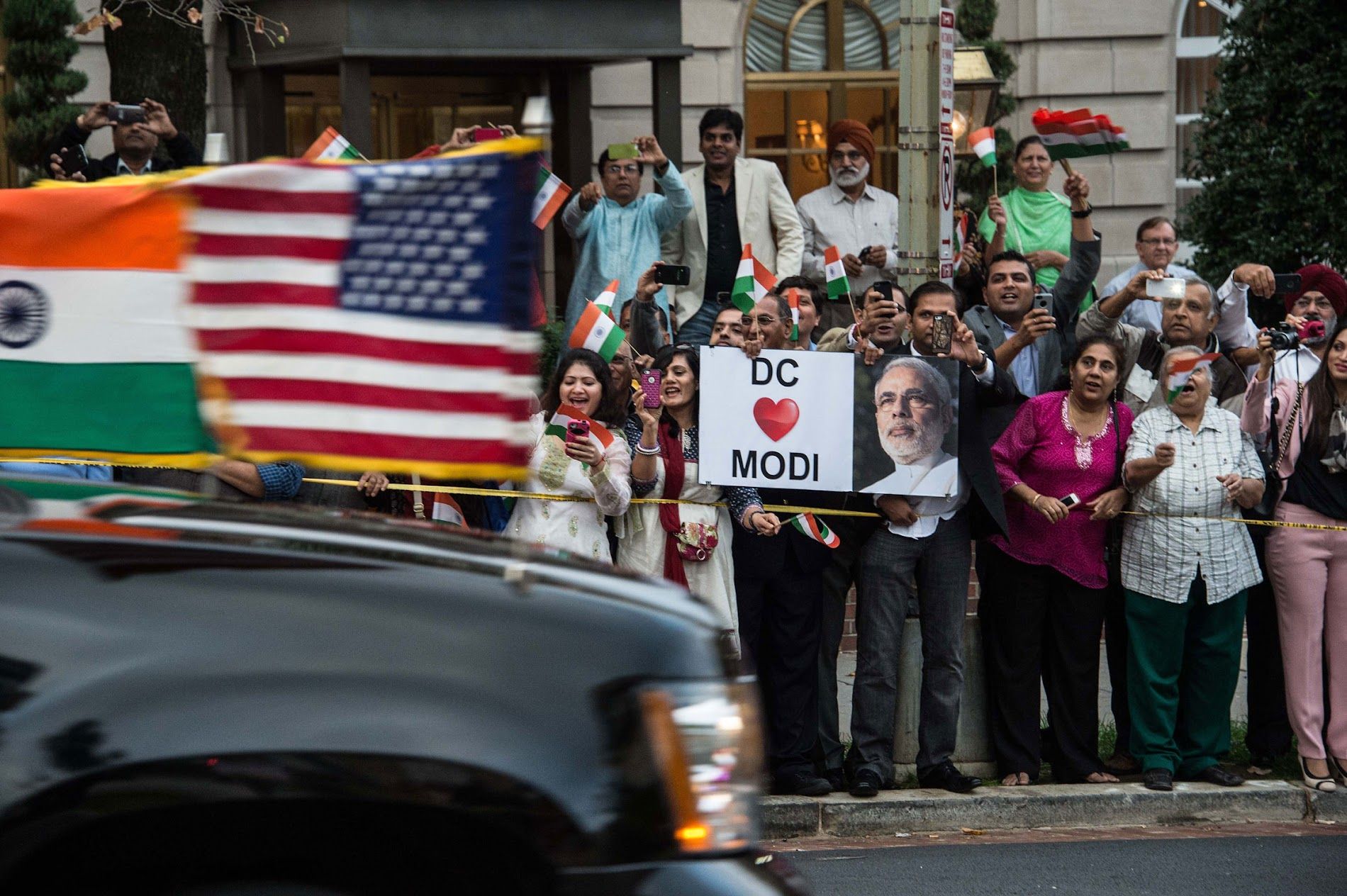
    Wellwishers greet Narendra Modi as he arrives at the Indian embassy in Washington in September 2014.

    THE DEMOCRATIC PARTY OF INDIA, an entity whose origins remain obscure, was used to influence US lawmakers’ views on Kashmir following the abrogation of Article 370 of the Indian constitution, documents show. The Democratic Party of India was represented by Cornerstone Government Affairs, a Washington DC-based consulting firm. Public records in the United States filed under the Foreign Agents Registration Act—which imposes public disclosure obligations on persons representing foreign interests—show that the Democratic Party of India was registered with the same address as the Indian embassy: 2107 Massachusetts Avenue. The records also show contracts between the embassy and Cornerstone for “strategic counsel, tactical planning and government relations assistance on policy matters before the U.S. Government, the U.S. Congress, and select state governments, as well as academic institutions and think-tanks.”

    In August 2019, the Narendra Modi government in New Delhi announced an end to Article 370, stripping Kashmir of its constitutionally mandated limited autonomy. The move sparked international condemnation and searing reports in major US newspapers, including the Washington Post and the New York Times. By mid-December, prominent Democrats in the US Congress had sponsored two resolutions aimed at the Modi government, both calling on it to respect human rights and one expressing support for Kashmiri self-determination

    In a letter dated 10 December 2019, Harsh Vardhan Shringla, who was then the Indian ambassador to the United States—and later served as India’s foreign secretary—wrote to two senior members of the Foreign Affairs Committee of the US House of Representatives. Shringla repeated the Modi government’s line that Article 370 had been abrogated in the interests of “good governance, economic opportunities and socio-economic justice” and that the situation in Kashmir “has returned to normalcy”—even as the security clampdown, internet blackout and a ban on foreign journalists in the valley continued…

    Published by Caravan Magazine, 10 February 2023.

    Read the full article: https://caravanmagazine.in/politics/s-jaishankar-indian-embassy-covert-us-lobbying-article-370-kashmir

  • Kashmir: A look at the Kunan Poshpora rapes

    Writers Ifrah Butt and Natasha Rather

    Published in Al Jazeera. 24 December 2016

    Twenty-five years have passed since the 1991 incident in which Indian army soldiers allegedly raped between 23 and 100 women in Kashmir’s Kunan and Poshpora villages during a search operation.

    The Indian army has denied the accusations and a delayed investigation of the incident concluded that the allegations were “worthless” and no one was prosecuted for the alleged crimes.

    But, in 2013, a group of 50 women, including the authors Ifrah Butt and Natasha Rather, petitioned the Supreme Court of India to re-open the investigations. Since then, a reinvestigation was ordered and the Kashmir High Court ordered that victims be paid compensation. The state government and army have mounted efforts to stop these orders.

    Al Jazeera spoke to Ifrah Butt and Natasha Rather who, along with three others, co-wrote a book, Do You Remember Kunan Poshpora?, published earlier this year.

    Butt and Rather, both young women in their twenties, spoke about the impact of militarisation on Kashmiri Muslim women and men, political solidarities, about Kashmiri women who inspire, and the issue of self-determination in Kashmir.

    Al Jazeera: How and when did you learn about the Kunan Poshpora rapes?

    Ifrah Butt: I had a faint idea of the events of Kunan Poshpora, but it was not something which we talked about, because it is taboo to discuss rape in Kashmiri society. We were documenting cases of sexual violence at Jammu Kashmir Coalition of Civil Society, when we learned about the full details.

    At that time, people were on the streets in India, demanding immediate justice for a young woman who was raped in Delhi in December 2012. We wondered why nobody had sought justice for the Kashmiri women who were raped more than 20 years ago.

    Al Jazeera: How has the conflict in Kashmir affected women and their participation in the public sphere?

    Natasha Rather: Before the conflict escalated in the late 1980s, girls were encouraged to attend college, work and occupy high positions. But they were forced to drop out due to the conflict.

    During the conflict, women helped [fighters] with meals and shelter, and acted as their couriers.

    Increasing instances of rape were recorded after the armed uprising began in 1990s and incidents like Kunan Poshpora made women more aware of their vulnerability.

    Rapes were humiliating for the entire Kashmiri community and demoralising. As a result, women were made to cover their faces and wear burqas. Their movements were restricted.

    But after a point they had to go out and work because the men were being killed, or were in jail. There are hundreds of half-widows in Kashmir – women whose husbands disappeared.

    Since the year 2000, more women started working. Now, many own big businesses, boutiques and beauty parlours, and are in the bureaucracy.

    But the result of militarisation is that [Kashmiri women] dread men in uniform. We won’t enter a park, if we see them sitting even far away, or walk down streets where there is an army bunker.

    Butt: Kashmiri women have been abused both by militants and Indian security forces. Militants also used rape, especially if women were caught as informers. For example, in the 1990s, a Kashmiri Pandit [Hindu] nurse was raped and shot for being a suspected police informer.

    Similarly, there are instances of Indian security forces raping female members of a militant’s family as a way of punishing the fighter.

    Women were raped on both sides.

    Al Jazeera: Men have been tortured and brutalised during the conflict as well. What were the consequences?

    Rather: Incidents of sexual torture and assault against men and boys have been recorded. But many such incidents go unreported because the victims fear shame and dishonour.

    Butt: Also, I think, men started thinking that they could not take care of the women after incidents of rape and sexual assault against women by military and paramilitary forces increased.

    Al Jazeera: What is the situation of Kashmiri women with regard to employment, marriage and sexual freedom?

    Rather: Government jobs or education and banking jobs are considered the best for Kashmiri girls. Some families express discomfort about women working with men. Caste and class considerations can be important in selection of partners, but such ideas are slowly changing, especially among the middle class.

    There is complete silence around premarital sex since Kashmiri society considers this to be a disgrace and dishonour.

    Butt: We have the liberty to choose our partners, that is, husbands, but we cannot cohabitate with a partner if unmarried. Premarital sex is a big no. Sexuality and related issues like rape or even harassment are not discussed.

    Al Jazeera: During the exodus of Kashmiri Pandits during early 1990s, women from the Pandit community were reportedly raped. Has the violence against them been forgotten?

    Rather: Rape of a Kashmiri Pandit woman is as condemnable as of a Kashmiri Muslim woman.

    Butt: There were some incidents of rapes committed by militants in the 1990s. Such incidents, too, need documenting.Al Jazeera: The outrage around the 2012 Delhi rape prompted you to delve into Kunan Poshpora. Do these other incidents in India also affect you?

    Rather: The 2012 agitations demanded that the culture of silence [over rape] be broken. It seemed to be an apt time for talking about gendered violence in Kashmir.

    Events in India do impact us, especially movements led by the people. But while most other agitating groups do not want freedom from India, Kashmiris want self-determination.

    Butt: Events from all over the world impact us, be it Palestine, Syria or Yemen. We express our solidarity with every oppressed nation and groups like the Dalits or tribal groups. We do it by writing about it and expressing ourselves on social media.

    Al Jazeera: Are you indicating that Kashmir needs freedom first, and only then can social problems like patriarchy and caste be dealt with?

    Butt: We can solve our problems only if we are alive. We saw how young boys and girls were killed since 2008. There are massacres, and if this continues, there will soon be no one left to deal with the other social problems.

    Once we get freedom we will work for a perfect nation. But when our existence is in peril, we cannot think of anything else.

    Rather: The right to self-determination precedes everything else. When India was waging its struggle for freedom, did it wait to eliminate caste biases, religious intolerance or patriarchy?

    Read the original article: https://www.aljazeera.com/features/2016/12/24/kashmir-a-look-at-the-kunan-poshpora-rapes/

Urvashi Sarkar – 2026 – All rights reserved.

web things by Studio Goncharov