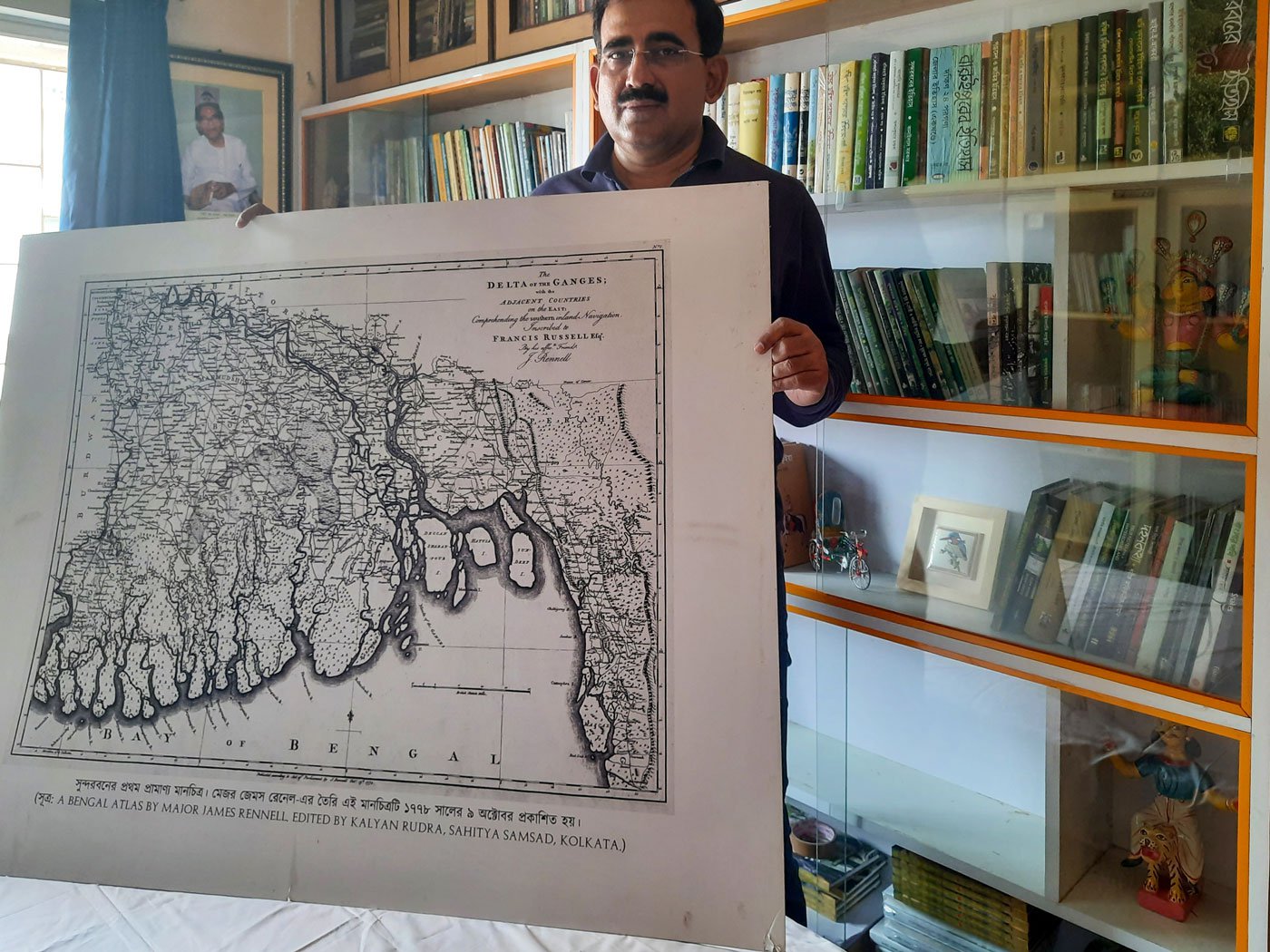
It’s a Sunday morning, but Jyotirindra Narayan Lahiri is busy. In a corner room of his apartment in Hooghly district, the 50-year-old is poring over the first map of the Sundarbans prepared by Major James Rennel in 1778.
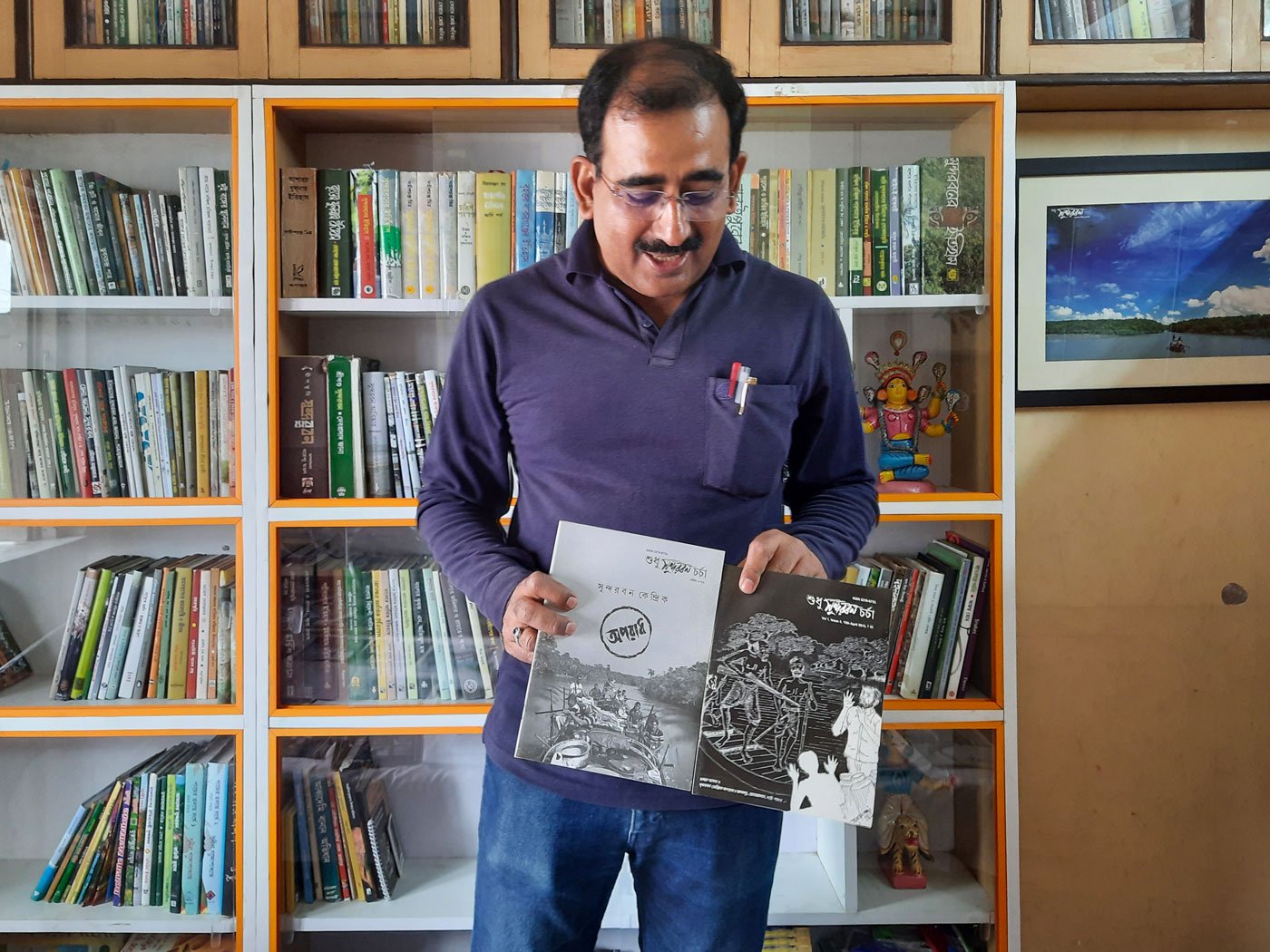
“This is the first authentic map of the Sundarbans based on a survey by the British. This map shows mangroves extending right up to Kolkata. So much has changed since then,” Lahiri says, his finger tracing the map. Straddling both India and Bangladesh, the Sundarbans, the site of the world’s largest mangroves, is known for its immense biodiversity and, of course, the Royal Bengal Tiger ( Panthera tigris ).
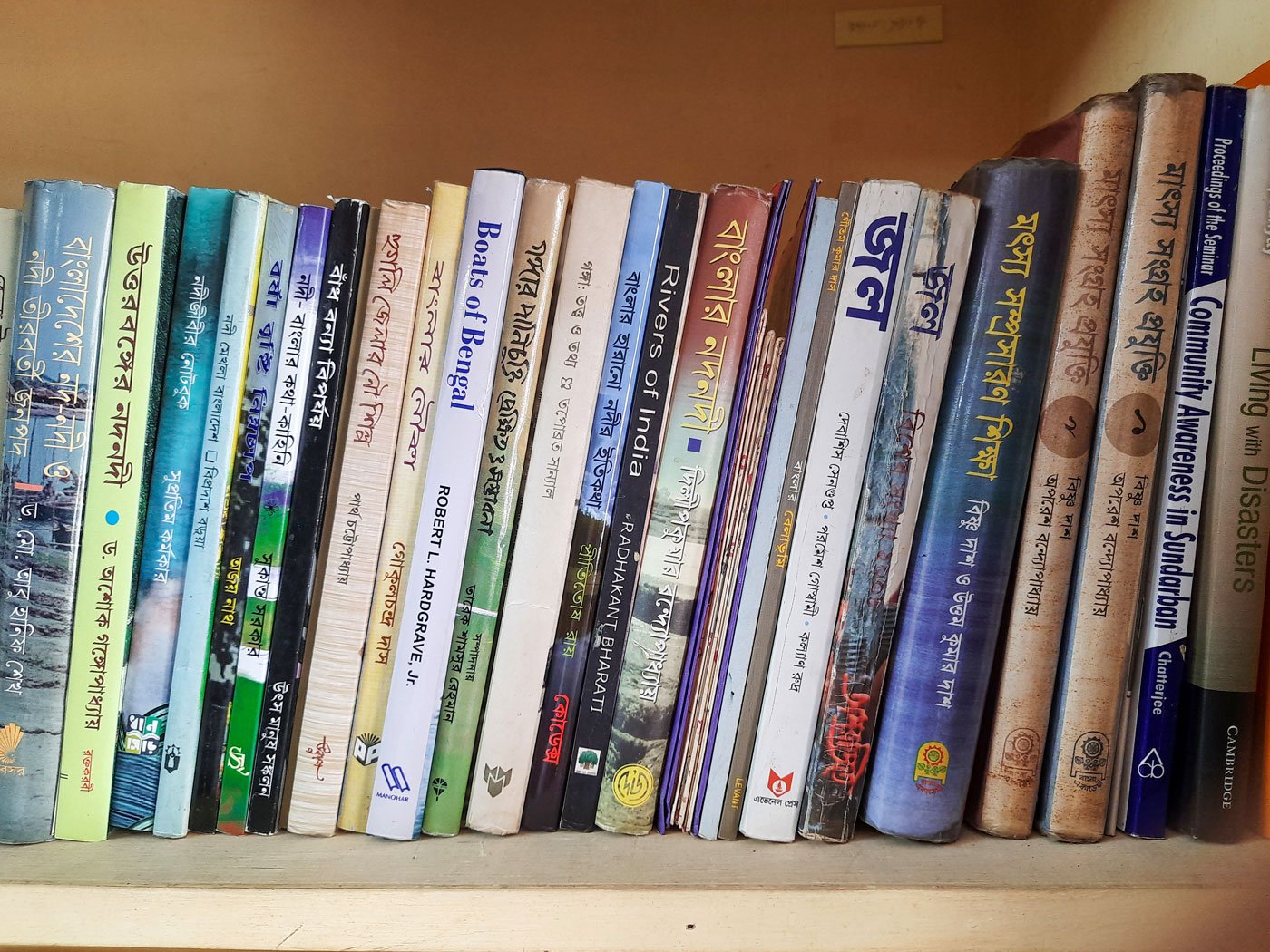
The bookcases lining the walls of his room are packed with hundreds of titles on every conceivable subject about the Sundarbans – flora, fauna, daily life, maps, atlases, and children’s books in English and Bengali. This is where he researches and plans issues of Sudhu Sundarban Charcha , a quarterly publication about the Sundarbans that he started after Cyclone Aila left a trail of devastation in the region in 2009.
“I made repeated trips to see the condition of the area. It was frightening,’’ he recalls. “Children were out of school, people had lost their homes, masses of men had migrated, and everything was left to the women to take care of. The people’s fate entirely depended on whether the river embankments would stay in place or collapse.”
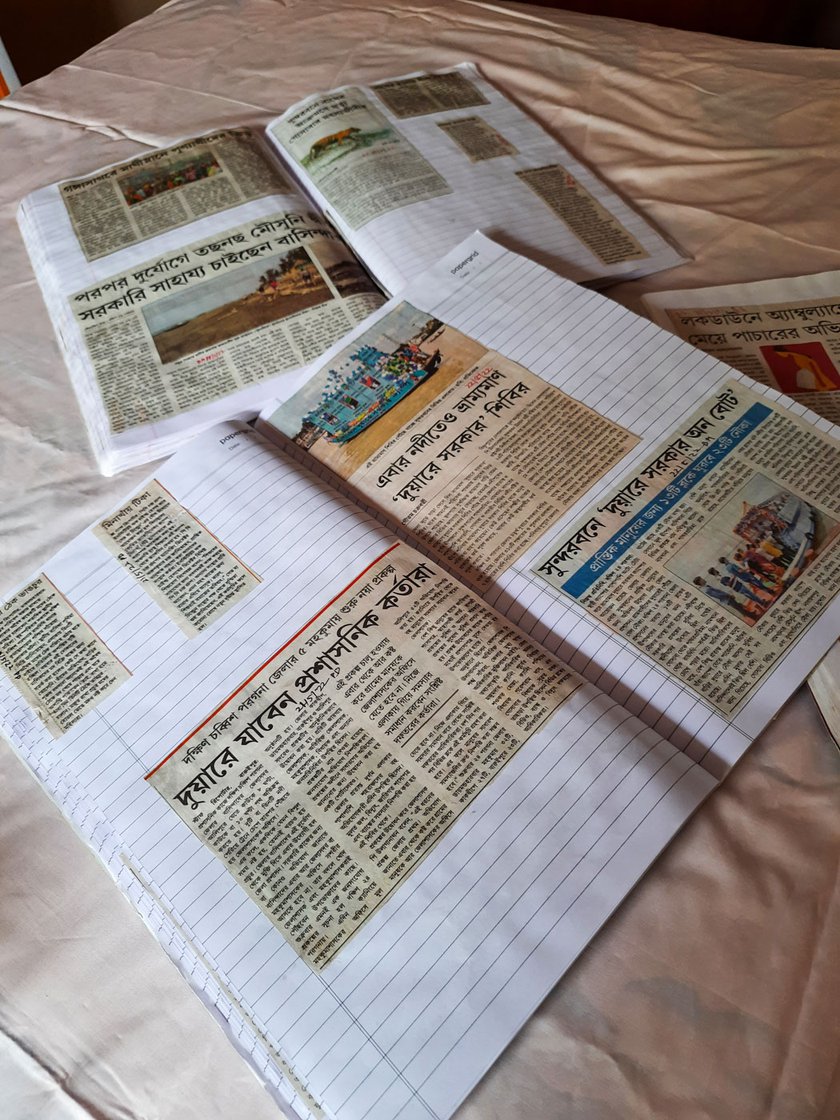
Lahiri found media reports on the disaster sparse and superficial. “The media recycles stereotypes about the Sundarbans. Typically, you will find accounts of tiger attacks or rain. When it isn’t raining or flooded, the Sundarbans is rarely in the news,” he says. “Disaster, wildlife and tourism – that is the sum of what interests the media.”
PHOTO • Urvashi Sarkar
PHOTO • Urvashi Sarkar
Lahiri holds the first map of the Sundarbans (left) prepared by Major James Rennel in 1778. In his collection (right) are many books on the region
PHOTO • Urvashi Sarkar
PHOTO • Urvashi Sarkar
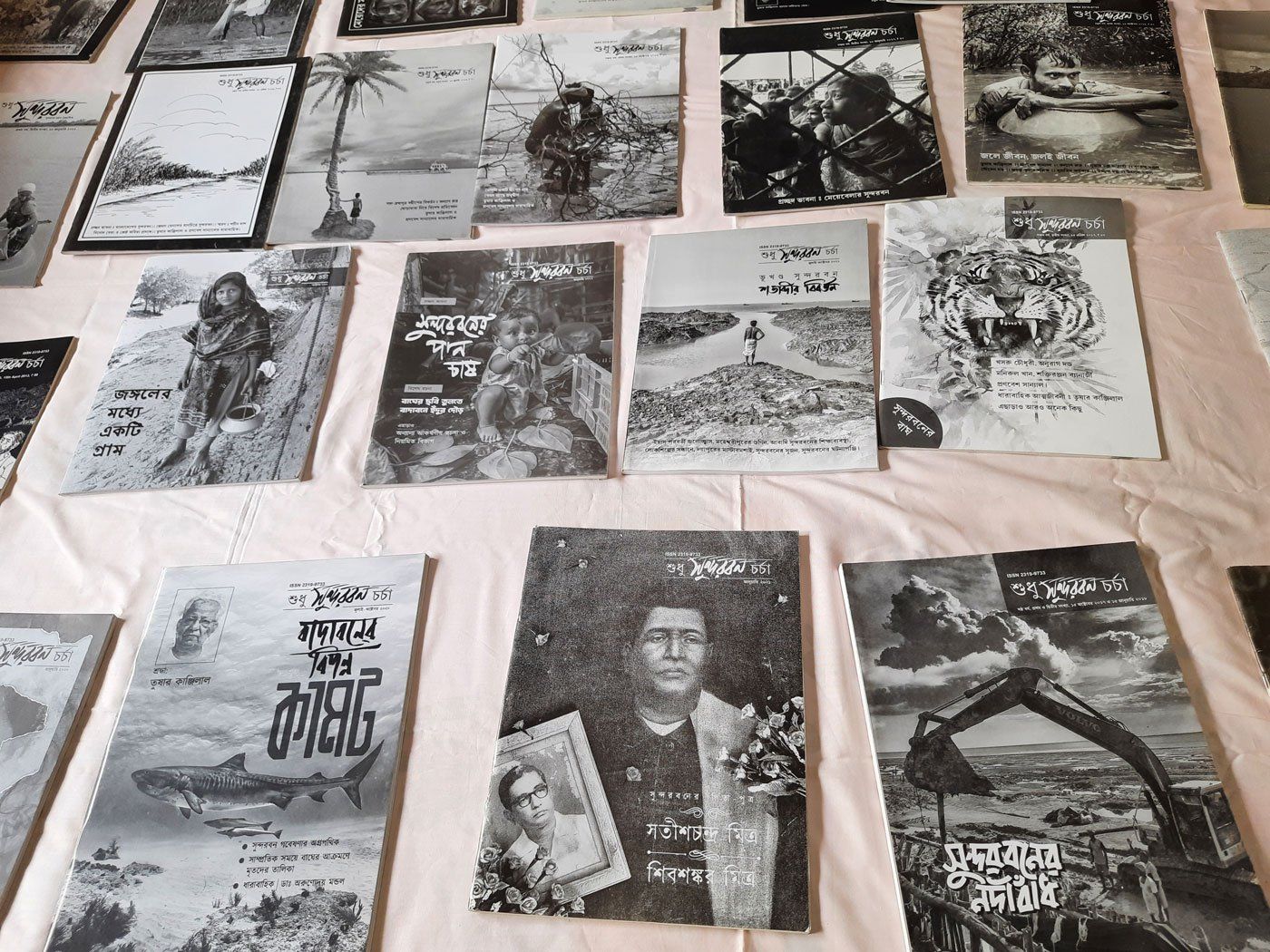
Lahiri has been collecting news (left) about the Sundarbans for many years. ‘When it isn’t raining or flooded, the Sundarbans is rarely in the news,’ he says. He holds up issues of Sudhu Sundarban Charcha (right), a magazine he founded in 2010 to counter this and provide local Indian and Bangladeshi perspectives on the region
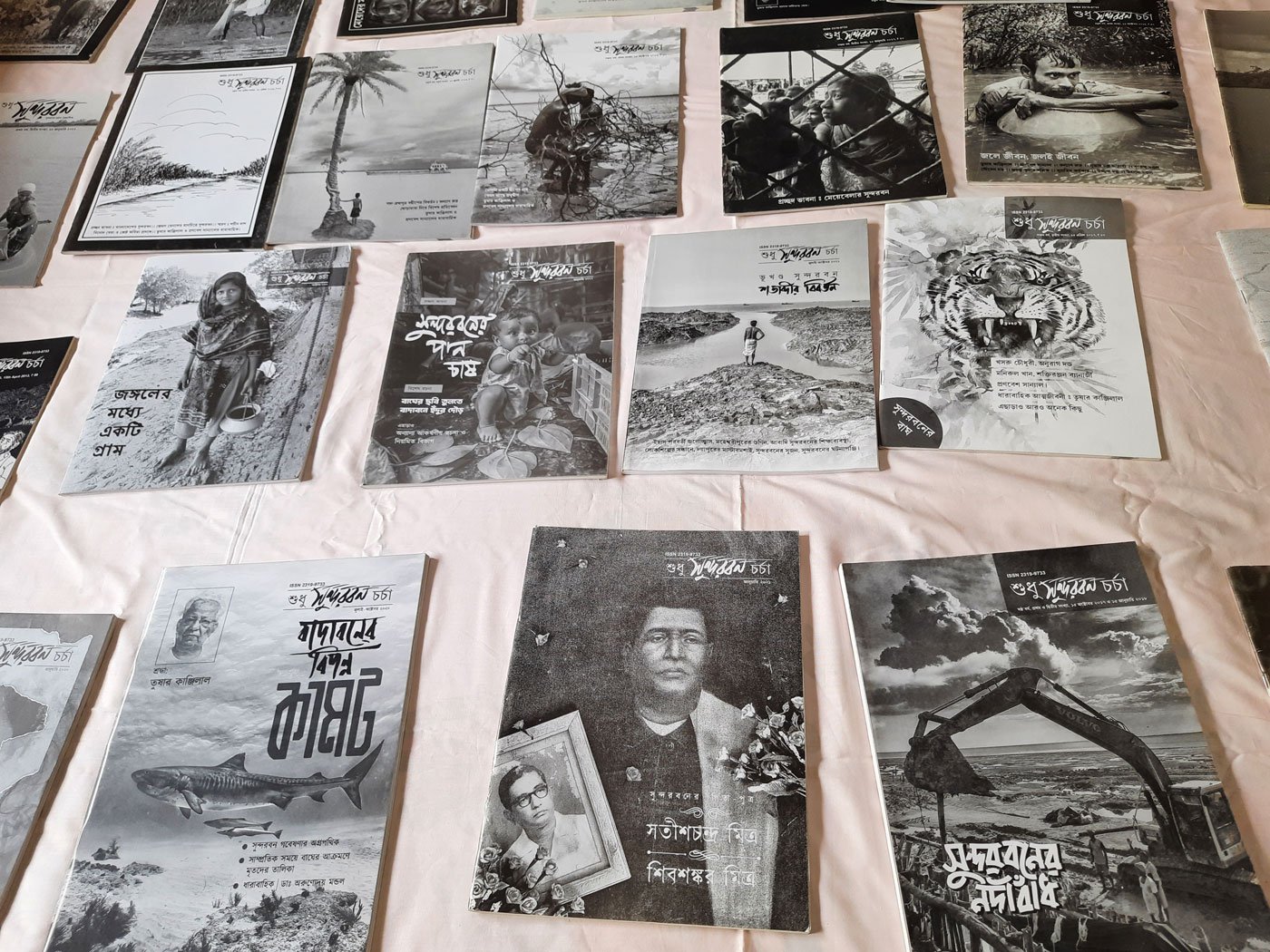
He founded Sudhu Sundarban Charcha (loosely translated as ‘Just Sundarbans Discussions’) to comprehensively cover the region from both Indian and Bangladeshi perspectives. Since 2010, he has published 49 issues of the magazine and the 50th issue is slated to be published in November 2023. “Past issues have focused on everything, from how paan is grown, to maps of the Sundarbans, the lives of girl children, profiles of individual villages, piracy and rainfall,” he says. One issue even discussed how media covers the Sundarbans, featuring perspectives from journalists in West Bengal and Bangladesh.
The magazine’s last issue published in April 2023 – its 49th – is dedicated to mangroves and tigers. “Sundarbans are possibly the only mangroves in the world where tigers live. Therefore, we planned an issue around this.” he says. Planning has also begun on the 50th issue, which will focus on the work of a retired university professor who has extensively researched how climate change and rising sea levels impact the Sundarbans.
“Our readers are usually students and university researchers seeking specific data or information, and individuals genuinely interested in the region. We even have 80-year-old patrons who read our issues line by line,” says Lahiri.
Approximately 1,000 copies of the magazine are printed each quarter. “We have 520-530 regular subscribers, mostly in West Bengal. The magazine is couriered to them. Some 50 copies go to Bangladesh – we do not directly courier these copies as that becomes too expensive,” Lahiri explains. Instead, Bangladeshi booksellers purchase copies from Kolkata’s popular book market in College Street and carry them back to their country. “We also publish Bangladeshi writers and photographers,” he says.
PHOTO • Urvashi Sarkar
PHOTO • Urvashi Sarkar
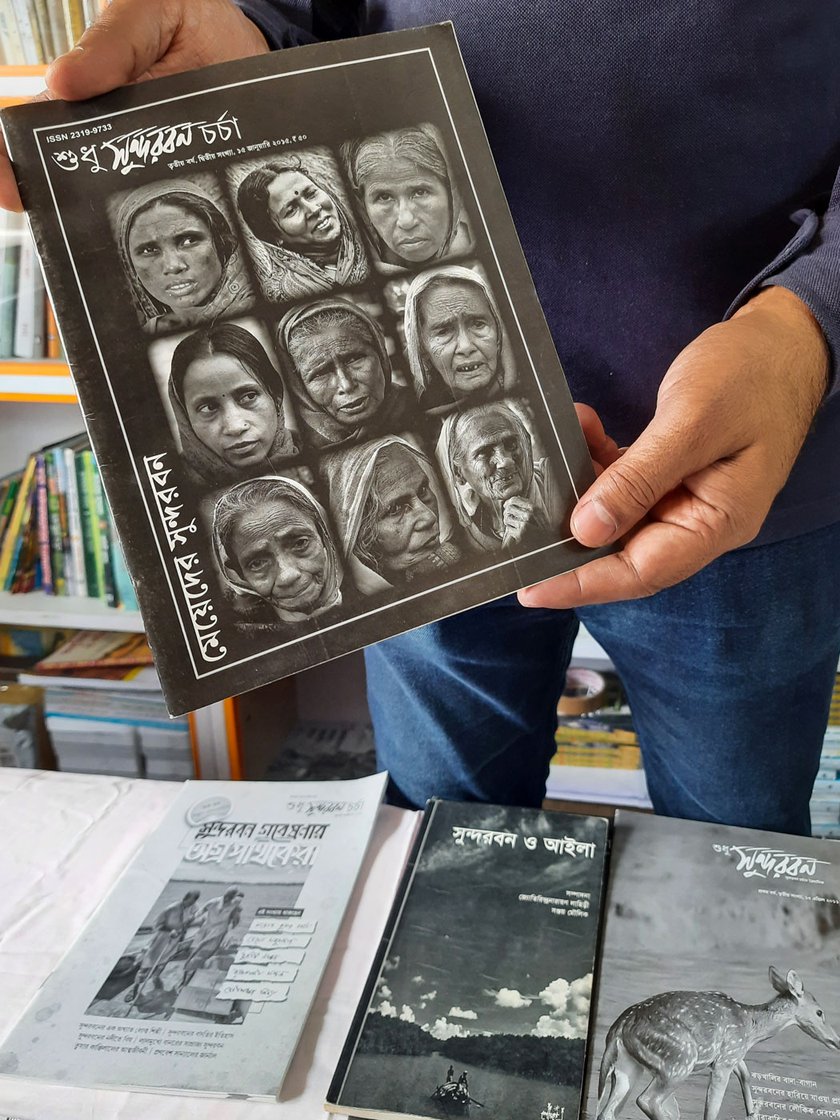
Left: An issue of Sudhu Sundarban Charcha that focuses on women in the Sundarbans. Right: Forty nine issues have been published so far
PHOTO • Urvashi Sarkar
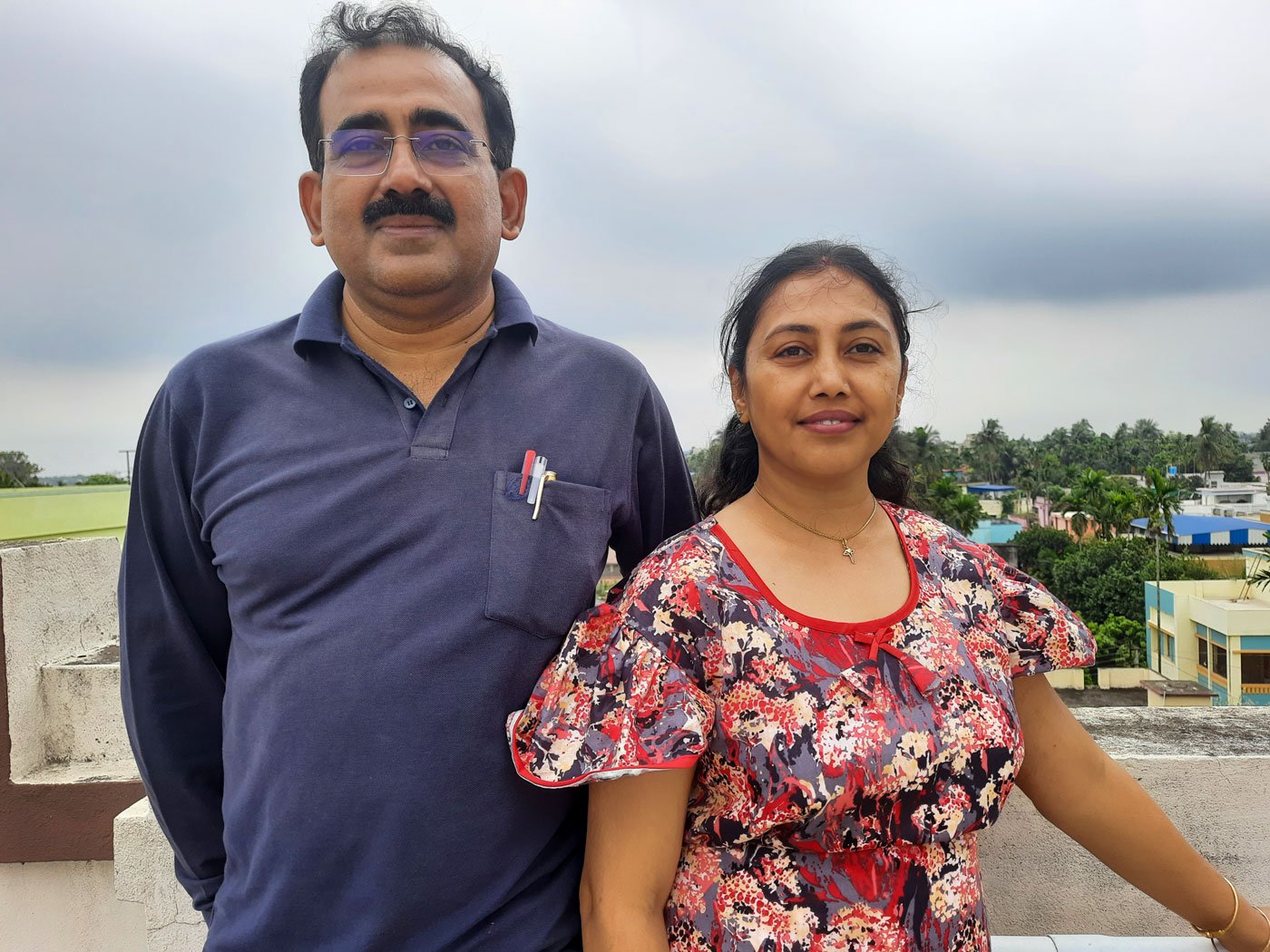
Jyotirindra Narayan Lahiri with his wife Srijani Sadhukhan. She along with their two children, Ritaja and Archisman help in running the magazine
Bringing out the magazine is a costly exercise as every edition is typeset before being printed in black and white on glossy paper. “Then, there are ink, paper, and transport costs. However, our editorial costs are not high because we do everything ourselves,” says Lahiri, who is assisted by his wife Srijani Sadhukhan , 48, daughter Ritaja, 22, and son Archisman, 15. The editorial team consists of around 15-16 members who pitch in with their time and effort free of cost. “We do not have the means to employ people. Those who contribute their time and labour do so because they care about the issues we raise in the magazine,” he says.
A copy of the magazine is priced at Rs. 150. “If our own cost is 80 rupees, we must sell [each copy] at 150 rupees because we need to straightaway give [news] stand owners a 35 per cent commission,” says Lahiri, explaining the economics of publishing.
Nearly every day, Lahiri and his family monitor six Bengali and three English newspapers for news on the region. Since he is himself a recognised voice in the area, news – of tiger attacks, for example – often reaches him directly. Lahiri also collects letters written by readers to the editors of newspapers. “The readers may not be rich or powerful, but they know their subject and ask relevant questions,” he says.
The magazine is not his only responsibility. Every day, he travels 180 km to the adjoining Purba Bardhaman district to teach Geography to Classes V-XII students in a government school. “I leave home at 7 a.m. and return only at 8 p.m. The printing press is in Bardhaman city, so if there is work to be done there, I stop by the press and return home late evening,” says Lahiri who has been teaching since the last 26 years. “Teaching is my passion, just like the magazine,” he says.
Published in People’s Archive of Rural India. 10 September, 2019
South 24 Parganas, West Bengal: Kajal Lata Biswas is still haunted by memories of the cyclone. Though it’s been 10 years since Aila hit the Sundarbans, she still clearly recalls May 25, 2009.
It was just before noon. “The [Kalindi] river water rushed into the village and flooded all the houses,” says Kajal Lata. She was at a relative’s house in Kumirmari village that day, around seven kilometres from her own village, Gobindakati. “Some 40-50 of us took shelter in a boat where we stayed the whole day and night. We watched trees, boats, cattle and paddy being swept away. At night, we could not see a thing. Even the matchsticks were soaked. We could see only when lightning flashed across the sky.”
Sitting outside her house and cleaning fish for lunch, 48-year-old Kajal Lata, a farmer, continues, “That night can never be forgotten. There wasn’t a drop of drinking water. Somehow, I collected a few raindrops in a plastic bag, which I used to wet the lips of my two daughters and niece, who were very thirsty.” Her voice shakes with the memory.
The next morning, they used a boat to to reach their village. Then waded through flood water to reach home. “Tanushree, my elder daughter, then 17, almost drowned where the water was very high. Luckily, she grabbed her aunt’s saree pallu which had come loose,” Kajal Lata says, her eyes relaying the fear she felt.
In May 2019, her fear returned with cyclone Fani, its arrival coinciding with the wedding of her younger daughter, 25-year-old Anushree.
Kajal Lata Biswas, cleaning fish outside her house in Gobindakati village, recalls the terror of approaching cyclones; paddy is stored in these huts in her village, and the crop has taken a hit
The wedding was fixed for May 6. Loudspeaker announcements about Fani by the panchayat and on radio by the government had started a few days earlier. “Imagine our plight and fear,” Kajal Lata says. “We were terrified that winds and rain would destroy all the preparations. There was some rain in the days before the wedding. But thankfully, the cyclone did not affect our village,” she adds, clearly relieved.
On May 2, the India Meteorological Department had issued a warning about Fani hitting Andhra Pradesh, Odisha (which turned out to be the worst affected) and West Bengal. Talking about Fani, Prafulla Mondal, an 80-year-old farmer and former teacher in Rajat Jubilee village, raises his voice a few notches: “Fani missed the Sundarbans very narrowly. The winds whistled by us. If it had hit our village, we would have been destroyed, along with our houses and land…”
As both Mondal and Kajal Lata know only too well, cyclones are common in the Sundarbans. The Disaster Management and Civil Defence Department of the West Bengal government categorises both South and 24 North Parganas districts as ‘very high damage risk zones’ due to cyclones.
Mondal’s village is in Gosaba block of South 24 Parganas district, and Kajal Lata’s village is in North 24 Parganas district’s Hingalganj block. Both are among the 19 blocks which comprise the Indian Sundarbans in West Bengal – 6 blocks in North 24 Parganas and 13 in South 24 Parganas.
Spread across India and Bangladesh, the Sundarbans is a vast delta with perhaps the largest contiguous mangrove forest in the world – covering around 10,200 square kilometres. “The Sundarbans region is one of the richest ecosystems in the world…” says a 2014 report by the World Bank titled Building Resilience for the Sustainable Development of the Sundarbans. “The entire mangrove forest region is known for its exceptional biodiversity, including numerous threatened species such as the Royal Bengal tiger, estuarine crocodile, Indian python, and several species of river dolphin. It is home to more than 10 per cent of mammal and 25 percent of bird species found in India.”
The Indian Sundarbans – roughly 4,200 square kilometres – is also home to nearly 4.5 million people, many of whom live on the edge, struggling with meagre livelihoods, a harsh terrain and weather extremes.
Though the region has not seen a major cyclone after Aila, it remains severely vulnerable. A 2006 report by the Indian Institute of Technology, Kharagpur, done for the West Bengal government’s Department of Disaster Management, notes that the state experienced 71 cyclonic storms from the years 1891 to 2004. In that period, South 24 Pargana district’s Gosaba was the most affected block, with six severe cyclones and 19 cyclones.
n Rajat Jubilee village, 80-year-old Prafulla Mondal has weathered many storms, but his family is now struggling with erratic weather changes
Prafulla can thus recall cyclones even before Aila. “I cannot forget the 1998 cyclone [described as West Bengal’s ‘most intense storm’ since Independence, stronger even than Aila, which was a ‘severe cyclonic storm’] with its strong and violent winds. Before that too, I can remember the cyclone of 1988,” he says.
But even given this stormy past, cyclonic depressions (a tropical weather disturbance at sea, in the range of 31- 60 kilometres an hour, below the range of a cyclonic storm of 62-82 kilometres) have increased 2.5 times in the last 10 years in the lower Gangetic delta (where the Sundarbans are located), notes Dr. Abhijit Mitra, a Kolkata-based oceanographer, in a 2019 book titled Mangrove Forests in India. Exploring Ecosystem Services. “This means that cyclones occur more frequently,” he says.
Various other studies show that the incidence of cyclones has increased in the Bay of Bengal, alongside the Sundarbans. One study published in 2015 in the Diversity journal puts the increase at 26 per cent between 1881 and 2001. And using available data from 1877 to 2005 on cyclones in the Bay of Bengal during May, October and November, a 2007 study shows that the frequency of severe cyclonic storms here has registered significant increasing trends in past 129 years during these intense cyclonic months
In part, this is attributed to the increase in sea surface temperature (notes, among others, a paper in the Journal of Earth Science & Climate Change). These temperatures rose in the Indian Sundarbans at 0.5 degrees Celsius per decade from 1980 through 2007 – higher than the globally observed warming rate of 0.06° C per decade.
There have been several catastrophic fallouts. “While the Sundarbans last experienced a major cyclone in 2009,” says Prof. Sugata Hazra of the School of Oceanographic Studies at Jadavpur University, Kolkata, “the region has suffered because of repeated inundation and embankment failure owing to subsequent cyclones in the northern Bay of Bengal.”
Rising sea levels and sea surface temperatures, among several other shifts, are threatening the Sundarbans
Embankments, the World Bank report notes, “play a key role in the Sundarbans as systems of defense against cyclonic storms and sea level rise. The people and the productivity of their holdings are under increased threat from deltaic subsidence, sea level rise, and increased cyclone intensity as climate change and the decay of a 19th century 3,500-kilometer system of embankments take their toll…”
A 2011 World Wildlife Fund paper says that the relative mean sea level for 2002-2009 measured at the Sagar island observatory, Sundarbans, rose at the rate of 12 mm per year or at the rate of 8 mm per year for 25 years.
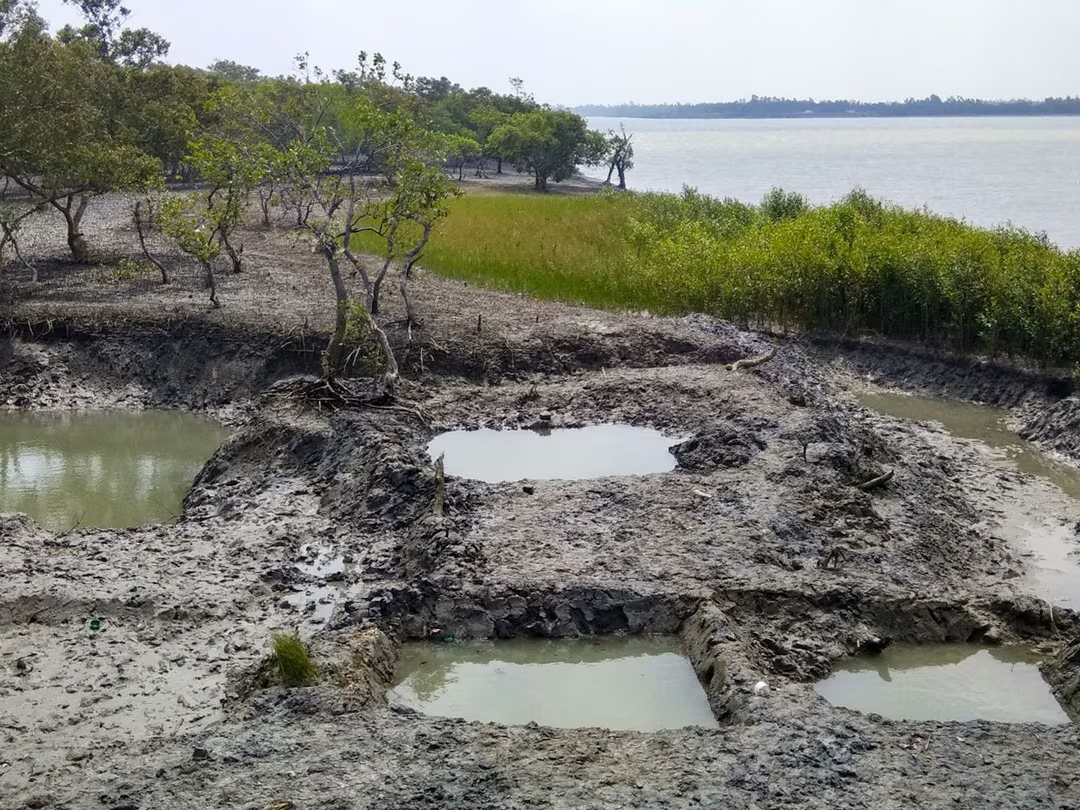
The warming and related sea level rise is also adverse affecting mangroves. These forests help protect coastal areas from cyclones and erosion, act as breeding ground for fish and other species, and are also the habitat of the Bengal Tiger. A 2010 paper by Jadavpur University’s School of Oceanographic Studies, titled Temporal Change Detection (2001-2008) Study of Sundarban notes that the rise in sea level and cyclones seriously affect the health of Sundarban’s mangrove forests by reducing the forest cover.
Arjun Mondal a fisherman from Rajat Jubilee village, was acutely aware of the importance of mangroves to the Sundarbans. He worked with an NGO, the Sundarbans Rural Development Society. “Everyone has heard of climate change, but how is it affecting us? We need to know more about this,” he told me in May 2019.
On June 29, 2019, Arjun was carried away by a tiger while hunting for crabs in the Pirkhali forest. While humans have for long been attacked by tigers in the Sundarbans, the increasing reports of attacks are at least partially due to the erosion of forest land caused by rising sea levels, bringing tigers in closer contact with inhabited villages.
With the battering of the region by cyclones, water salinity levels have also risen, especially in the central Sundarbans, where Gosaba is located. “…the ecosystem is being adversely impacted by significant increases in salinity due, in part, to sea level rise as well as reductions in freshwater flows to the delta,” notes the World Bank report.
The extensive embankments in the Sundarbans, crucial to farming and controlling soil salinity, are steadily being eroded by the rising sea levels
A research paper co-authored by Dr. Mitra describes the Sundarbans as ‘hypersaline’. “Water salinity has increased due to rising sea levels in the central part of Sundarbans. This is clearly linked to climate change,” says Dr Mitra.
Other researchers have noted that the siltation of the Bidyadhari river, which prevents fresh water flows from the Himalayas to the central and eastern Sundarbans. Researchers have attributed the siltation in part to land reclamation, cultivation, dumping of sewage sludge and fisheries waste. The building of the Farakka Barrage in 1975 (on the Ganga, in West Bengal’s Murshidabad district) also contributed to the increasing salinity of the central Sundarbans.
The Mondal family in Rajat Jubilee knows the effects of the high salinity – they had no rice to sell for three years after Aila. Their annual income of Rs. 10, 000- 12,000 from selling rice was wiped out. “With rice cultivation gone, entire villages emptied out as men left to hunt for work, to Tamil Nadu, Karnataka, Gujarat and Maharashtra, where they joined factories or construction sites as labourers,” Prafulla recalls.
Across the state, Aila affected more than 2 lakh hectares of cropped area and over 6 million people, and it killed 137 and destroyed over 1 million houses . “There was nobody in my village who did not suffer losses,” Prafulla says. “My house and crops were destroyed. I lost 14 goats and could not cultivate paddy for three years. Everything had to be rebuilt from scratch. Those were hard years. I took up carpentry and odd jobs to make a living.”
After Aila intensified salinity, Kajal Lata’s family too had to sell six bighas of their 23 bighas (7.6 acres) of land. “Not a blade of grass grew for two years because the soil was so salty. Not even rice could grow. Slowly, vegetables like mustard, cabbage, cauliflower and gourds are growing again, enough for our consumption, but not enough to sell,” she says. “We also had a pond which produced different fish like shol, magur, rui and we could earn Rs. 25,000-30,000 a year by selling these. But after Aila, the water became entirely salty, so there is barely any fish.”
Mangroves are critical to the ecosystem of the Sundarbans, but they too are slowly thinning out
The soil degradation – including high salinity and high alkalinity – caused by Aila resulted in poor paddy growth across much of North and South 24 Pargana, notes a 2016 paper in the Journal of Experimental Biology and Agricultural Sciences. A study in the journal shows that to grow paddy again, phosphate and potash-based fertiliser had to be used above the recommended levels.
“After Aila, fertiliser use has increased. Only then we are able to get the required yield,” says Prabir Mondal, Prafulla’s 48-year-old son. “It isn’t healthy to eat, but we still need to eat it. I remember the rice we ate as children. You could eat it as it is. Now, even when eaten with vegetables, something feels amiss.”
His father owns 13 bighas (4.29 acres) of land which produces 8-9 bastas of rice per bigha – one basta equals 60 kilos. “The cost of planting, cutting and lifting the rice plus fertiliser costs means that we earn very little over what we have spent,” says Prabir.
Paddy production across the Sundarbans, a 2018 research article observes, fell by half after Aila – from 64-80 quintal to 32-40 quintals per 1.6 hectares. Though paddy production has now stabilised to pre-Aila levels, says Prabir, his family and others in his village remain completely dependent on rainfall from June to September.
And that rainfall has become unreliable. “The accelerated sea level rise,” says Prof. Hazra, “and the delayed arrival and deficiency of monsoon, are impacts of climate change in the long run.”
High rainfall exceeding 100 millimetres a day is occurring more often in the last two decades over the northern Bay of Bengal (where the Sundarbans is located), says ongoing research at the School of Oceanographic Studies, Kolkata. At the same time, in the sowing season, Prof. Hazra says, the monsoon has often fallen short, as it did this year – till September 4, around 307 millimetres short in South 24 Parganas and nearly 157 mm less in North 24 Parganas.
It’s not just this year – a shortfall or excess rain has been recurring in the Sundarbans for some years. The normal June to September monsoon rain in South 24 Parganas is 1552.6 mm. The monsoon data for 2012-2017 the district indicates that rainfall was deficient in four out of six years, with major lows in 2017 (1173.3 mm) and 2012 (1130.4 mm).
In the North 24 Parganas, the opposite has happened: excess rainfall. The normal June to September rainfall here is 1172.8 mm. The monsoon data for 2012-2017 shows that rainfall was excess in four out of these six years with the highest in 2015 – 1428 mm.
“The real trouble is the untimely rain,” says Kajal Lata. “In February this year, there was plenty of rain, almost like monsoon. Even the elders said they could not recall a time when it rained so much in February.” Her family depends on paddy for an income, sown in June-July and harvested in November-December. “The paddy growth depends entirely on rainfall. If there is no rain, the rice will not grow.”
Since the last four or five years, she says, it’s been raining in her village in November-December, in addition to the monsoon months. While some showers during these months usually occur here, their intensity can harm the paddy harvest. “Either there is no rain when required or it rains excessively out of season. This is destroying the harvest. Every year we think this time there won’t be excessive [unseasonal] rain. But it rains so much and the crop is completely destroyed. That is why we have the saying, ‘Aashay morey chaasa’ [‘Hope kills the farmer’].”
In Rajat Jubilee village, Prabir Mondal is also worried. “Through June and July, there was no rainfall [in my village]. Some paddy leaves dried up. Thankfully, rain has arrived [in August]. But will it be enough? What if it rains too much and the crop drowns?”
As a healthcare practitioner (he has a BA degree in alternative medicine), Prabir says his patients also increasingly complain of the heat.“Many now suffer from heat stroke. It can hit at any time and can be fatal,” he explains.
Land temperatures in the Sundarbans are also increasing, besides the rising sea surface temperatures. From 180 days in a year when the temperature was 32 degrees Celsius or higher here in 1960, the number of such days increased to 188 in 2017, show data on an interactive portal of the New York Times on climate and global warming. This could become 213 to 258 days by the end of the century.
Buffeted repeatedly by the growing heat, cyclones, erratic rain, salinity, vanishing mangroves and more, the residents of the Sundarbans live in a near-constant state of uncertainty. Prafulla Mondal, witness of several storms and cyclones, wonders: “Who knows what will come next?”
Published in People’s Archive of Rural India. 28 December, 2018
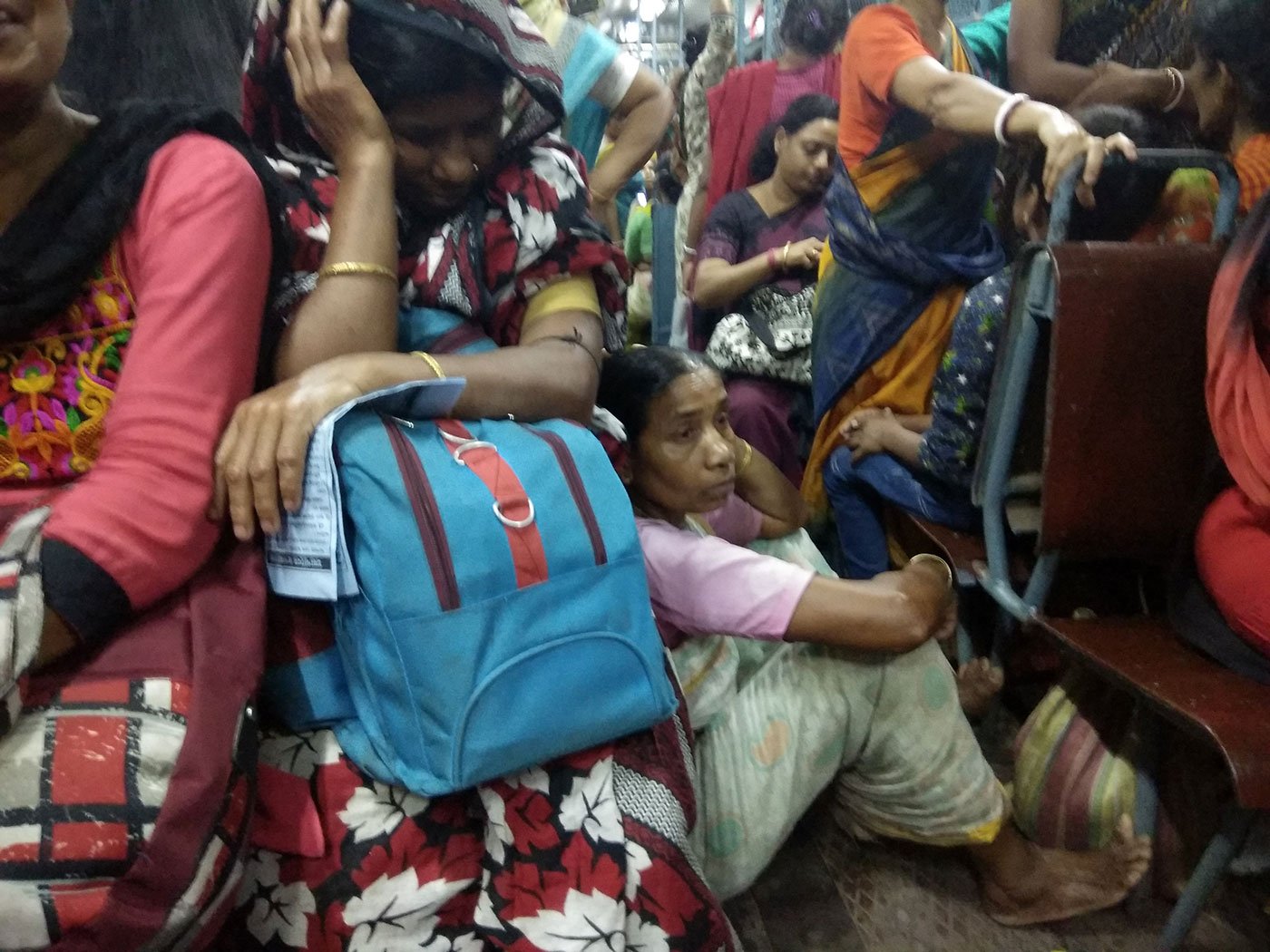
“Do you think, there will be a place to sit inside the train today?” yells Breshpati Sardar, standing on a crowded platform at Jadavpur railway station in south Kolkata. The women waiting next to her shake their heads in disappointment and laugh at the question.
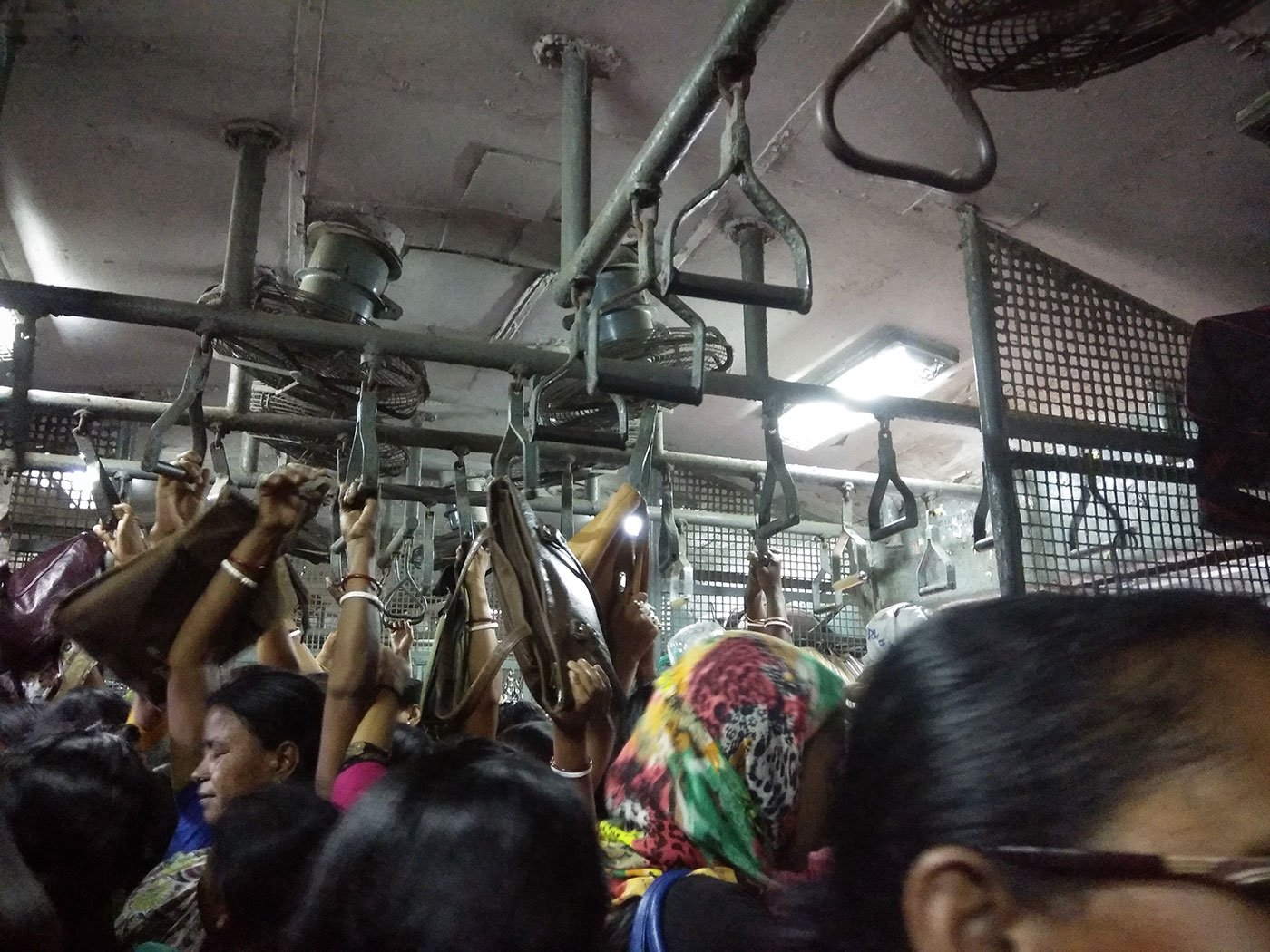
Breshpati is waiting for the 4:35 p.m. train to Canning. The train rushes into Jadavpur station. The women brace themselves in the crowd, pushing to enter one of the two already-full ladies compartments.
The train has come from Sealdah station in north Kolkata, stopping at Park Circus, Ballygunge Junction and Dhakuria. After Jadavpur, it will halt at Bagha Jatin, New Garia and Garia – all predominantly middle class and affluent areas of South Kolkata. The women waiting at Jadavpur – as well as at the other stations along the route – work as domestic helpers in these south Kolkata localities.
Many of them take the 45-kilometres Sealdah-Canning route, which covers 16 stations, and the 65-kilometres Sealdah-Lakshmikantapur train that halts at 25 stations, or the Sealdah-Namkhana line, which goes even further south. So some in Kolkata call these Eastern Railways trains the ‘jhi special’. Jhi is a disparaging term in Bengali for female domestic workers.
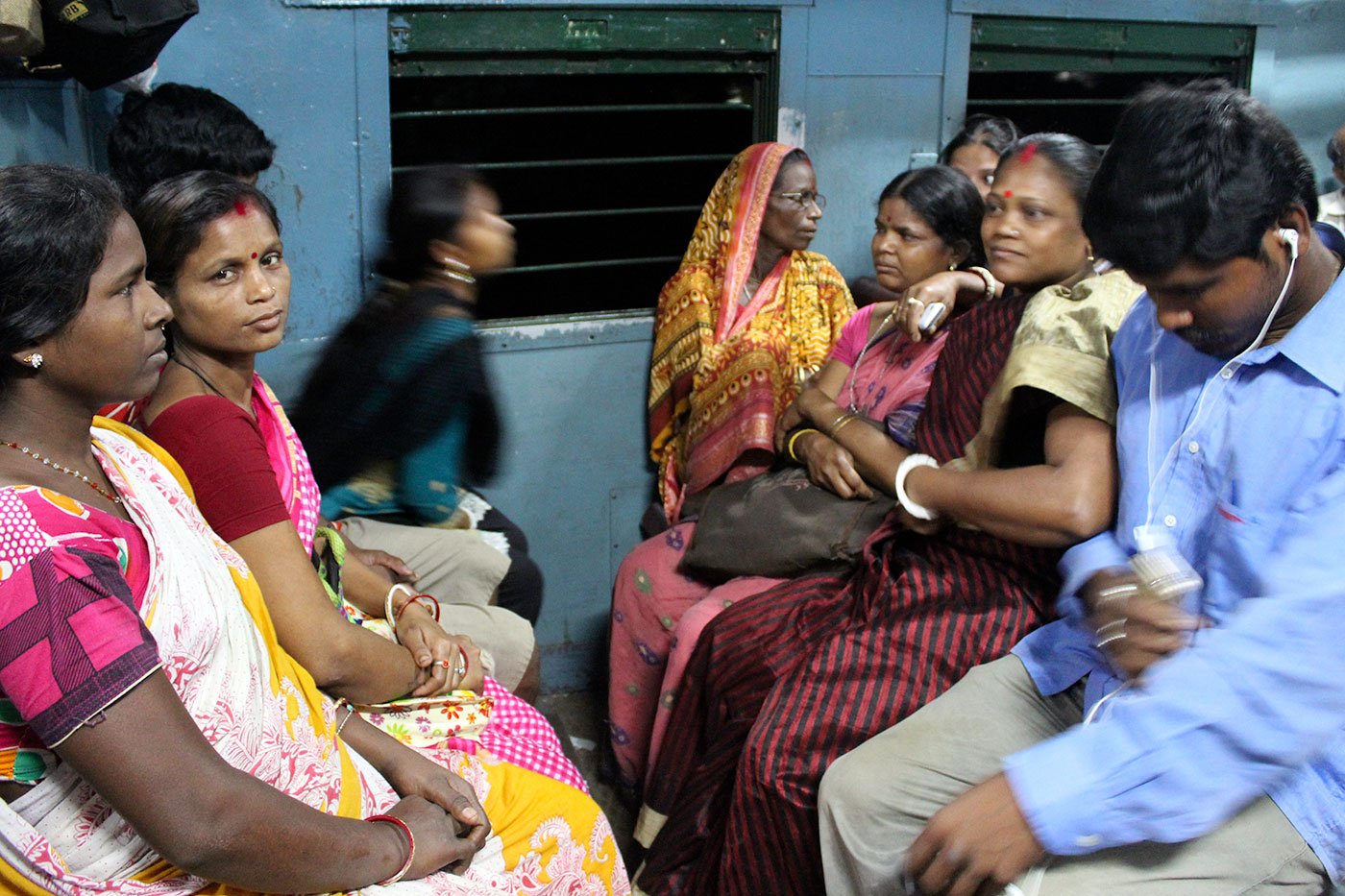
Photo: Urvashi SarkarPhoto: Urvashi Sarkar On the Sealdah-Canning train: some in Kolkata call these Eastern Railways trains the ‘jhi special’ – ‘jhi‘ is a disparaging term in Bengali for female domestic workers
That afternoon, on her way back home from work, wearing an orange saree, a red bindi and clutching a white handbag, Breshpati pushes her way into the compartment. Inside, amid the crush of bodies, bags and bangles, she finds a narrow space, just enough to stand. And repeatedly looks at the nearest window seat. When the person sitting there gets up to leave, Breshpati dives in to capture the coveted seat. Another woman, who has been pushed aside, screams at her.
A fight erupts. Breshpati’s voice rises and she turns red with anger. Other women quickly intervene. She calms down and settles down on another woman’s lap. The smile returns to her face and she excitedly shows a video of a snake consuming a rabbit to the women near her. “I usually never get into fights. But didn’t you see how the woman was behaving?” she says, angrily.
Some 75 minutes later, the train pulls into Canning, around 45 kilometres from Jadavpur, where Breshpati boarded the train. Canning is on the outer edges of the Sundarbans region in South 24 Parganas district. A lack of work options near their homes forces the women to commute to the city every day.
Breshpati’s house is a 30-minute walk from the station, near the market. On the way, she tells me, “Earlier I lived with my parents and went to school. But after Class 5, it became difficult for them to make ends meet.” Breshpati has three sisters and a brother. She started working in people’s houses when she was 11, and has continued ever since. She was married at the age of 14, and is now 28.
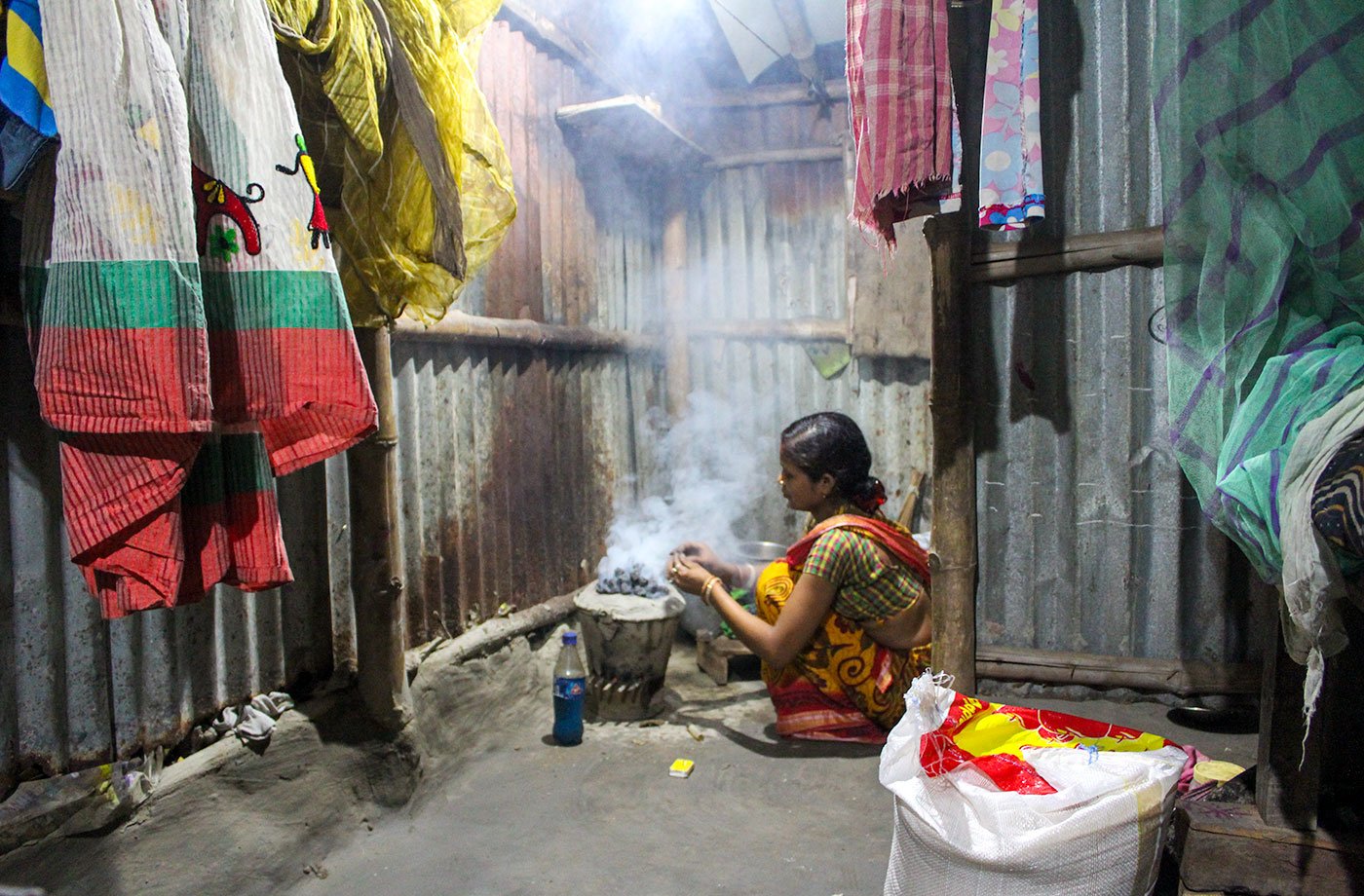
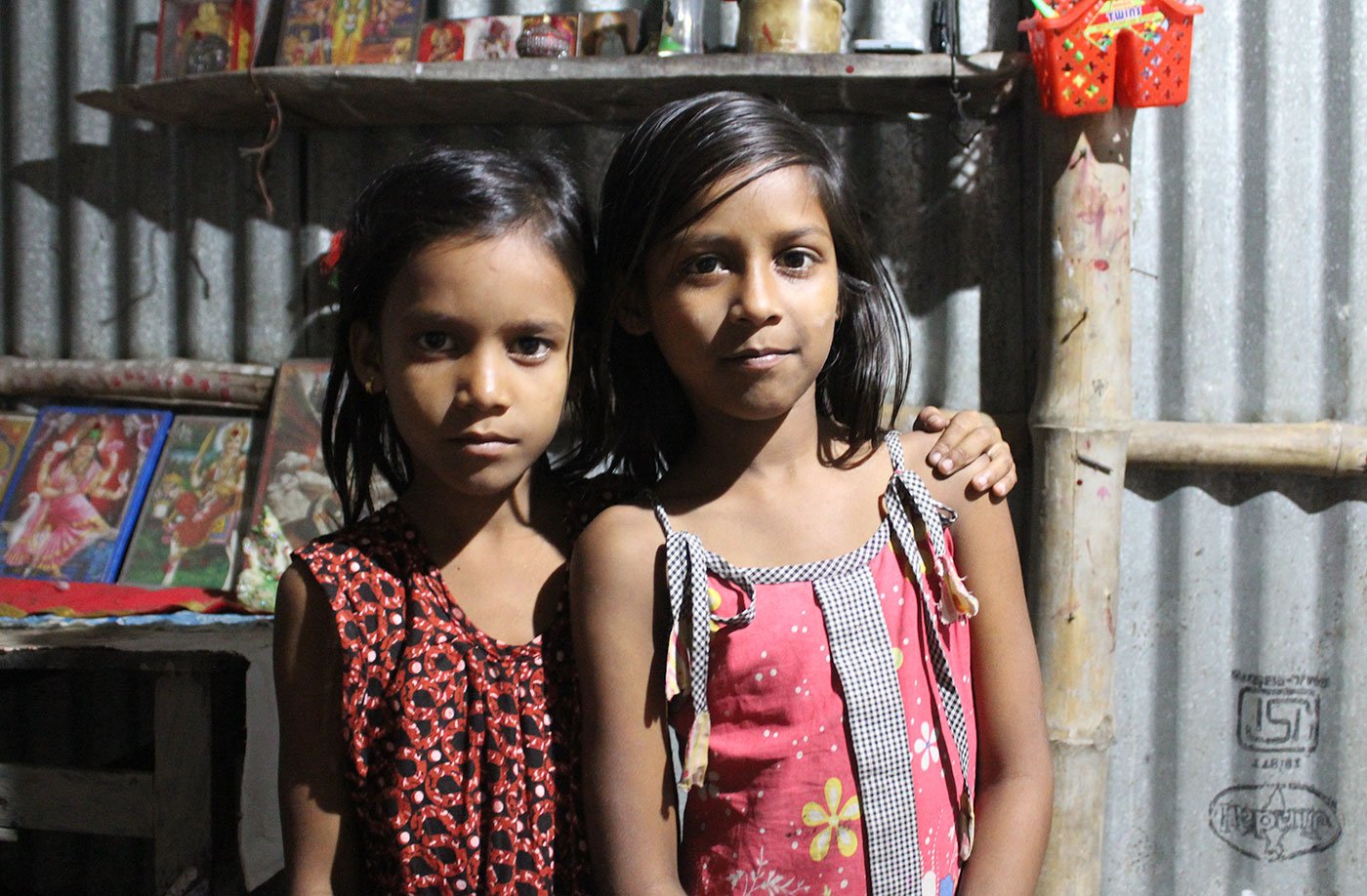
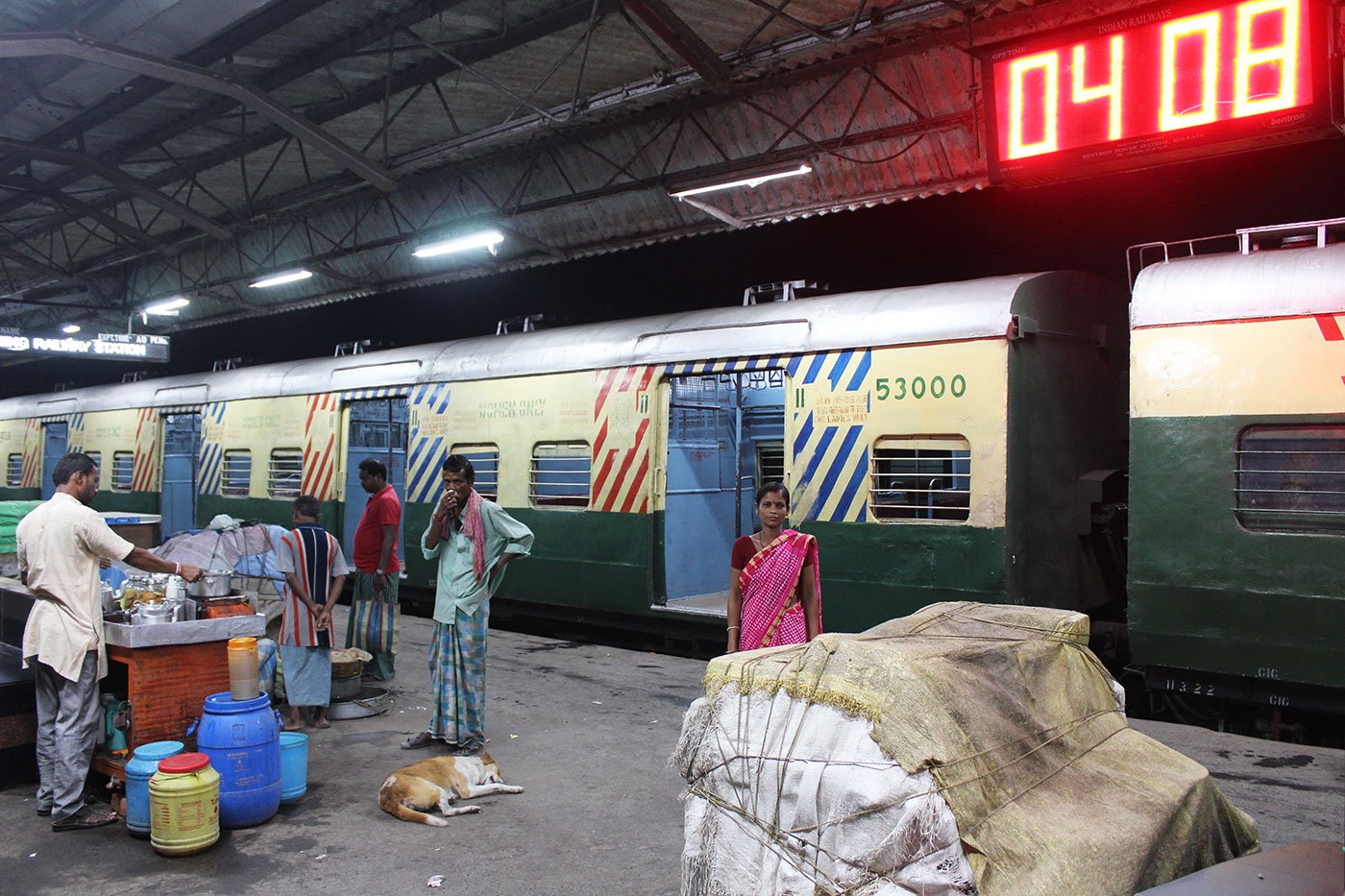
Photo: Siddharth AdelkarPhoto: Siddharth Adelkar. Breshpati Sardar takes the 4:30 a.m. train from Canning to Jadavpur in south Kolkata, and the 4:35 p.m. train back to her two-room tin home (left); her daughters Sanya and Tanya (right) and a son live with her parents and in-laws because the work schedules of Breshpati and her husband allow them almost no time at home
Breshpati’s daughters, Tanya, 11 and Sanya, 10, are waiting for her when we reach their two-room tin house around 6 p.m. She also has a six-year-old son, Biswajit. The children live with her parents and in-laws. The work schedules of Breshpati and her husband, Sanjib Sardar, leave them with little spare time. Sanijb works in a farsan-making unit and earns Rs. 9,000 a month.
That evening, their daughters are visiting. Breshpati instructs them to buy oil and vegetables, lights up the gobar gas furnace for cooking and fetches water from a nearby tubewell. Sanjib too will be home soon. After feeding the family and herself, and cleaning the utensils, Breshpati will sleep for a few hours and wake up at 3 a.m. to be able to reach Canning station in time for the 4:30 a.m. train to Jadavpur. “It is dark and sometimes cold. But I do not feel scared because many of us from my neighbourhood work at people’s homes in Kolkata and travel together. We call out to each other as we pass each other’s houses,” she says.
Breshpati’s day then covers work in six households. “My tasks include cooking, washing clothes and utensils, and cleaning. I get Rs. 8,500 a month in all. I usually get tea and food at my employers’ houses and 3-4 holidays a month. But not all employers are good. Once, an employer cut 20 days salary because I did not come to work for a few days. I stopped going there.”
Though Breshpati claims to be largely treated well by her employers, domestic workers usually labour in difficult conditions. A lack of decent wages, an absence of defined hours and benefit, abuse and sexual harassment are some of the issues they regularly face, says a 2016 memorandum submitted to the West Bengal government by the Griho Shramik Adhikar Abhiyan, a collective of organisations and unions of domestic workers.
‘If the women ask for more wages, they can lose their jobs, since others are willing to work at lesser rates. They are sometimes given stale food…’
Watch video: Riding the dawn train, doing the domestic work grind
The memorandum also lists victimisation by traffickers and placement agencies, forced migration, a lack of welfare measures and of skill development avenues. It notes that domestic workers are recognised under the Unorganised Workers’ Social Security Act (2008) and the Sexual Harassment of Women at Workplace (Prevention, Prohibition and Redressal) Act, 2013. But their working conditions were yet to be regulated by the West Bengal government.
The central government has formulated a draft national policy for domestic workers with recommendations on social security and minimum wages. But its implementation has been left to the states.
In June 2018, a domestic workers’ organisation, Paschim Banga Griha Paricharika Samity was granted trade union status for the first time in West Bengal. Soon after, the organisation presented its demands to the state government, including Rs. 54 as the hourly wage, maternal leave, four days paid leave each month and the right to use the toilet at the workplace.
“If the women ask for more wages, they can lose their jobs, since others are willing to work at lesser rates,” says Mallika Das, who works with Parichiti, a Kolkata-based non-governmental organisation that works with domestic workers. “There is no creche at the workplace, so they are forced to leave their children with others. They are sometimes given stale food to eat. Some employers do not even allow them use their toilets. The toilets in the railway station are mostly locked, broken or in such a bad condition that the women have to hold themselves until they reach home in the evening.”
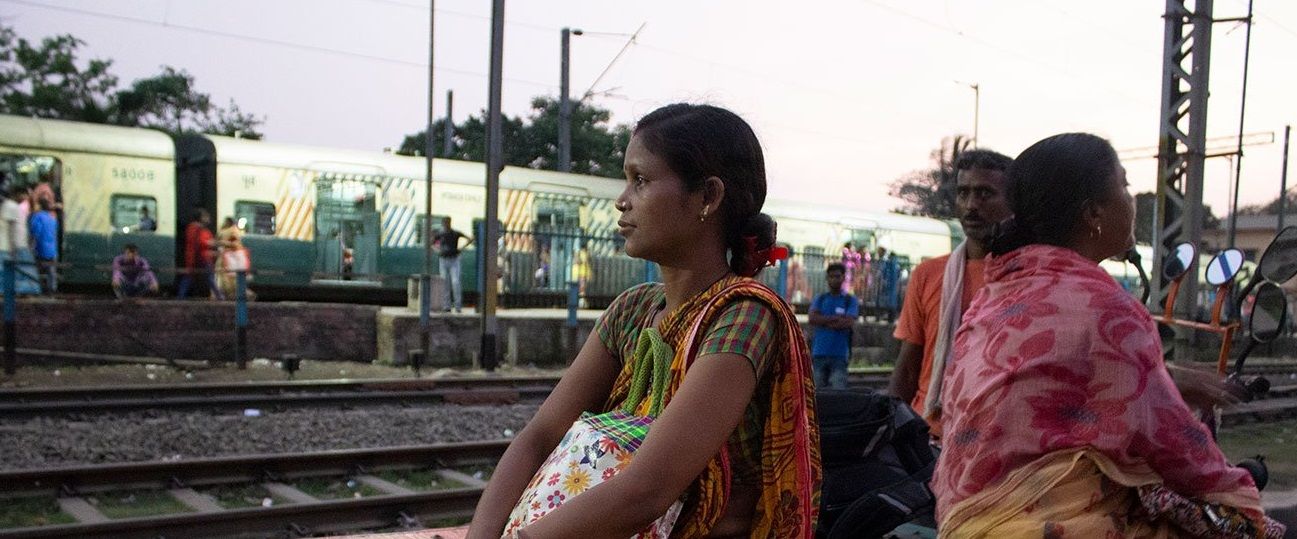
Photo: Siddharth AdelkarPhoto: Siddharth Adelkar. Breshpati Sardar at the Canning railway station in the morning, and on the train heading to work before daylight
Breshpati’s employers permit her to use their toilets. “I knead their chapatis and cut and chop vegetables with my own hands. Why should they object?” Her biggest discomfort is having to stand all day in the houses she works at and in the train while returning. “My legs and back constantly ache,” she admits.
The night passes and Canning station begins to stir around 4 a.m. We see Breshpati on the platform, a cup of tea and biscuits in hand. At that early hour, she appears fresh with her hair tied in a bun, the bindi in place and her face shining. Other women arrive, all going to work, including her friend Basanti Sardar, who works at Jadavpur too. “Come rain or shine, we maids must go and work, else our employers will be angry. They can’t do without us!” says Basanti. The women laugh.
Photo: Siddharth Adelkar. After alighting at Jadavpur (above) and other stations, the women walk off to work
“Our lives are tough and we are poor. But these are the moments of laughter that we live for,” says Breshpati. At that early hour, the train is empty, but it will rapidly fill as it heads into Kolkata. Breshpati and Basanti sit in the general compartment instead of the ladies compartment. “In the general compartment, men sometimes offer their seats and will not scream at us. When possible, we board this compartment,” Basanti says.
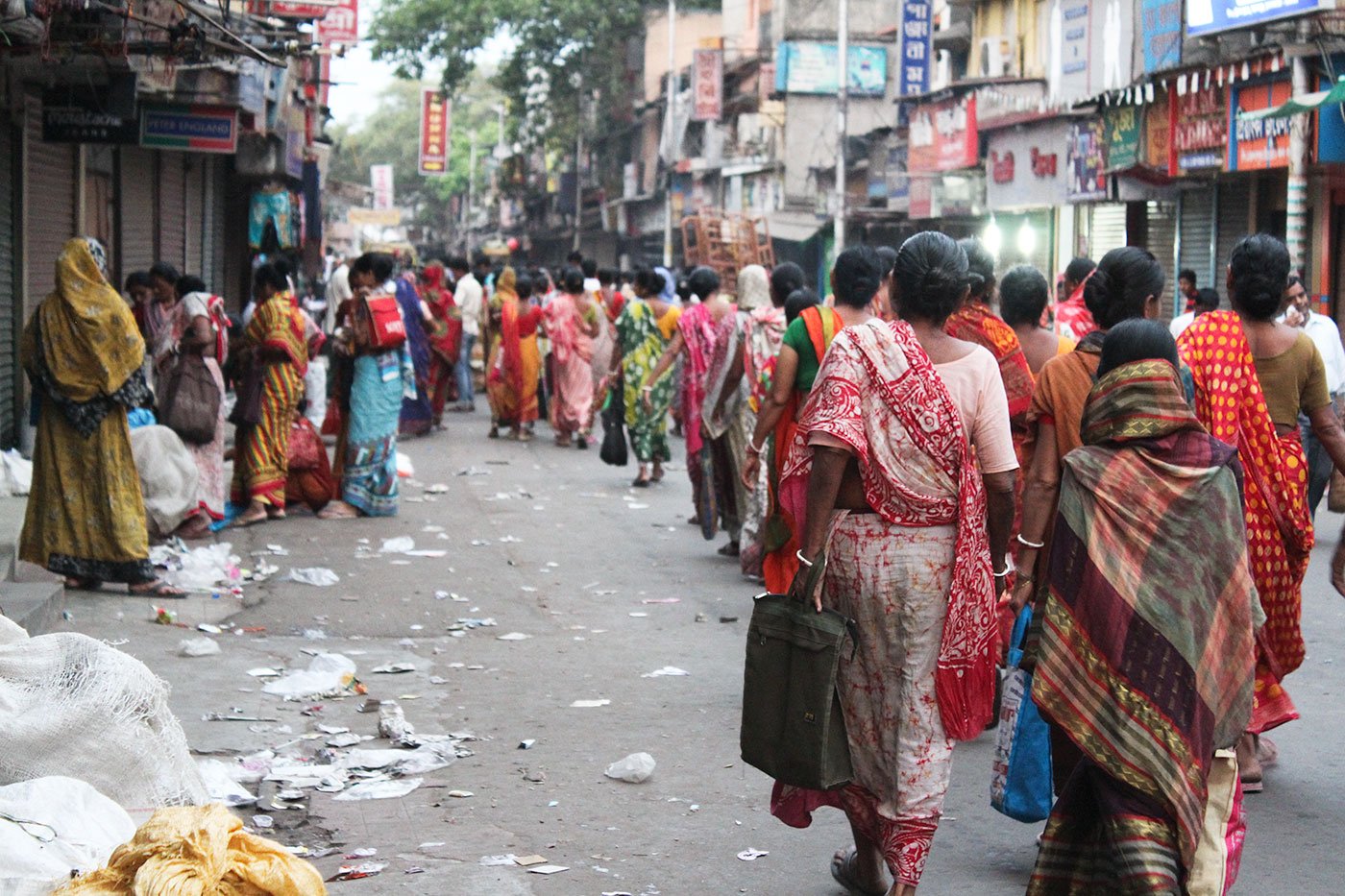
The train leaves at 4:30 a.m. and reached Jadavpur after roughly 75 minutes. Breshpati hurries away, walking, to her workplace, amid the crowds of other domestic workers making their way outside the station.
Many workers also travel from Lakshmikantapur town in South 24 Parganas district, to Sealdah. The train journey of over 60 kilometres takes around 85 minutes. Chameli Baidya boards from Mathurapur Road station, the third stop on the line. She works at six households in the Ballygunge neighbourhood in south Kolkata. Ten years ago, she had a different life.
“My husband and I owned a paan-beedi shop,” she recalls. “Things were fine for some time, then my husband stopped working and began wasting money. We had to close the shop and I started working at people’s houses. When I ran the shop, I was independent. Now, working at people’s places, I get scolded if I am late or if I miss even a day’s work.” Chameli is now unable to even pay her house rent, and she and her husband, along with their three daughters and a son, live in a shanty near the Mathurapur railway line.
Chameli says the train journey is more difficult than working in houses. “I suffer each morning during the journey. Everyone pushes and screams. Sometimes, people even start hitting each other. There is no place to sit. If I had a handful of rice to put in my children’s mouths, I would not make this journey. I would stay at home.”
Published in People’s Archive of Rural India. 20 July, 2018
“I remember the storm arriving and heavy rain pounding away at my house. Then the house crumbled before my eyes and the [Muri Ganga] river washed it away,” says Purnima Bhuyan. She is recalling one of the many times her home in Khasimara was destroyed.
Now more than 70 years old, Bhuyan no longer lives in Khasimara village on the tiny Ghoramara island in Sagar block of South 24 Parganas district. In 1993, hers was one of the 13 families from Ghoramara granted a small piece of land by the West Bengal government in Gangasagar village on Sagar island, a 45-minute boat ride away.
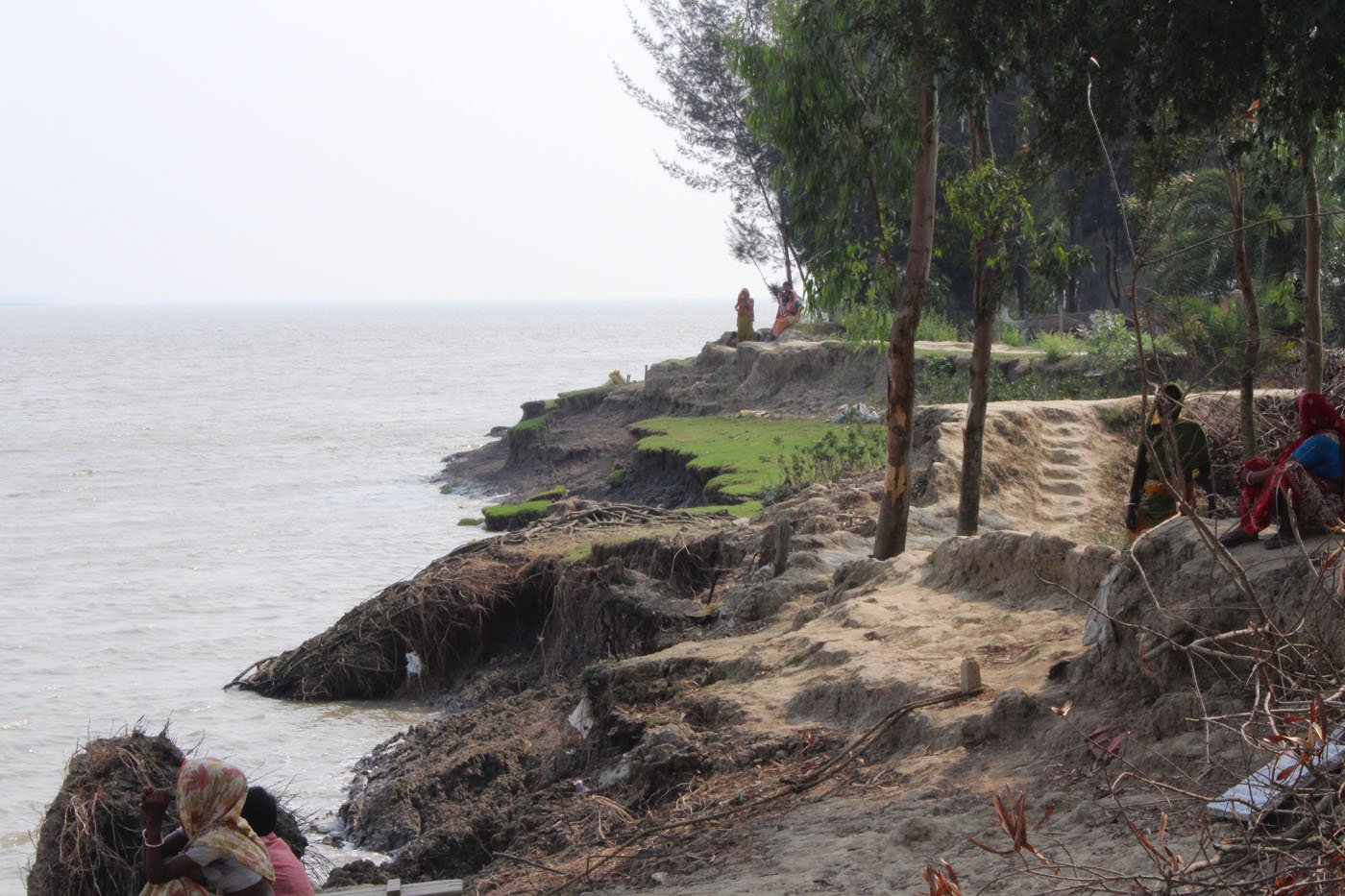
Since the mid-1970s, Ghoramara’s land mass has shrunk by nearly half – from 8.51 square kilometres in 1975 to 4.43 square kilometres in 2012, says a 2014 paper in the journal International Perspectives on Climate Change. The causes for this are many – river and coastal erosion in the Sundarbans region where the island is located, flooding, cyclones, the loss of mangroves, the rise in sea levels. While the total number of people on Ghoramara displaced by these processes is unclear, some islanders believe that, in various batches, around 4,000 have been forced to move to Sagar or to mainland areas like Kakdwip and Namkhana.
Bhuyan clearly remembers that day when her house collapsed, though she cannot recall which year it was. “I was washing vessels in my neighbour’s pond from where I could see my home. My husband was sick with typhoid. My neighbour, whose house was bigger than ours, asked me to bring him and our children there,” she says. “It had started raining, high tide had set in and the river had reached the land on which our house was built. Our house withstood the rains for a long time, but then a storm came in from the east bringing even more rain. Soon, the house [broke down and] vanished. I’ve lost my house to the river 10-12 times.”
Photo: Siddharth AdelkarPhoto: Siddharth Adelkar. Purnima Bhuyan (left) shifted to Sagar island in 1993 after her home was destroyed 10-12 times, and Montu Mondal (right) moved after losing his house twice
During the years that Purnima’s home was repeatedly washed away by the river (she cannot recall in which decades), she says she received no help from the government. It was only in 1993 that small plots of land – barely an acre – on Sagar island were allotted to families whose houses on Ghoramara had been destroyed.
Given a choice Bhuyan would still live on Ghoramara. “Let me tell you why I love it. The people were more helpful. If a family lost its house, another would immediately offer its land for building a new one. That does not happen here,” she says with a sigh. Sadly, Khasimara village was completely submerged and Census 2011 recorded its population as zero. People still live in some of the other six villages on the island though – around 5,000 (Census 2011) across the Ghoramara gram panchayat area (and in the course of later years, this population has declined too).
Montu Mondol, who arrived in Gangasagar in 1993 along with other families from Ghoramara, has not forgotten the hardships of the early years on Sagar island. The land allotted to him by the government could not initially be cultivated because of high levels of soil salinity. Besides, fresh water for drinking and bathing was also scarce. To earn a livelihood, Mondal, now 65, did daily-wage work like digging and selling dried fish. On his 1.5 bighas (around half an acre) of land, he built a house and, over time, was able to cultivate rice too.
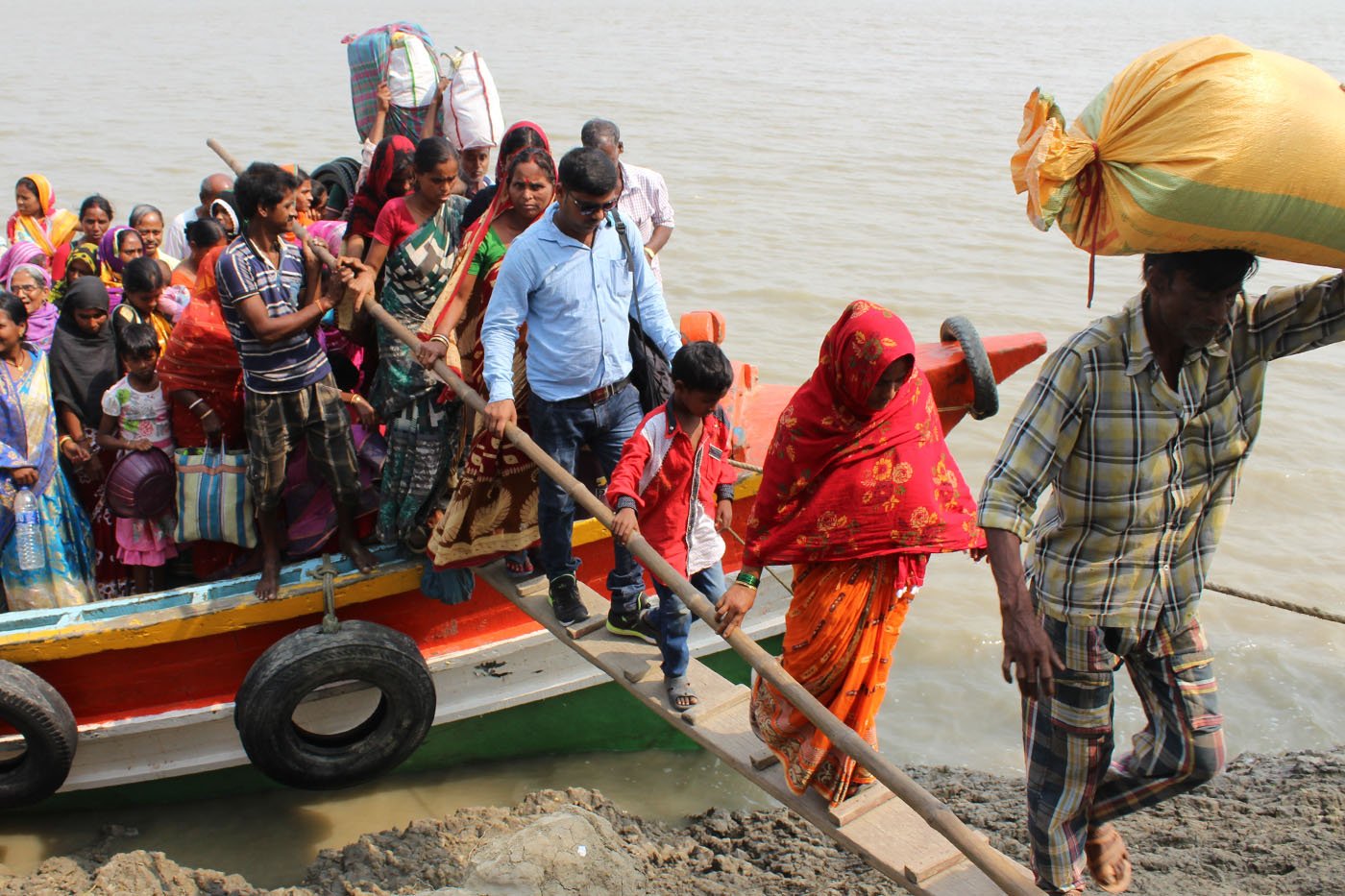
Photo: Siddharth AdelkarPhoto: Siddharth Adelkar. A precariously balanced wooden plank acts as a bridge between boats and Ghoramara island, where the embankments have been eroded by the Muri Gangariver
When he lived on Ghoramara, the river had destroyed Mondal’s house twice. “Till about 10-15 years ago, it would take 2-3 hours to walk from the north of Ghoramara to the south. Now it will take you under an hour to cover that distance,” he says.
Prof. Sugata Hazra at the School of Oceanographic Studies, Jadavpur University, Kolkata, says that the displaced villagers of Ghoramara are not recognised as ‘climate refugees’ by the government because they were forced to migrate within the country. “But they should be recognised as environmental migrants, a category which the government should create, and ensure dignity and justice for these helpless people,” he adds.
Watch video: ‘Ghoramara was a land of happiness and gold’
According to an activist on Sagar island (who did not want to be named), from the 1970s to the 1990s, when people moved from Ghoramara to Sagar island, there were tensions between the migrants and the locals. He says, “The locals were unhappy that the areas for fishing were given away to people from Ghoramara. The number of people who needed fresh water also increased. The tensions reduced as time passed.”
Mondal and Bhuyan miss the kindness of people on Ghoramara island, but they haven’t made the trip back, even though it’s only a short boat ride away. Meanwhile, those who remain on Ghoramara have it tough. Sheikh Diljaan stands next to his cycle rickshaw near the landing point on Ghoramora, waiting to ferry people home. The island doesn’t have a jetty or a landing area at present – the river has taken it away. A precariously balanced wooden plank acts as a bridge between the boat and the island. Large parts of the embankment have eroded too, making the land difficult to walk on.
Watch video: The vanishing land beneath their feet
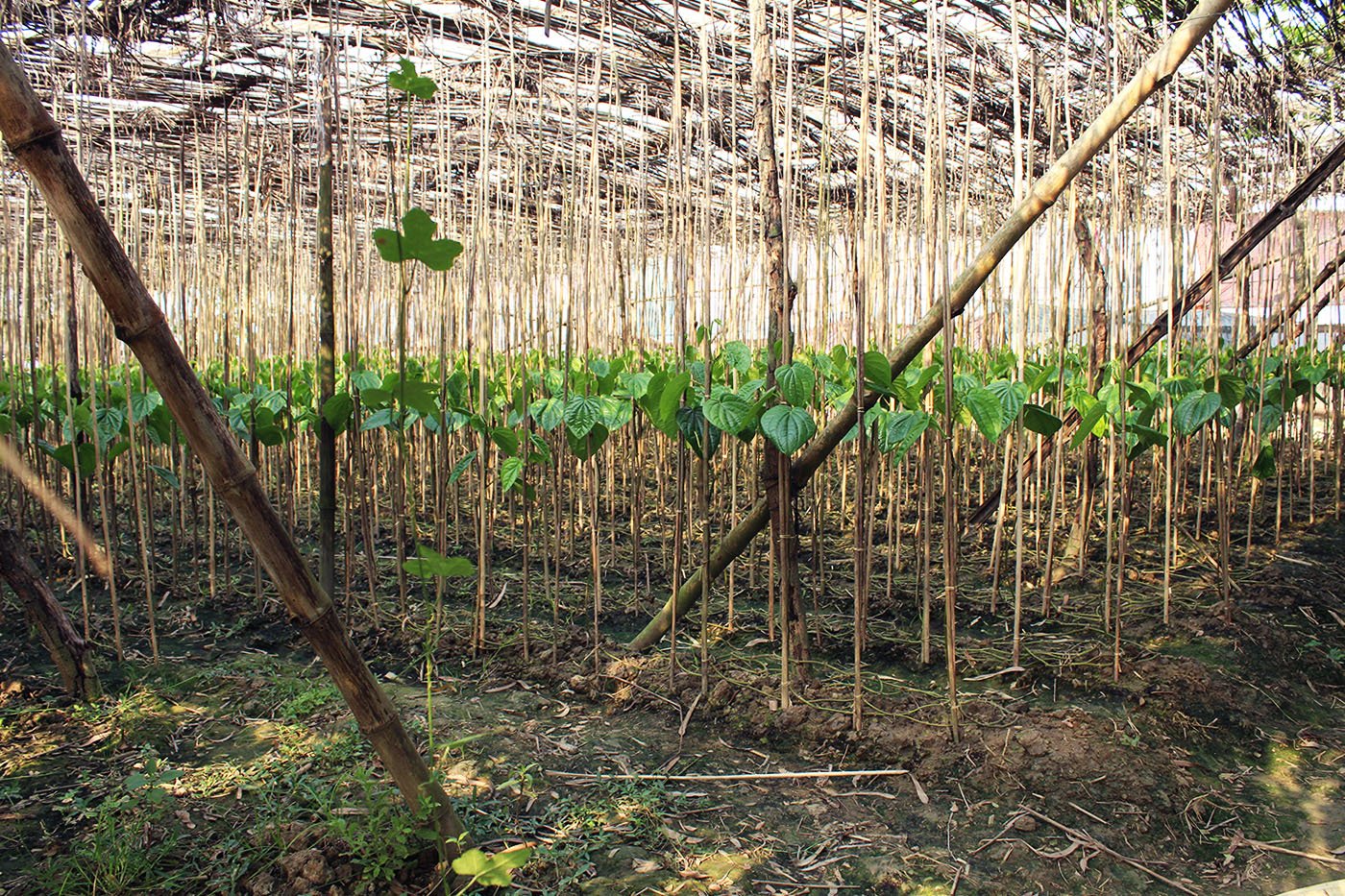
A few trips earn Diljaan Rs. 200-300 per day. To increase his income, he tried to grow paan leaves four years ago, but failed. “The plantation was washed away in less than a year. I did not expect the river to come so close to the land so quickly,” he says.
Ghoramara’s saline soil and water limit agricultural options, and many on the island have turned to cultivating cash crops like paan. The sandy silt soil, though susceptible to salinity, is suitable for growing paan. Islanders are known to pray to goddess Bindubashini for the health of their plantations. But even that could not save Diljaan’s paan leaves.
Besides limited livelihood options, the residents of Ghoramara also have to travel to Kakdwip city (a half-hour journey) for daily necessities like vegetables and food grains. One health sub-centre in Ghoramara caters to the basic health needs of the approximately 5,000 people on the island. For serious illnesses however, residents have to travel to the hospital in Kakdwip.
Photo: Siddharth AdelkarPhoto: Siddharth Adelkar. Due to a lack of work options, Sheikh Diljaan cultivated paan leaves on Ghoramara, but his plantation lost out to the water in less than a year
“I would be happy to leave this shrinking island with my wife and two sons,” says Diljaan. “But the government is not giving us land elsewhere.” After 1993, the government stopped resettling people on Sagar island reportedly because of a shortage of available land.
The lack of work on Sagar island is increasingly forcing the men in many families to migrate outside West Bengal in search of work. There is another worry – Sagar island is also shrinking and eroding every year, and its residents are fearful of losing their lands and homes yet again.
As we’re talking to Diljaan, who takes us on his rickshaw to a spot on the island where the river has swallowed up large chunks of land, Ranjita Purkait joins the conversation. Her house, which was washed away once, is a few metres from the river bank. “I might lose this house too. What has the government done? Nothing,” she says. “At least they could have strengthened the embankments! So many journalists come and take pictures and disappear. But our situation never changes. Will the government give us land elsewhere? This island is shrinking and our houses and lands are vanishing. Nobody cares.”