Tag: Sundarbans

  • From river to plate: the journey of the Sundarbans tiger prawn

    Published in People’s Archive of Rural India. 11 January 2017

    Purnima Mistry walks out of the Raimangal river with her fishing net, water swirling around her waist. She has been swimming near the riverbank for half-an-hour, dragging the net behind her in search of tiger prawn seedlings.

    On the riverbank, she sorts the contents of the net, separating the seedlings from weeds, twigs and other fish. Her saree and plait are beginning to dry under the hot sun. But Purnima has to get back to the river again. “I have to collect enough tiger prawn seedlings so that I can sell them. It will take another 2-3 hours,” she says.

    Squatting on the muddy bank to sort the catch, Purnima talks about the long hours she spends in saline waters and mud, which cause skin infections and itches.  “Look how difficult our jobs are,” she says. “This is how the people of Sundarbans live and eat.”

    Purnima started doing this work two years ago to support her family, which includes two daughters and a son. Her husband is afraid of water and cannot go fishing, which is the most common occupation here. So he grows vegetables for sale at home.

    Watch video: Purnima Mistry trawls through the Raimangal river to catch enough seedlings to sell

    Is she afraid of encountering crocodiles and tigers – both common in some parts of the Sundarbans?  “Sometimes, I am scared of crocodiles; they have attacked people in this village,” Purnima says. “The tigers do not come to here because a security net near the forest keeps them away.”

    Purnima lives in Jogesganj, a village of 7,000-plus people and houses scattered along the banks of the Raimangal river in Hingalganj block of West Bengal. Many of the women and children in Jogesganj, like in the rest of the Sundarbans, work as seedling collectors. This supplements their household incomes from the sale of fish and crabs, and of forest products such as honey and wood.

    State government data [from 2009] shows that poverty drives more than 2 lakh people – of the 44 lakhs who live in the Sundarbans – to collect tiger prawn seedlings.

    Shoma Mondal of Hemnagar village says this work is mostly done by women. “Men go after bigger catch like crabs, which fetch better returns [and for which they hire boats in groups]. Gathering seedlings becomes the women’s task, and in very poor houses, even children [do this work]. The returns are poor but there are no other options. At least one woman from every household in the village does this work.  We cannot do much agriculture, because for much of the year the soil and water are saline, except in the monsoons, when we cultivate rice.”
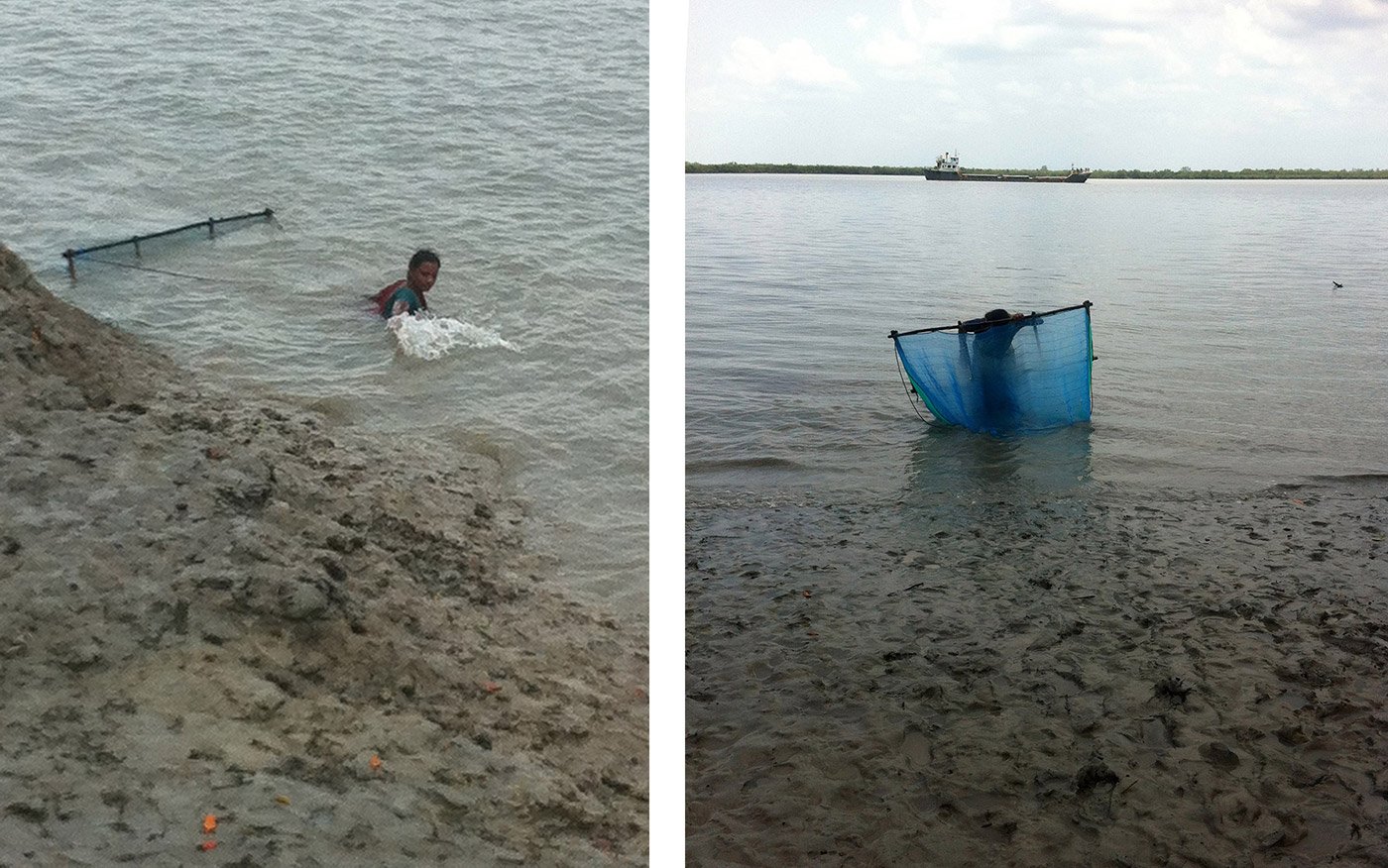
    Left: The people who collect tiger prawn seedlings spend close to five hours in the water to get a sufficient catch. Right: A woman drags her net into the river at low tide, which is the best time to gather the seedlings
    Left: The people who collect tiger prawn seedlings spend close to five hours in the water to get a sufficient catch. Right: A woman drags her net into the river at low tide, which is the best time to gather the seedlings

    Shoma goes to the river almost every day at low tide in search of seedlings. Low tides are the best for a good catch – but they occur at different times. So Shoma sometimes goes to the river at midnight or at 4 a.m. “When it is pitch dark, we are unable to see if there are crocodiles or other wild animals nearby. In the daylight, at least we can see them and move away.”

    The earnings of seedling collectors like Purnima and Shoma vary according to the season. “During winter, which is peak season, we get Rs. 300 per 1,000 seedlings,” she says. “At other times, the prices can drop to Rs. 100 and even sink as low as Rs. 60.”

    On good days, the catch reaches 2,000 seedlings, but this is only a few times a year. Most other times, Shoma only manages to net 200-500 seedlings. “It’s enough money to go to the market [in Hemnagar] and buy essentials [like rice and pulses], but nothing more,” she says.
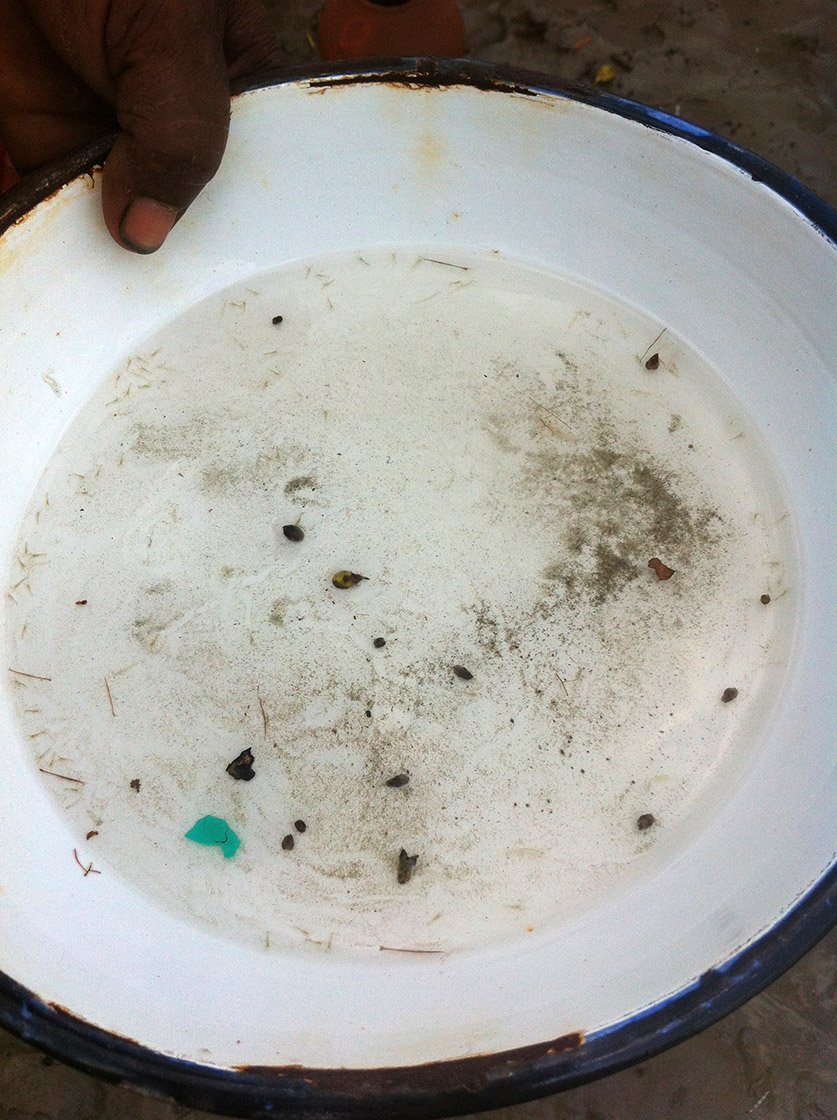
    Tiger prawn seedlings are tiny, almost like strands of hair. Their price is fixed per 1,000 seedlings
    After cultivation in brackish water enclosures in South 24 Parganas district, the seedlings grow in size

    During the winter months, from December to February, Shoma goes to Erode district in Tamil Nadu to work in a garments factory, where she stitches curtains and pillow covers. Although winter can bring the highest rates for the seedlings, many women try to not work in the biting cold river waters. Shoma’s husband Soumen Mondol works full-time in the same factory in Erode. She earns between Rs. 200-500 daily, he earns a little more.  Their five-year-old daughter stays back in the village with her grandmother.

    The methods of collecting prawn seedlings have been criticised by environmentalists as well as the state’s Forest Department. The nets trap many other fish species besides the seedlings. But the women usually discard the other fish, which can deplete those species.  The dragging of nets causes soil erosion and weakens embankments meant to prevent rivers from overflowing.

    Purnima however does not throw away the other fish. She has a pond near her home, where she harvests these species. “Those who do not have ponds have to throw away the remaining fish,” she explains, as she continues to sort the seedlings on the Raimangal riverbank.

    Although the tiger prawn trade rests on the labour of the women in these villages, they are paid the least along the chain. After the seedlings are collected, men take over the profitable part of the trade.

    Typically, middlemen visit the villages to purchase the seedlings from the women and sell it for cultivation in bheries. These are large artificial enclosures for brackish water aquaculture in Canning, Jibantala, Sarberia and other locations in the South 24 Parganas district. Here, the seedlings are cultivated for at least three months during which they grow in size.  Then they are sold in the wholesale markets of Canning, Barasat and Dhamakhali , and sent onward for export – often by men on motorbikes who carry the seedlings in plastic bags full of water.
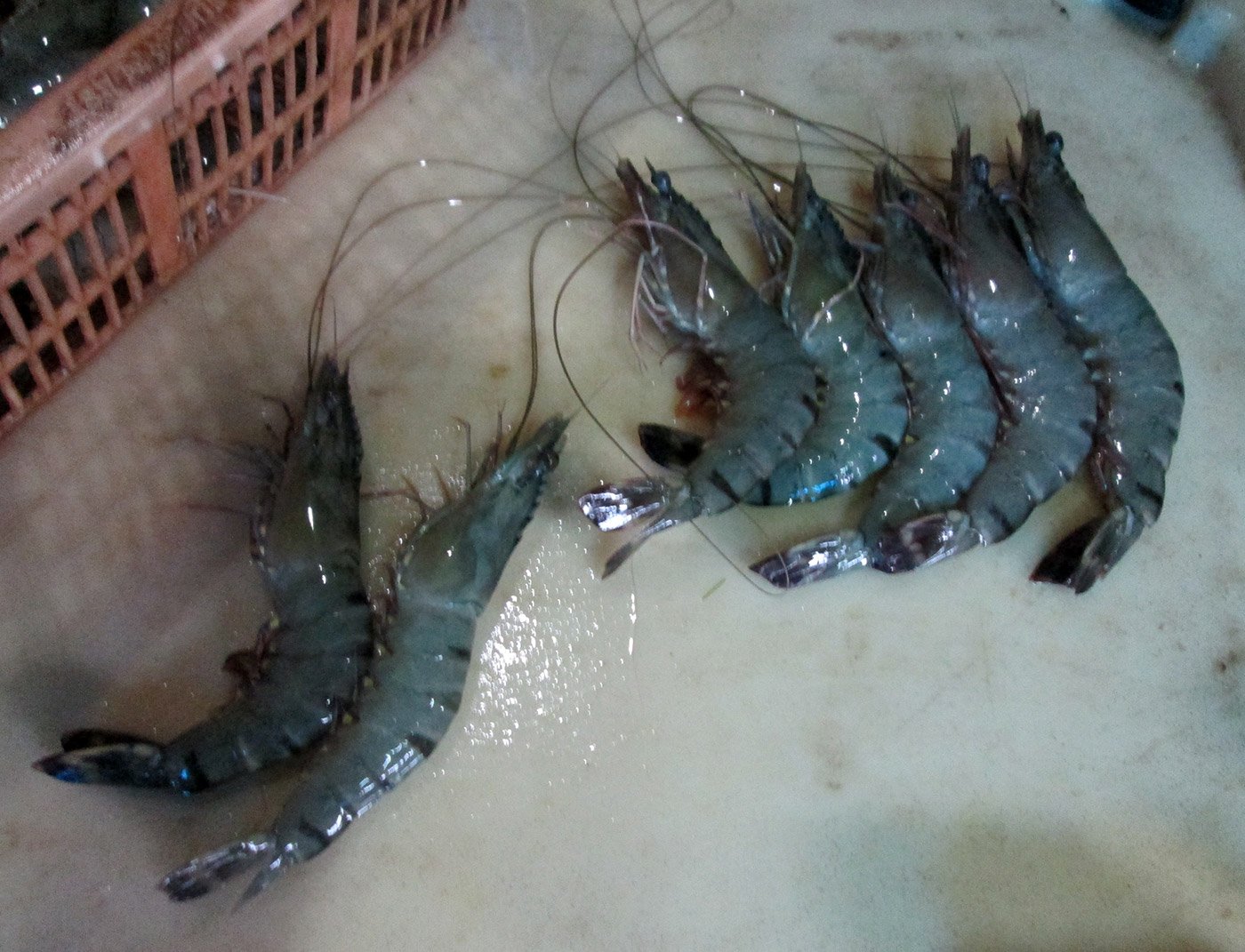
    After cultivation in brackish water enclosures in South 24 Parganas district, the seedlings grow in size
    After cultivation in brackish water enclosures in South 24 Parganas district, the seedlings grow in size

    Full-grown tiger prawns fetch attractive prices in the wholesale markets. Tarun Mondal, a wholesaler in the Canning fish market, says his main income comes from tiger prawns.  “It is good business. We buy them at a rate of Rs. 380-880 per kilo from the bheries, and we sell them for Rs. 400-900 [per kilo, depending on size]. Our profit margin is Rs. 10- 20 [per kilo]. Most of our supply is from the Sunderbans, from blocks such as Basanti and Gosaba. We sell them to agents who work for bigger companies that ultimately export them.”

    India’s seafood exports were valued at $4.68 billion in 2015-16 ; shrimps constitute almost 70 per cent of these exports and are mostly exported to Japan, China and the United States. Tiger prawns, also known as black tiger shrimps, are an important part of shrimp exports. West Bengal is one of India’s largest shrimp producers and exporters of seafood.

    Seedling collectors like Shoma and Purnima though see only a fraction of this money. The women are unable to demand higher prices because the agents determine their rates and control the trade. “In addition to the price of seedlings, the middleman gives us an annual deposit [of Rs. 200-500 per person], which we don’t have to return, ” Shoma says. “The deposit forces us to sell only to him, and nobody else. We women are unable to gather in large numbers and bargain.” But it is the labour of workers like Shoma and Purnima that sustains the wholesale and export markets in tiger prawns, and brings these expensive delicacies to upscale plates in India and around the world.

    Photos: Urvashi Sarkar

    Read the original article: https://ruralindiaonline.org/articles/from-river-to-plate-the-journey-of-the-sundarbans-tiger-prawn/
  • The sting of bees and the tyranny of tigers

    Published in People’s Archive of Rural India. 23 September 2016

    “I grabbed the kamot with my arms. You can see its teeth marks even now.” Nitai Joddar, a mouley (honey collector), remembers exactly when a kamot (crocodile) bit him, from hip to leg. It was on March 23 in 1980, and he had gone to the Raimangal river to catch fish.

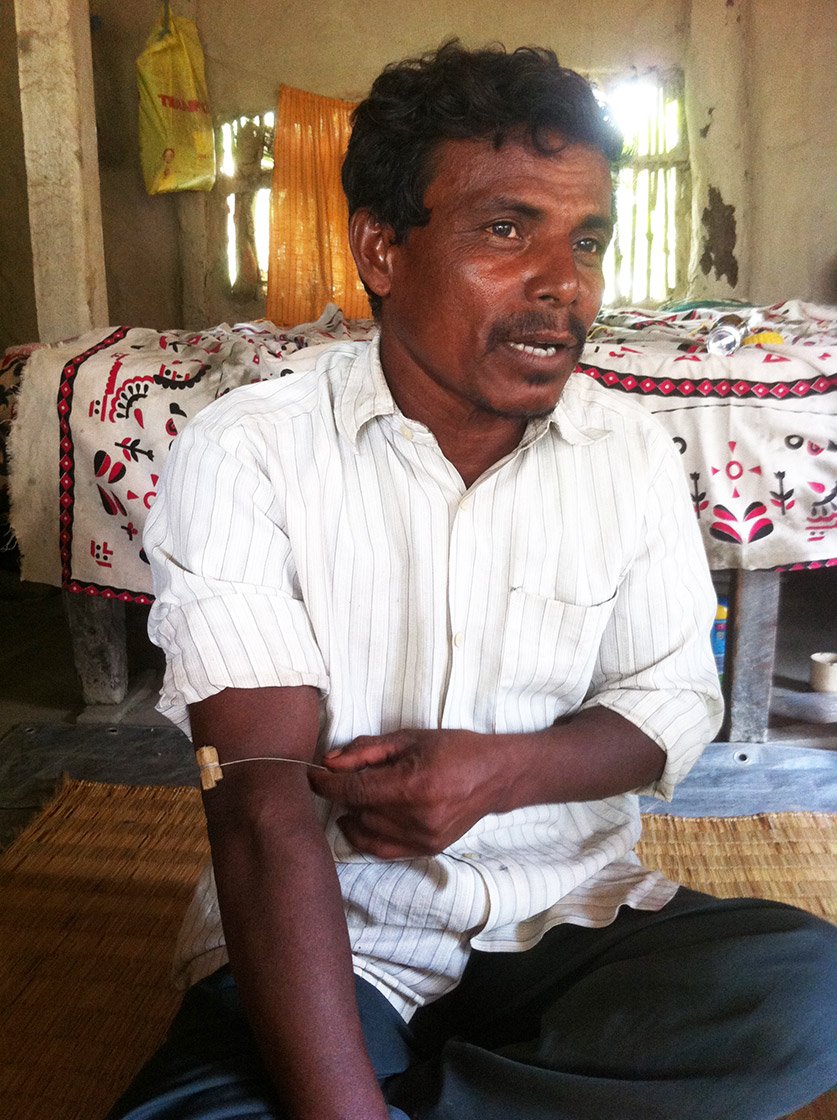
    Nitai, of Hemnagar village in the North 24 Parganas district of West Bengal, is 41 now. His father, a honey collector, started taking him along on his work trips to the jungle when he was 10. After the kamot incident, Nitai began wearing an amulet as a safeguard. Encounters with crocodiles are common on the riverbanks of many parts of the Sundarbans. People, especially fish workers, have been injured or have even been killed.

    Nitai Joddar wore this armlet after being bitten by a crocodile, and has placed his complete trust in it to protect him in the jungles of the Sundarbans

    Collecting honey for sale is a common occupation in the Sundarbans – and it can be very hazardous. For Nitai and others, just as real as the possibility of being attacked by a crocodile, is the threat of tigers while fishing or collecting honey from the dense jungles. According to the website of the Department of Sundarbans Affairs, “…men in the Sundarbans are attacked by wild animals – sharks, crocodiles, or tigers… especially when fishermen or honey collectors enter the dense mangrove forests…” Women, of course, are equally at risk of such attacks, though usually the community does not allow them to go on the extended honey gathering trips.

    Honey is collected in the Sundarbans mainly from April to June. During these months, the state government bans the catching of fish, so that the fish can replenish themselves. This is when many fishermen become honey collectors and make two trips to the jungle, each lasting 15 days or longer. West Bengal is a major honey-producing state and exports a large part of its production.

    Collecting honey requires advance preparations. The honey gatherers inform the Forest Department, rent a boat whose owner has a BLC (boat licence certificate) and borrow from the money lender or mahajan . Nitai’s son Sanjit Joddar, 23, explains: “If five or six people go together to collect honey, we take a combined loan of Rs. 10,000-15,000. The interest is 2-3 per cent, which we repay along with principle in 30-45 days. The loan is taken once a year.”

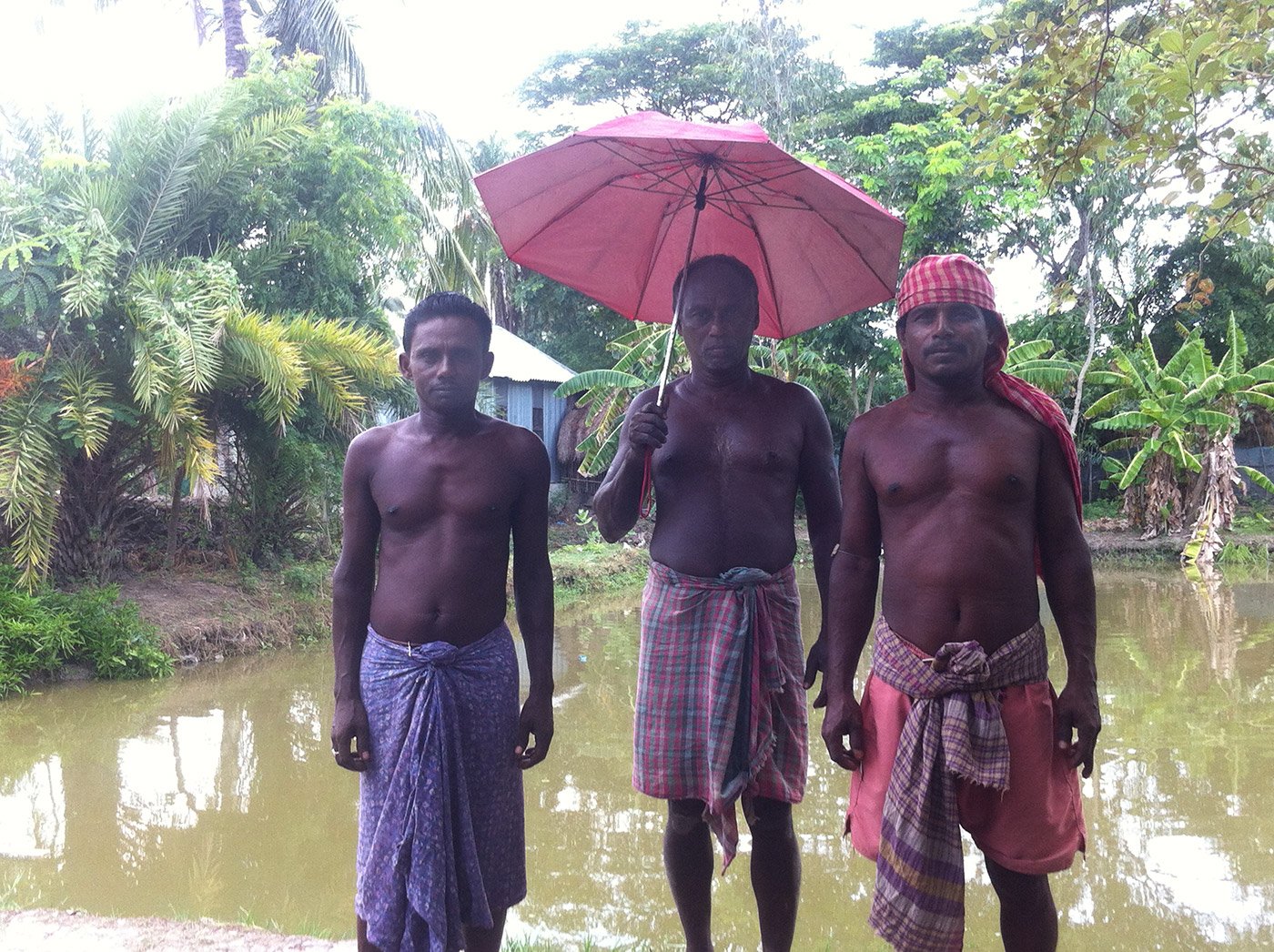
    Mouleys of the Sundarbans’ (right to left): Nitai Joddar, Binay Mondal and Haripada Joddar

    The loan is required to buy provisions for the 15-day journey. Renting the boat costs Rs. 2,800-3,000 for the season [a little over 60 days between April to June] of honey collecting. The boat owner is also paid in kind – with a few kilos of honey. Another Rs. 120 is paid annually to the Forest Department as insurance in case of an accident in the jungle. After clearing all debts and payments, each mouley gets Rs. 15,000-25,000 [for the entire season].

    At times, the mouleys incur another expense: dacoits in the jungles steal from them or even kidnap them. Nitai recalls an instance when a few men were kidnapped last year and their families had to put together Rs. 2-3 lakhs for their release.

    “We set off on when the sky is clear and the river is at low tide,” Nitai says. “It takes several hours to reach our location, depending on the tide. We leave the boat and enter the jungle. One person stays behind to row the boat along the bank. When some honey is gathered, it is deposited in the boat. We eat and sleep in the boat itself.”

    The direction in which the bees fly guides the mouleys to the trees with hives. “We prepare bundles, layered with dry leaves and green hetal leaves, which are attached to sticks,” Nitai says. “We burn the bundles and the ensuing smoke curls up to the hives, driving away the bees. A sharp curved instrument is used to break the hive. We do not break the entire hive, since it needs to regrow.”

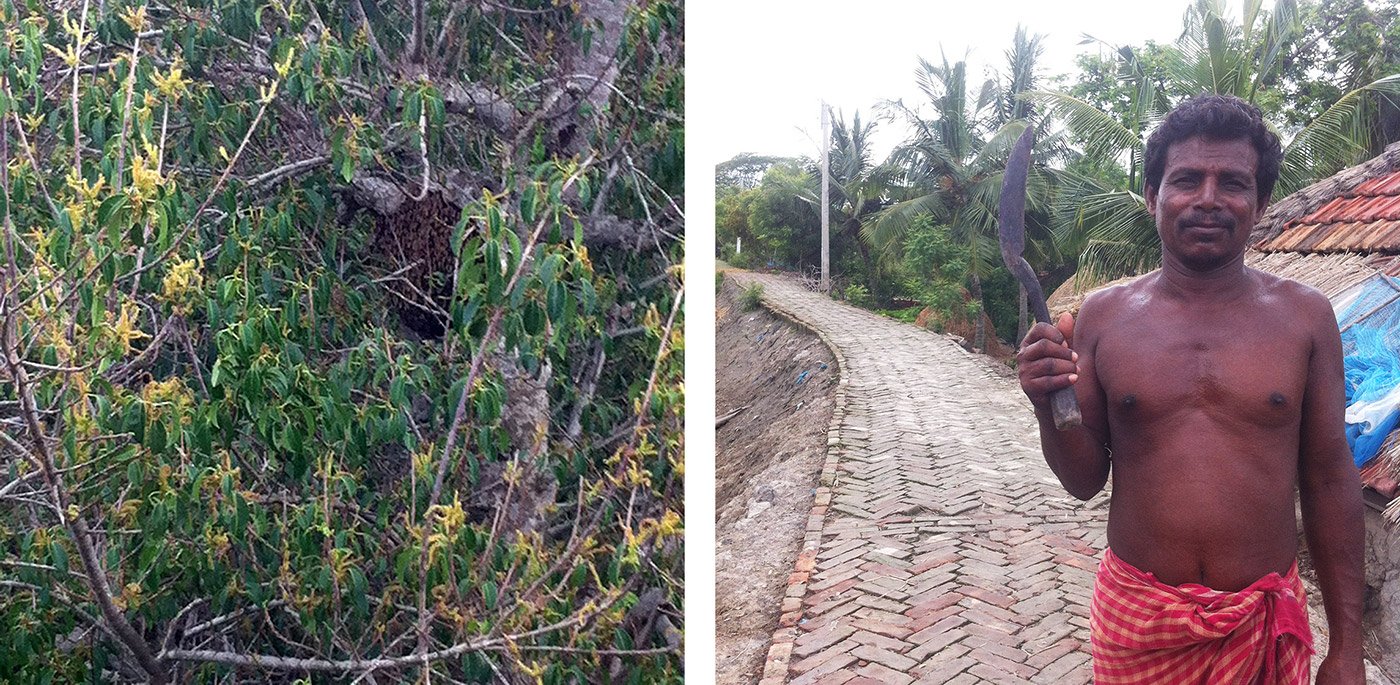
    A beehive on a tree in Hemnagar village / The sharp and curved instrument used to break the bee hives

    Sometimes the bees sense the threat and sting even before the smoke rises.  But Nitai and his co-workers have no use for ointments or protective clothing. “We only pluck out the sting with our fingers. Once a man was stung by 300-400 bees. He could not get up or eat for weeks!”

    Nitai expresses faith in two things: his amulet and Bonbibi, protector of the forests and people, a highly revered deity in the Sundarbans.  “There are different chants to the goddess according to the difficulty of the situation,” he says. We ask him to recite a chant; he breathlessly rattles off one in Bengali that the honey gatherers use when leaving home for the jungle.

    As often happens when in the Sundarbans, the conversation turns to tigers. And everyone has a story or two to tell. “Once a tiger confronted my friend and he froze with terror,” Nitai recalls. “I chanted some mantras to Bonbibi – but could not rescue him and the tiger killed him. I found the body and took it to his home. Many years ago, about 150-200 men surrounded a tiger in the jungle. Even then it carried away 1-2 people.”

    There was a time, he says, when the government rewarded villagers for killing tigers. “But now, one cannot touch them, because of laws.” Nitai, like others living in the Sundarbans, sometimes feels that the state protects the tiger more than the people. “We cannot even go to the forest in case we disturb the tiger’s sleep,” he jokes. But he knows that tigers are important and is a member of the local Forest Protection Committee, a part of the government’s forest management strategy. “If the tiger goes, Sundarbans goes. Nothing will stop people from entering and destroying the forests.”

    We go to Nitai’s small and cramped house, where he stores honey in aluminium containers and cans on the floor. “Depending on which trees and flowers  – kewra, goran, khols i – you extract it from and the season, the colour and taste varies. But your commercial honey looks and tastes exactly the same through the year.”

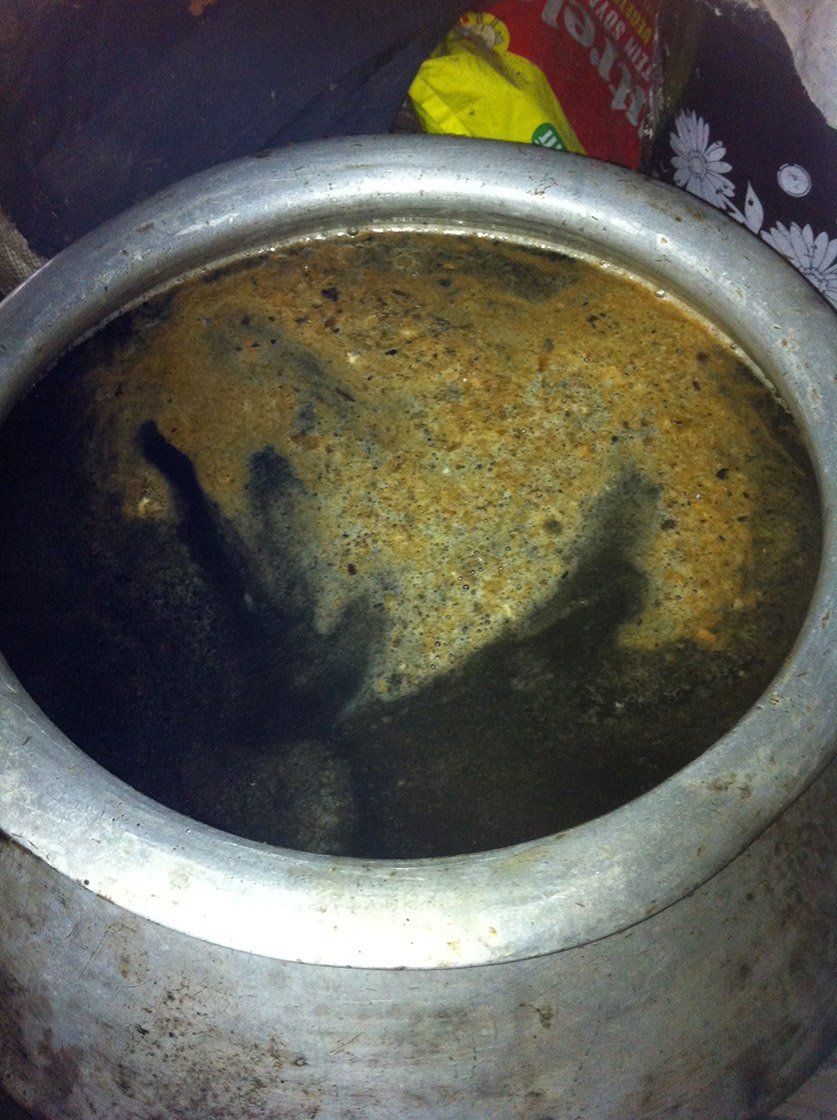
    The honey is stored in an aluminium container. Its colour and taste vary according to the trees, flowers and seasons, unlike commercial honey which tastes and looks the same throughout the year

    Usually, 6-7 individuals participate in a single 15-day trip and gather roughly 1-1.5 quintals of honey each. The mouleys are compelled to sell most of the collected honey to the Forest Department at a price fixed by the government. The price this year, Sanjit says, was Rs. 115 for a kilo – and in August 2016 the price at which the department sold the honey in the market was Rs. 300 a kilo.  The West Bengal Forest Development Cooperation Limited refines and markets it as the Mouban brand of honey.

    This year, instead of all the collected honey, the Forest Department specified a quota that the mouleys were required to deposit. “They did not buy honey from our family because the department met its quota early,” Sanjit says. He and his family plan to sell the surplus themselves. “We collected 80-90 kilos and have priced it at Rs. 200-250 per kilo for the neighbouring village areas. In Kolkata, we can get a higher rate.”

    In previous years, Sanjit says, “We could take home only five kilos. We had to deposit the rest with the Forest Department. They searched our boats for hidden honey. If caught selling in the market, our boats could be seized.”

    Although Sanjit, like his father, is a fisherman and honey collector, he migrates for 2-3 months every year to Bangalore and Chennai to work on construction sites where he earns Rs. 350-400 per day. “My father and his friends have worked only in the Sundarbans. They have fallen in love with the forest and say there cannot be peace without it. My generation goes to bidesh [outside] to work. How do we feed our family just by catching fish and collecting honey?”

    Sanjit had to drop out before completing his BA degree to help with his family’s earnings. He now has an 18-month-old son who he wants to educate. “My son should not go to the jungles. Too dangerous.”

    But Nitai believes that those who migrate are not happy, since there are more chances of getting cheated or murdered in the big cities. To him, the dangers of working in the Sundarbans seem preferable.

    Nitai Joddar, 41, started going to the jungles with his father, also a honey collector, three decades ago

    In 2015, a Trinamool Congress member of Parliament, Pratima Mandal, highlighted these dangers in the Lok Sabha when she spoke of the issues faced by the honey collectors of the Sundarbans. She asked the central government to take safety measures and allot funds.

    It may be too early to know if this has had an impact, but over the years a few measures have indeed been taken. Pradip Chatterjee, president of the Dakshinbanga Matsyajibi Forum (Fishworkers Forum of South Bengal), says, “There have been some improvements. Four years ago, the Forest Department would pay the mouleys only Rs. 42 per kilo of honey; now the rate is more than Rs. 100 for a kilo, and they are free to sell extra honey in the market. The department would earlier give only one pass of 15 days for honey collection, now they give two such passes.”

    However, he says, nothing has been done to protect the men at work. “There is no provision for their individual safety or safety as a group.” And so, men like Nitai continue working in the dense and dangerous jungles without any safeguards.

    Photos: Urvashi Sarkar

    Read the original article: https://ruralindiaonline.org/articles/the-sting-of-bees-and-the-tyranny-of-tigers/

  • In emergencies we are really stranded

    Published in People’s Archive of Rural India. 3 August 2016

    It was only after Fatima Bibi’s newborn died that she came to the community delivery centre for her fifth delivery. All her children – three girls and a boy – were born at home. “The boy died due to a lack of oxygen,” her mother Jamila says. “So we came to the hospital this time.”

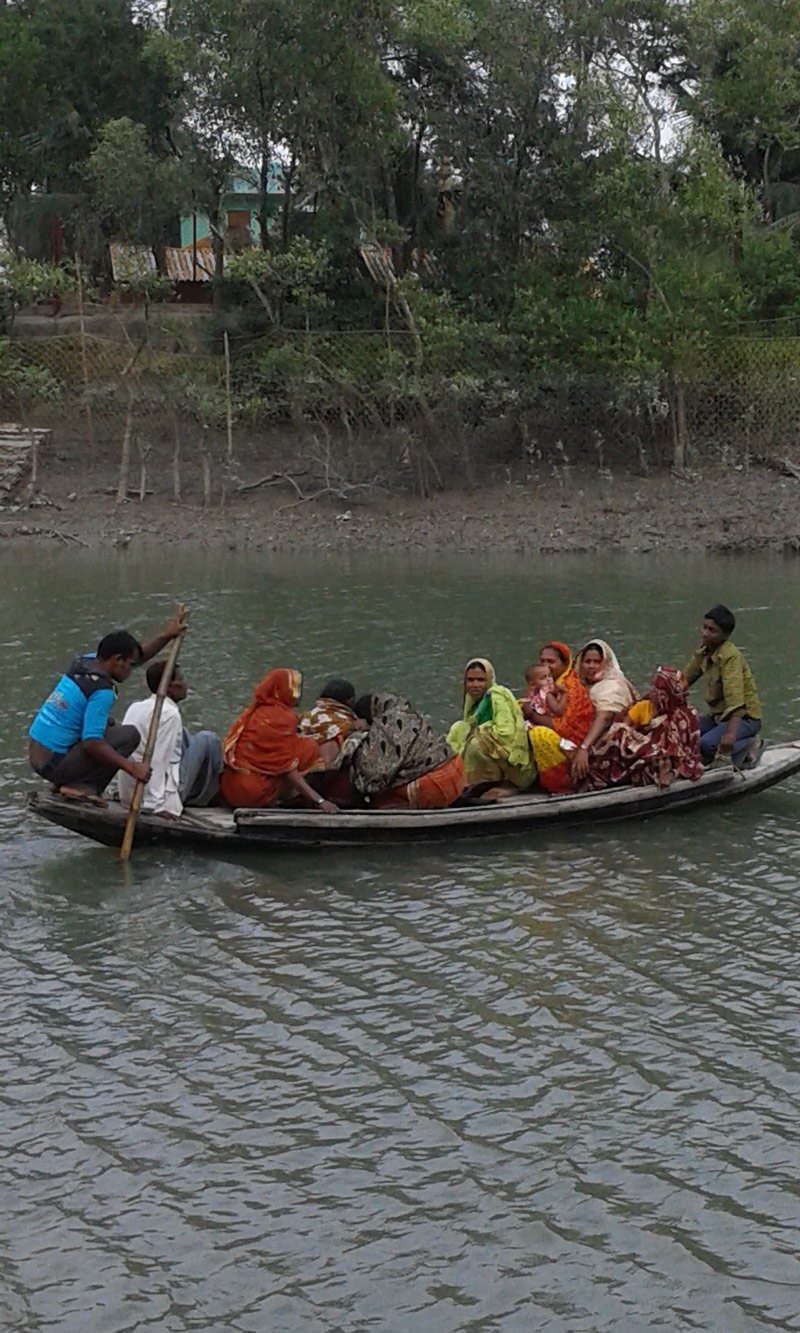
    The family hired a van for Rs. 700 for a mere 30-minute journey from their village Rampur to Bayermari village in North 24 Parganas district. “Poor women in our village take the boat to travel to the hospital,” Fatima says. “In high tide it’s very risky. Last year, a heavily loaded boat capsized near Kathkhali during high tide. Some people even died.”

    Fatima’s struggle speaks of the difficulties pregnant women in the Sundarbans frequently face. And this is true for all health concerns – getting medical help is an uphill journey for most people living on these islands.

    The Sundarbans is covered by only a bare patchwork of medical sub-centres – the first contact point for the community with the government’s primary health care system. Each sub-centre is meant to cover 5,000 people. In Paschim Sripatinagar and Purba Sripatinagar villages in South 24 Parganas district, the total population is around 9500 (according to Census 2011). This number will have since grown – so more than 10,000 people are entirely dependent on two ill-equipped sub-centres and a few self-proclaimed local ‘doctors’ for their health care needs.

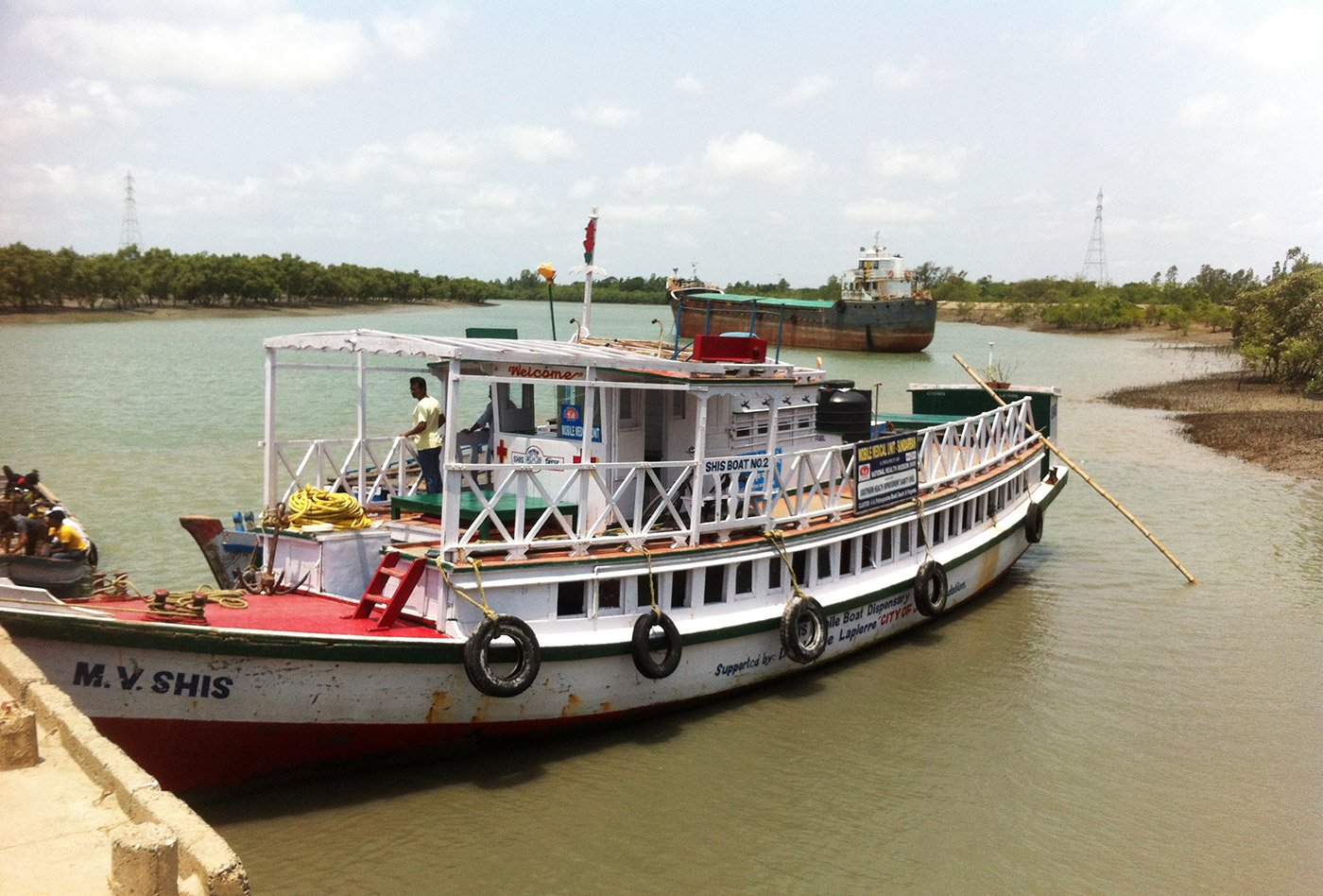
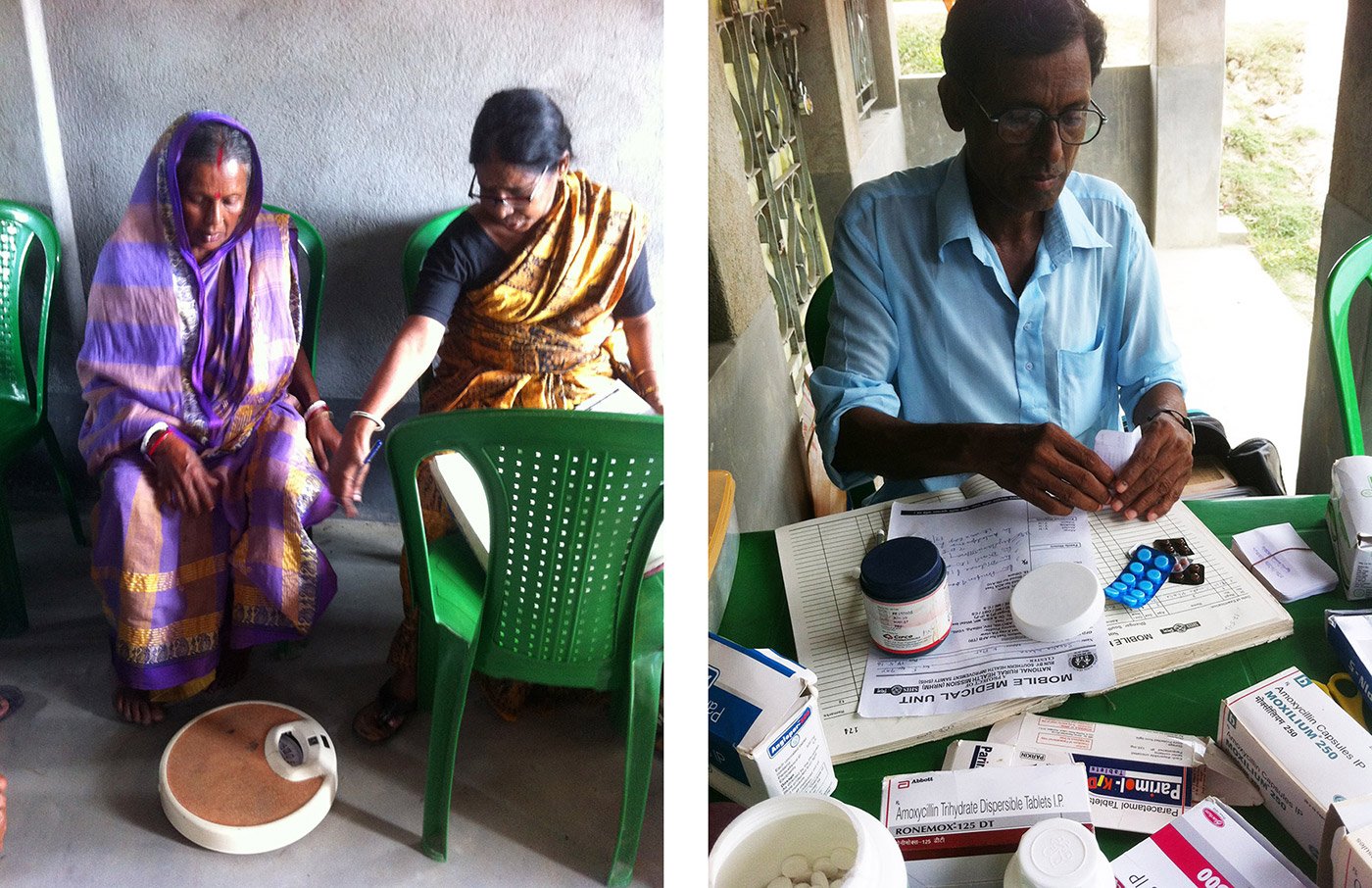
    A mobile medical unit, run as part of the National Health Mission, traverses the waters of the Sundarbans
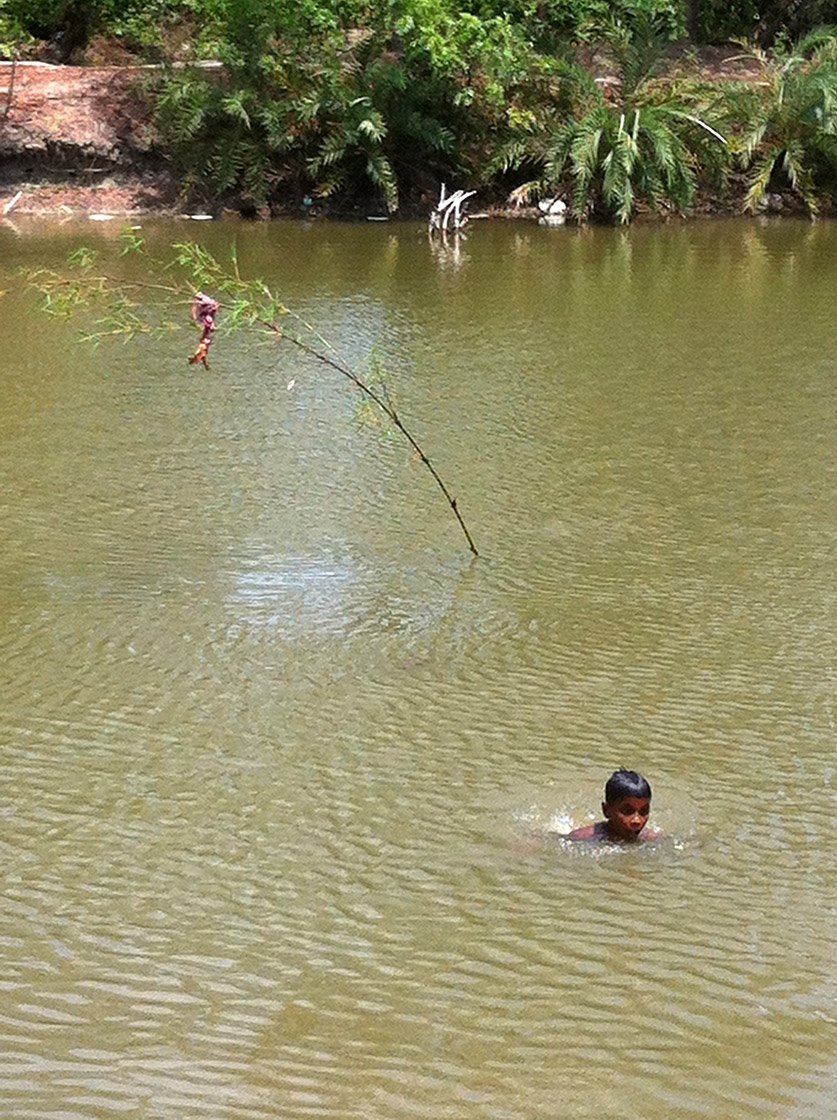
    The high salt content of water in the Sundarbans can cause many illnesses

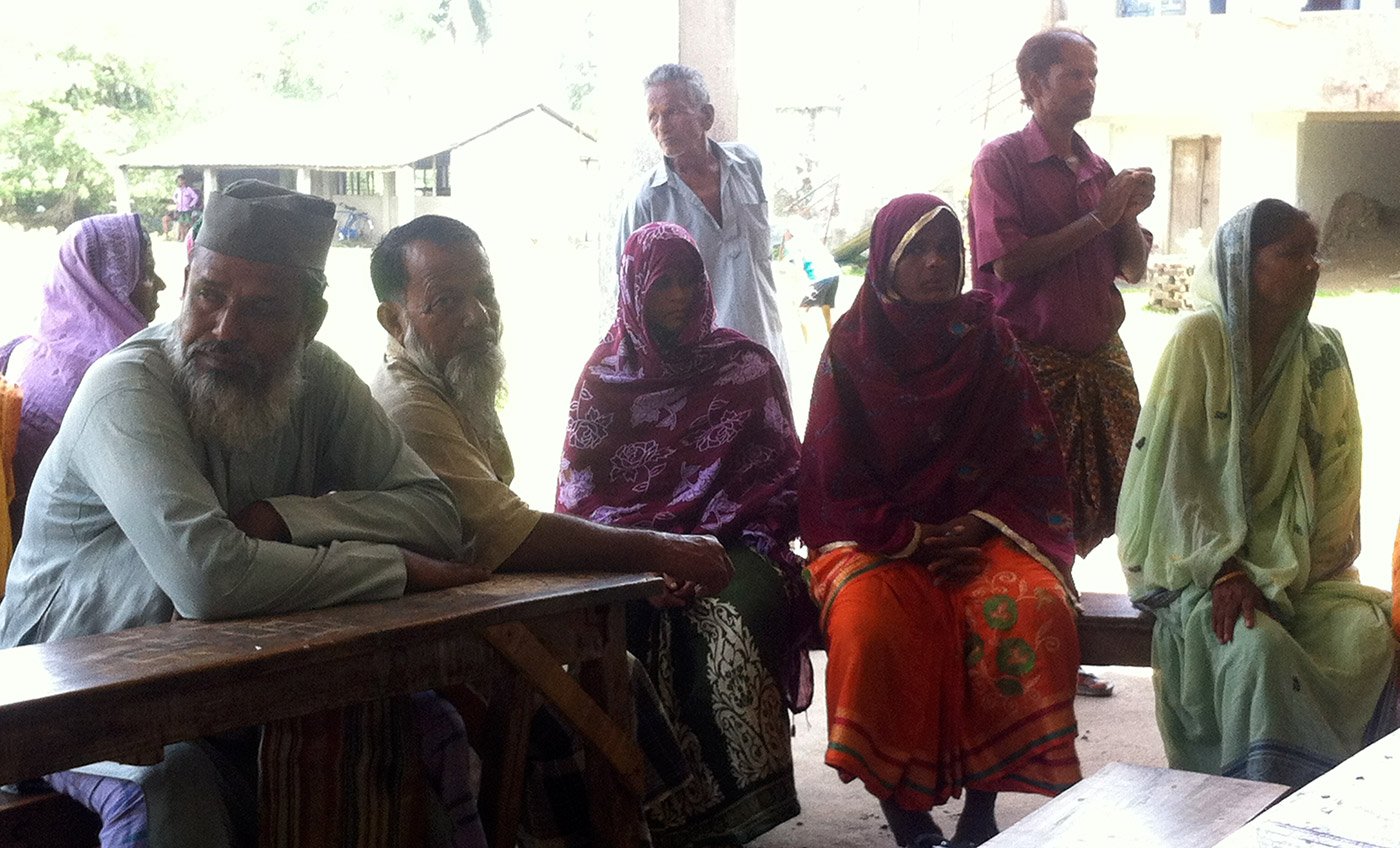
    This forces people living in villages like Paschim Sripatinagar, located in remote parts of the Sundarbans, to turn to services like mobile medical units. Some of these units are operated on boats that traverse the waters here. On the day of our visit, a handful of ill and ailing people have formed a small crowd just outside a bare room, which will become a clinic for the day. A medical crew has just arrived after a two-hour journey across the river Shibua.  It is Tuesday, the day designated for the unit to visit this village.

    This mobile clinic is a part of the National Health Mission. The Southern Health Improvement Samity (SHIS) and other non-governmental organisations operate these units to plug the coverage gaps of the two government sub-centres in Paschim Sripatinagar and Purba Sripatinagar, as well as in other parts of the Sundarbans.

    Fewer than 10 such mobile units operate in the Sundarbans – and the islands have a total population of 4.4 million. But many villagers prefer to visit these temporary clinics because getting to the sub-centres can mean crossing difficult terrain, often only to encounter a shortage of qualified doctors.

    In Paschim Sripatinagar, Asha Das has walked from her home to reach the one-room weekly clinic. When ill, walking across semi-formed brick roads with a harsh sun beating down cannot be easy. She speaks of the difficulties of seeking treatment: “Organisations like SHIS operate clinics on one or two days of the week. On all other days, we are dependent on the sub-centre or on quacks.  The [public] hospital at Patharpratima is nearly three hours away and takes at least Rs. 100 to reach. We need to change at least two boats and vans.  In emergencies we are really stranded.”

    Nurse Bulu Samanta and pharmacist Pareshchandra Jana of the mobile SHIS clinic at work

    The most common complaints of the people who visit the mobile clinic, Debjit Maity, of the SHIS says, are arthritis, gout, spondylitis, leucorrhoea, scabies, eczema and boils. Dr. Prasanta Roychowdhury, who sees patients at the SHIS clinic, says the high salt content of the water is a key trigger for many illnesses across the Sundarbans.

    He too speaks of the problems with accessing health care across the Sundarbans: “Doctors don’t want to come here, there is little money and no life. The government does not even give them a place to practice in some areas. Why should they come? So local quacks administer to the people in an unsatisfactory way and even occasionally fleece them.”

    And these health care obstacles are magnified for pregnant women. The government sub-centre in Paschim Sripatinagar is located a short distance away from the SHIS clinic. Inside, two ANMs (auxiliary nurse midwife), Mohima Mondal and Lokhi Bor Mondal, sit at a desk. The centre has two tables to examine patients – there is no bed or electricity. Not a single patient has come here that afternoon, the day of the mobile SHIS clinic. The ANMs say, “We ourselves urge people to visit a qualified doctors, like those of SHIS, when they come to the island.”

    At the sub-centre, treatment is available for basic illnesses, and ante-natal and post-natal care for pregnant women – dispensed by the ANMs, a few ASHA (Accredited Social Health Activist) workers and a male nurse. However, deliveries are not performed there. Lokhi Bor Mondal says, “We have to really convince women to deliver at the hospital [since the distance and cost are real deterrents]. Even the panchayat has had to deploy tactics and say that women will receive birth certificates and ration cards only if they deliver in the hospital.”

    Hamedon Bibi, a ‘daima’ , and her granddaughter Hosnara Khatun, from Mousuni island. 
    An eye camp in process on Mousuni island

    Hamedon Bibi, who works at the sub-centre in Baliara village as a ‘daima’ [traditional birth attendant], is well over 50.  When she started working 14 years ago, her monthly salary was Rs. 25. Now it is Rs. 550. Her work involves helping pregnant women to deliver their babies. She says, “Why do I not receive coloured saris like the ANMs and the ASHA workers? I work so much, but receive no recognition. I do not even receive lunch or food money.”

    A community delivery centre (CDC), established at nearby Lakshmipur village three months ago, has improved the situation to some extent. CDCs, many of them run by NGOs, promote institutional deliveries. Along with government hospitals, they have made it possible for more women here to get such deliveries. But 55 per cent of babies in the Sundarbans are still born at home, according to a 2014 study by the Indian Institute of Health Management Research, Kolkata.

    At times, an NGO fills a few of the health care gaps by setting up a camp. On Mousuni island of Namkhana block, Farida Baig, a villager, is helping set up such a camp organised by the Samaj Unnayan Kendra in a classroom in a rundown school. This NGO also operated a daily medical launch (not part of the National Health Mission) until its funding ran out in 2015. Now it runs occasional health camps, and in May this year it organised an eye camp on the island.

    “The villagers know of the camp because the panchayat made an announcement on a mike,” Farida says. “When we fall ill, we are referred to Dariknagar public hospital which is around 15 kilometres away. But boats are not always available. Sometimes, the hospital has no doctors or oxygen or will not perform caesarean [deliveries]. They then refer us to the Kakdweep hospital, another 35 kilometres away. When pregnant women travel to Kakdweep, they brave non-existent roads and high tides.”

    Patients await their turn to see the doctor on Mousuni island

    And when none these hospitals can help, the islanders go to the bigger hospitals at Diamond Harbour and Kolkata – this involves 5-6 hours of travel and considerable expense.

    Anwar Alam, coordinator of the SHIS’s health programme, feels it is impossible for the government to reach the remotest corners. Talking to me in his office in Ghatakpukur, he says, “How far can they reach? They are also strapped for funds. Whether the mobile medical launches or the CDCs, these are mostly run on the public-private partnership model. The government relies heavily on the assistance of those NGOs which can deliver health services.”

    Debjit Maity adds, “Despite the PPP model, large sections of the Sunderbans in South 24 Parganas district are barely touched by health care – for example, parts of Namkhana, Kultali, Patharpratima, Raidighi, Gosaba and Basanti, and swathes of North 24 Parganas district as well.”

    But Dr. Nilmadhab Banerjee of the Bayermari CDC has a different view: “How long will you blame the broken roads and violent rivers?” he asks. “This situation is not only in the Sundarbans. These are only excuses. There are problems at every level of the health system which need to be addressed, including the challenges that rural doctors face.”

    In the meantime, the people of the Sundarbans continue to take chances with their life and health.

    Photos: Urvashi Sarkar

    Read the original article: https://ruralindiaonline.org/articles/in-emergencies-we-are-really-stranded/

  • Voting in a Sundarbans village

    Published in People’s Archive of Rural India. 19 May 2016

    “The government sees the Sundarbans jungles, but not the human beings who reside in them,” says Gita Mridha, whose husband, a fisherman, was killed by a tiger in February 2012. Despite being eligible for compensation, Gita says she received nothing; several other women in her village too did not receive compensation after tigers killed their fishermen husbands.

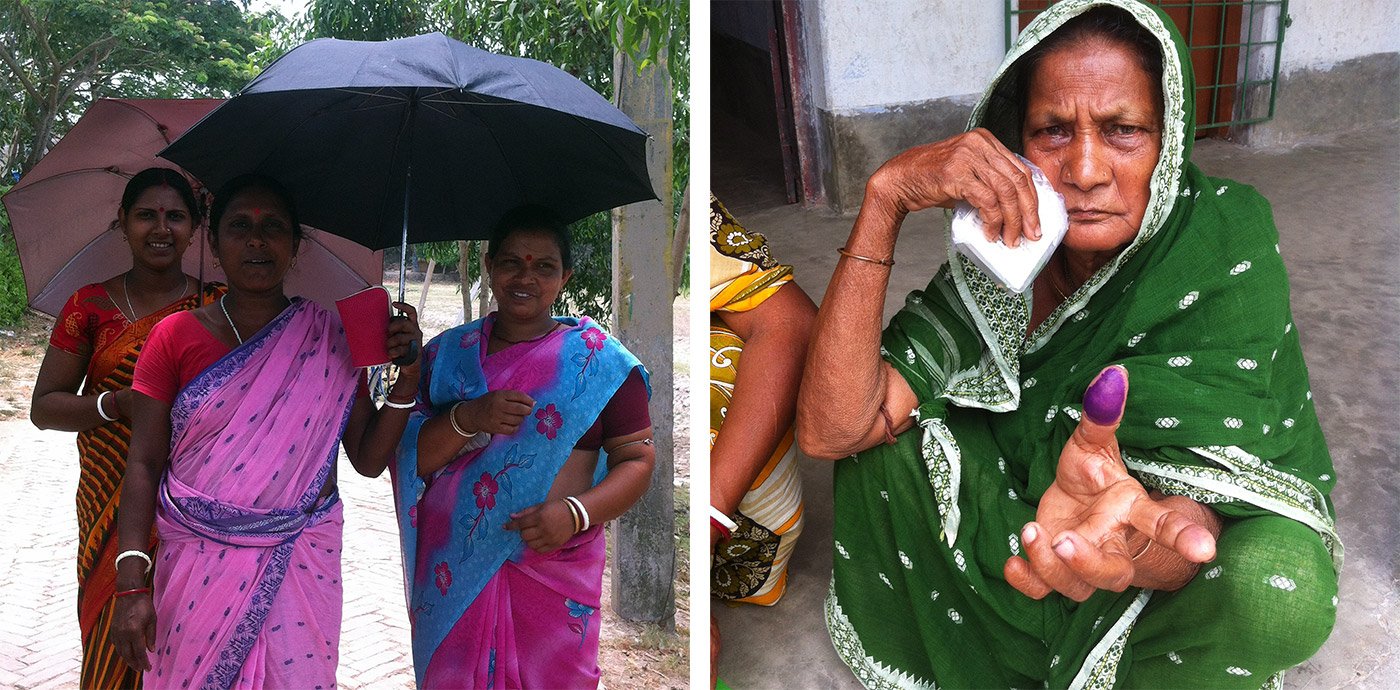
    “They do not forget to ask for your vote,” she adds. Gita did cast her vote. “I did my duty as a citizen,” she says. Gita is a resident of Rajat Jubilee village in the Sundarbans.

    ‘I did my duty as a citizen,’ says Gita Mridha of Rajat Jubilee village

    Rajat Jubilee is among 22 villages of the Lahiripur gram panchayat, in the Gosaba block of the South 24 Parganas district. Its population is mainly from the Scheduled Castes (SC).

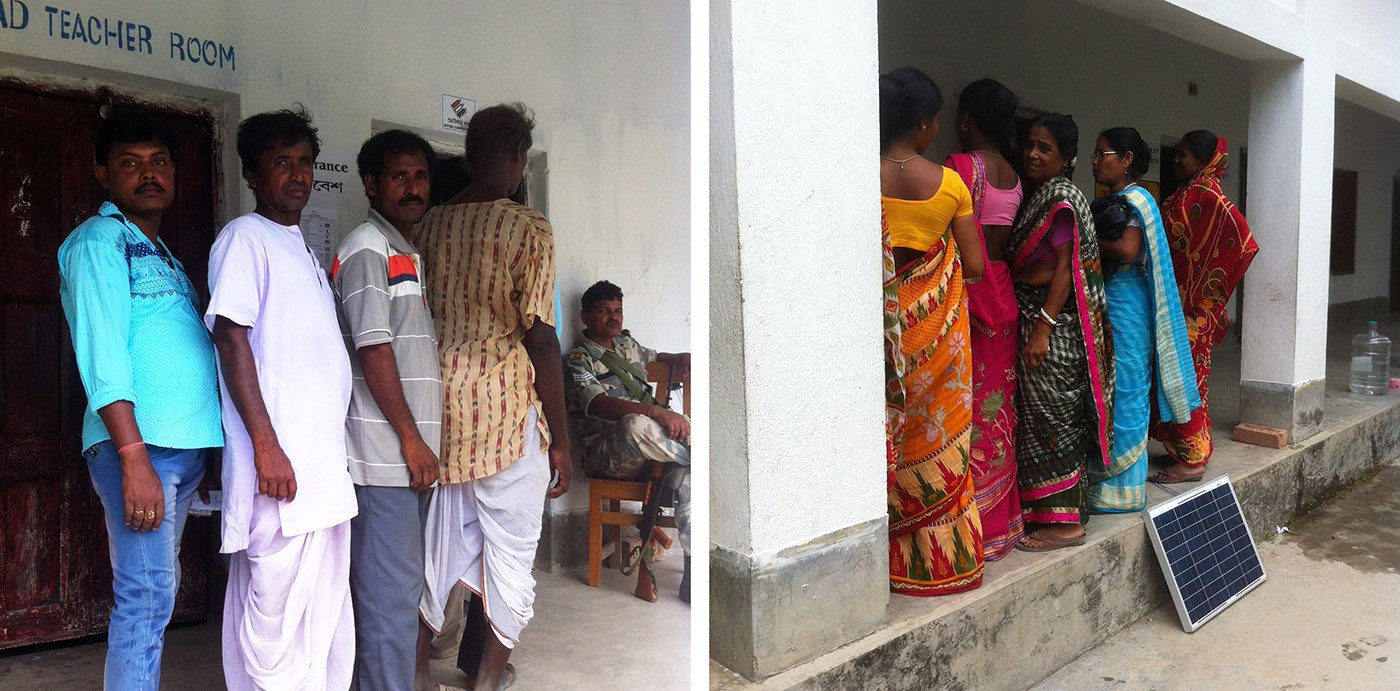
    On April 30, people from Gosaba’s villages voted in the elections for the West Bengal Assembly. Many of them live in areas adjacent to Rajat Jubilee, about 1.5-2 kilometres from the polling booth, which they covered on foot. Some traversed long distances, arriving from Kolkata and other parts of the state by train, boat and van.

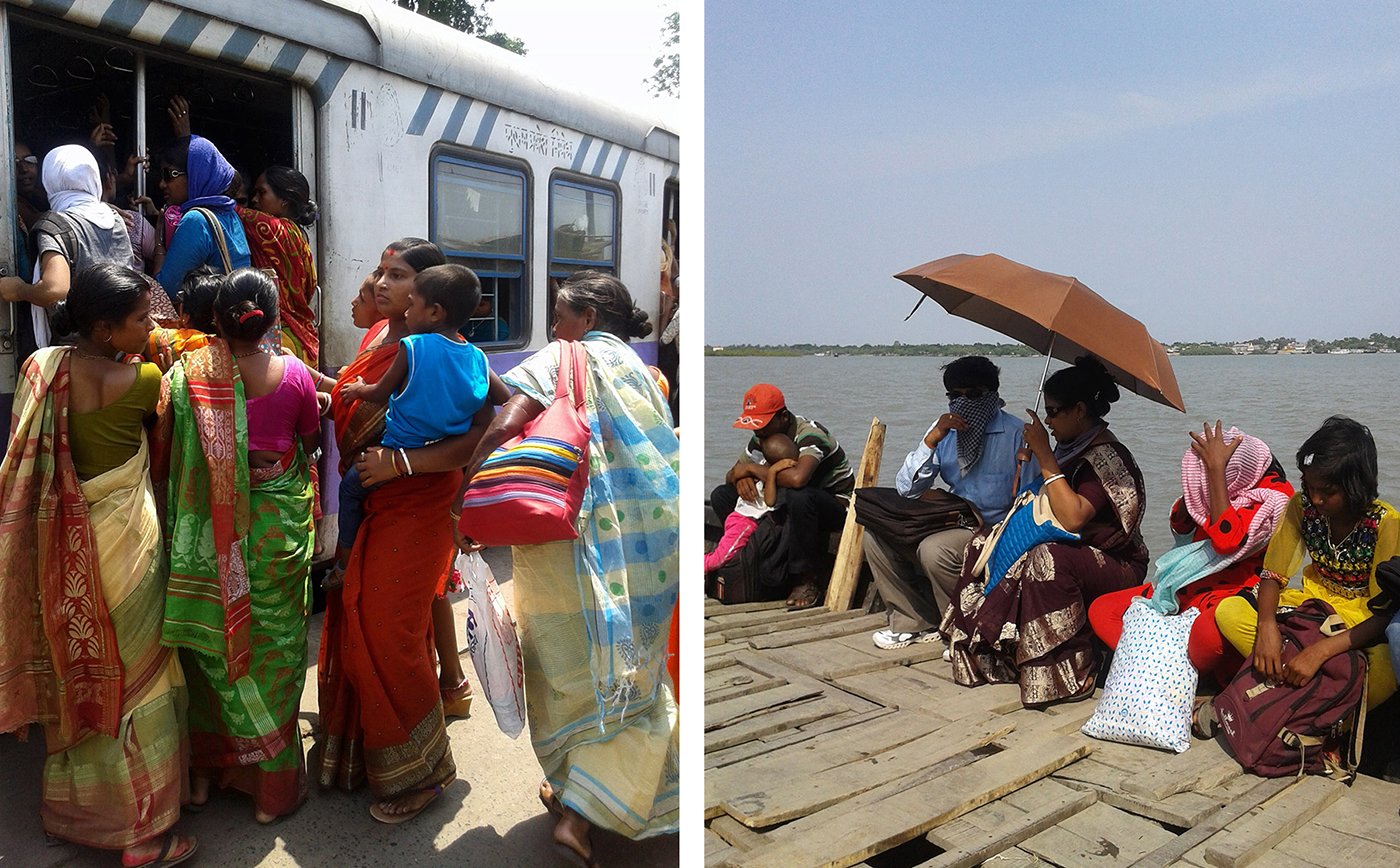
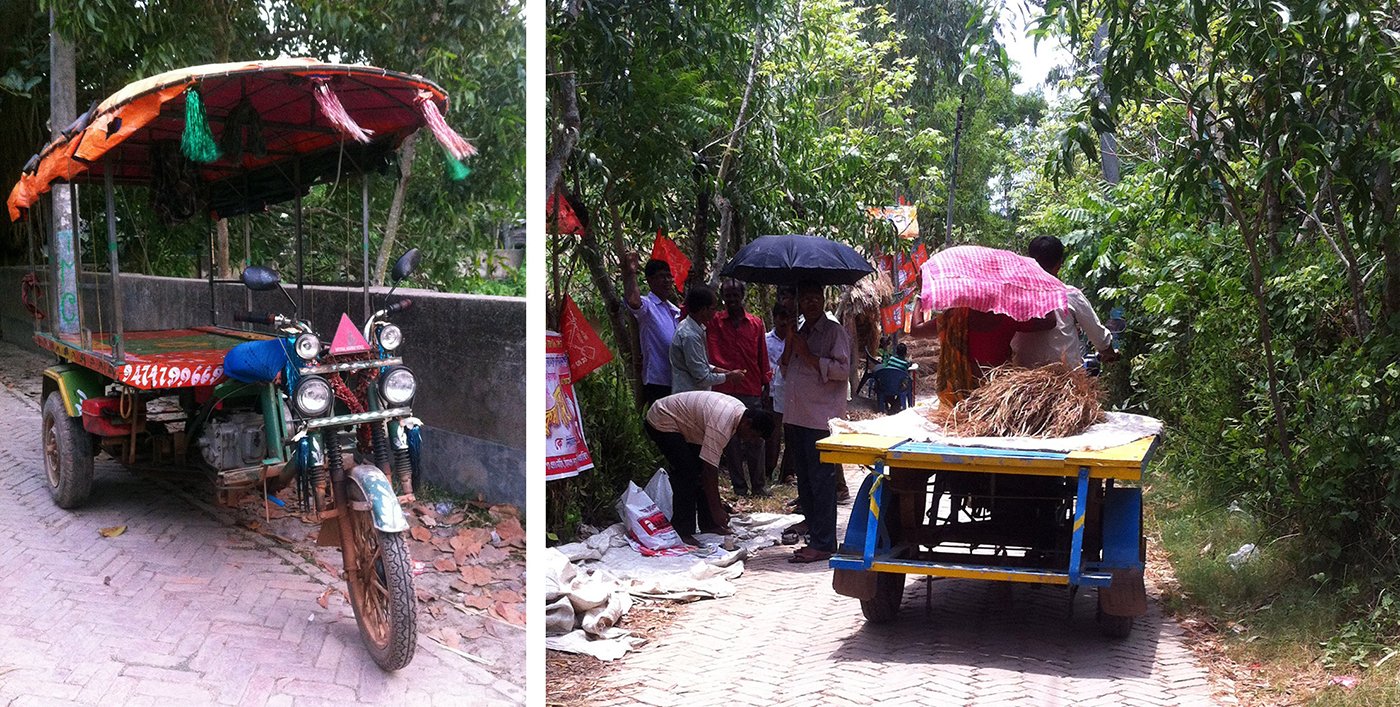
    People from Lahiripur gram panchayat’s 22 villages took trains, boats and tractors to reach the voting venue

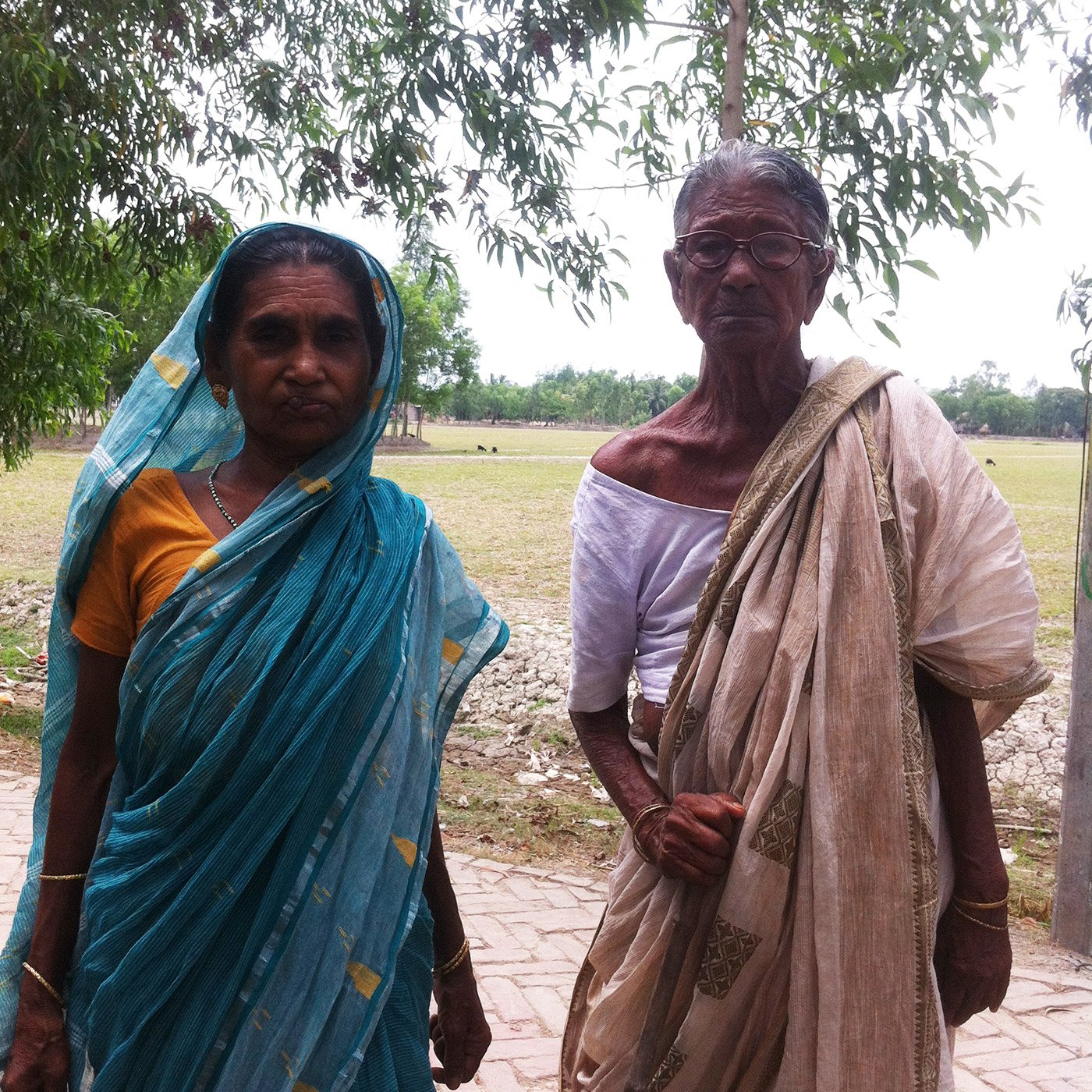
    Voting started at 7 a.m. and continued till 6 p.m. Some, including 95-year-old Phool Bashi and her daughter-in-law Kalpana Mondol, voted in the early hours to avoid the afternoon heat.

    Phool Bashi (right) and her daughter-in-law Kalpana Mondol voted early to avoid the afternoon heat

    Beena Mridha, a resident of Rajat Jubilee, summarised the problems of her village: “There is no hospital here, only a big one in Gosaba. To reach, you need to change two boats and vans. There is the problem of tigers and crocodiles, which kill our people and cattle regularly. We are also not getting good value for our rice, just about Rs. 650 per quintal, whereas the market rate is Rs. 800 per quintal. The government was supposed to buy grain from us, but that has stopped. The food security cards are full of errors, so many of us do not even get our food entitlements. Our roads need broadening and elevating above the river level.”

    Beena also laments the lack of institutions for higher education near the village. “My daughter studies in Kolkata, where we have enrolled her at great expense. There are no jobs here, other than fishing or collecting honey. ”

    Polling in process at the village high school; some are done, others await their turn

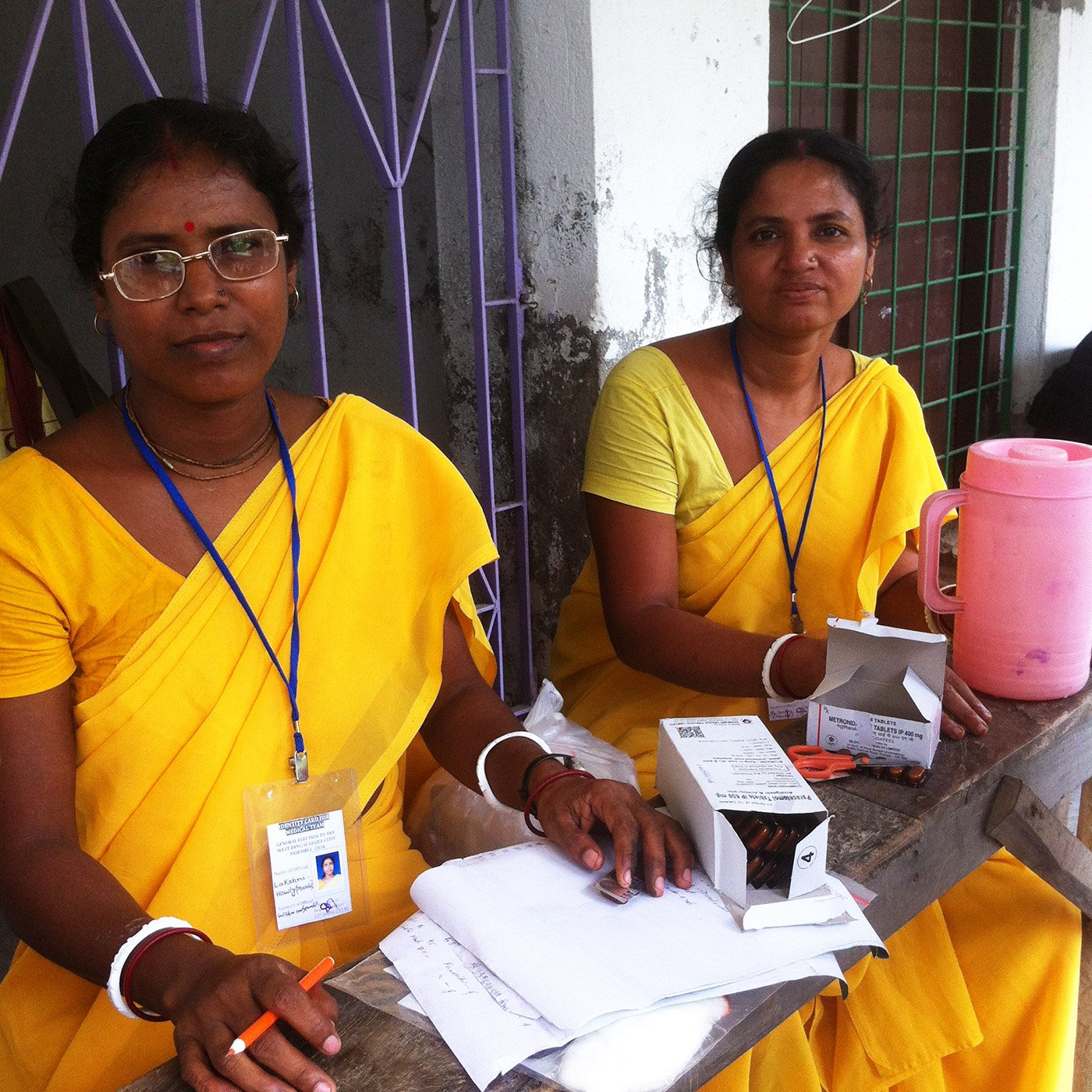
    The polling was held at Rajat Jubilee High School. Inside the school, health workers Lokhi Howly Mondol and Ila Sarkar Mondol from Gosaba hospital were on election duty as a medical team. Lokhi said, “We give ORS [oral rehydration salts] to all voters and medicines to those who feel unwell. Some people also take medicines for the sick in their homes.”

    Both women were at the venue from 7 a.m. to 6 p.m. Were they getting paid for this work? Lokhi said, “We do not know yet [how much we will get]. We will know once our duty is over.”

    On election duty from 7 a.m. to 6 p.m. as a medical team, Lokhi Mondol and Ila Mondol from Gosaba hospital don’t know how much they will get paid for this work

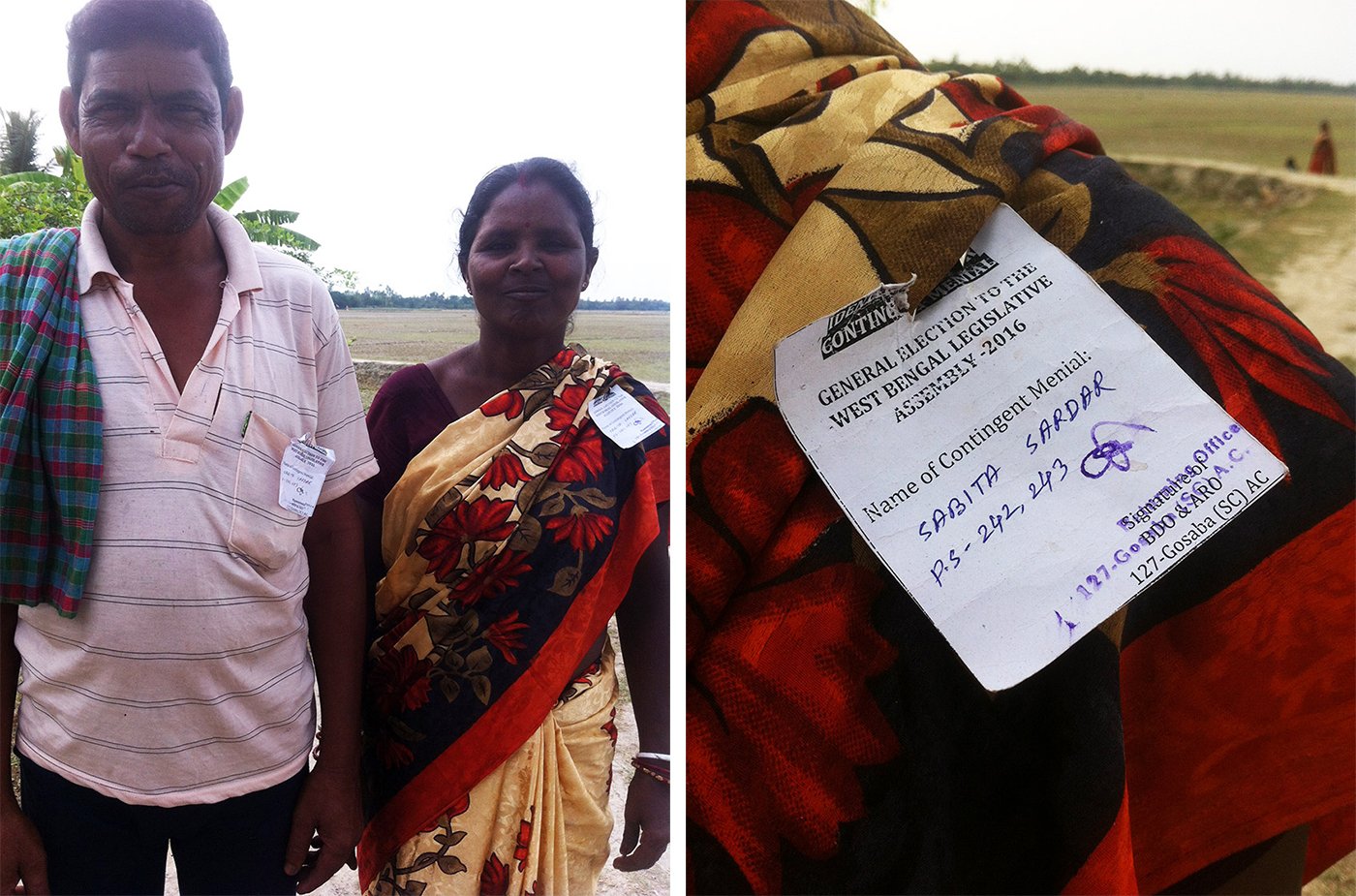
    Vinod and Sabita Sardar, a couple, were also on election duty. Their task was to take care of the needs of polling officers. Vinod said, “The officers need food and refreshments. We bring them tea, coffee and cigarettes. The Sardars belong to the Scheduled Tribes (ST) community and do not own any land. Their election duty designation was, strangely, ‘contingent menial’.

    Vinod and Sabita Sardar attended to the needs of polling officers; both are from a Scheduled Tribes community and were listed for election duty as ‘contingent menial’

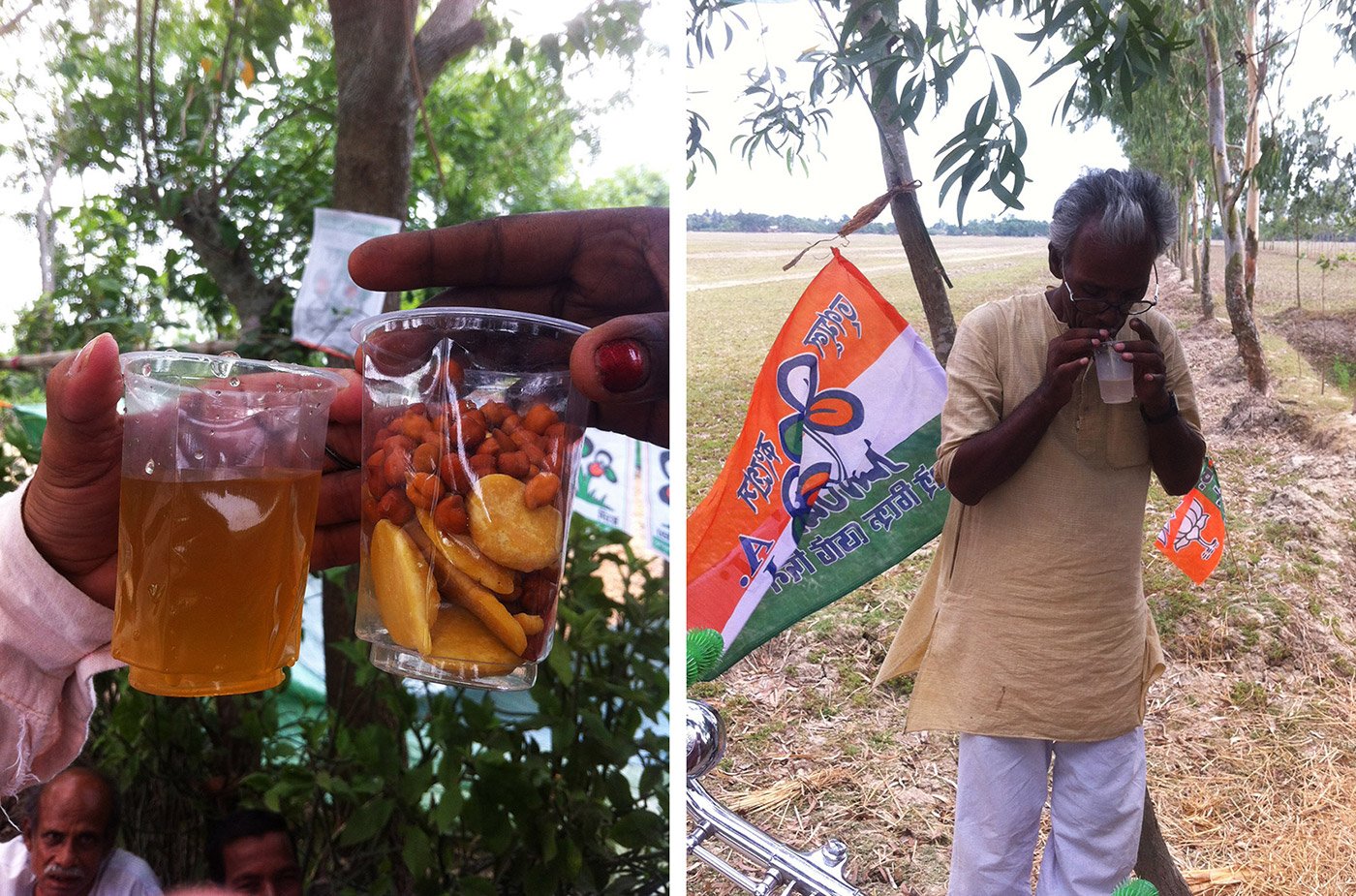
    Coming out to vote in the sultry and humid Sundarbans is no easy feat. For some relief from the heat, locals, some affiliated to various parties, offered batasha drinks made from sugarcane and nuts to voters. Also on offer were paan and bidi .

    Party workers offered cold drinks to the voters for some relief from the heat; Ronojit Burman (right) refreshes himself after casting his vote

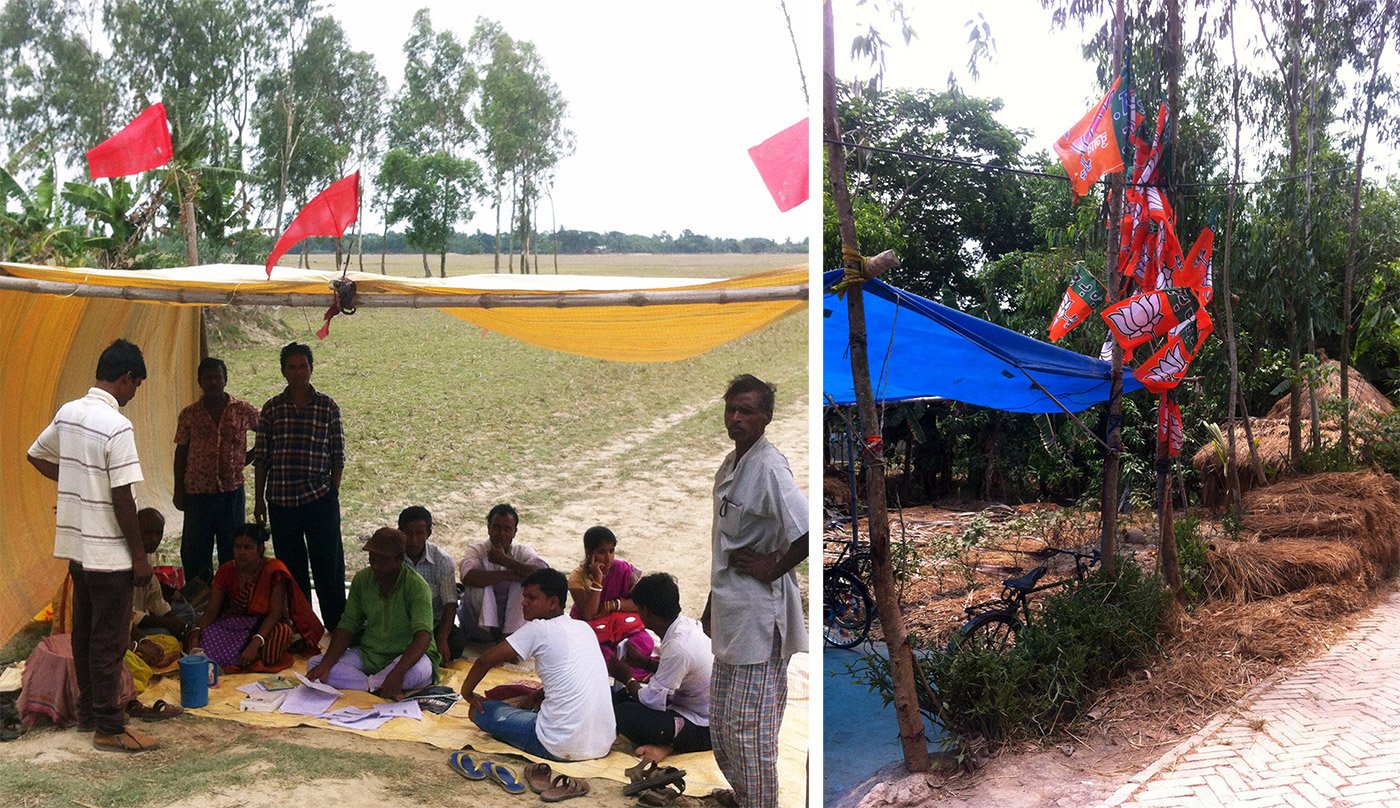
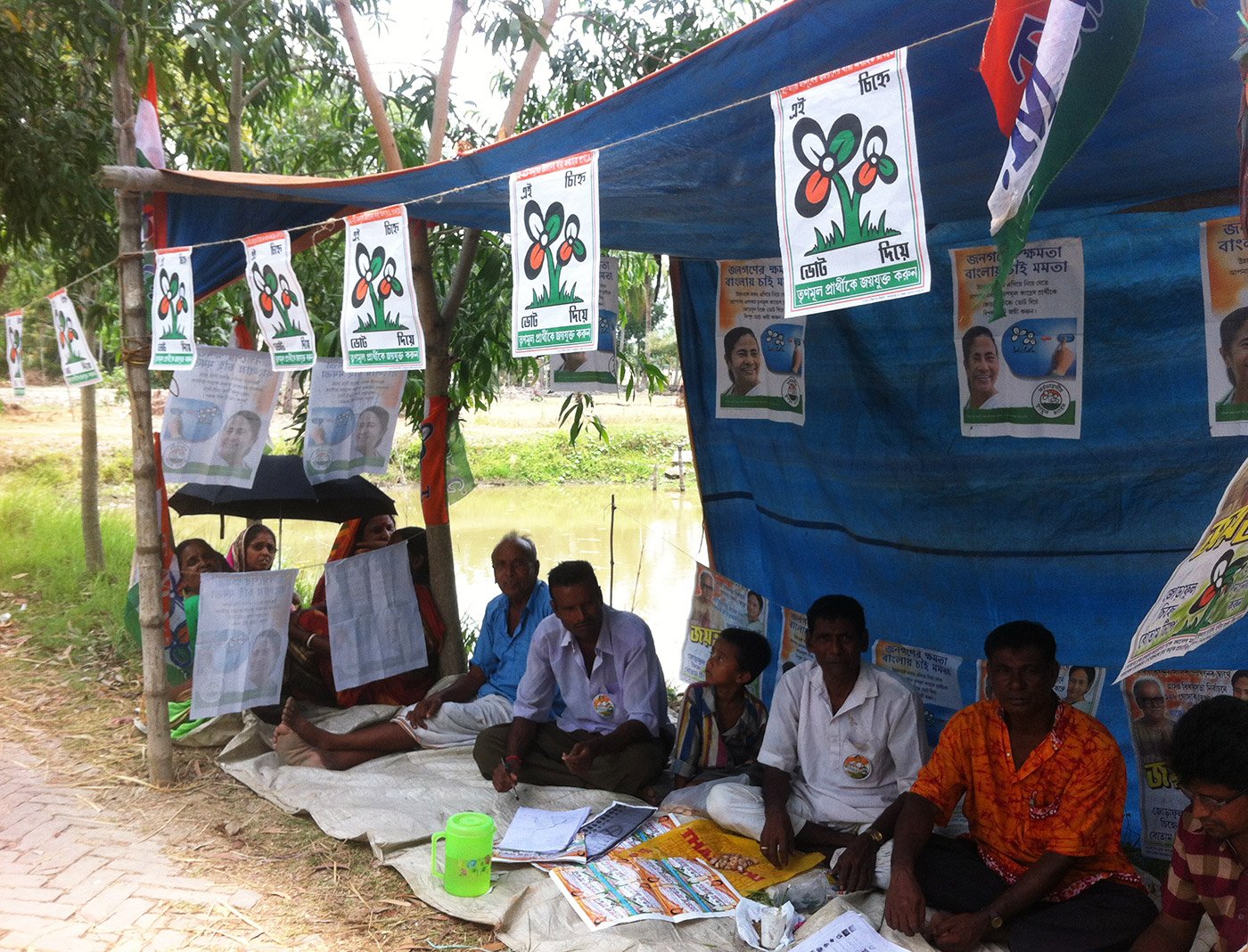
    Political parties in the fray – such as the Revolutionary Socialist Party, the Trinamool Congress, and the Bharatiya Janata Party – set up mini tents where party workers helped voters match their voter identity numbers, and guided first-timers on how to vote. The tents had to be located at least 200 metres away from the polling booth.

    Political parties set up tents to help voters match their identity numbers and guide first-timers

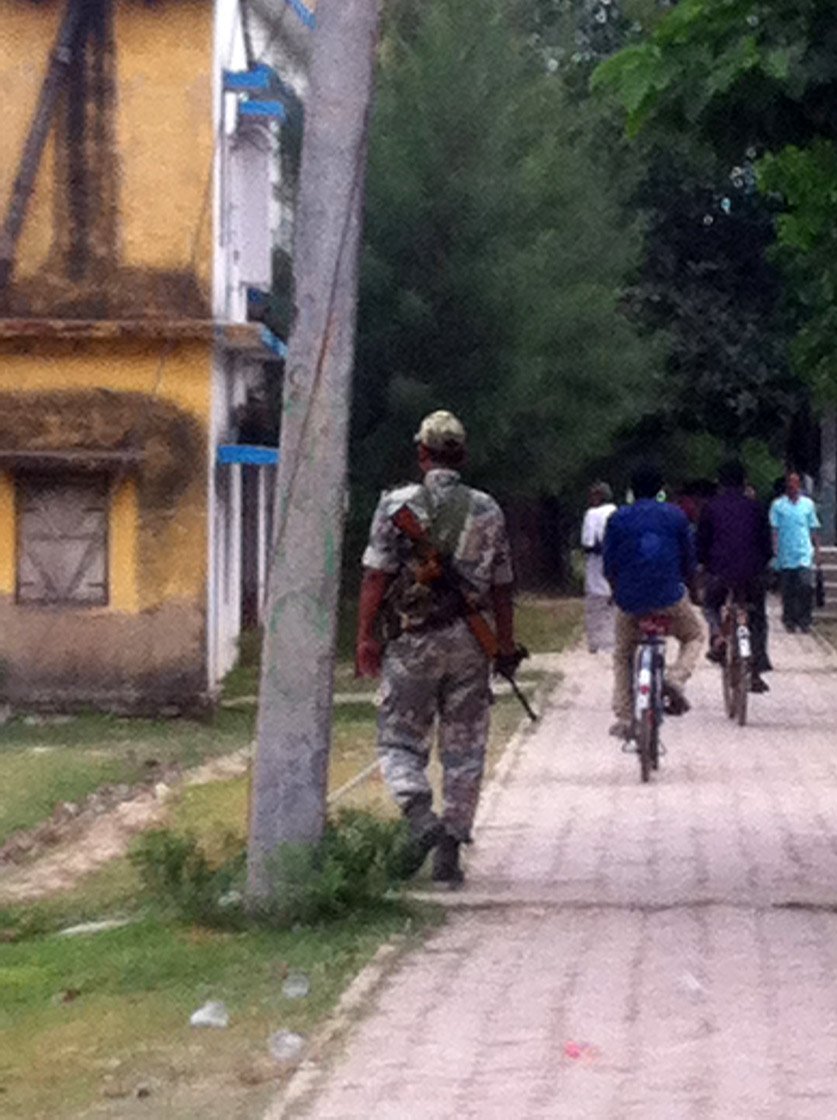
    Central Reserve Police Force personnel were present everywhere, patrolling the village and stationed at the polling booth. They refused to allow their faces to be photographed. One of them said: “We just came out for tea. If you take a picture of us sitting and relaxing under a tree, people will think we are not doing our duty.”

    High-visibility CRPF personnel were on patrol at the village and the voting venue

    Photos: Urvashi Sarkar

    Read the original article: https://ruralindiaonline.org/articles/voting-in-a-sunderbans-village/

  • A right to fish, a fight to live

    Published in People’s Archive of Rural India. 12 March 2015

    A tall and lean fisherwoman with a strong face stares at the evening sun fading into the still waters running through Kultali, an island in the Sunderbans forest; Anima Mandal is angry. She hasn’t eaten since
    morning.

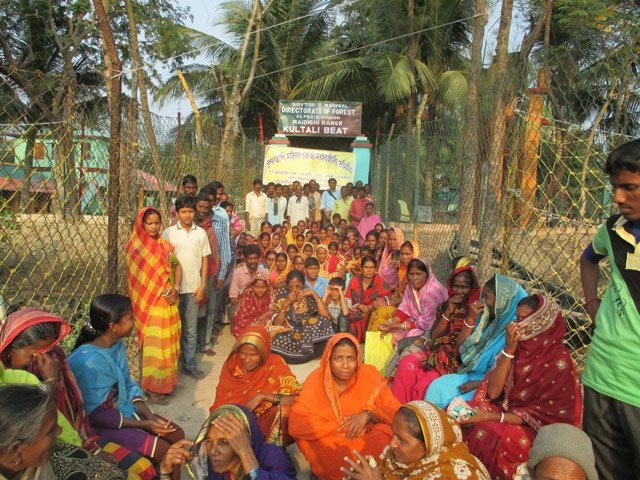
    She was there for a meeting that the Kultali Forest Range beat officer had fixed for 2 pm on February 14, 2015 at the forest range compound in a corner of Kultali, across a river. Nearly 50 women, and a few men, had turned up for this crucial meeting to make two pressing demands – the return of their confiscated fishing canoes (dongas) and for the women to be recognized as traditional small-scale fishworkers, with a right to fish for their livelihood.

    The women, organized under the Kultali Mahila Donga Matsyajibi Samity, had travelled a long way from Madhya Gurguria village – on foot, on cycles fitted with wooden planks and by boat – to make it to their appointment.

    It is already past 5 pm. A number of women begin tracing their steps back towards a dinghy headed homeward: some hurry back to feed and care for the children they’ve left at home and others return home for fear of husbands who could turn violent. Anima and a few others choose to stay back at Kultali and represent the group, determined to get a response from the Forest Department.

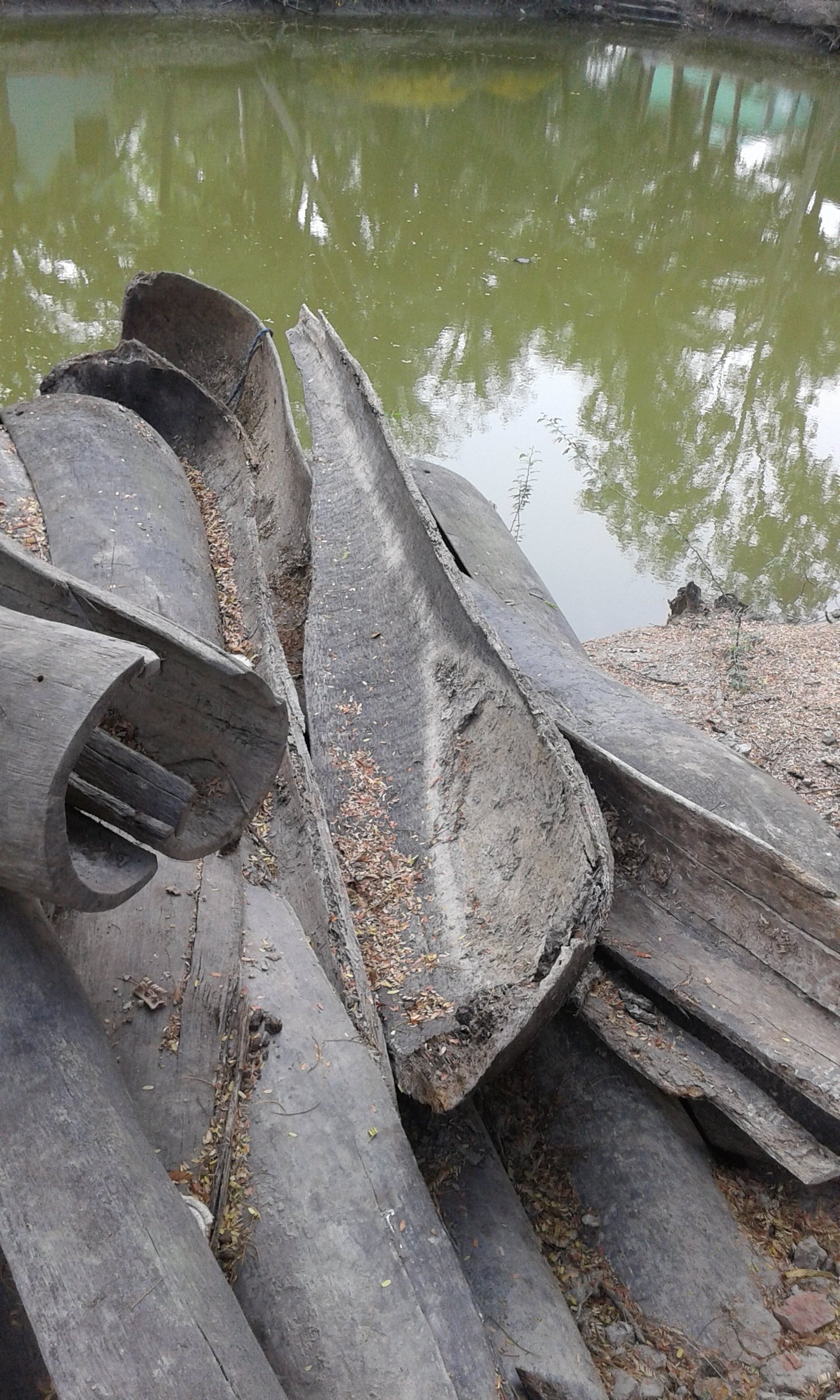
    They walk around the compound, to the edge of a murky green pond, where their confiscated canoes of palm trunk lie stacked. The women are appalled; debris and wood bits from the canoes have started to peel off and mingle with the water. “Our canoes have been broken into pieces and thrown into the water. There must be lakhs of rupees (floating) in this river, ” says Geeta Sahu, a fisherwoman speaking softly. Her indignation, however, is unmistakable, shared by the workers standing beside her, still waiting.

    Sole Means

    The conversation among the waiting crowd turns to input costs: the cost of palm trunks from which the canoes are dug out, the labour cost for chiseling, and the cost for coal-tar coating maintenance, all amounting to about Rs 5,000. Almost every confiscation necessitates this princely expenditure on their part, to build a canoe from scratch. “It can take at least two or three months to gather such a sum. Wooden boats, permitted by the Forest Department, are too expensive to afford,” explains Beena Bag, one of the fisherwomen.

    They walk down some distance and spot a couple of confiscated dinghies, still sturdy, poking out through a mass of trees. The canoes and dinghies are the fishworkers’ only means to catch crab and fish, their sole means to earn a living. By now Anima is fuming: “Why confiscate the canoes and hurt us in the stomach? We don’t earn salaries, you know. This is not Calcutta city, where each month people earn something to be deposited in the bank. Nobody is going to hand me a bag of vegetables to cook. Life is different here.”

    Slice of Life

    Indeed, life is starkly different in the Sunderbans. For Anima, and other fisherwomen like her, the day begins at 3 am. After housework, they take their canoes into the rivers. To make a catch, they wade into cold, chest-level water. Once they have caught the fish, they return home to cook and feed their children. Crab and fish depots are the next stop. The women come here to sell their catch with hope and no guarantees to make a little money. On days there are earnings, they are funneled into immediate household expenses, fishing input costs (if any), and savings for the less fortunate days in the week. Many of the communities here are landless second or third generation fishworkers, entirely dependent on fishing for their survival. And so, what they earn will determine what they buy at the market.

    No Avenues

    Anima was 10 or 12 when she got married. She recently lost her husband to a stroke. “There is no decent hospital here. Even pregnant women need to travel for two hours to Joynagar, where there are hospitals,” she exclaims, frustrated. The number of men in the Sunderbans has declined over time, mainly due to migration for better livelihoods; most move to cities as construction workers or get involved in tiger killings for the profit.

    The women are also bitter about having no stake in the proposed tourism projects in the Sunderbans. “Why won’t they involve us in the tourism projects? It will give us better jobs and a better quality of life. Nobody seems to wants to (positively) engage with us. For instance, the big boats catch fish and crab just like we do, but it is us that the Forest Department goes after.”

    Certified Catch

    If life is not hard enough, the Forest Department’s confiscation of their canoes has ensured that it becomes even harder. The reason cited is that since the canoes do not have a boat license certificate (BLC), granted by the Forest Department, they are therefore not authorised to ply in the Sunderbans; Kultali is part of Sunderbans reserve forest area, preventing the fishworkers from catching crab on their own land, unless they have a BLCs.

    The BLC regime has several problems including a non-transferable nature, the possession of BLCs by those who are no longer fishworkers, a thriving black market, and the non-issuance of fresh licenses. A study on the Sunderbans fishers by the International Collective in Support of Fishworkers (ICSF) outlines these problems in detail. To deter fishworkers, the Forest Department uses methods such as seizing fishing nets; the women complained of receiving threats that glass bits would be mixed into with the riverbank sand, to prevent them from going (as they walk barefoot) to fish.

    “The denial of the community rights of the forest dependent fisherwomen to fish in the forest waters is a violation of the FRA,” says Pradip Chatterjee, President of the Dakshinbanga Matsyajibi Forum. The Forest Rights Act (FRA) is meant to secure the access rights of forest-dwelling people, including sustainable use and conservation of the biodiversity of their home grounds.

    He notes that despite repeated calls, the West Bengal government is yet to notify the FRA in the North and South 24 Parganas Districts: “The failure to notify the Act has resulted in the denial of livelihood rights to forest-dependent people including fishers, wild honey collectors, drywood collectors, and shell collectors (among others), leading to consequent conflicts with the Forest Department.” Implementing the FRA would allow fishworkers to catch crab without BLCs.

    Hope and a victory

    The beat officer enters the scene a little past 6 pm. He speaks with the women of the Mahila Donga Samity
    and members of the Dakshin Matsyajibi Forum. The officer states that the canoes have been confiscated because of their alleged use for poaching. Episodes of poaching involving canoes have been sporadic, the
    women argue, the entire fishing community should not be penalised.

    They promise to act as informers for the Forest Department during instances of poaching, but insist on their right to continue using canoes for fishing. The beat officer agrees not to seize canoes for the next three months, during which time the movements of the canoes will be supervised. He also agrees to take up the issue of the rights of forest-dependent fisher communities with higher authorities.

    When he voices a grouse about the government having to pay compensation when there are deaths caused by fishworkers venturing into tiger territory, he is reminded that fishworkers do not voluntarily venture into tiger territory, but because it is a question of their livelihood.

    By the time discussions conclude, night has already set in. The women are happy to have this victory, even if temporary. They pile into a dinghy that takes them into the dark waters of the Sunderbans. Anima gazes at the still waters and towards home.

    Read the original article: https://ruralindiaonline.org/articles/a-right-to-fish-a-fight-to-live/

Urvashi Sarkar – 2026 – All rights reserved.

web things by Studio Goncharov