Tag: United States

  • India’s tough talk on Kashmir belies its lobbying for US support

    India’s tough talk on Kashmir belies its lobbying for US support

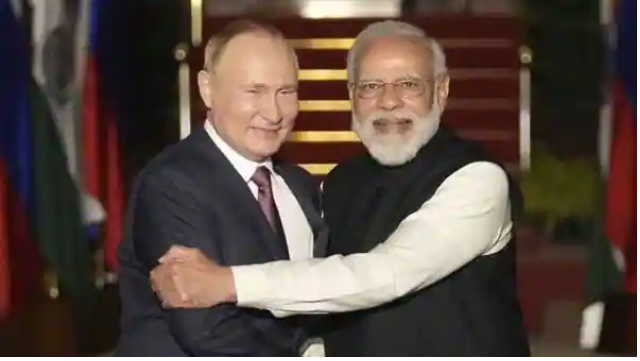
    India’s Prime Minister Narendra Modi (R) with US President Joe Biden (C) as India’s Foreign Minister Subrahmanyam Jaishankar looks on at the G20 leaders’ summit in Bali on 15 November 2022 (AFP)

    “My reputation is not decided by a newspaper in New York,” India’s foreign minister, Subrahmanyam Jaishankar, declared in 2019, referring to foreign press criticism about the revoking of article 370 which nullified Kashmir’s autonomous status.

    Jaishankar has repeatedly accused the US media of being biased and ideological on Kashmir and defended the move as India’s internal business. Jaishankar belongs to the right-wing Bharatiya Janta Party (BJP), which forms the national government headed by Prime Minister Narendra Modi.

    This week, Modi is in Washington for a historic state visit.

    While his government publicly and robustly rebuffs American criticism of its domestic matters, behind the scenes it has been lobbying hard through the Indian embassy in Washington to present its version of events to US policy-makers.

    In May, the US Commission on International Religious Freedom (USCIRF), a government body, recommended for the fourth time that India be designated by the US State Department as a “country of particular concern”, citing systematic violations of the right to freedom of religion. The Indian government rejected the USCIRF charges as motivated and biased.

    The BJP’s blunt responses to international criticism on Kashmir and India’s increasingly problematic human rights record have resonated with large sections of the party’s right-wing nationalist voter base.

    But tough postures aside, how India is perceived among US policymakers and media matters greatly to the Modi government, much as it mattered to preceding Indian governments. This is because the US has emerged as one of India’s most important bilateral partners, seen in steadily increasing trade ties and a burgeoning defence partnership.

    The Indian diaspora in the US is 4.9 million strong and influential in American politics. Therefore, when US congresspersons wade into domestic Indian issues, it is with an eye on Indian diaspora voters.

    Behind the scenes

    Shortly after the August 2019 abrogation of Article 370, Democrats Rashida Tlaib and Pramila Jayapal sponsored resolutions 724 and 745 denouncing human rights violations in Kashmir.

    Reacting to the resolutions, a former Indian ambassador to the US, Harsh Vardhan Shringla, wrote a letter in December of that year to the US House Foreign Affairs Committee (HFAC).

    In it, Shringla argued that life in Kashmir had returned to normalcy. However, Kashmir at that time was in the middle of a lengthy internet blackout and a continuing security clampdown, with Kashmiri political leaders still under house arrest.

    Documents filed under the US Foreign Agents Registration Act (FARA) show that India also hired several lobbying firms to represent its stance to US lawmakers. Foreign governments routinely utilise lobbying firms in the US to advocate their interests.

    FARA laws require entities working in the US on behalf of foreign interests – such as the governments of foreign countries and foreign political parties – to disclose their work and register with the US government. In December 2019, the Indian embassy hired a lobbying firm to provide “strategic counsel, tactical planning and government relations assistance”.

    According to FARA filings, several communications have been established between the lobbying firm with US congresspersons on the subject of Kashmir. For example, emails with the subject “Kashmir update” were sent to several Democrat congresspersons in January 2020.

    Lobbying contracts

    Later that year, Indian farmers began mass protests against a set of new farming laws, which they saw as a threat to their livelihoods. In this instance, too, US lawmakers took note and expressed support for the farmers.

    Two lobbying firms working for the Indian embassy, sent emails to US lawmakers on the subject and shared background information on the protests.

    The Modi government signed lobbying contracts worth over $4.41m between June 2019 and September 2022.

    It was the period during which the Observer Research Foundation, a think tank created by Indian conglomerate Reliance Industries and which has close ties to the Ministry of External Affairs, established its Washington DC affiliate.

    Dhruva Jaishankar, the son of India’s foreign minister, was appointed as director of the initiative in September 2019 while ORF America was incorporated in Washington, DC, in 2020.

    The US chapter of the Overseas Friends of BJP, the foreign arm of the BJP, registered as a foreign agent in August 2020.

    Strained US ties

    This is not the only instance when the Indian government has felt compelled to accelerate its lobbying efforts. India’s ambition of being a nuclear weapons power in the 1990s majorly strained ties with the US, which imposed sanctions on India (and Pakistan) for conducting nuclear weapons tests in 1998.

    In 1996, lobbying constituted 10.51 percent of the total budget of the Indian embassy in Washington, according to a statement in the Indian parliament. Between 1994 and 1999, the Indian embassy spent approximately $3.56m in lobbying fees and expenses with a range of lobbying firms, according to FARA records.

    In 2001, the US government lifted sanctions on India and in 2005 the two countries signed a 10-year defence partnership agreement, widely regarded as a turning point.

    Under Prime Minister Manmohan Singh, India lobbied hard for the US-India Civil Nuclear Agreement 2008, which enabled India to import uranium and nuclear technology for its reactors despite not being a signatory to the Nuclear Non-Proliferation Treaty (NPT) and resulted in major contracts for US energy companies.

    Alongside lobbying firms, the Indian diaspora in the US played a major role in enabling the agreement, contributing with dollars and clout.

    Lack of transparency

    FARA documents show the Singh government spent approximately $4.93m between 2006 and 2010 in contracts with lobbying firms. The government further spent approximately $2.2m from 2010 to April 2012 on lobbying firms, according to Indian parliament data.

    Doubtless, India’s lobbying expenditures are a tiny drop in the vast lobbying ocean of the United States. The Open Secrets database points out that countries such as China, Japan, South Korea, Russia and Saudi Arabia spend millions of dollars annually lobbying the US government and decision-makers such as the media, universities and think tanks.

    However, the lack of transparency under the Modi government is stark. So far, it has not disclosed any information on lobbying abroad, whether in parliament or under the Right to Information Act.

    In February 2019, the Caravan magazine reported the existence of an obscure entity called the “Democratic Party of India”, which was operated by a lobbying firm hired by the Indian embassy. No questions about this were raised in India’s parliament.

    The Indian government wants citizens to believe that it is capable of retaliating against western criticism and will not brook interference in the country’s internal affairs. But the behind-the-scenes lobbying, especially on Kashmir, suggests a starkly different reality.

    Published by The Middle East Eye

    Link to original article: https://www.middleeasteye.net/opinion/india-us-kashmir-tough-talk-lobbying-support

  • India’s refusal to side with the West should not be interpreted as a revival of its non-alignment policy

    India’s refusal to side with the West should not be interpreted as a revival of its non-alignment policy

    Photo: AP

    Published by City University of London. 6 June 2022

    India’s refusal to outrightly condemn Russia for invading Ukraine is driven by its own interests and not by the nobler ideals which imbued the non-aligned movement of the 1960s and 1970s.

    Thick in the midst of its bloody invasion of Ukraine, Russia’s Foreign Minister Sergei Lavrov found time to visit India in early April 2022. Lavrov met India’s Prime Minister Narendra Modi and foreign minister S. Jaishankar and praised India for not taking a “one-sided” view of the war and considering “the entirety of facts”.

    Lavrov’s visit coincided with visits of UK Foreign Secretary Liz Truss and US Deputy National Security Advisor Daleep Singh to Delhi. Truss was in India to urge democracies to counter Russia’s invasion of Ukraine, especially by reducing dependence on Russian oil imports.  Meanwhile, Singh said that countries trying to circumvent sanctions on Russia would face consequences.

    Both the West and Russia share close ties with India and are keen to enlist its support on the war in Ukraine. India on its part has refrained from directly condemning Russia, ignored sanctions and stepped up purchases of discounted Russian oil.

    Observers of India’s foreign relations wonder if India’s explicit alignment with Russia and pushback against the West marks a new direction in India’s foreign policy. But on the contrary, India’s foreign policy choices are a continuation of the muscular and strongman policies set in motion by the Narendra Modi government since it came to power in 2014.

    Electoral manifestoes of Bharatiya Janata Party (BJP) to which Narendra Modi belongs, promise a major role for India in shaping the global agenda. While this is a positive goal for India, in practice the effects have not always been benign.  For example, in South Asia, where India is the most dominant country, neighbours like Nepal and Bhutan— while economically dependent on India — also resent its interference.

    India’s ‘unofficial’ economic blockade of fuel and supplies to Nepal in 2015, because it did not approve of its new Constitution, triggered deep resentment in the country. Nepal accused the Indian government of the blockade, which the latter denied.

    Bhutan too is uncomfortable with India’s influence. This was evident during the 2017 stand-off between India and China over the Doklam Pass which is contested territory between Bhutan and China and located at the tri-junction of the three countries. Bhutan was not pleased with India’s intervention.

    India which was earlier known for sheltering refugees has subjected Rohingyas fleeing genocide in Myanmar to discrimination, detention and deportation.  Though India hosts approximately 40,000 Rohingyas, there have been multiple instances of refugee camps being set on fire. BJP leaders have labelled Rohingyas as terrorists and demanded that they be expelled from the country. Interestingly, even as the Myanmar government stands accused of genocide, the country was the largest recipient of Indian military exports from 2017-2021.

    Another visible transformation in India’s foreign policy since the Modi government took power is its proximity to Israel and diminishing support for Palestine. Modi became the first Indian Prime Minister to visit Israel in 2017 and India was the top recipient of Israeli military exports from 2017-2021. The Indian government is also reported to have purchased  Israeli Pegasus spyware, and used it to spy on journalists, politicians, lawyers, students, activists and bureaucrats —a charge that it is yet to confirm or deny.

    Even as the Modi government flexes muscle internationally, it has been authoritarian domestically too; suppressing dissent and permitting right-wing vigilante groups to target Muslims and Christian minorities. Recent celebrations of the Hindu festival Ram Navami saw hate speech against Muslims and vandalism of their shops and properties. A Muslim majority neighbourhood of Delhi’s Jahangirpuri also witnessed an unprecedented demolition drive of their homes. When confronted with international criticism over its human rights record, amending citizenship laws or clamping down on major protests by farmers – India has been dismissive and defiant.

    It is admittedly hard to ignore India because of its economy, population and powerful diaspora. It is a top supplier of vaccines and plays an important role in groupings such as the Quad.

    Significantly, India is also the world’s largest importer of arms with Russia being a major supplier. Russian Foreign Minister Lavrov underlined India’s importance when he pointed out that Russia is a major foreign contractor for New Delhi.

    But Russia is equally important to India, supporting the latter’s bid for a permanent UNSC seat, during the 1971 Bangladesh war and opposed sanctions on India for testing nuclear weapons in 1998. In not criticising Russia, India is not just returning favours but also protecting its interests which include imports of Russian arms and oil.

    These actions cumulatively signal India’s continuing aggressive and muscular foreign policy, in line with the vision of its right-wing government whose authoritarian tendencies are increasingly evident, at home and abroad.

    India’s refusal to side with the West should not be interpreted as a revival of its non-alignment policy which was imbued with ideals of anti-colonialism, anti-imperialism and Third World solidarity.  Instead, realpolitik and hard realism drive India’s current decisions.

    Read the original article: https://blogs.city.ac.uk/internationalsystemofpower/2022/06/06/indias-refusal-to-side-with-the-west-should-not-be-interpreted-as-a-revival-of-its-non-alignment-policy/

  • Think tanks in India and the United States and the alignment of state and corporate goals

    Think tanks in India and the United States and the alignment of state and corporate goals

    Photo: Gateway House

    Published by City University of London. 9 July 2021

    For several years, the United States has emerged as India’s most important bilateral partner.  There are several components to this relationship not limited to trade, defense deals, and immigration.

    In 2019, U.S.-India bilateral trade in goods and services reached $149 billion. Indian American diaspora in the United States number around four million (United States Department of State, 2021). Joint military exercises, defense cooperation and defense trade are a crucial peg of relationship. The two countries also became part of the Quadrilateral Security Dialogue (or the Quad), along with Japan and Australia as a flagship initiative in the U.S. Indo-Pacific Strategy (Kronstadt et al., 2021). These are just a few of the many areas in which India and the United States cooperate.

    Since the United States exercises control over both the global financial system and international political system, many countries including India feel that they must actively lobby the United States and be persuasive of their interests. To name a few such interests, India has concerns about restrictions to the H1-B visa programme which makes it possible for thousands of Indian IT workers to work in the USA (Iyengar, 2021). There are also concerns about the US government seeking lesser and lesser tariffs and duties on its exports to India (Miglani et al., 2018), issues with US foreign policy in Afghanistan and Pakistan and many other areas where India seeks concessions and better bargains.

    Also, there are costs to getting on the wrong side the US, as many countries such as Iran have discovered. India too underwent US economic sanctions after the 1999 nuclear tests (Wadhwa, 1998).

    Lobbying, diplomacy and advocacy mechanisms

    India deploys a range of instruments which work to build support for Indian government’s viewpoint in the United States. These include formal Embassy presence in Washington DC, Indian consulates across various cities, high level diplomatic exchanges and the more informal Track-II exchanges.  The Indian government also spends hundreds of thousands of dollars annually in employing lobbying firms, who in turn lobby US lawmakers and opinion makers. The relationship is additionally bolstered by think tanks, universities, and a range of interest groups which promote different aspects of ties, including business, educational, cultural and scientific. In the context of private sector ties, commerce and industry bodies like Federation of Indian Chambers of Commerce and Industry (FICCI), CII (Confederation of Indian Industry) (Malik and Medcalf, 2011), NASSCOM, US based groups like the Indo-US Friendship Council, US-India Political Action Committee, US India Strategic Partnership Forum, US India Business Council and the like have an important part to play.

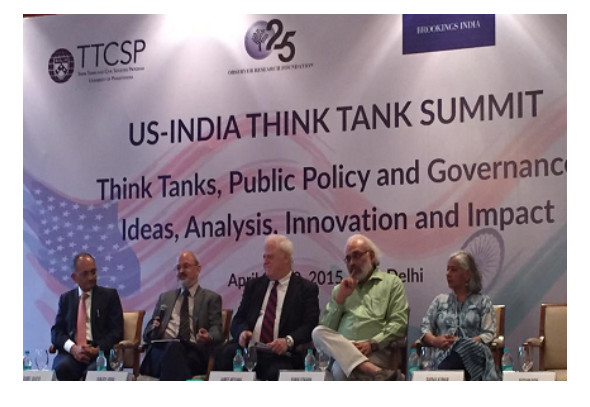
    This paper is especially interested in understanding how Indian foreign policy think tanks have played a role in enhancing US-India ties, and how this is driven by a common alignment of goals of the Indian and American states and the private sector of the two countries.

    Indian foreign policy thinks

    While the role of foreign think tanks in America’s policy making is fairly well understood and documented, this has not been the case in India. New studies are looking at the subject and attempting to plug this gap (See Reading list). As of 2020, India had the third largest number of think tanks (Global Go To Think Tank Index Report, 2020) in the world (612), behind China and United States.  In 2019 (Global Go To Think Tank Index Report, 2019), India had the second largest (509), behind the United States (1871).

    Most Indian foreign policy think tanks tend to be based in Delhi, while a handful are located in cities such as Mumbai, Kolkata and Chennai.

    Several foreign policy think tanks offer funding information in varying degrees of transparency on their websites. However, the funding and/or political affiliations are rarely if ever publicly explained, debated or elaborated on. In some cases, even the source of funding for the think tank isn’t public information.

    In course of her research on Indian think tanks, the author learnt that non-government foreign policy think tanks struggle to get much funding from the Ministry of External Affairs. Even while select private think tanks have been beneficiaries of some government largesse, by and large, private think tanks need to raise much of their funds from external sources. They thus turn to the Indian private sector, foundations, international development aid agencies, embassies and consulates of foreign countries, and international organizations like the United Nations.

    India’s prominent business families and corporations have widely invested in foreign policy, energy, environment and telecom think tanks. But even as Indian foreign policy think tanks owe much to the Indian private sector, the broader opinion in the think tank community is that big Indian business gives much more generously to American universities and think tanks.

    For example, the businessman Anand Mahindra gave $10 million to Harvard University’s Humanities Centre in 2010 (PTI, 2010). The same year Harvard Business School received a gift of $ 50 million from Tata Trusts and Companies (HBS, 2010).

    In 2017-2018 alone, Carnegie Endowment for International Peace received over $ 1 million from Indian sources like the Tata Education and Development Trusts, in the range of $100,000-499,999 from Bharti Enterprises, Kiran Mazumdar-Shaw, GM Rao and Tata Consultancy Services (carnegieendowment.org)

    Interestingly, the same set of Indian business donors which fund think tanks domestically also pour millions into educational institutions and think tanks in the United States.

    Endorsing ties with the US

    Delhi’s foreign policy think tanks in Delhi usually endorse stronger ties with the US. Indian think tanks also feel deeply inspired by their American counterparts. At one point, the Reliance Industries funded Observer Research Foundation (ORF) aspired to be the ‘Indian Brookings’ (Muni, 2010). When India’s defense ministry founded the Institute for Defense Studies and Analyses (IDSA), America’s RAND Corporation and the London’s International Institute for Strategic Studies (IISS) were considered as possible models (Subrahmanyam, 1990). The Indian Council of World Affairs, established by the Ministry of External Affairs was partly inspired by the Institute of Pacific Relations (Thakur and Davis, 2017).

    Interest from the US foreign policy community in India gained significant momentum after India’s nuclear tests of 1998. “With India going nuclear in May 1998, there was a growing eagerness in the US and other western countries to plumb the thinking in strategic circles here. In addition, India’s economic growth and its emergence as an investment destination stoked further interest.” (Sharma, 2011)

    In 2001, the Confederation of Indian Industry (CII) partnered with the United States-based Aspen Institute to sponsor a meeting between Indian and American leaders in the Indian city of Udaipur.  The meeting brought together names like Henry A. Kissinger, Brent Scowcroft, the scholar Joseph S. Nye Jr., industrialist Ratan N. Tata and influential Indian diplomats. (Yardley, 2012)

    This gave birth to the US-India strategic dialogue, a Track II dialogue, involving participation from academia, industry, media, NGOs, members of US Congress and Indian parliamentarians (aspeninstitute.org).  A few years later the Ananta Aspen Centre was established in Delhi, as an offshoot of the US based Aspen Institute. A major activity of the Ananta Aspen institute has been the convening of track-II dialogues with the US, in addition to nations like Singapore and Israel (anantaaspencentre.in).

    The Indo-US nuclear deal negotiated in the 2000s added to  India’s visibility in international fora. Plus, increasing Chinese activities in the South China Sea and India’s emergence as a major consumer market and with lucrative projects in gas, oil and infrastructure, in addition to its increasing purchase of arms made India much more significant (Interview to the author by Ajai Shukla, 2017).

    Delegations from the Brookings Institution, Rand Corporation, Centre for International and Strategic Studies and Heritage Foundation and other think tanks cultivated increasing ties with Indian think tanks (Sharma, 2011), government and analysts, seeking to understand Indian strategic and business interests and the common ground with the United States.

    The Brookings Institution set up its Delhi office in 2013 while the Carnegie Endowment followed suit in 2013. Brookings had already opened its China and Doha centres.

    According to ‘Brookings 2.0‘, a vision document of the think tank, suggests that the overseas centres will work towards promoting American leadership abroad, which it views as ‘essential’ (Sarkar, 2018)

    “Brookings is well positioned to be part of the solution to America’s problems precisely because we know our city well. Since America’s difficulties are troublesome for the world and American leadership abroad is essential, our identity as a Washington-based think tank is an asset as we ply our trade globally by virtue of our overseas centers.”

    Similarly, Carnegie Endowment with its headquarters in Washington has centres in Brussels, Moscow, Beirut, Beijing, and established its Delhi office in 2016. The stated rationale for the centres being that the think tank needed to globalise because issues like trade, terrorism, nonproliferation and climate change have a global significance – and areas where US leadership is needed (Sarkar 2017).

    Carnegie and Brookings were perhaps following the American flag in setting up their overseas centres. However, their arrival in India was facilitated and welcomed by different sections of the Indian elite including government, media, academia and business (ibid.).

    Brookings India was renamed as the Centre for Social and Economic Progress in 2020 (Mukul, 2020), while continuing to retain Brookings India’s personnel, values and funding structures (csep.org). Its major donors represent big Indian business, ranging from Adi Godrej, Aditya Birla Group, Nita and Mukesh Ambani, Rahul Bajaj, Tata Group and Kiran Mazumdar Shaw among others (ibid.). Carnegie India is a recipient of similar funding.

    Indian business interests also had a major role in establishing the Ananta Aspen Centre in the early 2000s. The former director general of the Confederation of Indian Industrry (CII), Tarun Das was a longtime advocate of an Aspen Institute in India (anantaaspencentre.in).

    Indian business too is represented on the boards of American think tanks. For example, businessmen Ratan Tata and CK Birla are on the board of trustees of the Carnegie Endowment (carnegieendowment.org). Representatives of Bharti Enterprises and ArcelorMittal Europe are on the Brookings’ board of trustees (brookings.edu).

    Figures from the US India Business Council give us further insights into the significant extent of India US business ties. More than 750 US companies are operational in India while Indian companies invested $13.1 billion in the US in 2017 (USIBC, 2019)

    Following the flag

    More recently, the India US relationship was constrained when the Indian BJP government under Prime Minister passed a series of controversial and deeply contested measures, which were also the subject of much international criticism.

    These include but are not limited to abrogation of Article 370 which changed the special status of Kashmir, the 2019 Citizenship Amendment Act which discriminates against Muslims, and new farming bills, which triggered tremendous unrest and brought Indian farmers on to the streets. The protests were met with a brutal government crackdown.   These developments received adverse commentary in American press, were raised by US senators and were also the subject of US Congress hearings (Kronstadt et al., 2021).

    The broader issue of human rights in India has received growing attention in the U.S. Congress especially with regard to Kashmir, new Indian citizenship laws, freedoms of religion and expression, and, most recently, Indian farmer protests (ibid.)

    The 2021 Annual Report of the U.S. Commission on International Religious Freedom (USCIRF) recommended that the United States designate India as a “country of particular concern” for engaging in and tolerating systematic, egregious religious freedom violations. The Indian government rejected the findings of the USCIRF reports, calling them “prejudiced, inaccurate, and misleading. The Narendra Modi led government has also been widely criticised for ordering internet shutdowns, arresting journalists and activists, and stiflling dissent- all strong indicators of authoritarianism (ibid.)

    The international criticism (Haider, 2020) was such that rather than dealing with bilateral ties,  India’s  Ministry of External Affairs and its missions abroad were ”fully devoted to dealing with India’s domestic concerns and their fallout.” India’s External Affairs Minister S. Jaishankar had to give extensive interviews to the European and US, media and make speeches at prominent think tanks in Washington and New York “Missions everywhere, including in friendly countries, have been overworked, disseminating FAQs and lobbying with lawmakers on Article 370, the Ayodhya verdict and the CAA.  (ibid).”

    It was on the heels of the abrogation of Article 370 in Kashmir that Observer Research Foundation, an Indian think tank with very close links to the Indian government and founded by Reliance Industries, a giant Indian corporation – announced the launch of ORF America, its overseas affiliate in Washington. Interestingly, the son of Indian External Affairs Minister, S. Jaishankar was chosen to lead the think tank’s Washington operations.  (Sarkar, 2020).

    Of the seven board members of ORF America, one is a senior executive of Reliance Jio (orfamerica.org).

    ORF America’s launch was made evident at a high profile event jointly organised in Washington DC by ORF India and the conservative Heritage Foundation. Held in September 2019, the event was titled India on the Hill: Charting a Future for Indo-US Relations,” and attended by India’s ambassador to the United States, Indian and US politicians the corporate world. It was timed to occur just before a week-long visit to the United States by Indian Prime Minister Narendra Modi (Sarkar, 2020).

    The think tank maintains that it is independent, but it doubtlessly remains deeply tied to its core funder Reliance Industries, both financially and operationally. ORF India is also the organizer of India’s flagship foreign policy conference known as the Raisina Dialogue, which it organizes jointly with the Indian Ministry of  External Affairs (ibid.)

    Conclusion

    India and the United States have maintained their ties through wide-ranging means and mechanisms. Indian and American foreign policy think tanks, backed by corporate funding in both countries, have played a significant but less understood role. The last decade saw prominent American think tanks express interest in establishing India centres. A much more recent development is that Indian think tanks, supported by private sector funding and the Indian government, are trying to make their presence felt in Washington.

    References

    Brookings. Board of Trustees. Available at: https://www.brookings.edu/about-us/board-of-trustees/

    Read original article: https://blogs.city.ac.uk/internationalsystemofpower/2021/09/07/think-tanks-in-india-and-the-united-states-and-the-alignment-of-state-and-corporate-goals-urvashi-sarkar/

    Carnegie Endowment for International Peace.  About/Board of Trustees. Available at: https://carnegieendowment.org/about/trustees

    CSEP (2020). Who We Are. Available at: https://csep.org/who-we-are/

    Harvard Business School (2010).  Harvard Business School Receives $50 Million Gift from the Tata Trusts and Companies. Available at: https://www.hbs.edu/news/releases/Pages/tatagift.aspx

    Haider, S. (2020). The new worry of depleting diplomatic capital. The Hindu. 2 Jan. Available at: https://www.thehindu.com/opinion/lead/the-new-worry-of-depleting-diplomatic-capital/article30453800.ece

    Iyengar, R. (2019). H-1B visas are good for India and Silicon Valley. Capping them would hurt. CNN Business. 21 June. Available at: https://edition.cnn.com/2019/06/20/tech/h1b-visa-cap-india-us/index.html

    Kronstadt, et al.  (2021). India-US Relations.  Congressional Research Service. Available at: https://sgp.fas.org/crs/row/R46845.pdf

    Malik, A. and Medcalf, R., (2011). India’s New World: Civil Society in the Making of Foreign Policy. Lowy Institute for International Policy. Available at: <https://www.files.ethz.ch/isn/130113/Malik%20and%20Medcalf,%20India’s%20new%20world_web.pdf&gt;

    Miglani et.al (2018). U.S. tells India to cut tariffs as trade friction heats up. Reuters. [online] 23 Feb. Available at: https://www.reuters.com/article/us-india-usa-trade-exclusive-idINKCN1G70J3.

    Mukul, J. (2020). After ending ties with Brookings, CSEP brings Adi Godrej, 6 others on board. Business Standard. 25 Sep. Available at: https://www.business-standard.com/article/companies/after-ending-ties-with-brookings-csep-brings-adi-godrej-6-others-on-board-120092401390_1.html.

    Muni, S., 2010. Public Policy. The Man, His Mission and His Message. In: A Brahmin Without Caste. Rupa & Company.

    ORF America. Board of Directors. Available at: https://orfamerica.org/board

    PTI (2010). Anand Mahindra donates $10 million to Harvard University. The Economic Times.  4 Oct.  Available at:  https://economictimes.indiatimes.com/anand-mahindra-donates-10-million-to-harvard-university/articleshow/6684592.cms?from=mdr

    Sarkar, U. (2020). Parent Entity. The Jaishankars blur the lines between the ministry of external affairs and Reliance-funded ORF. The Caravan. Available at: https://caravanmagazine.in/government/jaishankar-orf-reliance-dhruva-conflict-interest-raisina-kashmir.

    Sarkar, U. (2018). Brookings Demystified: Overlapping Networks And The Business Of Influencing Policy. The Wire. 3 Jan. Available at: https://thewire.in/diplomacy/brookings-business-influencing-policy.

    Sarkar, U. (2017). Carnegie Endowment In India: Promoting US Leadership With Indian Corporate Wealth. The Wire. Available at: https://thewire.in/business/carnegie-india-think-tank-role

    Sharma, P. (2011). Bases For Heads. Outlook India. Available at: https://magazine.outlookindia.com/story/bases-for-heads/278938

    Subrahmanyam, K., 1990. ‘The Birth of IDSA and the Early Years. Strategic Analysis, 13(4).

    Thakur, V. and Davis, A., 2017. A Communal Affair over International Affairs: The Arrival of IR in Late Colonial India. South Asia: Journal of South Asian Studies, 40(4)

    The Aspen Institute. 2021. The U.S.-India Strategic Dialogue – The Aspen Institute. Available at: <https://www.aspeninstitute.org/programs/aspen-strategy-group/the-u-s-india-strategic-dialogue/&gt;

    United States Department of State (2021). U.S. Relations With India – United States Department of State. Available at: https://www.state.gov/u-s-relations-with-india/.

    U.S.-India Business Council. The Voice of Industry. Available at:   https://www.usibc.com/USIBC-Pamphlet-(February-2019).pdf

    Wadhwa D. (1998). Costs of Economic Sanctions: Aftermath of Pokhran II. Economic and Political Weekly, 33(26).

    Yardley, J. (2012). Industry in India Helps Open a Door to the World. The New York Times. 31 March. Available at: https://www.nytimes.com/2012/04/01/world/asia/private-sector-helps-propel-india-onto-world-stage.html.

    Suggested readings:

    Khan, R. and Kollner, P. (2018). Foreign Policy Think Tanks in India: New Actors, Divergent Profiles. German Institute for Global and Area Studies Focus. Available at: https://www.researchgate.net/profile/Patrick-Koellner/publication/323285210_Foreign_Policy_Think_Tanks_in_India_New_Actors_Divergent_Profiles/links/5ac77740a6fdcc8bfc7fa137/Foreign-Policy-Think-Tanks-in-India-New-Actors-Divergent-Profiles.pdf

    Miller C., M. (2013). India’s Feeble Foreign Policy: A Would-Be Great Power Resists Its Own Rise. Foreign Affairs, 92(3). Available at: https://www.jstor.org/stable/23526832.

    Stuti Bhatnagar (2021). India’s Pakistan policy : How Think tanks are Shaping Foreign Relations. : Routledge, Taylor & Francis Group.
  • India, Israel and Palestine: A triangle that does not sum up

    Prime Minister Narendra Modi with his Israeli counterpart Benjamin Netanyahu in New York in 2014. Photo Credit: PMO

    Published in The Wire. 2 July 2017

    It is the 50th year of the Israeli occupation of Palestine. It has been 50 years since Israel annexed the Palestinian territories of West Bank, East Jerusalem and Gaza Strip following the Six Day Arab-Israeli War of June 1967.

    During this time, Israel has tightened its hold over the territories, crushed Palestinian resistance and created hundreds of thousands of refugees. Its discriminatory policies affecting every area of Palestinian life have invited comparisons with the South African apartheid. However, UN resolutions condemning the occupation and Israeli settlements in the West Bank leave Israel unaffected, even as it relies on the continued support of the United States for its actions.

    This is also the year that India’s Prime Minister Narendra Modi will travel to Israel; the first Indian PM to do so. He will address a gathering of Jews of Indian origin in a community reception in Tel Aviv on July 5. Modi he will not visit Palestine.

    Historically, India framed its relationship with Israel based on a priority accorded to Palestine. In 1936, Jawaharlal Nehru informed the Zionist emissary Immanuel Olsvanger that he could not tolerate imperialism in India or Palestine.

    P.R. Kumaraswamy, professor of West Asian Studies at Jawaharlal Nehru University, writes that while anti-colonialism was an important aspect of India’s backing Palestine, there was a religious dimension to the matter. The Congress and the Muslim League perceived the anti-imperialist Palestinian cause as a way to win over Indian Muslims whose support they were competing for and to unite Indian Muslims with the resistance against the British. Supporting Palestine was also a method of leveraging India’s interests in the Middle East.

    Road to Washington and arms access through Israel

    Nevertheless, India established full diplomatic ties with Israel only in 1992, even though it had formally recognised Israel in 1950. The end of the Cold War in 1991 reconfigured world politics and established the United States as the sole superpower.

    Vijay Prashad, professor of International Relations at Trinity College, says: “India’s road to Washington and arms lay through Israel. After India’s nuclear weapon tests in 1998, the US imposed economic and military sanctions. During the 1999 war with Pakistan, Israel supplied arms to India, which were American in any case. India under Indira Gandhi had already reached out to Israel in 1971 for arms despite absent diplomatic ties. The Palestine issue started getting sidelined long ago, while the Congress was in power.”

    In 2009, following lobbying by US and Israeli governments, India diluted its stand on the Goldstone Report which showed the illegality of Israel’s blockade of Gaza and accused it of violating international law.  The Congress expressed “reservations in making unqualified endorsement” of the report recommendations.  According to Prashad, there is not much difference in the language used in 2009, and the language subsequently used by India for Israel’s attacks on Gaza in 2012 and 2014.

    Then, for the first time in 2015, India abstained on a UNHRC resolution calling for a probe by the International Criminal Court into war crimes by Israel.  It continued to abstain on the resolution in 2016 and 2017 as well. However, it has voted in favour of other UNHRC resolutions that criticised Israel on the expansion of settlements and the right of Palestinians to self-determination.

    India justified abstaining on the grounds that the resolution referred to ICC of which India is not a member. But a report in The Telegraph showed that India voted at least twice in favour of UNHRC resolutions which refer to the ICC in the context of atrocities in Syria. India’s altered voting behaviour therefore caused speculation that India had changed its policies on Palestine which the government has denied.

    India-Israel bonhomie under Modi

    Undoubtedly, there is markedly more visible warmth between the two countries since 2014 when Modi was elected PM.  High level visits to Israel by Home Minister Rajnath Singh, President Pranab Mukherjee and External Affairs Minister Sushma Swaraj have already happened.  While Singh did not visit Palestine, Mukherjee and Swaraj did so. During the Congress regime too, a steady stream of bilateral visits continued to Israel.

    Interestingly, the first time that a senior Indian minister visited Israel was only in the year 2000, when the BJP was in power; and the minister was L.K. Advani.  This is despite the fact that diplomatic relations were established since 1992 and Israel had been sending its presidents and prime ministers to India since 1993.  The most recent visit being of President Reuven Rivlin in November 2016.

    India and Israel have been cooperating in a range of areas including agriculture, water conservation, science and technology, trade and investment. India and Israel also view each other as victims of Islamist terror which complements Modi’s Hindutva background. But by far, the largest area of cooperation is in defense.

    Israel’s defense industry bagged its biggest security contract in April 2017 with the state-owned Israel Aerospace Industries being awarded contracts worth $2 billion for providing medium range surface to air missile systems to the Indian Army. There are expectations of further arms deals when Modi visits Israel. It is no secret that India is currently the biggest importer of arms in the world while Israel is its second largest foreign supplier.

    Where does Palestine stand?

    Where does Palestine stand next to India-Israel bonhomie? When Palestinian President Mahmoud Abbas visited India last month – his third state visit to the country – Modi mentioned India’s unwavering support to Palestine and for a two state solution. He also spoke of a ‘sovereign, independent, united and viable Palestine, co-existing peacefully with Israel.’

    Even before Abbas’ visit, a Palestinian Authority official said that while India had the right to build relations with Israel, it should not come at the expense of support for Palestine.

    How has that panned out? Is it possible for India to de-hyphenate its ties with the two countries, considering that one is an internationally condemned transgressor state and the other fighting for independence from it? India’s defense ties with Israel make this even more difficult.

    Palestinian embassy officials in Delhi who monitor India-Israel ties have expressed unhappiness over the increasing defense relationship.  A Der Spiegel investigation in 2014 showed that Israel invests significant sums into defense research and production. A good chunk of defense production is exported to countries like India. Defense export revenues in turn make it possible for the Israeli forces to sustain the military occupation of Palestine, inviting allegations that India is subsidising or underwriting the occupation.

    When Modi visits Israel on July 4, what should we expect? Will he refer to the Palestinian cause? One can expect utterances about ‘the peace process and support for the two state solution. But it is doubtful he will go further – he is unlikely to raise the issue of the Palestinian prisoners’ hunger strike for example.

    Any criticism of Israel’s human rights records at international forums could invite criticism of the Modi government’s own policies in Kashmir where he has militarily suppressed dissent and separatism. Neither Netanyahu nor Modi will embarrass each other; Netanyahu in particular would be eager to win over India for the longer term, especially as a voting ally at various human rights forums.

    As Palestine observes its 50th year of Israeli occupation, hard strategic and military calculations define India’s national interest and colour its ties with Israel and Palestine.

    Read the original article: https://thewire.in/diplomacy/india-israel-palestine-modi

Urvashi Sarkar – 2026 – All rights reserved.

web things by Studio Goncharov