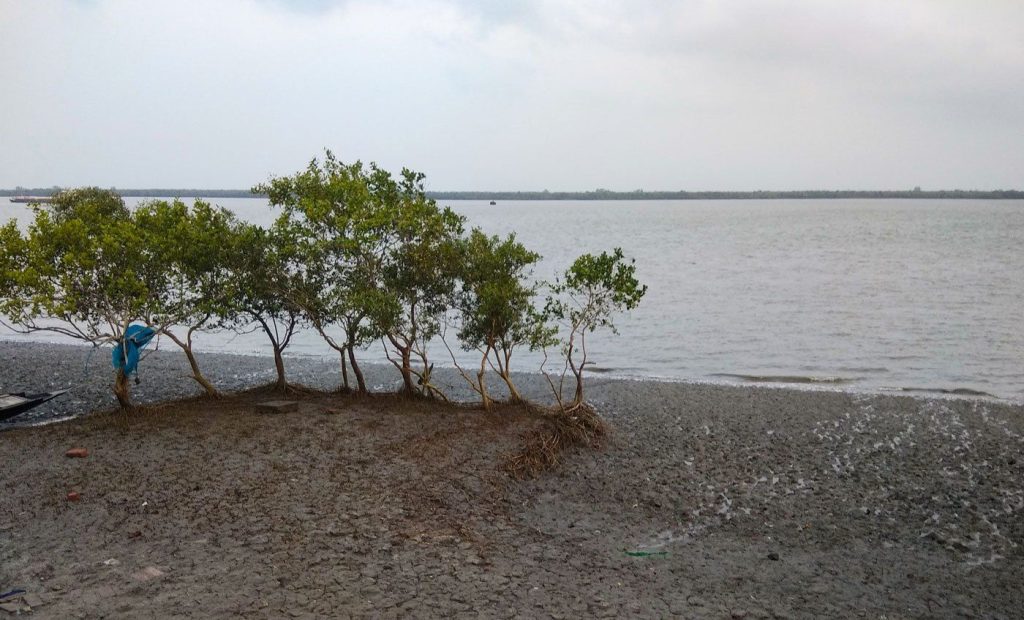
In Gosaba block, on the Indian side of the Sundarbans, a woman named Rina Mondal keeps a calendar on the wall of her mud-and-thatch home. It is not a calendar of dates. It is a calendar of water — markings in blue pen that track the height of the tide against her doorframe after each cyclonic surge. The markings have climbed eleven centimeters in six years. Rina is not a climate scientist. She is a crab collector whose livelihood depends on reading the estuary with a precision that satellite altimetry is only beginning to match. When I asked her whether she had heard of the Intergovernmental Panel on Climate Change, she laughed and said she didn’t need a panel to tell her the river was eating her yard.
Across the tidal islands of the Indian and Bangladeshi Sundarbans, women like Rina have become the primary economic agents of climate adaptation — not because policy designed it that way, but because male out-migration to construction sites in Kolkata, Dhaka, and the Gulf states has left them managing households, fisheries, and small agriculture plots alone. They are the ones negotiating with moneylenders when a harvest fails, the ones walking three hours to collect drinking water when salinity intrusion poisons the tube wells, the ones deciding which child stays in school when income contracts. Their adaptation strategies are sophisticated: rotating between crab harvesting, prawn seed collection, and seasonal rice cultivation to spread risk across the calendar. But these strategies are invisible to the state-level climate action plans that govern adaptation funding in both West Bengal and Khulna Division.
The disconnect is structural. India’s National Adaptation Fund channels resources through district-level bureaucracies that measure outcomes in infrastructure — embankments built, cyclone shelters constructed, solar pumps installed. These are necessary interventions. But they do not reach the livelihood layer where women are making daily trade-offs between present consumption and future resilience. A woman who shifts from rice to salt-tolerant varieties is performing adaptation. A woman who forms a self-help group to collectively negotiate crab prices at the Canning market is building adaptive capacity. Neither action registers in the metrics that determine where the next tranche of funding goes. Until adaptation policy learns to see what women in the Sundarbans are already doing, it will continue to build walls against the sea while the economy behind those walls quietly hollows out.