Tag: Al Jazeera

  • Does India have enough insurance coverage for a nuclear disaster?

    Does India have enough insurance coverage for a nuclear disaster?

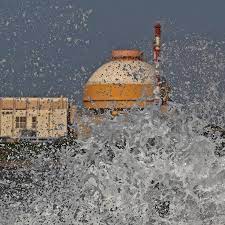
    India has plans for adding several nuclear power plants but has not laid out how any of them will be insured [File: Adnan Abidi/Reuters]

    India has barely half the insurance amount it needs in the event of a nuclear disaster, raising concerns among experts about the lack of oversight on the nuclear sector.

    The India Nuclear Insurance Pool (INIP) has collected around 7 billion to 8 billion rupees ($84.5m to $96.6m) of the 15 billion rupees ($182.9m) required under the Civil Liability for Nuclear Damage Act, 2010 (CLND), indicating a critical shortfall in funds that will be needed to compensate victims and pay for cleanup in case of a nuclear disaster.

    The funds disclosure was made at the nuclear insurance session of the India Nuclear Business Platform in December where the speakers included representatives of Nuclear Power Corporation of India Limited (NPCIL), which operates the country’s nuclear reactors, and leading insurance companies including New India Assurance and GIC Re.

    The INIP was set up in 2015 under the CLND legislation. Under that law, operators and suppliers of nuclear power plants are liable in case of an accident, and both must obtain insurance through the INIP.

    At the time, India’s Department of Atomic Energy in its frequently asked questions (FAQs) on the CLND Act stated that GIC Re and four other public sector insurers would collectively contribute half of the total required amount of 15 billion rupees ($182.9m), with the government filling in the balance for the first few years “till the insurance companies are able to maintain it on their own”.

    “The fact that the nuclear insurance pool has not even met what is required by law is concerning — it shows that the Parliament is not overseeing how the nuclear sector is operating,” said MV Ramana, professor at the School of Public Policy and Global Affairs, University of British Columbia and author of The Power of Promise: Examining Nuclear Energy in India. “My greater concern is the approach of NPCIL and other parties involved, which seem to think of liability requirements as a box to check off, rather than something they need to prudently plan for.”

    “They seem to be victims of the same ‘safety myth’ that was at the root of the inadequate preparations for nuclear accidents revealed in the aftermath of the multiple reactor accidents at the Fukushima Daiichi nuclear plant in Japan [in March 2011],” Ramana said.

    India currently has 22 reactors, all of which are operated by the NPCIL. The INIP provides insurance to all of them. Apart from this, it has 10 reactors that are at various stages of construction (one of which has been connected to the grid) and New Delhi has sanctioned another 10 — all of which are expected to start functioning by 2031. But how these plants will be insured is unknown.

    Nuclear pools

    Nuclear pools were first set up in the 1950s in the United States by insurance companies to deal with potential accidents at civilian nuclear reactors. A number of insurers come together to jointly underwrite civil nuclear risks since a nuclear accident has catastrophic potential with enormous costs – beyond the capacity of individual risk insurers to take on.

    The INIP, which is made up of India’s national re-insurance company GIC Re in association with 11 domestic non-life insurance companies, is managed GIC Re. Of the amount raised, public sector insurance companies have so far contributed 86 percent, with private insurance companies bringing in the rest. GIC Re’s contribution is the largest, with 6 billion rupees ($73m).

    “The insurance companies might have paid their share if the reinsurance market had supported them,” said Shreyas Jayasimha, co-founder of Banglaore-based Aarna Law. “Just as individuals seek insurance for their risks, insurance companies too require to cover their risks.”

    Inadequate cover

    There is also concern about whether the insurance cover of 15 billion rupees ($182.9m) is enough to insure all of NPCIL’s 22 reactors annually.

    “If there is a nuclear incident where the annual limit of 15 billion rupees of the policy issued under INIP is partially or completely utilised, the other nuclear installations would be without full or any cover for that year,” said Pallavi Bedi, partner at Phoenix Legal and a specialist in energy projects.

    The Indian nuclear pool’s genesis can be traced to a 2008 agreement between India and the US for civilian nuclear cooperation. Under the agreement, India was allowed to start importing nuclear technology and materials and enabled the entry of private firms into the Indian civilian nuclear market.

    But India lacked a regime that assigned legal liability in the event of a nuclear accident. The CLND Act 2010 was brought in to resolve that, amidst much debate and wrangling in the Indian Parliament. The question of whether suppliers should be held liable emerged as a serious point of contention, with critics in India accusing the government of providing a shield to US firms in an effort to get them on board as suppliers, at the expense of Indian citizens.

    Fukushima, Chernobyl and Bhopal

    While the insurance industry refers to nuclear incidents as the “rarest of rare”, the last major nuclear disasters were in 1986, when there was a leak at a plant in Chernobyl in Ukraine when it was still a part of the Soviet Union, and in 2011, when a major earthquake and a tsunami caused a nuclear accident in Fukushima in Japan.

    The explosion and fire at the Chernobyl nuclear reactor released radioactive material into the atmosphere, affecting thousands and having ramifications across Russia, Belarus, Ukraine and several European countries. The economic costs of the accident ranged anywhere between $235bn and $700bn, including compensation worth hundreds of billions of dollars, not to mention far-reaching costs to the environment and health.

    The costs of Japan’s Fukushima disaster have been estimated at more than $200bn, of which compensation costs included $72bn. The Fukushima disaster displaced thousands, with cleanup activities continuing for a decade.

    Closer to home, India’s variant of an industrial disaster – the 1984 Bhopal gas leak – killed more than 15,000 and caused serious health problems in about half a million people when a pesticide plant leaked toxic methyl isocyanate gas into the atmosphere, subjecting generations of people to adverse health effects such as cancer, congenital malfunctions, and lung and heart diseases.

    Union Carbide Corporation, a US company that built the damage-causing Bhopal plant, paid a paltry $470m in compensation to victims and their families. In the US, Union Carbide was altogether cleared of any direct liability towards victims.

    Liability regimes

    Chernobyl nuclear disaster
    An explosion and fire at the Chernobyl nuclear reactor released radioactive material into the atmosphere, affecting thousands across Europe and the Soviet Union [File: Damir Sagolj/Reuters]

    As far as the nuclear industry is concerned, liability is usually chanelled towards operators of power plants while suppliers remain shielded. This practice began in the 1950s in the US, where in order to encourage private sector participation in the nuclear industry, operators are held almost wholly liable. Many other countries followed suit, with the US also influencing the shaping of the international Convention on Supplementary Compensation for Nuclear Damage (CSC). Even when operators are held liable, the economic liability is capped at a small figure at a fraction of actual costs.

    “This cap varies by country, but is usually set below $1 billion — a number that is almost a hundred times smaller than the financial impact of a severe nuclear accident like Fukushima” the physicists MV Ramana and Suvrat Raju wrote in the New York Times.

    India’s liability laws too fall in line with the global trend, barring Section 17 b of the CLND Act, 2010, which allows the operator the right of recourse in case the accident is found to be “the consequence of an act of supplier”, which includes the supply of defective or sub-standard equipment or material.

    The operator of nuclear installations in India is the government-run NPCIL. Suppliers – which may not necessarily be foreign companies – provide manufacturing, supplies, building and design services

    According to insurance companies, the reason for including such a clause is because of “bad experiences” in the aftermath of the Bhopal gas tragedy.

    Liability beyond 15 billion rupees ($182.9m)

    Victims of Bhopal gas tragedy hold posters during a demonstration outside a court in the central Indian city of Bhopal
    India’s Supreme Court in a decision that dismissed the federal government’s effort to seek additional compensation from Union Carbide in the Bhopal gas disaster said that it was India’s ‘responsibility’ to make up for the deficiency in compensation [File: Raj Patidar/Reuters]

    An updated version of FAQs on the nuclear liability act released by the Department of Atomic Energy in 2020 continues to stress the operator as the primary bearer of liability up to 15 billion rupees ($182.9m). In case compensation claims exceed this limit, the government is expected to step in.

    “In case liability exceeds 15 billion ($182.9m), the government will have to pay the rest. The government owns and operates the country’s nuclear power plants for the people and is therefore responsible to them,” said Prabir Purkayastha of the Delhi Science Forum, who was an expert witness for the Parliamentary Standing Committee for the Nuclear Safety Regulatory Authority Bill, 2011.

    The Indian government has also limited the maximum liability, including its own, in the event of a nuclear incident, to the rupee equivalent of 300 million Special Drawing Rights (SDRs) or over 33 billion rupees ($374m).

    SDRs are a global reserve asset created by the International Monetary Fund. The SDR is based on a basket of five major currencies, and holders – including IMF member countries, among others – can exchange SDRs for currency when needed.

    If liability exceeds 300 million SDRs in the event of a nuclear mishap, the government expects to meet balance claims by “access(ing) international funds under the CSC.”  India joined the Convention on Supplementary Compensation for Nuclear Damage (CSC) in 2016.

    But how claims would play out at the CSC is unclear.

    More recently, India’s Supreme Court in a decision that dismissed the federal government’s effort to seek additional compensation from Union Carbide in the Bhopal gas disaster said that it was India’s “responsibility” to “make good the deficiency [in compensation] and to take out the relevant insurance policy. Surprisingly we are informed that no such insurance policy was taken out. This is gross negligence.”

    According to Jayasimha, the wording of the Supreme Court judgement is significant for the nuclear industry and all hazardous waste industries. “The court has indicated that there is a duty on the part of the state to ensure people are adequately insured.”

    For now, it’s unclear if the judgement will be used to push for better insurance provisions.

    Questions to NPCIL, the Department of Atomic Energy, New India Assurance and GIC Re about the failure of the INIP to accumulate the corpus of 15 billion rupees ($182.9m) and how the government plans to insure forthcoming nuclear reactors did not receive a response.

    Managing director of the Nuclear Business Platform, Zaf Coelho, said via email: “In case of any nuclear disaster, the claim amount exceeding the accumulated corpus will be shared by the INIP consortium partners on a pro-rata basis based on their committed share in the pool.”

    Originally published in Al Jazeera.

    Read the full article here: https://www.aljazeera.com/economy/2023/4/21/does-india-have-enough-insurance-coverage-for-a-nuclear-disaster
  • With no formal schools or jobs, young Rohingya left in lurch

    Published in Al Jazeera. 13 April 2018.

    Cox’s Bazar, Bangladesh – It is a hot, chaotic morning at Kutupalong, the world’s largest refugee camp located on the Bangladesh-Myanmar border. Rohingya women, men and children, uprooted from Myanmar, form long queues outside the offices of various aid organisations and wait to receive clothes, food and medicines.

    There is a rush to collect stacks of bamboo to protect weak settlements from the upcoming monsoon. Children help out too, carrying the heavy poles as they balance boxes of aid material on their little heads. Some children run around and play in groups, while others attend temporary learning centres where English, Burmese and mathematics are taught.

    The Rohingya have faced brutal persecution and discrimination at the hands of the Myanmar government, which refuses to recognise them as citizens and has killed or forced out large chunks of their population in repeated, barbaric acts of ethnic cleansing.

    Following the most recent cycle of violence in August 2017, more than 700,000 Rohingya have sought refuge in Bangladesh’s Cox’s Bazar district, taking their population in Bangladesh to about a million now.

    Children and youth between 3-24 years comprise nearly half of the Rohingya refugees and are not allowed to pursue formal education in Bangladesh.

    Only informal education is available through temporary learning centres and religious schools or ‘maktabs’ which offer Arabic language and Quranic education.

    Maktabs are separate from the network of temporary learning centres and are funded by private Bangladeshi donors or countries like Saudi Arabia and Turkey.

    Viewed against the backdrop of religious oppression of the Rohingya in Rakhine state, the maktabs are seen positively by the refugees in Bangladesh camp. The maktabs also keep the children occupied, since any movement outside the camp is not allowed.

    Informal education their only option

    Set up by UNICEF, Save the Children and local Bangladeshi organisations, the temporary learning centres, now numbering close to 1,100, provide informal education to Rohingya children aged 4-14 years.

    Bengali, however, is not being taught, since the Bangladesh government does not plan to integrate Rohingya refugees with the local population.

    It is past noon, and the temporary learning centre at the camp has wound up for the day. Children scamper out of the small room made of tin, sticks, and coarse cloth.

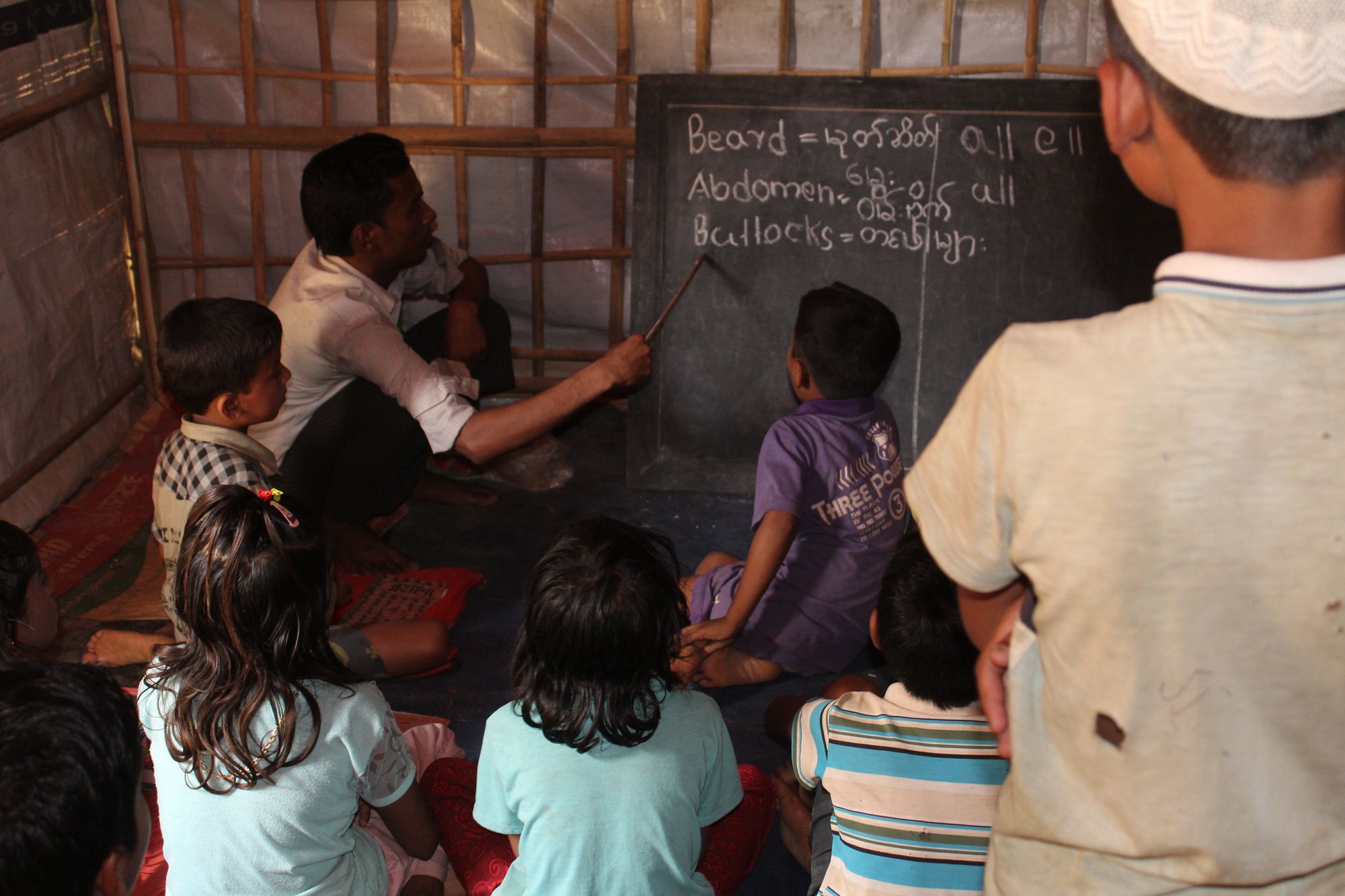
    A blackboard, bearing the words ‘beard’, ‘buttocks’ and ‘abdomen’ in English, stands in a corner. The teacher, Mohammed Abdullah, an 18-year-old Rohingya refugee, rubs it clean.

    As s Abdullah explains the curriculum to me, he is joined by Janatullah, also 18 and a Rohingya refugee.

    Janatullah appears restless and angry – he was unable to attend his matriculation exam because of the violence that broke out in Myanmar’s Rakhine state in August 2017.

    “I would have appeared for the examination this year. I was the best in my class. But the violence drove us out. The Myanmar government murdered our families and prevented us from education. I wanted to study in a university and learn English. I do not know if it will ever happen. Now, I can only live on charity,” Janatullah told Al Jazeera.

    Staring at a bleak future

    Janatullah speaks in English, which he says he learned after arriving in Bangladesh. But since he is 18 years old, no form of education – even informal – is available for him in the refugee camp. While Abdullah was able to find work as a teacher in the camp, Janatullah was not as fortunate.

    His despair is echoed by Sanjib Sil, a resident of the adjacent Hindupara camp. A Hindu Rohingya in his early 20s, Sanjib said he had both fertile land and his own business in Myanmar. Now, he has nothing.

    “I do not have even five rupees. I have to stand in line and beg for charity. I cannot step out of the camp. My future is ruined, and I am condemned to an unproductive existence. No girl will be willing to marry me,” said a distraught Sanjib.

    The tribulations of Janatullah and Sanjib are shared by hundreds of young Rohingya in Bangladeshi refugee camps who have been abruptly wrested from formal education and any chances of employment.

    Photo: Siddharth Adelkar

    There are no formal jobs available for Rohingya in the camps. According to a recent report, nearly 62,000 refugees have been able to do small cash jobs in the camps.

    There are also a few Rohingya who managed to escape Myanmar with some money and have been able to set up small shops where they sell vegetables, fruits and clothes to other refugees.

    Nizamuddin, 32, is a Rohingya teacher at a temporary learning centre in Balukhali camp. He is a graduate, a rare distinction among the refugees because of long discrimination against the Rohingya in schools and universities in Rakhine state.

    “It was not easy to complete graduation. I ignored the insults and humiliation of Muslims and tried not to get into fights. I passed out of Rakhine state’s Sittwe University before 2012. That was the year fighting broke out between Muslims and Buddhists, and many Muslims were killed. It became almost impossible for Muslims to get admission in Rakhine colleges after 2012,” he said.

    Nizamuddin worked as a private tutor and taught in small rural schools in Rakhine and earned a satisfactory living. In Bangladesh, he earns 8000 taka ($96) a month and can teach only Burmese, English and mathematics, whereas, in Myanmar, he could teach more subjects.

    My prospects have reduced here. I remember how I struggled to graduate. Has it amounted to nothing?” he asked.

    Rohingya girls’ situation worse

    If boys and young Rohingya men are staring at a bleak future as stateless refugees, the situation is possibly grimmer for female children and adolescents who, apart from being forced to pull out of formal education, face the additional threats of child marriage and sex trafficking.

    Nine-year-old Kasmin Fatema goes to both a temporary learning centre and a maktab at the Kutupalong camp. Gultaz Begum, her mother, has yet not decided how long she will permit Kasmin to go out.

    Gultaz herself dropped out after third grade in Myanmar. “As I grew up, my family was scared that I would be harassed by Rakhine men,” she said.

    However, she is happy that Kasmin is learning English at the temporary centre. “Despite attending school in Myanmar, my daughter could not even write her name.”

    “Muslims faced a lot of discrimination in schools. Now she can write her name in English and read too,” she said, hoping against hope that Kasmin could become a teacher one day.

    Cover photo: Urvashi Sarkar

    Read the original article: https://www.aljazeera.com/features/2018/04/13/with-no-formal-schools-or-jobs-young-rohingya-left-in-lurch/

  • Kashmir: A look at the Kunan Poshpora rapes

    Writers Ifrah Butt and Natasha Rather

    Published in Al Jazeera. 24 December 2016

    Twenty-five years have passed since the 1991 incident in which Indian army soldiers allegedly raped between 23 and 100 women in Kashmir’s Kunan and Poshpora villages during a search operation.

    The Indian army has denied the accusations and a delayed investigation of the incident concluded that the allegations were “worthless” and no one was prosecuted for the alleged crimes.

    But, in 2013, a group of 50 women, including the authors Ifrah Butt and Natasha Rather, petitioned the Supreme Court of India to re-open the investigations. Since then, a reinvestigation was ordered and the Kashmir High Court ordered that victims be paid compensation. The state government and army have mounted efforts to stop these orders.

    Al Jazeera spoke to Ifrah Butt and Natasha Rather who, along with three others, co-wrote a book, Do You Remember Kunan Poshpora?, published earlier this year.

    Butt and Rather, both young women in their twenties, spoke about the impact of militarisation on Kashmiri Muslim women and men, political solidarities, about Kashmiri women who inspire, and the issue of self-determination in Kashmir.

    Al Jazeera: How and when did you learn about the Kunan Poshpora rapes?

    Ifrah Butt: I had a faint idea of the events of Kunan Poshpora, but it was not something which we talked about, because it is taboo to discuss rape in Kashmiri society. We were documenting cases of sexual violence at Jammu Kashmir Coalition of Civil Society, when we learned about the full details.

    At that time, people were on the streets in India, demanding immediate justice for a young woman who was raped in Delhi in December 2012. We wondered why nobody had sought justice for the Kashmiri women who were raped more than 20 years ago.

    Al Jazeera: How has the conflict in Kashmir affected women and their participation in the public sphere?

    Natasha Rather: Before the conflict escalated in the late 1980s, girls were encouraged to attend college, work and occupy high positions. But they were forced to drop out due to the conflict.

    During the conflict, women helped [fighters] with meals and shelter, and acted as their couriers.

    Increasing instances of rape were recorded after the armed uprising began in 1990s and incidents like Kunan Poshpora made women more aware of their vulnerability.

    Rapes were humiliating for the entire Kashmiri community and demoralising. As a result, women were made to cover their faces and wear burqas. Their movements were restricted.

    But after a point they had to go out and work because the men were being killed, or were in jail. There are hundreds of half-widows in Kashmir – women whose husbands disappeared.

    Since the year 2000, more women started working. Now, many own big businesses, boutiques and beauty parlours, and are in the bureaucracy.

    But the result of militarisation is that [Kashmiri women] dread men in uniform. We won’t enter a park, if we see them sitting even far away, or walk down streets where there is an army bunker.

    Butt: Kashmiri women have been abused both by militants and Indian security forces. Militants also used rape, especially if women were caught as informers. For example, in the 1990s, a Kashmiri Pandit [Hindu] nurse was raped and shot for being a suspected police informer.

    Similarly, there are instances of Indian security forces raping female members of a militant’s family as a way of punishing the fighter.

    Women were raped on both sides.

    Al Jazeera: Men have been tortured and brutalised during the conflict as well. What were the consequences?

    Rather: Incidents of sexual torture and assault against men and boys have been recorded. But many such incidents go unreported because the victims fear shame and dishonour.

    Butt: Also, I think, men started thinking that they could not take care of the women after incidents of rape and sexual assault against women by military and paramilitary forces increased.

    Al Jazeera: What is the situation of Kashmiri women with regard to employment, marriage and sexual freedom?

    Rather: Government jobs or education and banking jobs are considered the best for Kashmiri girls. Some families express discomfort about women working with men. Caste and class considerations can be important in selection of partners, but such ideas are slowly changing, especially among the middle class.

    There is complete silence around premarital sex since Kashmiri society considers this to be a disgrace and dishonour.

    Butt: We have the liberty to choose our partners, that is, husbands, but we cannot cohabitate with a partner if unmarried. Premarital sex is a big no. Sexuality and related issues like rape or even harassment are not discussed.

    Al Jazeera: During the exodus of Kashmiri Pandits during early 1990s, women from the Pandit community were reportedly raped. Has the violence against them been forgotten?

    Rather: Rape of a Kashmiri Pandit woman is as condemnable as of a Kashmiri Muslim woman.

    Butt: There were some incidents of rapes committed by militants in the 1990s. Such incidents, too, need documenting.Al Jazeera: The outrage around the 2012 Delhi rape prompted you to delve into Kunan Poshpora. Do these other incidents in India also affect you?

    Rather: The 2012 agitations demanded that the culture of silence [over rape] be broken. It seemed to be an apt time for talking about gendered violence in Kashmir.

    Events in India do impact us, especially movements led by the people. But while most other agitating groups do not want freedom from India, Kashmiris want self-determination.

    Butt: Events from all over the world impact us, be it Palestine, Syria or Yemen. We express our solidarity with every oppressed nation and groups like the Dalits or tribal groups. We do it by writing about it and expressing ourselves on social media.

    Al Jazeera: Are you indicating that Kashmir needs freedom first, and only then can social problems like patriarchy and caste be dealt with?

    Butt: We can solve our problems only if we are alive. We saw how young boys and girls were killed since 2008. There are massacres, and if this continues, there will soon be no one left to deal with the other social problems.

    Once we get freedom we will work for a perfect nation. But when our existence is in peril, we cannot think of anything else.

    Rather: The right to self-determination precedes everything else. When India was waging its struggle for freedom, did it wait to eliminate caste biases, religious intolerance or patriarchy?

    Read the original article: https://www.aljazeera.com/features/2016/12/24/kashmir-a-look-at-the-kunan-poshpora-rapes/

  • The bookseller saving Jerusalem’s Palestinian identity

    Published in Al Jazeera. 30 May 2016

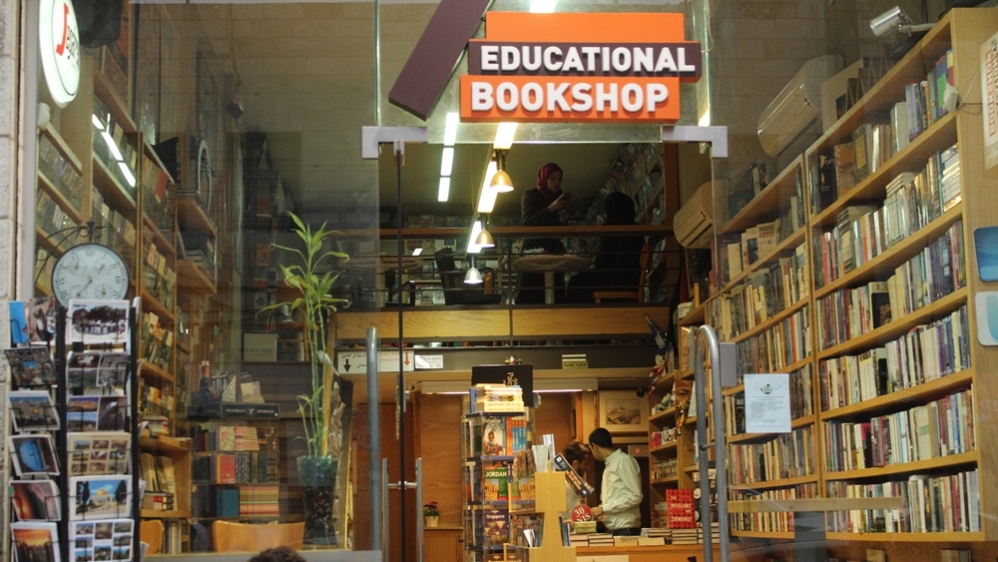
    Jerusalem – On Jerusalem’s busy Salah Eddin Street, where cafes, grocery stores, money exchange centres and jewellery shops proliferate the landscape, a prominent board at number 22 announces itself as the Educational Bookshop.

    Shortly ahead, across the road, is another bookstore and cafe, also titled the Educational Bookshop. Both belong to the Jerusalem-based Muna family; the first sells Arabic books and stationery while the latter sells English books. “The bookshop started with one bookseller: my father. Now we are six brothers who read, recommend and sell books,” said Mahmoud Muna, manager of the English bookshop.

    Upon entering the English bookstore, a shelf stocked with books by noted Palestinian academic Edward Said catches the eye. The presence of Said at the entrance is significant since it was his family who originally owned the Arabic bookshop.

    Muna traces the connection: “The Edward Said family had bookstores in East and West Jerusalem. They ran the Palestine Educational Bookshop on Salah Eddin Street, where they sold stationery and books,” Muna told Al Jazeera.

    The shop changed hands a few times. When Muna’s father, Ahmed, bought and established it in 1984, he dropped Palestine from the title, since it was illegal then to have the word ‘Palestine’ in the title of an entity or the Palestinian flag. Therefore, the name was changed to The Educational Bookshop.

    Photo: Urvashi Sarkar. The mission of the bookstore is to reinforce the Palestinian culture and identity, says Muna 

    The history of both bookshops is a reflection of the reading preferences of Jerusalem’s inhabitants, both locals and tourists, over the years. During the 1980s and early 1990s, the Arabic bookstore stocked mostly books in Arabic on politics, history, poetry, literature and fiction, and some English books on tourism.

    A turning point came in 1994-95, when, according to Muna, many Palestinians stopped reading. “Palestinians had been reading about the supposed light at the end of the tunnel, promoted by nationalist Palestinian writers who wrote about how the peace process would bring freedom,” recalls Muna.

    But after the 1993 Oslo Agreement, things changed. “It turned out to be lies, and people stopped trusting books. Consequently, the bookstore also suffered.”

    Muna characterises the post-Oslo years as a time when Jerusalem received an influx of international NGO workers, diplomats and journalists. “Jerusalem’s newcomers sought to understand Palestine and the Middle East better and wanted English books. We made a conscious decision to increase our English selection.”

    Therefore, Imad Muna, the eldest of the Muna brothers in charge, decided to increase the English selection of the store.

    Muna still remembers the ripples created by the publication of Said’s Peace and its Discontents, published in 1996. “It was the first book to criticise the Palestinian Authority [PA], exposing the peace process and Oslo. We sold hundreds of copies in English and Arabic to Palestinians and foreigners. The PA banned it, but we could sell it since being in Jerusalem we are not under the PA.”

    The history of both bookshops is a reflection of reading preferences of Jerusalem’s inhabitants, both locals and tourists [Courtsey of the Muna Family/Al Jazeera]

    The bookstore expanded on Said’s collection, also stocking books by Israeli historians like Ilan Pappe and Avi Shlaim, who were critical of the Israeli narrative. Realising that there was a big market for English books, in 2007-08, a new bookstore was established with only English books, along with a cafe and a literary-cultural space called the Jerusalem Literary Salon.

    “We also witnessed a revival of Arabic readership during this period to which the Arabic bookstore catered.”

    ‘The bookshop started with one bookseller: my father. Now we are six brothers who all read, recommend and sell books,’ says Mahmoud Muna [Courtesy of the Muna Family/Al Jazeera]

    Muna reflected on the need to present the Palestinian story in English. “There were no proper English bookstores in Jerusalem, and the only English books were in Israeli bookshops which portrayed the Israeli viewpoint. British and American authors with orientalist perspectives were writing about Israel and there was very little on the Palestinian viewpoint. This, however, changed in the 90s.”

    The English Educational Bookshop was the first of its kind in Palestine. “This was the first bookstore that sold books in English by Palestinians and about the Palestinian viewpoint,” he says.

    Central to the identity of the two bookstores is their location in Jerusalem. “We want to reinforce the notion of Jerusalem as the Palestinian capital. We may expand to other areas, but our main area of functioning needs to be Jerusalem,” Muna says, acknowledging that a Jerusalem location renders it inaccessible to many Palestinians who face restrictions on entering Jerusalem.

    The English bookstore also hosts cultural and literary events, such as readings, screenings, exhibitions and talks. The bookshop, according to Muna, plays a role in the larger spectrum of cultural resistance and it is being viewed as reinforcing Palestinian culture and identity.

    “The Palestinians have been stripped of their rights, political representation and freedom. The last thing we have is our culture – the last wall of resistance, which Israel will find very hard to break down. The mission of the bookshop is to reinforce Palestinian culture and identity.”

    The English bookstore hosts cultural and literary events, such as readings, screenings, exhibitions and talks [Courtesy of the Educational Bookshop/Al Jazeera]

    The store has about 1,500 titles encompassing history, fiction, politics, poetry and even cookery. “These are serious books, not propaganda. We sell books on Palestine written in different parts of the world.”

    The bookshop has titles from across the Middle East. Muna says: “This is not a Palestine-Israeli conflict; it was and is an Arab-Israeli conflict.”

    The operations of the bookshop are not without hurdles, with the delivery and clearances of books often delayed. “Our books come from the US, UK, India, France, Germany, Jordan, Egypt and Spain and pass through Israeli security,” he said.

    “The Israelis pick on titles. They do not like books such as the Ethnic Cleansing of Palestine by Ilan Pappe or Jeff Halper’s book on Israeli manufacture and sales of arms. They also do not like books on Hamas, or with provocative covers. The delivery of such books is delayed by two or three weeks. But since there is no censorship law over English books, no books are confiscated.”

    Books from Syria, Lebanon and Iran cannot come directly. Instead, they are routed through Jordan.

    Muna recalls when Mordechai Vanunu, who had revealed Israeli nuclear secrets, was kidnapped twice from the store. “When the Israeli army come, they create a scene. Once a man was shot outside, and our CCTV cameras recorded it.” According to Muna, the Israeli forces closed the shop for hours and wanted to take the camera. The lawyer, however, convinced them to take only the footage.

    They took the phones of customers and deleted pictures. “Sometimes, they spray chemical skunk gas in our neighbourhood, and the foul odours enter our store, too. We do not know if we are being targeted.”

    On the positive side, Muna points out that there has been a renewal of Palestinian Arab readership. He describes the current readership as fiction preferring, predominantly female, and in the 17-22 age bracket.

    “The older generation consumed mostly history and politics. The new readers like books on romance and sexuality. I want them to read more serious, classic stuff: Books on Palestinian history, Arab nationalism, Arab communism, and the great literature of the Arab world.”

    “They [young readers] use social media and ask us about books we don’t know of. As a bookseller, this ought to be disconcerting, but it makes me happy.”

    Cover photo: Urvashi Sarkar

    Read the original article: https://www.aljazeera.com/news/2016/05/30/the-bookseller-saving-jerusalems-palestinian-identity/

  • Janna Jihad: Meet Palestine’s 10-year-old journalist

    Photo: Courtesy of Janna Jihad Facebook page

    Published in Al Jazeera. 28 April 2016

    Nabi Saleh – Palestinian Janna Jihad Ayyad, who turned 10 this month, counts herself among the youngest journalists in the world.

    A resident of the village of Nabi Saleh in the occupied West Bank, Janna, along with many other local children, regularly participates in demonstrations against the Israeli occupation. She began making videos of what was happening in her village when she was only seven.

    While there are no journalists in Janna’s family, her uncle, Bilal Tamimi, is a photographer who has documented the violence of Israeli soldiers in Nabi Saleh. Janna was partly inspired by him.

    “I talk about what is happening,” Janna said. “I see an occupation, soldiers, cannons and police. They do a lot of things to make us go from our land.”

    The deaths of two men in her village – her cousin, Mustafa Tamimi, and another uncle, Rushdie Tamimi – served as a trigger for her to begin documenting everything that was happening in Nabi Saleh. Mustafa was killed by a gas canister and Rushdie was fatally shot in his kidney.

    Since then, Janna has expanded her work, travelling with her family and using her mother’s iPhone to shoot videos in Jerusalem, Hebron, Nablus and Jordan. Her videos show everything from people being detained at checkpoints, protest marches and violence against Palestinian children.

    As a child, she feels she has an advantage over adult reporters: “The soldiers catch the big journalists and take their cameras.”

    On Facebook, Janna describes herself as a news personality, and has attracted more than 22,000 followers. Her page includes several videos of her participating in demonstrations and confronting Israeli soldiers. Her reports are delivered in both Arabic and English.

    “My camera is my gun,” Janna explains. “The camera is stronger than the gun … I can send my message to small people, and they can send it to others.”

    Her mother, Nawal Tamimi, says she is both scared for and proud of her young daughter.

    “I am proud of my daughter because as a child, she tells her message to the world. She shares her fears, what she feels, and the problems of attending school,” Nawal told Al Jazeera.

    “But I am scared for her, when the army comes in the middle of the night and tear-gases our house, and we wake up in smoke … They attack our people who demonstrate against the settlers and the Israeli occupation.”

    Janna’s uncle, Bilal, says it has been difficult to accept Janna’s work. “She should be playing and studying, but in our life it’s not a choice,” he told Al Jazeera, noting that the family has a history of activism dating back to 1948. “We must teach our children to not accept humiliation and not be cowards. We are under occupation. We cannot teach our children silence; they must fight for their freedom.”

    When she gets older, Janna says she would like to work for CNN or Fox News because “they do not talk about Palestine, and I want to make reports on Palestine”.

    Asked what an ideal world would look like to her, Janna, for once, responds like a 10-year-old: “I want it to be pink.”

    Read the original article: https://www.aljazeera.com/news/2016/04/28/janna-jihad-meet-palestines-10-year-old-journalist/

  • India urged to use close Israeli ties for Palestine

    Published in Al Jazeera. 26 August 2015

    Once a champion of the Palestinian cause, India should now use its deepening diplomatic relations with Israel to press for an independent Palestinian state, critics say.

    Zikrur Rahman – a former Indian representative to Palestine – was one of 10 delegates at a Solidarity with Palestine convention last weekend, which was held to mark the first anniversary of Israel’s attack on Gaza.

    “India does not have to sever its ties with Israel, but why should it give up its stand of supporting the anti-colonial struggle in Palestine?” Rahman told Al Jazeera.

    “Palestine has never been detrimental to Indian national interest,” he said, adding India should use its position as the second-largest buyer of Israeli arms to pressure Israel to end its decades-old occupation of Palestine.

    “All Palestine demands is 22 percent of historic Palestine. India should play a proactive role in supporting the demand,” said Rahman.

    Patronage to neglect

    Though India recognised Israel in 1950, diplomatic relations were established only in 1992.

    “Prior to the 1990s, there was popular support, as well as official patronage for the Palestinian struggle. Members of the Congress and the left were vocal on solidarity platforms,” said journalist Sukumar Muralidharan, who has written extensively on India-Palestine relations.

    “But these platforms lost their political backbone in the 1990s. Now it is only the left and some individuals from other parts of the political spectrum that still support the [Palestinian] struggle.”

    Muralidharan traced the transition to the rightward political shift and rise of the Bharatiya Janata Party (BJP) in the 1990s.

    “The 1990s were a period of unrest in Kashmir, and the BJP and the mainstream media, which had no time for complexity, began increasingly to see both Palestine and Kashmir under the rubric of Islamic militancy. Following [India’s] 1998 nuclear tests, there was a big expansion in defence budgets, and India began buying increasingly from Israel,” Muralidharan said.

    Guns and butter

    Military ties with Israel continued under the Congress-led United Progressive Alliance as well. But the victory of the BJP in 2014 led to a decisive shift, with the government of Prime Minister Narendra Modi giving clear indications of its desire to be a close ally of Israel.

    India recently abstained from voting on a UN report that indicated the possibility of war crimes committed by both sides, especially Israel, during the 2014 Gaza assault – resulting in allegations of India having withdrawn its support for Palestine.

    The Palestinian ambassador in India expressed shock and said the abstention was a departure from India’s traditional position, and the move was affected by India’s growing military ties with Israel.

    The spokesman for the Ministry of External Affairs could not be reached for comment.

    The Indian government said in a statement, however: “There is no change in our policy of extending traditionally strong support for the Palestinian cause while maintaining good relations with Israel.”

    Currently ties between India and Israel are extensive – spanning defence, agriculture, trade, infrastructure, water, technology, and culture.

    Forgetting Palestine

    Popular mobilisation in India on the issue of Palestine has sharply declined over the years. While there were protests and solidarity events in 2014 over the attack on Gaza, they were not widespread.

    For members of the Palestine Solidarity Committee, organising the August 22-23 convention proved to be an uphill battle.

    Satyam Varma, a member of the organising committee, described “threats and psychological pressure” to not hold the event, which was attended by about 350 people.

    “We started receiving calls from law and enforcement agencies and right-wing organisations. Some callers wanted to know why we were supporting Palestine, others wanted to know if the organisers were Hindu or Muslim, and how many Muslims would attend,” Varma said.

    Shweta Kaul, another committee member, blamed the media for not detailing the plight of the Palestinian people.

    “Even educated people do not know about what is happening in Palestine,” Kaul said. “Much of the mainstream media has an ahistorical perspective of the Israel-Palestine conflict. Existing coverage tries to provide a ‘balanced’ picture, which misleads readers.

    “We are organising this convention to build awareness about the situation in Palestine and why it needs India’s support.”

    Flourishing ties

    Israeli embassy spokesman Ohad Orsandi told Al Jazeera he was not aware of what was said at the two-day gathering.

    “The Palestine solidarity convention was an Indian event, of which I do not have details. I do not see where Israel sits in this.”

    Orsandi added: “Relations among India, Israel and Palestine is far from a zero sum game. India’s support for Palestine is not affected by its flourishing ties with Israel. This used to be joined in the past, but not any more.”

    A Palestinian official in India, Yasser Dahlan, urged Indian officials to use their relations with Israel to promote the Palestinian cause.

    “India was the first non-Arab state to recognise Palestine [Palestine Liberation Organisation]. We want India to play a positive role in putting pressure on its friend, Israel – with whose leaders it has a personal relationship – for a sovereign state of Palestine based on 1967 borders and on international agreements.”

    Cover photo: Urvashi Sarkar

    Read the original article: https://www.aljazeera.com/features/2015/08/26/india-urged-to-use-close-israeli-ties-for-palestine/

  • Poll: Indian Muslim women want end to verbal divorce

    Published in Al Jazeera. 21 August 2015

    An overwhelming majority of Muslim women in India want reforms in religious laws involving matters of divorce, alimony, polygamy and custody of children, according to a survey conducted by a rights group.

    Titled “Seeking Justice Within Family: A National Study on Muslim Women’s Views on Reforms in Muslim Personal Law”, the survey released recently by Bharatiya Muslim Mahila Andolan (BMMA) focuses on religious laws perceived as discriminatory against Muslim women.

    More than 92 percent of the 4,710 Muslim women surveyed, mostly from disadvantaged communities, wanted a total ban on verbal or unilateral divorce, while 91.7 percent did not want their husbands to marry another woman while already married.

    India is one of the few countries that recognises verbal and triple talaq (divorce) – a practice under which a Muslim man can divorce his wife by simply uttering talaq thrice.

    Nearly 96 percent surveyed wanted their ex-husbands to pay for children’s maintenance, according to the survey conducted between July and December 2013 across 10 Indian states.

    Questions asked in the survey were related to the custody of children, domestic violence and under-age marriage as well as the status of the darul qazas (Sharia Courts) controlled by religious leaders.

    Numbering around 140 million or slightly less than 14 percent of the total population of 1.3 billion, Muslims are India’s largest religious minority group.

    They are governed by the Muslim Personal Law. The legislation is not codified, which means it is open to interpretation by local clergy.

    “Codification of Muslim personal law in India is a long-term struggle. The study is the first empirical and scientific articulation of what Muslim women have been aspiring for,” Dr Noorjehan Safia Niaz, BMMA co-founder and co-writer of the study, told Al Jazeera.

    ‘Excluded educationally, economically and socially’

    Using the 2006 Rajinder Sachar Committee report – which studied the socio-economic status of Indian Muslims – the BMMA study notes: “Muslim women are excluded educationally, economically and socially owing to government neglect and suffer from near absence of any legal framework in matters of family and marriage.

    “Owing to the way Muslim personal law is practised and understood in India, it is mired in ambiguity, obfuscation and apathy,” the report says.

    The study notes that even though Muslim women look to the state for codifying Muslim family law, “the state has taken more interest in codifying laws for other communities and neglected the needs of the Muslim women”.

    Zakia Soman, also a co-founder of BMMA and co-writer of the study, says: “Christians and Parsis, which are minorities in India, have codified personal laws. Muslim countries such as Tunisia, Morocco, Syria, Pakistan, Bangladesh and Malaysia have also enacted codification. As a result, in Morocco, for instance polygamy and triple talaq are banned.”

    Open for misinterpretation

    Muslim personal law in India

    • The Shariat Application Act, 1937 states that Muslims will be governed by Islamic law but does not list the contents of Muslim personal law, and thus allows people to apply their own interpretation.
    • Dissolution of the Muslim Marriage Act 1939, while granting women to seek the right to seek divorce through court, does not lay down a procedure or time-frame, neither compels men to approach the court to seek divorce.
    • The Muslim Women (Protection of Rights on Divorce) Act, 1986, was introduced and amended, following the landmark Shah Bano case related to alimony for a divorced woman with weak alimony provisions.

    In the realm of personal laws, Indian Muslims are governed by Islamic law (Sharia). The study documents the multiplicity of religious codes, which results in wide room for misinterpretation owing to the lack of codification.

    The Indian subcontinent has a wide diversity of Muslims, divided into Sunni and Shia with their sub sects, which have their own understanding and interpretation of Islamic law, especially concerning family matters.

    According to the study, the most prominent instance of multiple interpretations is triple talaq. Further, “women are denied their Quranic rights such as right to property and inheritance, right to divorce and right to matrimonial home in the name of Sharia”.

    “The British government had codified Muslim personal law to a large extent through the 1937 Act. This law continues to apply after independence to Sunni and Shia Muslims, but gives enormous powers to Muslim males, especially with regard to divorce,” Mumbai-based socio-political analyst AK Mukadam told Al Jazeera.

    “Even more than codification, amendments are needed to the law which currently discriminates between men and women with regard to marriage, divorce, alimony and inheritance.”

    Codified personal law

    Advocate and former member of the legislative assembly of Tamil Nadu state, Bader Sayeed, believes that All India Personal Muslim Law Board – the top religious body that overseas Islamic law – has resisted reforms.

    “Even as we hope for codification to occur, we need to ensure that all divorces happen in a court of law, within the Quran’s parameters. Men should have to go to court for divorce – currently, men can unilaterally divorce their wives just by saying the word talaq thrice, or even by SMS or through a letter. This causes grave injustice to women,” Sayeed said.

    She has appealed in court asking that Qazis (religious clerics) should be prohibited from approving triple talaq on the grounds that they did not have the authority to do so.

    The ruling Bharatiya Janata Party led by Prime Minister Narendra Modi, which came to power in 2014, had promised to draft a Uniform Civil Code (UCC) in its manifesto.

    The code is meant to introduce a common set of laws governing marriage, divorce, inheritance, adoption and maintenance for all citizens.

    “It is crucial that demand for codification of Muslim personal law should not be read as a demand for the UCC,” Soman of BMMA told Al Jazeera.

    “Communal forces have appropriated the demand and current proponents of UCC refuse to clarify if, for instance, Hindu laws on marriage will be repealed. Muslim women are far from convinced that the UCC will improve matters.”

    Read the original article: https://www.aljazeera.com/news/2015/08/21/poll-indian-muslim-women-want-end-to-verbal-divorce/

Urvashi Sarkar – 2026 – All rights reserved.

web things by Studio Goncharov