A citizens’ uprising takes Kazakhstan by storm. Socio-economic inequalities and neglect of workers’ rights might be at play.
Published in Bulletin of the Atomic Scientists. 1 February 2022
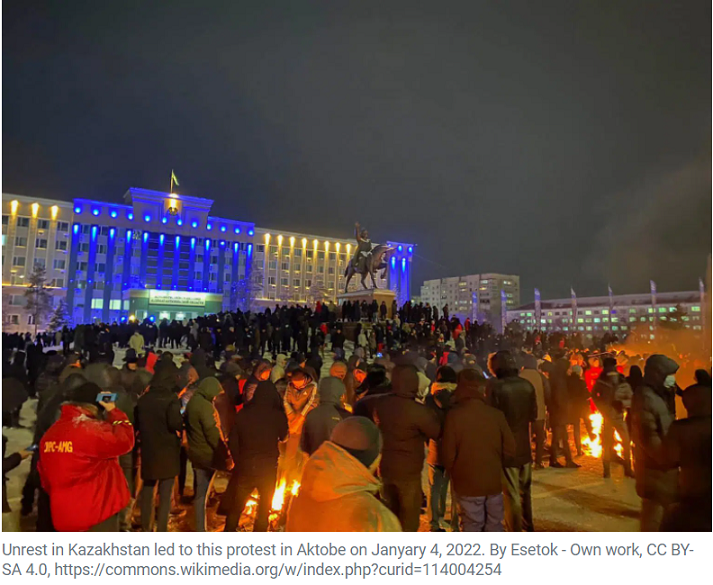
Not long after the Kazakhstani government hiked liquefied petroleum gas prices in early January, an angry mob flooded the streets of Almaty—Kazakhstan’s largest city—on a bitter, cold night. Police armed with batons and shields fought back. Mangled, blackened vehicles, some upturned and set ablaze, littered the streets. Thick plumes of smoke vented through smashed windows of shops and government offices. The unrest soon spread to other nights and cities. In these violent protests, which have been the country’s largest since its independence from the former Soviet Union in 1991, over 200 people have died.
What began as Kazakhstani citizen anger over gas prices quickly morphed into broad anger over government corruption and political authoritarianism. Kazakhstan may be an oil-rich Central Asian country, but it also harbors a discontented working class. President Kassym-Jomart Tokayev has promised to bring change, but that goal remains elusive given what many perceive to be a shadow presidency by former president Nursultan Nazarbyev.
Even after the government restored the gas price caps, citizens continued to protest. Tokayev deployed troops from the Collective Security Treaty Organization—a Russian-led military alliance of former Soviet Union republics. But this president, who has been in power since 2019 and is often described as a staunch Nazarbayev loyalist, appears to be part of the problem. Many suspect that his 2019 election was rigged to ensure victory.
“Tokayev’s appointment lacked legitimacy,” Luca Anceschi, a professor of Eurasian Studies at the University of Glasgow, said. “He did not introduce social or political changes and failed to deliver on an economic program, which made people unhappy.”
Nazarbayev ruled Kazakhstan for 30 years—until 2019. He oversaw a period of remarkable economic growth, fueled by the country’s vast hydrocarbon resources and high oil prices. During his reign, Kazakhstan became the richest country in Central Asia. But while Nazarbayev and other elite members of Kazhak society grew enormously wealthy, large swathes of society faced significant economic challenges.
Interestingly, the 2020 UN Human Development Index places Kazakhstan in the “very high human development” category ranking it 51st of 189 countries and territories. The HDI considers the criteria of a long and healthy life, access to knowledge, and a decent standard of living. However, the Inequality-adjusted Human Development Index, which reduces Kazakhstan’s Human Development Index score by approximately 7 percent, paints a less optimistic picture.
This is evident in Kazakhstan’s landscape. Cities like Nur-Sultan (the capital, formerly known as Astana) and Almaty have rapidly developed while rural regions still lack access to sufficient healthcare, clean water, sanitation, and roads. In a country where 162 people own about half of the nation’s wealth, the percentage of poor people doubled from 5.8 percent in 2013 to 12.2 percent in 2016. The COVID-19 pandemic has worsened the poverty problem, with the number of poor expected to increase significantly in rural areas. Then, when inflation hit a five-year high in November 2021, many low-income households struggled to afford basic necessities such as food and fuel. Oil industry workers, in particular, have felt excluded from Kazakhstan’s oil wealth.
“These are the people who make Kazakhstan rich but are paid very little in comparison to the profits made by the oil companies,” Ivar Dale, senior policy advisor at the Norwegian Helsinki Committee, said.
Social and labor conflicts rose sharply in Kazakhstan in 2021, according to one survey. Many of these conflicts occurred in the oil-rich Mangistau region, including the latest protests in Zhanaozen. This city and Shetpe were also the sites of oil worker sit-ins in 2011 during which police opened fire and at least 14 people died. The 2011 tragedy unfolded on December 16—Kazakhstan’s Independence Day. On the annual anniversary ever since, many government supporters may be found celebrating while activists hold memorials and protests.
“The [Zhanaozen] area continues to simmer with resentment over the 2011 episode where the police were found not guilty,” Dale said.
Despite Kazakhstan’s energy wealth, the country is not insulated from energy insecurity. In Kazakhstan, people use liquified petroleum gas, a low-carbon fuel, for their cars. It is cheaper than gasoline in the country. But subsidies that make liquified petroleum gas cheap cause shortages. “Prices for domestic consumers were regulated by the state and set at a rate below the cost of producing the fuel,” Almaz Kumenov and Joanna Lillis, Almaty-based journalists, wrote. Producers who were selling the fuel at a loss had little incentive to produce liquid petroleum gas, leading to shortages.
In 2021, the electricity grid experienced power outages, caused in part by the high electricity use in bitcoin mining operations that forced three major coal-fired power plants to shut down. Kazakhstan and neighbours Uzbekistan and Kyrgyzstan saw power cuts more recently too, owing to energy imbalances.
The recent unrest in which protesters pulled down the ex-leader Nazarbayev’s statue is unprecedented. Kazakhstani citizens had protested in 2019 over the election that installed Tokayev and in 2016 over reforms that would have enabled foreigners to own agricultural land. In both instances, police arrested and detained hundreds of protesters. However, none approached the violence and destruction of the 2022 protests in which 10,000 people were detained and over 200 died.
“Even though the police may have used force [against protesters in the 30 years since independence], policemen were never killed, state buildings weren’t set on fire, and cars weren’t burnt down,” Yevgeniy Zhovtis, director of Kazakhstan International Bureau for Human Rights and Rule of Law, said.
The Tokayev government claims that terrorists with foreign backing and bandits were responsible for the violence. But Zhovtis blames Nazabayev’s ongoing control, despite having stepped down. Nazarbayev has been the lifetime chairman of Kazakhstan’s powerful Security Council until Tokayev removed him following the recent protests. He retains veto power over important political and security appointments and the honorific title “leader of the nation.”
“That led to an unstable situation where you have two presidents—one who has the formal title of ‘leader of the nation’ and the other who actually manages the country,” Zhovtis said. “This created nervousness among some elites, which might have contributed to the violence.”
After the protests,Tokayev accused Nazarbayev of limiting market competition and of worsening inequalities. But many doubt both the authenticity of Tokayev’s opposition to the ex-leader and Nazarbayev’s willingness to relinquish power he continues to wield. Stuck between the current and former president are Kazakhstan’s citizens, whose desires for wide-ranging political and economic change are playing out on the streets.
On 15 December 2015, representatives of the 164 member states of the World Trade Organisation gathered in Nairobi for a ministerial conference—a biennial gathering, and the group’s highest decision-making forum. This was the tenth such meeting in the history of the organisation, which was founded in 1995 to arbitrate in matters of international commerce and to progressively lower trade barriers—such as import tariffs and domestic subsidies—in pursuit of an open global market. Writing in the Financial Times before the conference, Michael Froman, the United States’ top representative on trade policy, expressed his conviction that the meeting would “mark the end of an era.” It was time, he argued, “for the world to free itself of the strictures of Doha.”
Froman was referring to the Doha Development Agenda, the WTO’s current round of trade negotiations, which commenced in 2001 and is yet to be concluded. The Doha round aims at major reform of the international trading system through lowering barriers and revising trade rules, and also, as the round was originally pitched, at improving the trading prospects of developing countries—which form a majority of the WTO’s members, and argue that the current global trading regime is tilted steeply against them. The Doha round has had a mixed record on that latter goal, but, particularly in giving developing countries more room for manoeuvre in negotiations and pushing developed countries to acknowledge their protectionist policies, it has given developing countries hope. But, developing countries complain, it has also forced them to compromise on domestic interests in areas including agriculture, services and intellectual property regulation, to the benefit of their developed counterparts.
Negotiations of the Doha round have been fraught from the start. For India, a consistently contentious point has been opposition from developed countries to its agricultural and food subsidies, which, according to figures it submitted to the WTO in 2014, amounted to about $51 billion in the 2010 financial year. According to the Organisation for Economic Cooperation and Development, a coalition of primarily developed countries, the United States paid over $95 billion in agricultural subsidies in 2014, and the European Union over $125 billion that same year, to comparatively richer and smaller agricultural populations. Matters came to a head at the WTO’s ninth ministerial conference, in Bali in late 2013, after developed countries challenged India’s practice of buying grain at guaranteed minimum prices to maintain public stockpiles of food, and also other provisions of its National Food Security Act. To allow talks on other issues to move forward, India assented to a temporary clause which allowed it to continue its subsidies, and which promised that a permanent agreement on the issue would be negotiated in the near future. That was no real victory, since it committed India to not expanding its agricultural subsidies in the interim, and did not rule out legal action against it on charges of distorting trade.
Speaking in Delhi before the Nairobi conference, Nirmala Sitharaman, India’s trade minister and chief negotiator at the meeting, told reporters that she would insist on pursuing the promised permanent solution, and that “the spirit of Bali should be respected.” When she reached Nairobi, Sitharaman also made it clear that India would be seeking a reaffirmation of all the agreements reached thus far under the Doha round. The tenth ministerial conference of the WTO, then, looked set for yet more confrontation between developed and developing states, with India, as a leader of the latter block, on the front lines—a recurring pattern throughout the WTO’s 20-year history.
As the gathering unfolded, many developed countries refused to reaffirm the Doha round. The conference’s final declaration, which was repeatedly revised until all participants agreed to sign it, stated frankly that while “many Members reaffirm the Doha Development Agenda … Other Members do not.” Since WTO negotiations operate on the basis of unanimity and a principle often encapsulated as “nothing is agreed until everything is agreed,” the dispute imperils the entirety of the many years’ worth of negotiations under the Doha round. Sitharaman tweeted afterwards that she was “utterly disappointed that the unanimous reaffirmation of DDA hasn’t happened,” but won little sympathy back home, where many media commentators and civil society groups took her acceptance of the equivocal final statement as a capitulation.
The Nairobi meeting served as a reminder of India’s increasingly difficult position within the WTO, where it faces a dizzying matrix of national interests and international pressures. Since the country joined the organisation, upon its founding in 1995, India’s participation in the global economy has multiplied manyfold, increasing its stake in the WTO’s trading, regulatory and negotiating mechanisms. Much else has changed over that time too, not least India’s position in the diplomatic world—particularly with its growing alignment with the United States. The net result of these changes has been a weakening of India’s stance in the organisation, which in recent years has caused it to yield to a rising number of WTO policies detrimental to its domestic interests. The history of how India got here offers insight on just where the country stands within the organisation now, and what its options might be going forward.
India has long been ambivalent about the modern international trading regime. In 1947, it was one of 23 founding signatories of the General Agreement on Tariffs and Trade, a framework of rules established by the Allied powers, with an intent similar to that of the WTO. Signing the GATT was a move away from India’s pre-Independence isolation from the global trading system, but, for the most part, the country continued on its post-colonial economic path of self-reliance and import substitution. A 2009 paper from the Centre for International Trade and Development at Jawaharlal Nehru University notes, “Indeed, joining the GATT was definitely not a reflection of India’s visible faith in the neoliberal multi-lateral trading system.”
The first seven rounds of talks held under the GATT were limited to negotiating tariff reductions. But things changed in 1986, with the inauguration of the eighth and final GATT negotiation round, in Uruguay. Over 120 countries had signed on to the GATT by then, and the Uruguay round was to be a great bargain between the developed and the developing world. Developed countries promised to reduce barriers to imports from the developing world, and, in exchange, developing countries accepted several new trade agreements—including ones on intellectual property, services and agriculture—which bolstered the interests of developed economies. When the round closed, in 1994, it vastly increased the scope and complexity of global trade provisions.
The Uruguay round overlapped with India’s economic liberalisation in the early 1990s, which brought down many of the barriers that might have insulated the country from its effects. In 1995, with developed countries in particular concurring that the expanded rules required a more comprehensive organisation for enforcing them, the WTO was formed. India, though reluctantly, joined the new body, which offered access to regulated international markets, and promised to compel developed countries to reduce domestic subsidies that impeded imports from the developing world. Also, crucially, participation in the WTO allowed developing countries to bargain collectively with developed ones, using the force of numbers to balance out yawning imbalances in power, and to avoid coercive bilateral treaties.
India’s initial years in the organisation were characterised by cautious efforts to gain more international market access for its products, alongside opposition to subsidies in developed countries. The country’s interests aligned with those of other developing states, and India emerged as a leader of negotiating coalitions of developing countries, such as the G33. In 1999, India’s then minister of trade, Murasoli Maran, played a crucial role in stalling the opening of a new round of WTO negotiations that developing countries feared would further disadvantage them.
Meanwhile, India confronted the domestic implications of WTO policies—most prominently, then as now, in agriculture. The Uruguay round brought agricultural trade under a global system for the first time, and committed WTO members to easing their markets open to international competition by reducing tariffs and subsidies for agricultural products. This threatened numerous policies—including guaranteed pricing and public stockpiling of food—that the Indian government sees as checks against the fluctuations of price and supply inherent in an open market, and hence crucial to avoiding famine and protecting agricultural livelihoods at a time of rural distress and high rates of suicide among farmers.
Until 2005, India maintained its protests against the demands of the developed countries, and against the expansion of the WTO’s purview. But following that, it backed down on a number of issues. Biswajit Dhar, a professor of economics at Jawaharlal Nehru University, told me over email that “India was proactively raising issues of food security and rural livelihoods, protection of traditional knowledge, increased market access in services until 2007–08, but has gone strangely silent since.” At Nairobi, India was vocal in defending its food and agricultural subsidies, but not much else.
At home, too, India has bowed to more WTO policies since 2005, with grim consequences. The country’s ongoing implementation of the TRIPS Agreement, an accord on intellectual property negotiated during the Uruguay round, threatens its thriving production of generic drugs, which has drastically brought down prices of life-saving medicines across much of the developing world. The country’s struggling textile manufacturers face additional difficulty as a result of diminished export subsidies, as does its sugar industry. The implementation of the GATS, an agreement on liberalising services—including education, health, water, energy, communications and sanitation—promises to have far-reaching consequences for many public goods.
Many commentators and researchers have linked India’s milder position in the WTO to its growing closeness with the United States. That diplomatic shift has manifested itself in numerous bilateral agreements, including a deal for cooperation on India’s use of nuclear power for civil purposes, the framework for which was approved in 2005. In 2014, the two countries came to an agreement to resolve several disputes pending from the talks at Bali, including India’s opposition to WTO-stipulated rules on trade facilitation—that is, customs and border procedures.
Still, India’s softened temperament is baffling. If anything, its negotiating power in the WTO should be greater now than it has been in the past. Certainly, India’s delegations at WTO talks today are better informed and more capable than in the past. A former foreign secretary I interviewed, who asked to remain anonymous, said that “during the Uruguay round, we did not properly examine how it would affect our domestic policy. We did not study the implications.” Since then, he told me, “some NGOs had played an important role in demystifying the initial agreements,” particularly on services. India’s history of leading the developing countries’ cause allows it the privilege of mobilising considerable collective power when it chooses to, and the defence of the Doha round offers a potent rallying cry. In Nairobi, the Indian delegation could have tried to assemble a defiant front. Strangely, it did not.
In the long run, any dilution of India’s commitment to multilateral deal-making is risky, as bilateral negotiations would leave it with significantly less leverage than it could muster in the WTO. This is partly why even many of the most vocal detractors of the WTO do not think it is in the best interests of developing countries such as India to quit the organisation. The evidence from recent trading deals the United States has sealed outside the WTO framework—the Trade in Services Agreement, which involves 50 countries, including the members of the European Union; and the Trans-Pacific Partnership, which brings together 12 states along the Pacific Rim—is that these push for much greater liberalisation than anything passable in the WTO for now.
Meanwhile, India would do well to hold on jealously to what strength it has in the WTO, especially as developed countries continue pushing to extend the organisation’s reach into areas such as government procurement, labour practices and environmental safeguards. The South Centre, a Canada-based research group, has warned that if these issues “are brought into the WTO, and WTO principles are applied to them, developing countries will be at a disadvantage and lose a great deal of their economic sovereignty.” Yet India, by softening on matters such as the TRIPS Agreement, and by failing to block prevarication on the Doha round at Nairobi, is losing its stature among developing nations, and is eroding their tradition of standing together. In an article published shortly after the Nairobi conference, the former finance secretary SP Shukla wrote, “It would have been impossible to ignore India in Nairobi if it had stood courageously to defend its rights and those of developing countries.” His verdict was that “developing countries chose not to exercise their legal rights,” and that “India chose not to mobilise developing countries.” If the country’s history in the WTO teaches us anything, it is that strength in numbers alongside other developing countries is its best tool for defending its interests. The government would do well to understand that.