Highlights of the report (Authors: Geeta Seshu, Urvashi Sarkar)
• There were 40 killings of journalists between 2014-19. Of these, 21 have been confirmed as being related to their journalism.
• Of the over 30 killing of journalists since 2010, there were only three convictions. The cases were J Dey, killed in 2011; Rajesh Mishra, killed in 2012 and Tarun Acharya, killed in 2014.
• In a fourth case of journalist Ram Chandra Chhattrapati, killed in 2002, it took 17 years for justice to be delivered in the life imprisonment order for Dera Sacha Sauda chief Gurmeet Ram Rahim
• The study documented 198 serious attacks on journalists in the period between 2014-19, including 36 in 2019 alone.
• Journalists have been fired upon, blinded by pellet guns, forced to drink liquor laced with urine or urinated upon, kicked, beaten and chased. They have had petrol bombs thrown at their homes and the fuel pipes of their bikes cut.
• Journalists covering conflict or news events were specifically targeted by irate mobs, supporters of religious sects, political parties, student groups, lawyers, police and security forces. • Attacks on women journalists in the field were found to have increased. The targeted attacks on women journalists covering the Sabarimala temple entry were sustained and vicious. A total of 19 individual attacks of women journalists are listed in this report.
• Perpetrators of the killings and attacks included government agencies, security forces, political party members, religious sects, student groups, criminal gangs and local mafias. • This study followed up on 63 attacks against individual journalists between 2014-18, who were targeted for their investigative work.
• Of the 63 cases studied, First Information Reports (FIRs) were lodged in only 25 cases. And in 18 of these, the case has not progressed beyond the registering of the FIR.
• In 18 other cases where journalists did file complaints (but no FIRs registered), counter complaints were filed in three cases. In 12 cases, there is no information at all and even the affected journalists do not know what happened post the attacks.
The vulnerability of freelance journalists in India was recently magnified when independent journalist Priyanka Borpujari was assaulted and detained by the Mumbai Police on December 26, 2017 while recording stills and videos of a slum demolition and brutality against slum residents.
She was charged under various sections of the Indian Penal Code, including obstructing government action and unlawful assembly. Four women residents of the slum were also detained and charged under similar sections.
Speaking to The Hindu, Borpujari detailed her harassment because she did not have a press card: ““When I was about to be released, one of the policemen who was in plain clothes on Hans Bhugra Marg when I was taking videos, told me: ‘Only if you had had a press card, we wouldn’t have bothered you.’ But as a freelance journalist, I do not have a press card.”
When visiting the site of the slum demolition, Borpujari was doing a recce of the area based on information from a source. She had not yet proposed the idea for publication and was caught in a situation where she was without institutional support. However, through the single phone call she was allowed before the police confiscated her phone, she managed to contact a friend and colleague, Peter Griffin, deputy resident editor of The Hindu, Mumbai.
Acting in his personal capacity, Griffin and a few other journalists who got involved later, gave her considerable assistance in raising the issue on social media and extending legal and moral support.
The fact that Borpujari was not attached to a publication and lacked press identification is only a part of the broader issues faced by freelance journalists. Despite challenges, a section of journalists are freelancing for different reasons.
******
Freelancing gives me freedom
For Borpujari who has been freelancing since 2009, it was about getting a chance to do the kind of stories which wasn’t possible with the publications she was employed with.
“If I had been employed, I am not sure if I would have gotten similar opportunities and been able to do my kind of stories”
“Freelancing gave me a chance to explore human rights issues and people’s movements and resistances in diverse geographies like Chhattisgarh, El Salvador and Indonesia. After freelancing for eight years, I have a wide network of publications and editors which allows me to explore different facets and issues. If I had been employed, I am not sure if I would have gotten similar opportunities and been able to do my kind of stories. But the drawback is that none of us are indispensible as freelancers. We constantly hustle for the next gig or the next write-up. Payments are made on delayed cycles. We talk about labour rights in other industries as journalists covering human rights. But what about our own issues as freelance journalists?’
Borpujari has won prestigious fellowships and awards such as the IWMF Elizabeth Neuffer fellowship and the ICRC awards for humanitarian reporting. However, she is uncertain about the future because of the lack of stability.
*******
I was fed up with the hierarchy and structures
Similarly, Lucknow-based Puja Awasthi, a journalist since 2000 and a freelance journalist since 2014, freelancing has allowed her to do different kinds of reporting.
“I was at a fairly senior position at a magazine and into hard core political reporting, covering the Vidhan Sabha, elections and terror attacks. Also with the elections in 2014, there were subtle shifts with regard to how stories were covered. I was fed up with the hierarchy and structures around me. Through freelancing, my work began to focus on the most marginalised and vulnerable sections of society and people who are not on the media radar. Now, among other issues, I write about the tribals and women’s access to education and their safety.”
By the time Awasthi decided to freelance, she had been on the Chevening Fellowship and the Fellowship for Young Indian Print Journalists, had other achievements, and felt confident enough to break out on her own.
She acknowledges that financial sustainability can be a challenge. “This can be difficult. But once I decided that my journalistic writing did not need to make me money, I was far easier about things and used my qualifications in other ways to make a living for myself. I work on communication projects with international development organisations which help me gain access to different areas and communities. Such assignments have often yielded great stories and given me the freedom to write about issues that I feel are important.”
What is her biggest challenge? “An editor not liking a story I submit, and wanting me to make the tone softer and friendlier, for example. But I hold my ground when I feel strongly about the subject,” she says.
********
Poor pay prompted me to freelance
Low pay was the reason why Chitra Ahanthem quit her job at a newspaper in Imphal. “I had been writing a weekly column and feature stories for the publication since 2000. But the pay was not good and it did not make sense to carry on. In 2004, I started freelancing, while continuing to write for the same publication. The pay in freelance was not any better but I was able to carry on writing since I was asked and commissioned to write. I was also an editor at the Imphal Free Press in 2012-13.”
“We don’t often get to do stories for the larger national level media. And when something does happen, media houses send parachute journalists who ask us to help them instead”
Ahanthem writes about politics, drug use, health, gender issues, and the military. To write freely and not be forced to toe the state line, she takes up consultations in other sectors like training on gender and documentation to sustain her independence.
She feels freelancing comes with a big disadvantage. “I live in Imphal where there is miniscule media interest or focus. We don’t often get to do stories for the larger national level media. And when something does happen, media houses send parachute journalists who ask us to help them instead.”
********
I enjoy the greater mobility
Living in Anantapur, Andhra Pradesh, helps Rahul M cuts costs and enjoy greater mobility than being based out of a big metropolis. He is aware that regional language journalists sometimes make less of a living than freelancers who write for the English press. “A freelancer can publish two-three articles a month and earn more than employed local journalists working for regional language publications. It is tough for such journalists who also have families.”
But being based on the ground does not always work in his favour. “Publications cut costs by getting stories covered by a journalist in the newsroom rather than a freelancer on the ground. What may be important to a reporter on the ground may not be as important to editors in Delhi and Mumbai who may be looking at other stories as well. Organisations pay employed journalists for the risk of not getting a story. But as a freelancer, you might travel at your own expense and there may not be a story, so you tend not to take those risks which can be dangerous for journalism,” he says.
“What may be important to a reporter on the ground may not be as important to editors in Delhi and Mumbai who may be looking at other stories as well”
Since freelancers are usually on tight budgets, Rahul tries to save costs by bus travel. “I look for leads into multiple stories in one trip. Freelancers also tend to be a lot more alone because they are not employed with a single organisation and travel a lot.”
He is currently a fellow with the People’s Archive of Rural India.
********
Freelancing suits younger journalists fed up with news rooms
The increase in the number of digital media outlets has resulted in more writing avenues. Cyril Sam, associate at the International Centre for Journalists points out that the economics of freelance work also works well for digital media organisations. “Freelancers generate more content at a lower cost compared to full-time journalists on the rolls, who come at higher fixed costs,” he says.
When the Hindustan Times shut down four editions and three bureaus in February 2017, Sam and Shashidhar KJ, associate editors of Medianama, contacted 18 journalists from different publications who had lost their jobs. Sam says:“Older journalists were especially rattled by the loss of a stable job and income. It was intimidating for them to deal with the uncertainties of freelancing. Younger journalists and those at the entry level are turning more to freelance journalism because of the stress, monotony and long working hours in newsrooms.”
Jaideep Hardikar had been with The Telegraph for six years until he and a few other colleagues lost their jobs. He began freelancing from his base in Nagpur. “After losing the job, there were no jobs in the market which could fit my needs. I would have had to move to a metropolitan city and do a desk job. But I wanted to be in the field.”
In a career spanning 21 years with various newspapers, Hardikar has covered agriculture and farmers’ issues in different parts of the country. As a freelancer, he now also writes for digital media.
Referring to the growth of new digital platforms, Hardikar says there are enough avenues to write if one can regularly churn out stories. “But it is a taxing process and difficult to churn out new content on a regular basis. Also, many freelancers now compete for the same story and space. There is also a waning of reporting culture where few digital platforms are willing to pay for travel which is the biggest cost in terms of reporting.”
*******
The norm is still a full time job
Hardikar also feels that organisations deal with freelancers in an ad-hoc manner. “Some organisations pay the writer by the word which is peanuts. Most do not have policies or payment structures in place with regard to freelancers and deal with them on an ad-hoc basis. The freelancer is treated like a vendor where work happens on a per piece basis.”
“Freelancers generate more content at a lower cost compared to full-time journalists on the rolls, who come at higher fixed costs”
While appreciating the freedom that comes with freelancing, Hardikar feels that the current model of freelance journalism in India is not sustainable.
But freelancers are still not the norm and do not constitute a majority of the journalistic workforce. Independent journalist and columnist Kalpana Sharma says: “The bulk of journalistic employment is still full-time. Newspapers and magazines, barring a few, still have full-time journalists for much of the writing. Some women in the earlier generation of women journalists started to freelance because of family needs. Now it is a choice for both women and men, since avenues for freelancing are far more and paysomewhat better.”
Nevertheless, she points out that journalists are feeling increasingly frustrated because of the diminishing freedom to cover issues from perspectives such as gender and development.
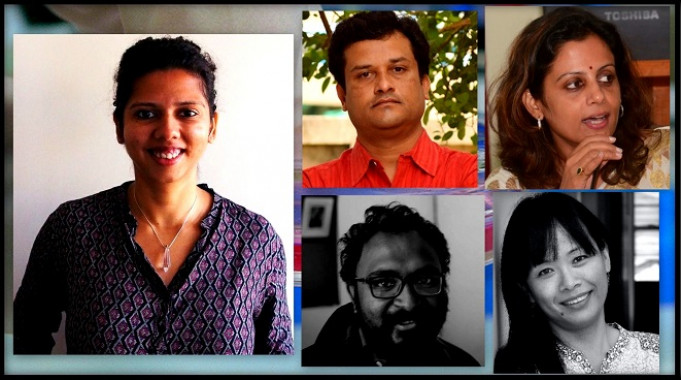
Left to right clockwise: Priyanka Borpujari, Jaideep Hardikar, Puja Awasthi, Chitra Ahanthem and Rahul M
*******
Press ID – a double edged sword
On the issue of press identification for journalists, Sharma agrees there is a need but cautions that it can be a double-edged sword. “Any government issued ID has the most credibility while reporting. But we are then seeking protection from the very state which attacks journalists. Also, a press ID no longer gets the same respect. This has a lot to do with the erosion of media credibility and the lack of appreciation for a free press.TV newspersons and their cameras have been attacked, despite and perhaps because, they were identified as press.”
However, as more journalists are freelancing, what might help, according to Sharma, is if publications provided a letter stating the journalist is covering a story for them. Press clubs can also be roped in efforts to provide freelancers with identification.
“A press ID no longer gets the same respect. This has a lot to do with the erosion of media credibility and the lack of appreciation for a free press”
Kumar Ketkar, president of the Mumbai Press Club, thinks otherwise. “Mumbai Press Club cannot provide identification to freelancers. How will we track and identify who is a freelance journalist? Especially with the wave of social media, it is tougher to identify who is one.”
When asked to elaborate further, Ketkar responded: “If someone writes for a Tamil newspaper from Mumbai, how will we identify them as a journalist?” He added that publications should provide letters to freelancers who are on assignment.
PIB requires that a freelance journalist have 15 years of experience to apply for a press card. http://pibaccreditation.nic.in/
When asked about procedures followed for freelance contributors, editor of Scroll.in, Naresh Fernandes said: “When journalist Malini Subramaniam began writingfrom Chhattisgarh, most of her pieces were for Scroll. We felt a sense of responsibility and enormously concerned about the attacks on her by vigilante groups. We even got in touch with the Chhattisgarh Chief Minister and extracted a promise that she would not be attacked. The attacks did not stop.”
Owing to the gravity of Subramaniam’s situation, Scroll provided her with press identification. However, it is not normally the organisation’s practice to provide ID to freelance contributors. Fernandes condemned the attack on Borpujari, noting that it was an assault on a citizen’s right to witness and record events.
Even as different views prevail on the issue, the state of freelance journalism deserves more attention and concern, with concerted steps required to address the vulnerabilities of such journalists.
Nabi Saleh – Palestinian Janna Jihad Ayyad, who turned 10 this month, counts herself among the youngest journalists in the world.
A resident of the village of Nabi Saleh in the occupied West Bank, Janna, along with many other local children, regularly participates in demonstrations against the Israeli occupation. She began making videos of what was happening in her village when she was only seven.
While there are no journalists in Janna’s family, her uncle, Bilal Tamimi, is a photographer who has documented the violence of Israeli soldiers in Nabi Saleh. Janna was partly inspired by him.
“I talk about what is happening,” Janna said. “I see an occupation, soldiers, cannons and police. They do a lot of things to make us go from our land.”
The deaths of two men in her village – her cousin, Mustafa Tamimi, and another uncle, Rushdie Tamimi – served as a trigger for her to begin documenting everything that was happening in Nabi Saleh. Mustafa was killed by a gas canister and Rushdie was fatally shot in his kidney.
Since then, Janna has expanded her work, travelling with her family and using her mother’s iPhone to shoot videos in Jerusalem, Hebron, Nablus and Jordan. Her videos show everything from people being detained at checkpoints, protest marches and violence against Palestinian children.
As a child, she feels she has an advantage over adult reporters: “The soldiers catch the big journalists and take their cameras.”
On Facebook, Janna describes herself as a news personality, and has attracted more than 22,000 followers. Her page includes several videos of her participating in demonstrations and confronting Israeli soldiers. Her reports are delivered in both Arabic and English.
“My camera is my gun,” Janna explains. “The camera is stronger than the gun … I can send my message to small people, and they can send it to others.”
Her mother, Nawal Tamimi, says she is both scared for and proud of her young daughter.
“I am proud of my daughter because as a child, she tells her message to the world. She shares her fears, what she feels, and the problems of attending school,” Nawal told Al Jazeera.
“But I am scared for her, when the army comes in the middle of the night and tear-gases our house, and we wake up in smoke … They attack our people who demonstrate against the settlers and the Israeli occupation.”
Janna’s uncle, Bilal, says it has been difficult to accept Janna’s work. “She should be playing and studying, but in our life it’s not a choice,” he told Al Jazeera, noting that the family has a history of activism dating back to 1948. “We must teach our children to not accept humiliation and not be cowards. We are under occupation. We cannot teach our children silence; they must fight for their freedom.”
When she gets older, Janna says she would like to work for CNN or Fox News because “they do not talk about Palestine, and I want to make reports on Palestine”.
Asked what an ideal world would look like to her, Janna, for once, responds like a 10-year-old: “I want it to be pink.”
A panel discussion organised here on Friday by The Editors Guild of India, the Press Association, the Press Club of India and the Indian Women Press Corps on “Radia tapes and journalistic ethics” turned into a slanging match between journalists and Editor-in Chief of CNN-IBN Rajdeep Sardesai after he pitched in strongly for Barkha Dutt and Vir Sanghvi, saying they had been judged guilty without corroborative evidence. On the panel were Vinod Mehta, Editor-in-Chief of Outlook, which along with Open magazine brought the Niira Radia tapes into the open; Mrinal Pande, former editor of Hindustan and chairperson of the Prasar Bharati; and Sunil Jain, a business journalist with TheFinancial Express.
Mr. Sardesai admitted that media groups needed to look inward and seriously examine where they had gone wrong in allowing the blurring of lines separating journalism, politics and lobbying. However, reporters did need to talk to a variety of sources, and the mere fact of talking to a lobbyist or even taking notes from one, was not an indication of professional misconduct. The CNN-IBN head questioned the journalistic standards adopted by the two magazines. A sense of scepticism was missing, assumptions had been made and those featured in the stories had not been given “the right to reply,” he said.
Mr. Sardesai also remarked that the response in the case of Ms. Dutt and Mr. Sanghvi had been lynch-mobbish, with their being judged guilty without any reference to their journalistic track records. “The fundamental principle of jurisprudence, that you are innocent until proven guilty, has been reversed here,” he said, adding there was an element of professional jealousy in the chorus of voices raised against them. This started a near riot on the Press Club lawns, where the discussion was held. Journalists rose as one to condemn the suggestion that talking to corporate sources was an unavoidable aspect of good reporting. Many of them pointed to their own experience of getting good stories and breaking scoops without ever having to talk to a lobbyist. They made their displeasure clear at the issue being reduced to a case of jealousy and envy, and sought to know if Mr. Sardesai’s own channel referred its exclusive stories to those featured on them.
Sensing the mood of the house, Mr. Sardesai, who is also president of the Editors Guild, quickly took back his words, promising immediate intervention by the Guild in formulating a code of ethics for journalists, including for editors. As a first step, he would declare his assets, he said.
Mr. Mehta said journalists who were recorded on tape talking to Ms. Radia were well aware of the interests she was representing and yet allowed themselves to be used by her. “Journalists are supposed to use sources; sources cannot use journalists.”
He said he did not think the issue was “complex” or “grey” as was being suggested by those arguing on behalf of the taped journalists. “It is a black and white issue, where the journalists knew who they were talking to and should have known where to stop a conversation and say, no, thank you.”
Journalists have to hear many people but what they finally end up writing depends on the kind of people they are speaking with. “When journalists speak with a public relations officer or lobbyist, they must be aware of the mandate, brief and interests of the persons they are talking to,” Mr. Mehta said.
Ms. Pande said: “The media is being expected to do a lot of what it is not meant to do. What we see in the English media is also occurring in the Hindi media except that the people involved are smaller players. It is important to question the ownership pattern in the Indian media. The boundaries between the editor and the owner are blurring and in some instances ownership is also in political hands.”
Referring to “journalists wanting to play power brokers,” Mr. Sunil Jain said what was being currently witnessed had been going on for a long time and both the print and television media had entered into “private treaties” to serve their purposes.