Tag: Palestine

  • How AI And Advanced Tech Are Reshaping The Battlefield

    How AI And Advanced Tech Are Reshaping The Battlefield

    The world is burning.

    In September 2024, thousands of pagers exploded in Lebanon in public streets, grocery stores and people’s homes. The next day, walkie-talkies were blown up. At least 37 people died and 2,931 people were injured. The attacks were carried out by Israel to target Hezbollah supporters known to carry pagers and walkie-talkies for communication and planning military operations.

    Hezbollah, a Shia militant group and movement in Lebanon, against whom Israel has a long-standing armed conflict, has been using old-fashioned pagers and walkie-talkies to avoid interception and hacking by Israeli forces. Israel managed to embed explosives in the pagers, which then exploded in Lebanon and Syria. The dystopian attack was widely condemned, especially since it did not account for harm to civilians, and spotlighted concerns about the rise of new types of cyber warfare.

    In the Russia-Ukraine theatre of conflict, Ukraine began using facial recognition to identify Russian targets as well as dead Russian soldiers. The technology was offered to Ukraine by Clearview AI, a facial recognition company, free of cost.

    The detonation of pagers and walkie-talkies, drones that deceive and kill, and the use of facial recognition to fight wars sound like hellish episodes from the pages of science fiction books or sub-plots of action movies. This isn’t fiction to be consumed vicariously from a distance, but a reality that we live and breathe.

    Wars Equipped With AI

    Clearly, war is no longer confined to the traditional remits of land, air and sea. The weaponisation of information flows and cyberspace, and the use of artificial intelligence (AI) are changing how wars are being conceived and implemented. We are already seeing the rise of technology-driven surveillance, cyber hacking and implanting of spyware, most infamously Israeli-origin Pegasus, on phones.

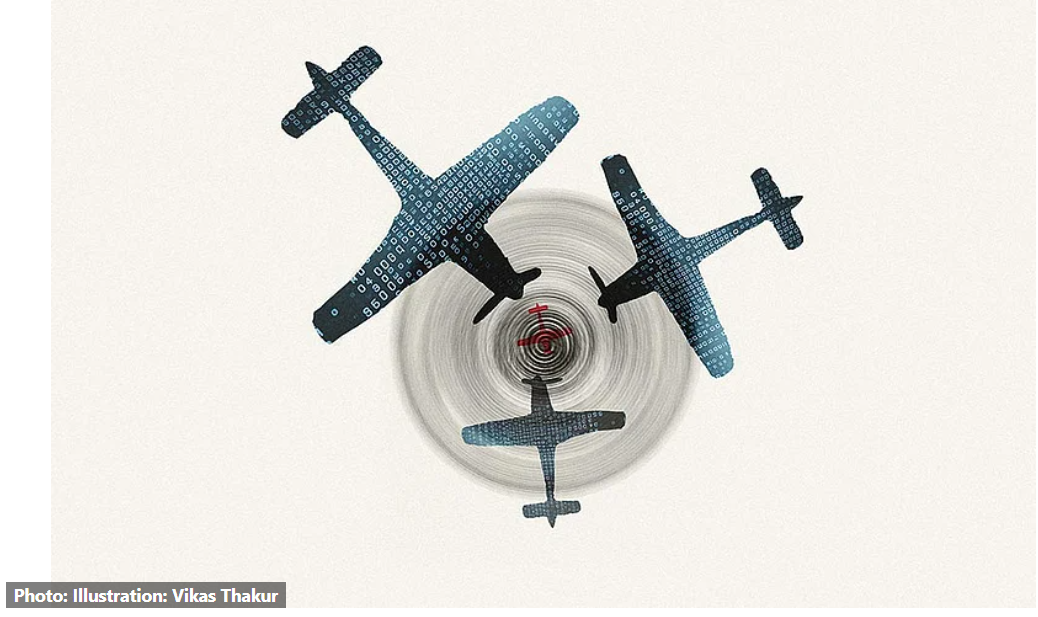
    The use of autonomous weapons, where critical functions of weapon systems are automated, throws up entirely new dimensions to conflict. According to the International Committee of the Red Cross, “Autonomous weapons can select (including search, detect, identify, track) and attack (use force against, neutralise, damage or destroy) targets without human intervention. After initial launch or activation by a human operator, it is the weapon system itself—using its sensors, computer programming (software) and weaponry—that takes on the targeting functions that would otherwise be controlled by humans.”

    Rise in Drone Warfare

    The war between Russia and Ukraine saw their armies use tanks, bombs, missiles and conventional artillery, but also the use of drones writes Dominika Kunertova in the journal of Contemporary Security Policy. “Russia and Ukraine have been using drones of all sorts from scouts collecting intelligence to lethal drone bomblets, one-way attack drones, loitering munition, and long-distance strike drones,”Kunertova writes. While these systems are not independently groundbreaking, the proliferation of low-cost drones shows the pace at which such technology is developing.

    For some time, drones have been equipped with stealth technology wherein they can evade being detected by enemies. Swarm drones include a group of drones that collectively perform tasks such as surveillance or coordinate attacks. Swarm drones are able to communicate with each other and act in coordination. These too were seen in action in the Russia-Ukraine conflict.

    Developments in CBRN Weapons

    Swift-paced developments in chemical, biological, radiological and nuclear (CBRN) weapons (more commonly known as weapons of mass destruction) are also unfolding. Annually, governments across the world are spending billions of dollars to finesse and fine-tune these weapons.

    Despite the destruction of chemical weapons stockpiles by member states of the Chemical Weapons Convention, the re-emergence of certain chemicals continues. Recent history is testimony to the use of toxic chemicals by states and non-state actors. A prime example is Syria, where chlorine gas was deployed by the Syrian government and sulphur mustard by terror group ISIL. Both Gaza and the Russia-Ukraine war are theatres where chemical weapons are being deployed with impunity with civilians suffering the worst of it.

    he use of chemical weapons isn’t new by any means. The US sprayed millions of gallons of ‘Agent Orange’ in the 1960s and 1970s during its invasion of Vietnam, with lasting repercussions for health and environment. AI is the new worrying addition to chemical warfare. Combined with chemistry and biology, AI is being used to develop and deploy newer toxic chemicals.

    Nuclear Weapons Proliferation

    After the bombing of Hiroshima and Nagasaki in 1945, people hoped that its horror and aftermath would be enough to deter nations from using nuclear weapons. In fact, A grassroots movement of the survivors of those atomic bombings, the Hibakusha, was awarded the 2024 Nobel Peace Prize for “its efforts to achieve a world free of nuclear weapons and for demonstrating through witness testimony that nuclear weapons must never be used again”.

    But here we are in 2025, perched on the nuclear precipice with nuclear flashpoints between Iran and Israel, North and South Korea, India and Pakistan, to name a few. Consider how advances in AI are being used to finesse nuclear energy production and what this means for the proliferation of nuclear weapons.

    Oklo Inc, a California-based company worth $3.33 billion in market capitalisation, started trading on the New York Stock Exchange in 2024. Its chairman is Sam Altman, the CEO of Open AI, the pathbreaking generative AI company. Why is Altman investing in nuclear energy? One reason is that the AI industry is eager to shed the ‘dirty’ label since it uses massive amounts of electricity to process data.

    AI’s alliances with the nuclear industry, as documented by physicist MV Ramana in his recent book Nuclear is Not the Solution: The Folly of Atomic Power in the Age of Climate Change allow whitewashing or greenwashing of AI and its power requirements and present itself as a clean technology.

    But there is another reason too, as Miles Pomper and Yanliang Pan suggest in the Bulletin of the Atomic Scientists.

    Advances in nuclear reactors, such as the micro-reactors being built by Oklo, clubbed with the application of AI increases the chances for proliferation of nuclear weapons. It could “increase the availability” of fissile materials such as weapons-grade uranium needed to build nuclear weapons in “less time, and lower detectability”.

    Bioweapons

    The use of bioweapons, not new by any means, presents an entire gamut of ethical and moral concerns. Biological weapons disseminate disease-causing organisms or toxins to harm or kill humans, animals or plants. They can be deadly and highly contagious. Diseases caused by such weapons may not be confined to national borders and could spread rapidly.

    CRISPR, a gene editing technology allows the rewriting of DNA sequences in any cell and has positive applications such as cancer therapy and exploring how to remove genetic illnesses. But then, CRISPR could also be weaponised to enable easier and widespread manipulation of pathogens and make targeted populations resistant to vaccines and treatments.

    At least three reasons exist for the current state of war. A giant military industrial complex where arms companies profit from wars through government contracts, a United Nations held hostage by the veto power of a narrow clique of countries, and the unchecked rise of technology for destructive purposes are taking conflict into deadly, uncharted waters.

    Originally published in Outlook Magazine.

    https://www.outlookindia.com/international/how-ai-and-advanced-tech-are-reshaping-the-battlefield
  • India, Israel and Palestine: A triangle that does not sum up

    Prime Minister Narendra Modi with his Israeli counterpart Benjamin Netanyahu in New York in 2014. Photo Credit: PMO

    Published in The Wire. 2 July 2017

    It is the 50th year of the Israeli occupation of Palestine. It has been 50 years since Israel annexed the Palestinian territories of West Bank, East Jerusalem and Gaza Strip following the Six Day Arab-Israeli War of June 1967.

    During this time, Israel has tightened its hold over the territories, crushed Palestinian resistance and created hundreds of thousands of refugees. Its discriminatory policies affecting every area of Palestinian life have invited comparisons with the South African apartheid. However, UN resolutions condemning the occupation and Israeli settlements in the West Bank leave Israel unaffected, even as it relies on the continued support of the United States for its actions.

    This is also the year that India’s Prime Minister Narendra Modi will travel to Israel; the first Indian PM to do so. He will address a gathering of Jews of Indian origin in a community reception in Tel Aviv on July 5. Modi he will not visit Palestine.

    Historically, India framed its relationship with Israel based on a priority accorded to Palestine. In 1936, Jawaharlal Nehru informed the Zionist emissary Immanuel Olsvanger that he could not tolerate imperialism in India or Palestine.

    P.R. Kumaraswamy, professor of West Asian Studies at Jawaharlal Nehru University, writes that while anti-colonialism was an important aspect of India’s backing Palestine, there was a religious dimension to the matter. The Congress and the Muslim League perceived the anti-imperialist Palestinian cause as a way to win over Indian Muslims whose support they were competing for and to unite Indian Muslims with the resistance against the British. Supporting Palestine was also a method of leveraging India’s interests in the Middle East.

    Road to Washington and arms access through Israel

    Nevertheless, India established full diplomatic ties with Israel only in 1992, even though it had formally recognised Israel in 1950. The end of the Cold War in 1991 reconfigured world politics and established the United States as the sole superpower.

    Vijay Prashad, professor of International Relations at Trinity College, says: “India’s road to Washington and arms lay through Israel. After India’s nuclear weapon tests in 1998, the US imposed economic and military sanctions. During the 1999 war with Pakistan, Israel supplied arms to India, which were American in any case. India under Indira Gandhi had already reached out to Israel in 1971 for arms despite absent diplomatic ties. The Palestine issue started getting sidelined long ago, while the Congress was in power.”

    In 2009, following lobbying by US and Israeli governments, India diluted its stand on the Goldstone Report which showed the illegality of Israel’s blockade of Gaza and accused it of violating international law.  The Congress expressed “reservations in making unqualified endorsement” of the report recommendations.  According to Prashad, there is not much difference in the language used in 2009, and the language subsequently used by India for Israel’s attacks on Gaza in 2012 and 2014.

    Then, for the first time in 2015, India abstained on a UNHRC resolution calling for a probe by the International Criminal Court into war crimes by Israel.  It continued to abstain on the resolution in 2016 and 2017 as well. However, it has voted in favour of other UNHRC resolutions that criticised Israel on the expansion of settlements and the right of Palestinians to self-determination.

    India justified abstaining on the grounds that the resolution referred to ICC of which India is not a member. But a report in The Telegraph showed that India voted at least twice in favour of UNHRC resolutions which refer to the ICC in the context of atrocities in Syria. India’s altered voting behaviour therefore caused speculation that India had changed its policies on Palestine which the government has denied.

    India-Israel bonhomie under Modi

    Undoubtedly, there is markedly more visible warmth between the two countries since 2014 when Modi was elected PM.  High level visits to Israel by Home Minister Rajnath Singh, President Pranab Mukherjee and External Affairs Minister Sushma Swaraj have already happened.  While Singh did not visit Palestine, Mukherjee and Swaraj did so. During the Congress regime too, a steady stream of bilateral visits continued to Israel.

    Interestingly, the first time that a senior Indian minister visited Israel was only in the year 2000, when the BJP was in power; and the minister was L.K. Advani.  This is despite the fact that diplomatic relations were established since 1992 and Israel had been sending its presidents and prime ministers to India since 1993.  The most recent visit being of President Reuven Rivlin in November 2016.

    India and Israel have been cooperating in a range of areas including agriculture, water conservation, science and technology, trade and investment. India and Israel also view each other as victims of Islamist terror which complements Modi’s Hindutva background. But by far, the largest area of cooperation is in defense.

    Israel’s defense industry bagged its biggest security contract in April 2017 with the state-owned Israel Aerospace Industries being awarded contracts worth $2 billion for providing medium range surface to air missile systems to the Indian Army. There are expectations of further arms deals when Modi visits Israel. It is no secret that India is currently the biggest importer of arms in the world while Israel is its second largest foreign supplier.

    Where does Palestine stand?

    Where does Palestine stand next to India-Israel bonhomie? When Palestinian President Mahmoud Abbas visited India last month – his third state visit to the country – Modi mentioned India’s unwavering support to Palestine and for a two state solution. He also spoke of a ‘sovereign, independent, united and viable Palestine, co-existing peacefully with Israel.’

    Even before Abbas’ visit, a Palestinian Authority official said that while India had the right to build relations with Israel, it should not come at the expense of support for Palestine.

    How has that panned out? Is it possible for India to de-hyphenate its ties with the two countries, considering that one is an internationally condemned transgressor state and the other fighting for independence from it? India’s defense ties with Israel make this even more difficult.

    Palestinian embassy officials in Delhi who monitor India-Israel ties have expressed unhappiness over the increasing defense relationship.  A Der Spiegel investigation in 2014 showed that Israel invests significant sums into defense research and production. A good chunk of defense production is exported to countries like India. Defense export revenues in turn make it possible for the Israeli forces to sustain the military occupation of Palestine, inviting allegations that India is subsidising or underwriting the occupation.

    When Modi visits Israel on July 4, what should we expect? Will he refer to the Palestinian cause? One can expect utterances about ‘the peace process and support for the two state solution. But it is doubtful he will go further – he is unlikely to raise the issue of the Palestinian prisoners’ hunger strike for example.

    Any criticism of Israel’s human rights records at international forums could invite criticism of the Modi government’s own policies in Kashmir where he has militarily suppressed dissent and separatism. Neither Netanyahu nor Modi will embarrass each other; Netanyahu in particular would be eager to win over India for the longer term, especially as a voting ally at various human rights forums.

    As Palestine observes its 50th year of Israeli occupation, hard strategic and military calculations define India’s national interest and colour its ties with Israel and Palestine.

    Read the original article: https://thewire.in/diplomacy/india-israel-palestine-modi

  • The bookseller saving Jerusalem’s Palestinian identity

    Published in Al Jazeera. 30 May 2016

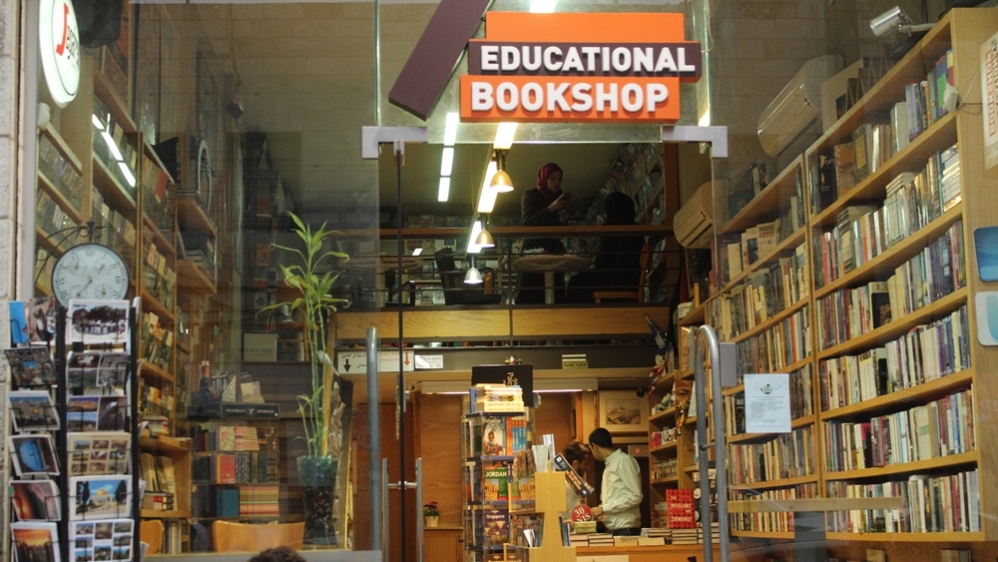
    Jerusalem – On Jerusalem’s busy Salah Eddin Street, where cafes, grocery stores, money exchange centres and jewellery shops proliferate the landscape, a prominent board at number 22 announces itself as the Educational Bookshop.

    Shortly ahead, across the road, is another bookstore and cafe, also titled the Educational Bookshop. Both belong to the Jerusalem-based Muna family; the first sells Arabic books and stationery while the latter sells English books. “The bookshop started with one bookseller: my father. Now we are six brothers who read, recommend and sell books,” said Mahmoud Muna, manager of the English bookshop.

    Upon entering the English bookstore, a shelf stocked with books by noted Palestinian academic Edward Said catches the eye. The presence of Said at the entrance is significant since it was his family who originally owned the Arabic bookshop.

    Muna traces the connection: “The Edward Said family had bookstores in East and West Jerusalem. They ran the Palestine Educational Bookshop on Salah Eddin Street, where they sold stationery and books,” Muna told Al Jazeera.

    The shop changed hands a few times. When Muna’s father, Ahmed, bought and established it in 1984, he dropped Palestine from the title, since it was illegal then to have the word ‘Palestine’ in the title of an entity or the Palestinian flag. Therefore, the name was changed to The Educational Bookshop.

    Photo: Urvashi Sarkar. The mission of the bookstore is to reinforce the Palestinian culture and identity, says Muna 

    The history of both bookshops is a reflection of the reading preferences of Jerusalem’s inhabitants, both locals and tourists, over the years. During the 1980s and early 1990s, the Arabic bookstore stocked mostly books in Arabic on politics, history, poetry, literature and fiction, and some English books on tourism.

    A turning point came in 1994-95, when, according to Muna, many Palestinians stopped reading. “Palestinians had been reading about the supposed light at the end of the tunnel, promoted by nationalist Palestinian writers who wrote about how the peace process would bring freedom,” recalls Muna.

    But after the 1993 Oslo Agreement, things changed. “It turned out to be lies, and people stopped trusting books. Consequently, the bookstore also suffered.”

    Muna characterises the post-Oslo years as a time when Jerusalem received an influx of international NGO workers, diplomats and journalists. “Jerusalem’s newcomers sought to understand Palestine and the Middle East better and wanted English books. We made a conscious decision to increase our English selection.”

    Therefore, Imad Muna, the eldest of the Muna brothers in charge, decided to increase the English selection of the store.

    Muna still remembers the ripples created by the publication of Said’s Peace and its Discontents, published in 1996. “It was the first book to criticise the Palestinian Authority [PA], exposing the peace process and Oslo. We sold hundreds of copies in English and Arabic to Palestinians and foreigners. The PA banned it, but we could sell it since being in Jerusalem we are not under the PA.”

    The history of both bookshops is a reflection of reading preferences of Jerusalem’s inhabitants, both locals and tourists [Courtsey of the Muna Family/Al Jazeera]

    The bookstore expanded on Said’s collection, also stocking books by Israeli historians like Ilan Pappe and Avi Shlaim, who were critical of the Israeli narrative. Realising that there was a big market for English books, in 2007-08, a new bookstore was established with only English books, along with a cafe and a literary-cultural space called the Jerusalem Literary Salon.

    “We also witnessed a revival of Arabic readership during this period to which the Arabic bookstore catered.”

    ‘The bookshop started with one bookseller: my father. Now we are six brothers who all read, recommend and sell books,’ says Mahmoud Muna [Courtesy of the Muna Family/Al Jazeera]

    Muna reflected on the need to present the Palestinian story in English. “There were no proper English bookstores in Jerusalem, and the only English books were in Israeli bookshops which portrayed the Israeli viewpoint. British and American authors with orientalist perspectives were writing about Israel and there was very little on the Palestinian viewpoint. This, however, changed in the 90s.”

    The English Educational Bookshop was the first of its kind in Palestine. “This was the first bookstore that sold books in English by Palestinians and about the Palestinian viewpoint,” he says.

    Central to the identity of the two bookstores is their location in Jerusalem. “We want to reinforce the notion of Jerusalem as the Palestinian capital. We may expand to other areas, but our main area of functioning needs to be Jerusalem,” Muna says, acknowledging that a Jerusalem location renders it inaccessible to many Palestinians who face restrictions on entering Jerusalem.

    The English bookstore also hosts cultural and literary events, such as readings, screenings, exhibitions and talks. The bookshop, according to Muna, plays a role in the larger spectrum of cultural resistance and it is being viewed as reinforcing Palestinian culture and identity.

    “The Palestinians have been stripped of their rights, political representation and freedom. The last thing we have is our culture – the last wall of resistance, which Israel will find very hard to break down. The mission of the bookshop is to reinforce Palestinian culture and identity.”

    The English bookstore hosts cultural and literary events, such as readings, screenings, exhibitions and talks [Courtesy of the Educational Bookshop/Al Jazeera]

    The store has about 1,500 titles encompassing history, fiction, politics, poetry and even cookery. “These are serious books, not propaganda. We sell books on Palestine written in different parts of the world.”

    The bookshop has titles from across the Middle East. Muna says: “This is not a Palestine-Israeli conflict; it was and is an Arab-Israeli conflict.”

    The operations of the bookshop are not without hurdles, with the delivery and clearances of books often delayed. “Our books come from the US, UK, India, France, Germany, Jordan, Egypt and Spain and pass through Israeli security,” he said.

    “The Israelis pick on titles. They do not like books such as the Ethnic Cleansing of Palestine by Ilan Pappe or Jeff Halper’s book on Israeli manufacture and sales of arms. They also do not like books on Hamas, or with provocative covers. The delivery of such books is delayed by two or three weeks. But since there is no censorship law over English books, no books are confiscated.”

    Books from Syria, Lebanon and Iran cannot come directly. Instead, they are routed through Jordan.

    Muna recalls when Mordechai Vanunu, who had revealed Israeli nuclear secrets, was kidnapped twice from the store. “When the Israeli army come, they create a scene. Once a man was shot outside, and our CCTV cameras recorded it.” According to Muna, the Israeli forces closed the shop for hours and wanted to take the camera. The lawyer, however, convinced them to take only the footage.

    They took the phones of customers and deleted pictures. “Sometimes, they spray chemical skunk gas in our neighbourhood, and the foul odours enter our store, too. We do not know if we are being targeted.”

    On the positive side, Muna points out that there has been a renewal of Palestinian Arab readership. He describes the current readership as fiction preferring, predominantly female, and in the 17-22 age bracket.

    “The older generation consumed mostly history and politics. The new readers like books on romance and sexuality. I want them to read more serious, classic stuff: Books on Palestinian history, Arab nationalism, Arab communism, and the great literature of the Arab world.”

    “They [young readers] use social media and ask us about books we don’t know of. As a bookseller, this ought to be disconcerting, but it makes me happy.”

    Cover photo: Urvashi Sarkar

    Read the original article: https://www.aljazeera.com/news/2016/05/30/the-bookseller-saving-jerusalems-palestinian-identity/

  • Janna Jihad: Meet Palestine’s 10-year-old journalist

    Photo: Courtesy of Janna Jihad Facebook page

    Published in Al Jazeera. 28 April 2016

    Nabi Saleh – Palestinian Janna Jihad Ayyad, who turned 10 this month, counts herself among the youngest journalists in the world.

    A resident of the village of Nabi Saleh in the occupied West Bank, Janna, along with many other local children, regularly participates in demonstrations against the Israeli occupation. She began making videos of what was happening in her village when she was only seven.

    While there are no journalists in Janna’s family, her uncle, Bilal Tamimi, is a photographer who has documented the violence of Israeli soldiers in Nabi Saleh. Janna was partly inspired by him.

    “I talk about what is happening,” Janna said. “I see an occupation, soldiers, cannons and police. They do a lot of things to make us go from our land.”

    The deaths of two men in her village – her cousin, Mustafa Tamimi, and another uncle, Rushdie Tamimi – served as a trigger for her to begin documenting everything that was happening in Nabi Saleh. Mustafa was killed by a gas canister and Rushdie was fatally shot in his kidney.

    Since then, Janna has expanded her work, travelling with her family and using her mother’s iPhone to shoot videos in Jerusalem, Hebron, Nablus and Jordan. Her videos show everything from people being detained at checkpoints, protest marches and violence against Palestinian children.

    As a child, she feels she has an advantage over adult reporters: “The soldiers catch the big journalists and take their cameras.”

    On Facebook, Janna describes herself as a news personality, and has attracted more than 22,000 followers. Her page includes several videos of her participating in demonstrations and confronting Israeli soldiers. Her reports are delivered in both Arabic and English.

    “My camera is my gun,” Janna explains. “The camera is stronger than the gun … I can send my message to small people, and they can send it to others.”

    Her mother, Nawal Tamimi, says she is both scared for and proud of her young daughter.

    “I am proud of my daughter because as a child, she tells her message to the world. She shares her fears, what she feels, and the problems of attending school,” Nawal told Al Jazeera.

    “But I am scared for her, when the army comes in the middle of the night and tear-gases our house, and we wake up in smoke … They attack our people who demonstrate against the settlers and the Israeli occupation.”

    Janna’s uncle, Bilal, says it has been difficult to accept Janna’s work. “She should be playing and studying, but in our life it’s not a choice,” he told Al Jazeera, noting that the family has a history of activism dating back to 1948. “We must teach our children to not accept humiliation and not be cowards. We are under occupation. We cannot teach our children silence; they must fight for their freedom.”

    When she gets older, Janna says she would like to work for CNN or Fox News because “they do not talk about Palestine, and I want to make reports on Palestine”.

    Asked what an ideal world would look like to her, Janna, for once, responds like a 10-year-old: “I want it to be pink.”

    Read the original article: https://www.aljazeera.com/news/2016/04/28/janna-jihad-meet-palestines-10-year-old-journalist/

  • How to fight intolerance with culture: A Palestinian-Indian theatre production shows the way

    Photo: The Palestinian Embassy, New Delhi

    Published in Scroll.in. 22 November 2015

    In 1989, Safdar Hashmi – the Indian actor, playwright and theatre activist – was shot dead while performing a street play in Jhandapur village in Uttar Pradesh. More than two decades later, in 2011, the Palestinian-Israeli actor Juliano Mer-Khamis was struck by a hail of bullets outside The Freedom Theatre in West Bank’s Jenin refugee camp.

    Both Hashmi and Mer-Khamis were murdered for the ideas they espoused: in Mer-Khamis’s case, it was Palestinian freedom from Israeli occupation, and in Hashmi’s instance, it was concerns about the working classes and the divisive forces of communalism. Both Hashmi and Mer-Khamis were united by a concern for the oppressed. Both of them were agitating for freedoms.

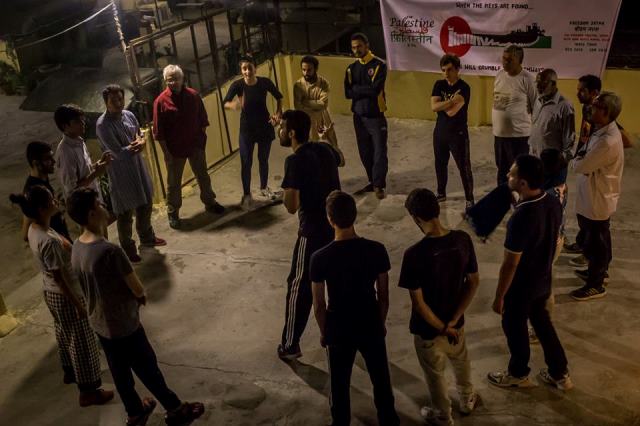
    To push forward their ideals of countering oppression through culture, The Freedom Theatre and Jan Natya Manch, the theatre company co-founded by Hashmi, have come together this year. Both groups will participate in a joint production which will travel, over the next three months, to Lucknow, Bhopal, Mumbai, Bangalore, Hyderabad, Kolkata, Patna, Kozhikode and Mallapuram. There will also be a performance on January 1, 2016, at Jhandapur, where Hashmi was assassinated.

    The TFT website notes: “Janam and TFT have suffered the loss of friends as a consequence of intolerance; we are connected by experiences of resisting oppression in search of freedom.”

    This collaboration, announced by the Palestine embassy in Delhi last week, becomes important in the light of the killings of MM Kalburgi, Govind Pansare and Narendra Dabholkar. Prominent writers or activists, they were again murdered for their views.

    ‌‌Courtesy: Jan Natya Manch

    For Faisal Abu Alhayjaa, director of The Freedom Theatre, art and culture have a strong ability to shake up the status quo.

    “Do you know what intifada means?” he asked. “It is an Arabic word meaning shaking up. The first Palestinian intifada of the 1980s saw demonstrations, a lot of street fighting and stone pelting. The second intifada, which began in 2000, was more aggressive – with soldiers, guns and F-16. The third intifada must be cultural.

    “The killing of Hashmi and Mer-Khamis showed that their art was effective. It proved that their art could be dangerous. They opened new ways of thinking, offering ways of saying no, and saying no is dangerous. But this is a responsibility of art.”

    In the same vein, he cites the works of writer Ghassan Kanafani and cartoonist Naji al-Ali, both Palestinian, who were also killed.

    Cultural resistance

    Faisal, who learnt from and was greatly inspired by Mer-Khamis, feels theatre is a powerful weapon against the Israeli occupation. “The Israelis want to us become shaheed, that we become stone pelters so that they can kill us. Even children are attracted by the idea of becoming a shaheed when they grow up. Palestine isn’t just a name, it has to grow and needs it people.”

    The Israeli occupation isn’t just a physical occupation, he says. “It is in the minds, thoughts and images. This needs to be countered.”

    “When we perform a play it stays for 100 years. Take Arna’s Children, a documentary which shows the history of TFT. It was made by Mer-Khamis and shows the history of a theatre which had its origins in the ’80s. But we still talk about it and ask people to see it.”

    Faisal feels that Palestinians have always been placed in situations where they could only react. “Even intifadas were a reaction. But we need to ask questions, create and initiate. This is possible through theatre.”

    Brijesh Sharma, actor and writer for Jan Natya Manch, says the Indian theatre company’s production with TFT will raise awareness of the occupation of Palestine and show the “parallels of experiences of anti-imperialism in India and Palestine”. Given the rise of intolerance in India, he adds, cultural resistance will be crucial.

    Read the original article: https://scroll.in/article/769703/how-to-fight-intolerance-with-culture-a-palestinian-indian-theatre-production-shows-the-way

  • Is India’s trade with Israel significant enough to justify jettisoning its support for Palestine?

    Photo: President of India/Facebook

    Published in Scroll.in. 17 October 2015

    A “historic political milestone” is how President Reuven Rivlin of Israel described Pranab Mukherjee’s just concluded visit, the first by an Indian President to Israel and Palestine.

    Prime Minister Narendra Modi is expected to visit Israel in 2016. India and Israel have never been closer, and the cooperation between them never quite as visible.

    Advocates of India-Israel partnership on economic grounds cite burgeoning trade, investment and business ties as reasons for this close relationship. Israel’s considerable defence supplies to India are also considered an important component in the relationship.

    However, the trade figures tell us another story, leading to the question: Does Israel need India more in this relationship?

    History of economic cooperation

    India recognised Israel in September 1950 and full diplomatic relations were established in 1992.  PR Kumaraswamy notes in India’s Israel Policy:

    “Indo-Arab trade was growing, but India’s bilateral trade with Israel was meagre and negligible. In 1960, the government informed the Lok Sabha that the size of the Israeli market was small and thus offered little incentive for Indian exports.”

    At the time of assassination of Prime Minister Indira Gandhi in 1984, Indo-Israel relations were at rock bottom, but under Rajiv Gandhi they started improving. Bilateral trade showed improvement, and was dominated by trade in diamonds, controlled by a group of Indian diamond merchants based in the Tel Aviv suburb of Ramat Gan, who had started operating in the late 1970s.  Though trade has diversified, diamonds continue to dominate.

    Kumaraswamy writes that from 1996-2006, the diamond trade ranged between 52%-71% of total trade.

    In 2014, diamonds still constituted 53.5% of bilateral trade. Bilateral trade which was $200 million in 1992 passed the billion mark before the end of the decade. By the end of the 1990s, Israel had emerged as India’s fourth-largest trading partner in the wider Middle East.

    In 2014, bilateral trade had reached $4.52 billion, excluding defence.

    Not a major trading partner

    Despite the expansion in trade, Israel does not figure among India’s top trading allies, not even among the top 10.  According to EXIM bank figures, India’s top bilateral trade partner is China with a trade partnership amounting to $72.4 billion for the financial year 2015, followed by the United States and United Arab Emirates. India’s trade partnership with Saudi Arabia is to the tune of $39.4 billion.  Even with Iran, a major Israeli rival, India has an annual bilateral trade of over $14 billion.

    In comparison, the India-Israel bilateral trade is under $5 billion. As for Israel, India is Israel’s tenth-largest trade partner and third-largest partner in Asia after China and Hong Kong.

    The defence partnership

    The real business between India and Israel is its defence partnership, and from which Israel has been earning nearly $1 billion annually and is currently valued at $10 billion over the past decade.

    Interestingly, according to the Stockholm International Peace Research Institute Israel was among the top 10 global exporters of arms between 2010-14. India emerged as the top arms importer in the same period.

    Exports are crucial for Israel’s defence economy. Ajai Shukla, Strategic Affairs Editor of the Business Standard, explains the economics:

    “The Israeli Defence Forces are largely equipped with American equipment which comes in the form of US aid. That means Israeli defence forces buy relatively small amounts of equipment from Israeli defence companies, which must, therefore, rely on sales to foreign markets. India, the world’s biggest arms importer, has become a major buyer of Israeli defence equipment.

    Israel is more willing than most other arms producers to transfer defence technology to India. India enjoys leverage with Israel, since a significant amount of Israeli defence research is funded through Indian purchases of Israeli arms. Much of the R&D of Elta Systems (an Israeli defence electronics company) for instance is supported by the proceeds of sales to India, not by Israeli tax payers.”

    Shukla points out that much of this support that India provides to Israeli firms could have been spent by the Ministry of Defence to support Indian defence research and development, but this has not been the practice.  However, he points out that both sides have benefited:

    “Active defence cooperation between India and Israel began during the Kargil war in 1999, when India urgently required defence equipment and ammunition, which Israel promptly supplied, no questions asked.”

    State of Israeli economy

    The recently released UNCTAD World Investment 2015 report showed that Foreign Direct Investment in Israel dropped by 46%. Inward FDI in Israel in the year 2014 was $6,432 million as against $11,804 million in 2013.  The decline, according to one of the authors of the report, was primarily because of the Israel Defence Forces Operation Edge of 2014 and international boycotts against the country for alleged violations of international law.

    Israel is facing tough trade negotiations with European Union, its largest trading partner, over the labelling of products made in Israeli settlements in the occupied territories. In order to reduce its dependence on the EU, it is actively tapping markets in Latin America and Asia. In fact, India, China, and Brazil are “focus” markets for increased trade.

    Even with regard to Israeli FDI in India, it is not a major source. During April 2000-October 2012, Israel ranked 43rd among foreign direct investors in India with with an investment of of $55.32 million in India.

    Though there is an India-Israel free trade agreement in the pipeline, which aims to significantly boost bilateral trade, and Israel is rendering assistance in a range of areas such as agriculture, irrigation, water, technology, education and Information Technology,   it appears that Israel has a much greater need for India as an ally, in a world where it faces isolation on account of its occupation and severely discriminatory policies towards Palestine.

    India under Modi is obliging, despite a history of active and vocal support for Palestine.

    Read the original article: https://scroll.in/article/762931/is-indias-trade-with-israel-significant-enough-to-justify-jettisoning-its-support-for-palestine

  • India urged to use close Israeli ties for Palestine

    Published in Al Jazeera. 26 August 2015

    Once a champion of the Palestinian cause, India should now use its deepening diplomatic relations with Israel to press for an independent Palestinian state, critics say.

    Zikrur Rahman – a former Indian representative to Palestine – was one of 10 delegates at a Solidarity with Palestine convention last weekend, which was held to mark the first anniversary of Israel’s attack on Gaza.

    “India does not have to sever its ties with Israel, but why should it give up its stand of supporting the anti-colonial struggle in Palestine?” Rahman told Al Jazeera.

    “Palestine has never been detrimental to Indian national interest,” he said, adding India should use its position as the second-largest buyer of Israeli arms to pressure Israel to end its decades-old occupation of Palestine.

    “All Palestine demands is 22 percent of historic Palestine. India should play a proactive role in supporting the demand,” said Rahman.

    Patronage to neglect

    Though India recognised Israel in 1950, diplomatic relations were established only in 1992.

    “Prior to the 1990s, there was popular support, as well as official patronage for the Palestinian struggle. Members of the Congress and the left were vocal on solidarity platforms,” said journalist Sukumar Muralidharan, who has written extensively on India-Palestine relations.

    “But these platforms lost their political backbone in the 1990s. Now it is only the left and some individuals from other parts of the political spectrum that still support the [Palestinian] struggle.”

    Muralidharan traced the transition to the rightward political shift and rise of the Bharatiya Janata Party (BJP) in the 1990s.

    “The 1990s were a period of unrest in Kashmir, and the BJP and the mainstream media, which had no time for complexity, began increasingly to see both Palestine and Kashmir under the rubric of Islamic militancy. Following [India’s] 1998 nuclear tests, there was a big expansion in defence budgets, and India began buying increasingly from Israel,” Muralidharan said.

    Guns and butter

    Military ties with Israel continued under the Congress-led United Progressive Alliance as well. But the victory of the BJP in 2014 led to a decisive shift, with the government of Prime Minister Narendra Modi giving clear indications of its desire to be a close ally of Israel.

    India recently abstained from voting on a UN report that indicated the possibility of war crimes committed by both sides, especially Israel, during the 2014 Gaza assault – resulting in allegations of India having withdrawn its support for Palestine.

    The Palestinian ambassador in India expressed shock and said the abstention was a departure from India’s traditional position, and the move was affected by India’s growing military ties with Israel.

    The spokesman for the Ministry of External Affairs could not be reached for comment.

    The Indian government said in a statement, however: “There is no change in our policy of extending traditionally strong support for the Palestinian cause while maintaining good relations with Israel.”

    Currently ties between India and Israel are extensive – spanning defence, agriculture, trade, infrastructure, water, technology, and culture.

    Forgetting Palestine

    Popular mobilisation in India on the issue of Palestine has sharply declined over the years. While there were protests and solidarity events in 2014 over the attack on Gaza, they were not widespread.

    For members of the Palestine Solidarity Committee, organising the August 22-23 convention proved to be an uphill battle.

    Satyam Varma, a member of the organising committee, described “threats and psychological pressure” to not hold the event, which was attended by about 350 people.

    “We started receiving calls from law and enforcement agencies and right-wing organisations. Some callers wanted to know why we were supporting Palestine, others wanted to know if the organisers were Hindu or Muslim, and how many Muslims would attend,” Varma said.

    Shweta Kaul, another committee member, blamed the media for not detailing the plight of the Palestinian people.

    “Even educated people do not know about what is happening in Palestine,” Kaul said. “Much of the mainstream media has an ahistorical perspective of the Israel-Palestine conflict. Existing coverage tries to provide a ‘balanced’ picture, which misleads readers.

    “We are organising this convention to build awareness about the situation in Palestine and why it needs India’s support.”

    Flourishing ties

    Israeli embassy spokesman Ohad Orsandi told Al Jazeera he was not aware of what was said at the two-day gathering.

    “The Palestine solidarity convention was an Indian event, of which I do not have details. I do not see where Israel sits in this.”

    Orsandi added: “Relations among India, Israel and Palestine is far from a zero sum game. India’s support for Palestine is not affected by its flourishing ties with Israel. This used to be joined in the past, but not any more.”

    A Palestinian official in India, Yasser Dahlan, urged Indian officials to use their relations with Israel to promote the Palestinian cause.

    “India was the first non-Arab state to recognise Palestine [Palestine Liberation Organisation]. We want India to play a positive role in putting pressure on its friend, Israel – with whose leaders it has a personal relationship – for a sovereign state of Palestine based on 1967 borders and on international agreements.”

    Cover photo: Urvashi Sarkar

    Read the original article: https://www.aljazeera.com/features/2015/08/26/india-urged-to-use-close-israeli-ties-for-palestine/

Urvashi Sarkar – 2026 – All rights reserved.

web things by Studio Goncharov