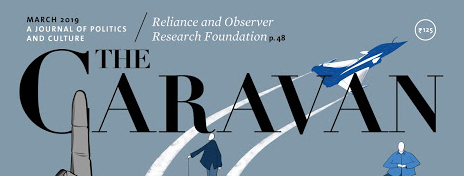
Published in Caravan Magazine. 1 March 2019
Excerpt
Observer Research Foundation (ORF) has tried hard to shed the Reliance Industries tag, and understandably so. A claim to independence is crucial to credibility in the think-tank world—especially when many think tanks are less than transparent about their funding and work. India’s oldest think tanks, government-affiliated and founded in the pre-liberalisation era, are typically thought to lack objectivity and sharpness, not to mention funds, and are not considered highly. In many cases, they have been outstripped in prominence and esteem by a surging number of privately-run recent arrivals—including local chapters of the Brookings Institution and the Carnegie Endowment for International Peace, two American powerhouses. The government itself, especially under the current administration, has increasingly broken faith with official think tanks, and granted pride of place to non-governmental ones.
ORF has benefitted the most from the shift in the government’s preferences. Since 2016, it has run the Raisina Dialogue—an annual pageant of Indian and international VIPs hosted in the national capital, and named after the part of Delhi, Raisina Hill, that contains the country’s highest organs of executive power. The ministry of external affairs is a partner in the Raisina Dialogue, providing a stamp of official approval and a minor share of the funding. ORF, as the event’s motive force, in effect uses Reliance funds to subsidise the government’s image, while also showing off its intimacy with the Indian state. In just a few years, the Raisina Dialogue has risen to become India’s premier geopolitical forum. It has carried ORF’s prestige up with it, in India and among the global power elite.
ORF’s output spans a wide range of fields and opinions, many with no connection to the interests of Reliance, or any of the think tank’s other funders. But in too many instances to ignore, its areas of interest and stated positions—including on such things as energy, cybersecurity and internet governance—overlap strongly with those of its primary backer.
Read the full article:
BY THE LATE 1980s, Dhirubhai Ambani wanted a newspaper. In 1986, the Indian Express had published a series of articles alleging that Reliance Industries had, among much else, manipulated its own share price, evaded duties and violated the limits of its licence for producing polyester feedstock—all while government officials looked the other way or made decisions that seemed customised to the corporation’s needs. The government responded with scrutiny and action that subtracted from Reliance’s bottom line, and Dhirubhai scrambled to limit his losses. A shift in the political tide and some deft manoeuvring soon brought him close to Prime Minister Rajiv Gandhi, and turned the might of the government against the Indian Express instead. But, by then, other outlets had also started publishing uncomfortable facts about Reliance’s doings.
In The Polyester Prince, his biography of Dhirubhai, the journalist Hamish McDonald writes that the Reliance chairman had “an urge to counter the Indian Express in print,” and “had talked for some years of getting into the media business.” Dhirubhai “had looked at several newspapers that came on the market,” and had earlier secured a controlling stake in The Patriot, “which had made vitriolic attacks on Nusli Wadia”—Dhirubhai’s main business rival, and a close friend of the publisher of the Indian Express—“in response to the Express campaigns.” In late 1988, Dhirubhai’s son-in-law bought Commerce, a Bombay-based weekly that was in financial trouble “but had a useful business and economic research bureau.” The hope was to turn it into a mainstream daily.
Commerce was put under the guidance of a high-profile editor, Prem Shankar Jha, and renamed the Observer of Business and Politics. It began printing in December 1989—just as the Congress administration under Rajiv Gandhi was replaced with a coalition government, under VP Singh, that was not friendly to Reliance. This was a problem for Dhirubhai. Some years earlier, in an interview with India Today, he had been asked, “One reason for your success is your ability to manage the external environment. How do you do this?” Dhirubhai responded, “The most important external environment is the Government of India. You have to sell your ideas to the Government. Selling the idea is the most important thing.”
Jha did not meet Dhirubhai’s requirements. He was well connected, but Dhirubhai was suspicious of his allegiances. He left the paper within months to join VP Singh, in the capacity of media advisor to the prime minister. As Jha’s replacement, Dhirubhai chose a man he could really trust—RK Mishra, the editor-in-chief of The Patriot.
VP Singh’s government failed, and was dissolved within a year. The Observer also failed, but more gradually. It never earned great readership or public clout, and was formally shut down after ten years. Dhirubhai’s hope of a newspaper to manage the “external environment” and sell ideas for Reliance remained unfulfilled. But his endeavour created the Observer Research Foundation—today, perhaps the country’s most prominent think tank.
On its website, ORF does not mention its roots in a defunct newspaper, but states that the organisation “began its journey in 1990 at the juncture of ideation tempered by pragmatism.”
Mishra remained at the helm of ORF through Dhirubhai’s death, in 2002, and until a couple of years before his own demise, in 2009. ORF received almost all of its funding from Reliance during Dhirubhai’s lifetime, and afterwards continued to draw the majority of its support from Reliance Industries Limited—the part of Dhirubhai’s corporation that, after an ugly split between his two sons, went to the elder Ambani brother, Mukesh. Today, Mukesh is the richest person in India, and one of the richest in the world, with an estimated wealth of $40 billion.
ORF has built up a wider set of financial backers in recent years, including numerous foreign ones, and so has driven down Reliance’s share in its total funding. In the 2017–18 financial year, ORF’s inflows totalled ₹35 crore—roughly $5.5 million at the time. Around sixty percent of the money came from Reliance. This, ORF insists, is proof that it is not a servant of its main benefactor, as it is often thought to be. In its literature, on its website and in the public statements of its representatives, ORF stresses that it is an independent entity, that it alone guides its methods and goals. Its largest office—a stand-alone modernist complex in central Delhi, custom-built by Reliance in the early 2000s—wears an impersonal architectural uniform of strict lines in glass and concrete, with not a hint of Reliance in sight. But its office in Mumbai, overshadowed by the Delhi unit in ORF’s internal hierarchies, is still in another garb. Located in an office tower in the city’s coveted Nariman Point area, it shares space with Reliance Industrial Infrastructure Limited. When I visited last month, a framed portrait of Dhirubhai Ambani hung from one wall, and a branded calendar from Reliance Jio, Mukesh’s mobile company, stood on the reception desk.
1/ PURPOSE
ORF HAS TRIED HARD to shed the Reliance tag, and understandably so. A claim to independence is crucial to credibility in the think-tank world—especially when many think tanks are less than transparent about their funding and work. India’s oldest think tanks, government-affiliated and founded in the pre-liberalisation era, are typically thought to lack objectivity and sharpness, not to mention funds, and are not considered highly. In many cases, they have been outstripped in prominence and esteem by a surging number of privately-run recent arrivals—including local chapters of the Brookings Institution and the Carnegie Endowment for International Peace, two American powerhouses. The government itself, especially under the current administration, has increasingly broken faith with official think tanks, and granted pride of place to non-governmental ones.
ORF has benefitted the most from the shift in the government’s preferences. Since 2016, it has run the Raisina Dialogue—an annual pageant of Indian and international VIPs hosted in the national capital, and named after the part of Delhi, Raisina Hill, that contains the country’s highest organs of executive power. The ministry of external affairs is a partner in the Raisina Dialogue, providing a stamp of official approval and a minor share of the funding. ORF, as the event’s motive force, in effect uses Reliance funds to subsidise the government’s image, while also showing off its intimacy with the Indian state. In just a few years, the Raisina Dialogue has risen to become India’s premier geopolitical forum. It has carried ORF’s prestige up with it, in India and among the global power elite.
This is reflected by ORF’s trajectory in global think-tank rankings. The Global Go To Think Tank Index, maintained by the University of Pennsylvania, put ORF in twenty-fifth place among the world’s non-US think tanks in 2018, up from eighty-second place in 2014. ORF was the top Indian think tank in the index last year, with only the Institute for Defence Studies and Analyses, affiliated to and funded by the ministry of defence, providing significant competition.
The financing and function of think tanks have not received much scrutiny in India, where their growing number and influence is still relatively new. But in the United States, where their impact on policy and discourse has been evident for decades, these are matters of much controversy and debate. Even so, the sociologist Thomas Medvetz writes in his book Think Tanks in America, “no one has yet offered a satisfying answer to the most basic question of all: What is a think tank?”
James McGann, the researcher behind the Global Go To Think Tank Index, defines them in loose terms, as “public-policy research analysis and engagement organizations that generate policy-oriented research, analysis, and advice on domestic and international issues, thereby enabling policy makers and the public to make informed decisions about public policy.” But many scholars believe there is more to what think tanks do than just such overt output.
In Foundations of the American Century, the scholar Inderjeet Parmar studies the outsize role on American foreign policy of the Ford, Rockefeller and Carnegie foundations—all old hands at intervening in public policy the world over. Parmar concludes that, throughout the near-century of the foundations’ foreign operations that he reviews, “the idea of the ‘network’ is a constant. The knowledge network is the foundations’ principal instrument and achievement.” These networks, Parmar argues, “achieve much when they are well funded and attractive to the brightest and best. They bring together scholars and practitioners in productive union. They bestow prestige on insiders and draw the boundaries of what constitutes valuable knowledge. They act as gatekeepers of ideas and approaches, certifying some and delegitimizing others. They determine what is current orthodoxy.” Networks “thereby generate outcomes that are not publicly stated,” and they are “what is continuous and longest lasting” in the foundations’ influence. Networks are “the end, not just a means to an end.”
ORF’s output spans a range of fields and opinions, many with no connection to the interests of Reliance, or any of the think tank’s other funders. But in too many instances to ignore, its areas of interest and stated positions—including on such things as energy, cyber security and internet governance—overlap strongly with those of its primary backer.
Medvetz argues that think tanks “are best understood, not as a discrete class of organizations per se, but as a fuzzy network of organizations.” Their complex missions, he writes, require that they “carry out a delicate balancing act that involves signaling their cognitive autonomy to a general audience while at the same time signaling their heteronomy—or willingness to subordinate their production to the demands of clients—to a more restricted audience. To reconcile this opposition, think tanks gather a combination of resources from the ‘parent’ fields of academia, politics, the market, and the media, and assemble these into novel packages.”
ORF describes itself in rhetoric similar to McGann’s, as an organisation that “provides non-partisan, independent analyses and inputs on matters of security, strategy, economy, development, energy, resources and global governance to diverse decision-makers (governments, business communities, academia, civil society).” But over many months of conversations with former and current ORF associates, and with top figures with experience in the government and in other think tanks, I was repeatedly told that ORF is not noted as a purely research-oriented organisation.
“ORF’s staff are not professional researchers,” the economist Ashok Desai, who was chief consultant to the finance ministry when it was led by Manmohan Singh, in the early 1990s, told me. For the most part, he said, “they are retired bureaucrats looking for something to do.”
A long-time ORF employee told me that the think tank “is now into mega-event management, and is hardly taken seriously for its academic or research work.” Even employees who are researchers “are being asked to do mega-events, and those with little research experience are being called ‘experts.’”
ORF’s output spans a wide range of fields and opinions, many with no connection to the interests of Reliance, or any of the think tank’s other funders. But in too many instances to ignore, its areas of interest and stated positions—including on such things as energy, cybersecurity and internet governance—overlap strongly with those of its primary backer. Dhirubhai’s richest asset at the culmination of his career was his petrochemical business, which is now in the care of Mukesh. It remains at the core of his business, where it has now been joined by Jio, which looks likely to monopolise the telecom market within a few years—much as Reliance has already done with the petrochemical sector. Tech giants such as Facebook, Google and Microsoft have also consistently funded ORF in recent years.
“ORF’s staff are not professional researchers,” the economist Ashok Desai told me. For the most part, “they are retired bureaucrats looking for something to do.”
The think tank’s top leaders, whatever their strengths, have not distinguished themselves in prior stints commanding eminent research institutions. ORF’s chairman, Sunjoy Joshi, joined the think tank after quitting his job as a high-ranking government bureaucrat. He had been in charge of exploration at the ministry of petroleum and natural gas at a time when the ministry took several decisions of benefit to Reliance’s petrochemical business, and served on the boards of the public-sector companies Oil India Limited and the Oil and Natural Gas Corporation. He remains closely connected to the corporation. ORF’s president, Samir Saran—who has spearheaded the think tank’s diversification of funding, and its recent rise to international prominence—came to ORF from Reliance. While there, he developed a penchant for handling journalists and public relations that continues to serve him today.
Public documents show that Joshi and Saran have close links to the Dewan Housing Finance Corporation, controlled by the tycoon Kapil Wadhawan. DHFL was a major funder of ORF in the past, and was recently reported to be at the centre of a colossal fraud, estimated to be worth billions of dollars.
Numerous figures on ORF’s board of trustees have uncontestable ties to Reliance. Annu Tandon, a former member of parliament from the Congress, is the widow of a top Reliance executive, and earlier ran a software company owned by the corporation. Bharat Goenka is the managing director of Tally Solutions, which counts Mukesh as an investor. Lalit Bhasin has served as a director with Reliance Capital and Reliance Petroleum, and is also the current president of the Bar Association of India. Past board members have included Rajan Luthra, who currently heads special projects at Mukesh Ambani’s office, and P Raghavendran, the president of Reliance’s refinery business.
What truly sets ORF apart—what it has that no other Indian think tank can rival—is its network. Between its roster of staff and fellows and the lists of people it has invited to its stages, ORF has forged links to all the “parent” fields Medvetz identifies in his book—academia, politics, the market, the media—and also to the bureaucracy.
“Bureaucrats who had done favours to Reliance while in the government found post-retirement jobs at ORF, which became sinecures for these individuals,” a person who worked with Reliance told me. Madhav Das Nalapat—an expert on international and defence affairs, and the editorial director of the Sunday Guardian—told me that, in politics, “ORF is a very well-conceived Plan B for Reliance Industries.” As part of the plan, “ORF cultivates the opposition, so that when there is a change in government, these individuals will be powerful.” The think tank’s associates include journalists young and old, with experience and connections in many of the most influential media organisations in the country. Its events draw journalists, scholars, activists and government officials at the heights of their professions.
Under the auspices of ORF, individuals from all these fields encounter a cast of the Reliance faithful. Najeeb Jung, the former lieutenant governor of Delhi, used to be a director at ORF. Prior to that, he was a top bureaucrat at the petroleum ministry, where he is alleged to have favoured Reliance. He later went on to join the corporation. Ashok Dhar, the president of ORF’s Kolkata chapter, earlier worked with a Reliance subsidiary, the Gulf Africa Petroleum Corporation. Atul Chandra, the president of Reliance’s international operations, is an advisor to the think tank. Sudheendra Kulkarni, the head of ORF Mumbai until last year, has joined the office of Mukesh Ambani. Reliance employees are a fixture at ORF events.
“You can’t always do something by telling a minister,” Desai said. “The case is made by writing a paper and sending it to the relevant ministry.” The think tank “may even submit papers privately, which others don’t know about.”
“There is an umbilical cord between ORF and Reliance, and that’s undeniable,” a former ORF fellow told me. “The final tipping point for a decision in government, with a policy which would have huge financial ramifications for a corporation like Reliance, needs ORF. ORF can come in and give that positive twist and final push. It is very subtle, and done with suaveness and finesse.”
Medvetz writes that American “think tanks have generated effects in the world of business by supplying vehicles through which corporations and wealthy individuals can intervene in political affairs, often without the unwanted visibility that accompanies more direct forms of political intervention. In this way, think tanks have expanded the strategic repertoires of market actors in American politics.” ORF functions in much the same way in India, as another tool for managing the “external environment.” It is one more of Reliance’s vehicles for pursuing that goal, which also include lobbyists, a stable of media organisations that the corporation has acquired or invested in, and relationships with politicians even outside ORF’s orbit. The think tank’s power lies not just in what it says, but also in its ability to put its views before the right people, at the right time, and to give them a reason to listen.
2/ POLICY
“RELIANCE IS MAKING a strategic transition to become a technology-platform company,” Mukesh Ambani declared at his corporation’s annual general meeting in July 2018. He boasted that “our connectivity platform has already made Jio the largest mobile data network in the world,” and announced plans to expand into fixed-line broadband as well. He promised that swift broadband would transform personal entertainment and domestic life, empower small businesses to compete with larger businesses, and give Indians “the ability to compete in the global marketplace using digital tools and techniques that are powering the fourth industrial revolution.” Reliance stood to gain too, of course. Mukesh told his shareholders that, with the new focus on telecommunication and cyber technology, “your company has prepared itself for this exciting future of non-linear and exponential growth.”
Mukesh first ventured into telecommunication in 2002, when he founded Reliance Communications. This was shortly after his father’s death, and before Dhirubhai’s corporation was partitioned. When the split was done, Reliance Communications went to the younger Ambani brother, Anil, and Mukesh came away with Reliance’s petroleum business. The brothers agreed to stay out of markets where the other was active. Mukesh was frozen out of telecommunication, until this non-compete agreement was mutually dissolved, in 2010, just in time for a major government auction of telecom spectrum.
Infotel Broadband Services, a previously inconsequential company, showed surprising reserves of capital to outbid more established rivals and secure 4G spectrum across the country. The larger companies, believing that Infotel was not a major threat, did not bid as aggressively as they might have otherwise. Reliance formally acquired Infotel as soon as the auction was done, and the company was renamed Reliance Jio Infocomm a few years later. Jio began commercial service, in September 2016, after signing up well over a million users during an unprecedentedly long period of “testing.” By the end of 2018, it had a user base approaching three hundred million people, and was steadily scraping revenue and subscribers away from its dwindling rivals.
ORF’s events and publications paid relatively scant attention to information technology through the first decade of the millennium, when India’s telecom market was already booming. In more recent years, the cyber world has become one of the think tank’s main areas of focus. In October 2013, ORF co-hosted the first “CyFy,” described as “the India conference on cyber security and cyber governance,” in Delhi. Four months earlier, at Reliance’s annual general meeting, Mukesh had first introduced Jio to shareholders. CyFy is now an annual event run entirely by ORF, and is considered one of its flagship forums. Google, Facebook, Twitter, Microsoft and ICANN—the non-profit that manages the online system of domain names—are among its partners.
ORF’s efforts yield an array of public events, papers and books, as well as articles on its own website and in the media. Staff, fellows and invitees can change, and the positions taken under the organisation’s name can vary. Some of these speak to areas where Reliance has no stake—as of yet, at least. On occasion, they contradict each other, and even clash with Reliance’s interests on specific points. This cacophony can help shield against suspicions of Reliance’s influence. But the wider currents of ORF and Reliance’s work move in synchrony—ORF looks most closely at what Reliance is looking at, and builds bridges where Reliance most needs them. And the public sentiments of ORF’s top officials—strong indicators of the institution’s views—frequently echo the concerns of its chief benefactor.
Nothing in Mukesh’s 2018 address would have surprised ORF. For years, the think tank has prepared the ground for exactly the strategy he revealed for Reliance: diversification away from hydrocarbons, as the availability and appeal of fossil fuels declines; and massive investment in telecommunication and cyberspace, with attention specifically on the fourth industrial revolution.
RISHI KUMAR MISHRA DESCRIBED the birth of ORF in a rare media interview, in 2004, with the news site Rediff. In the early 1990s, amid the balance-of-payments crisis that would famously spur economic liberalisation, “I was having dinner with India’s prominent economists,” Mishra said. “I told them, you have led the Indian economy in the past, tell us how to get out of this mess now.” The guests included PN Dhar, formerly Indira Gandhi’s principal secretary, and three former governors of the Reserve Bank of India. Mishra described how, under Dhar’s leadership, the economists “produced a paper called Agenda for Economic Reform. It was the first non-government document on reforms.”
Mishra said that ORF was founded “to carry out the nationwide debate generated by this paper. We had a conference in Delhi in which Manmohan Singh and P Chidambaram participated with Indian industrialists.” Singh was then the finance minister, and Chidambaram a minister of state for commerce with independent charge. Mishra said that ORF even organised a meeting, in Calcutta, between Singh and West Bengal’s communist chief minister, Jyoti Basu. “ORF believes in building a consensus on national issues,” Mishra said.
Whatever consensus Mishra built, he did it almost entirely behind the scenes. For a man heading an organisation that avowed a public purpose, he kept a low public profile, and almost never spoke on the record with the media. After his death, many of those who knew him contributed essays of remembrance to an honorary volume titled A Brahmin Without Caste. In essay after essay—from figures including the journalists Chandan Mitra, N Ram and Saeed Naqvi, the international think-tank heavyweight Strobe Talbott, the former head of the Research and Analysis Wing Vikram Sood, the Bharatiya Janata Party politician Ravi Shankar Prasad, and Mukesh Ambani himself—the few mentions of ORF’s policy research are overwhelmed by accounts of Mishra’s closed-door bonhomie with many of the most powerful people in the land, from Indira Gandhi at the height of her power to Brajesh Mishra, India’s first national security advisor, as he moulded the rule of Atal Bihari Vajpayee.
The policy work the book touches upon was largely focussed on regional diplomacy—ORF promoted the study of neighbours such as China and Sri Lanka—and national security, with a particular focus on Pakistan and Kashmir. This was reflected in the composition of ORF’s board as of 2004, when it included the former foreign secretary MK Rasgotra, the retired vice-admiral KK Nayyar, who served on the National Security Advisory Board, and the former army chief Ved Prakash Malik. In the book, Anand Bordia, a former high-ranking bureaucrat, mentions in passing that ORF also devoted some attention to “energy security, healthcare, education, science and technology and so on.” That is almost the book’s only reference to energy of the petrochemical kind, even as it devotes multiple chapters to Mishra’s interest in spiritual energy and the many books he authored on Vedic thought.
In fact, petroleum was a strong point of interest for ORF from quite early on. Dhirubhai spent a large part of the 1990s tending to his corporation’s move “upstream,” from manufacturing synthetic fibres and their petrochemical feedstocks to establishing his own oil refinery, at Jamnagar in Gujarat. In 1993, a fledgling Reliance Petroleum issued its first debentures to raise public capital. By the early 2000s, Reliance also scented profit in a proposed pipeline to bring gas to India from Central Asia—a project that would have to traverse the territory of Pakistan. Simultaneously, “ORF hosted a range of discussions on the Iran–Pakistan–India pipeline,” a scholar who worked with the think tank at the time told me. “There were visiting delegations from Pakistan, and there were several discussions about selling energy to Pakistan. Reliance officials would attend these closed-door discussions.” This was an exercise in “testing the waters,” to see “whether the governments of India and Pakistan were interested.”
ORF’s research also zoomed in on Central Asia. The think tank published widely on the region’s politics and security, and on the challenges to developing pipelines there. ORF also continued to look closely at Pakistan. Mishra was, by all accounts including his own, a vocal proponent of peace between India and its western neighbour. An end to the two countries’ antagonism promised many benefits. Among these, certainly, would have been the security of a potential gas pipeline to India, and possibly also a new national market for Reliance.
Prem Shankar Jha told me that Mishra began going to Pakistan in the 1990s. “Dhirubhai saw a market there,” he said, “and wanted access to it for Reliance’s Jamnagar refinery.”
Khurshid Mahmud Kasuri, a former Pakistani foreign minister, wrote in a memoir of his diplomatic work that, after India and Pakistan signed a landmark nuclear-control agreement in Lahore in early 1999, the two countries’ leaders established a “backchannel” of communication, outside the usual diplomatic chain of command. Vajpayee appointed RK Mishra as his go-between. Both sides continued to pass information along the backchannel when a Pakistani incursion into Kargil led to war later that year. By that point, Reliance had constructed its own refinery at Jamnagar—today the largest refinery complex in the world. Sanjaya Baru—who served as a media advisor to Manmohan Singh, Vajpayee’s successor as prime minister—writes in his book The Accidental Prime Minister that, during the war, Mishra “also doubled up as Reliance Industries Chairman Dhirubhai Ambani’s aide, seeking assurances from the Pakistanis that they would not bomb Reliance’s Jamnagar plant.”
Plans for a pipeline were frustrated by stubborn regional turmoil. Gradually, ORF’s interest in Central Asia also cooled—though it retains its focus on Pakistan, and on Indian strategic interests amid the war in Afghanistan.
Mishra’s access to Vajpayee and Brajesh Mishra—an old friend of his, whom many considered the most powerful man in Vajpayee’s administration—marked an apex in ORF’s influence. Through the 1990s, the organisation had remained relatively small. In the Vajpayee years, and as Mukesh replaced his father as the think tank’s patron, ORF received a new home—the large, Reliance-built Delhi office that is now its main base. Vajpayee’s government fell in 2004, but the think tank continued to grow. Many members of Vajpayee’s staff found places at ORF.
Pakistan was hardly the only matter that Reliance needed help with. In 2002, the corporation discovered giant gas reserves in the Krishna Godavari Basin, off the country’s eastern coast. It tapped these before the decade was out, opening up a stream of profits, and controversy. The state-owned Oil and Natural Gas Corporation, a rival to Reliance’s energy business, has remained in slow decline, to the great benefit of the private corporation. Reliance has faced accusations of stealing government intelligence on exploration, of siphoning off gas from gas fields allotted to ONGC, and exaggerating its production costs to reduce what it owed the government above its own fair returns, in line with existing policies for natural-resource concessions.
In the early 2000s, ORF set up the Energy News Monitor, a weekly round-up of energy news and policy in India and around the world. It also partnered with the India Energy Forum, a petrochemical industry group, to hold the Petro India conference. Last year, the conference celebrated its fifteenth edition. Reliance and ONGC were among the sponsors.
In 2007, an empowered group of ministers led by the finance minister, Pranab Mukherjee, went against the advice of government officials and sharply raised the price Reliance was to receive for supplying gas to a public-sector power company. In late 2012, an official committee headed by C Rangarajan, then the head of the prime minister’s economic advisory council, recommended a further, almost twofold increase. It suggested a formula to price Indian gas based on an average of global prices, with no regard to the specific conditions of the local market. The government eventually agreed.
In early 2013, as the Rangarajan recommendations fed a scandal, Surya P Sethi, a former principal advisor to the government on power and energy, excoriated the suggested pricing formula in The Hindu. Sunjoy Joshi, then the director of ORF, hit back in the same newspaper’s pages. He attacked Sethi’s understanding of basic economics, bewailed the government’s defective gas-pricing schemes, and sympathised with “the good economist, Dr. Rangarajan,” who had been confronted “by the irresolvable dilemma of discovering the market price for a market rendered dysfunctional by policy.” Only after thoroughly confusing the issue, near the end of his piece, did Joshi concede that the suggested pricing formula did not reflect the market price of gas in India. An endnote identified Joshi simply as the director of ORF—shielding the article from any direct connection to Reliance, the corporation that had the most at stake in the matter.
Joshi ended his rebuttal by calling for an end to all price controls on gas. A few months later, in the Times of India, he argued for the deregulation of petrochemical exploration, as companies would not be bold enough to find new deposits without a guarantee of a free hand and freer profits. Joshi has long kept up the refrain of deregulating oil and gas exploration, and other sectors of the petrochemical market. So have many other ORF associates and employees.
In 2010, Joshi authored a newspaper article that called for reform in fuel retailing, to end the “oil marketing companies’ stranglehold on dealers by way of mandatory supply linkages”—an arrangement that reserved the sector for government-owned companies. A few years later, Reliance began to reactivate a network of fuel stations that it had earlier decommissioned. It had well over a thousand of them by 2018, and, together with the British multinational BP, was reportedly planning to open up to two thousand more.
Over the course of Reliance’s petrochemical adventure, ORF became home to a growing list of former bureaucrats connected to oil and gas. The journalist and former ORF fellow Saeed Naqvi told me that “anyone who had advanced to the level of joint secretary in the ministry of petroleum was hired by ORF … anyone with a connection with government and oil.”
Also in 2010, Reliance entered the world of “non-conventional” gas—gas trapped in shale and coal formations, and released via fracking—by buying stakes in three companies operating in the United States. Three years later, India brought in a policy that allowed only state-owned firms to search for and exploit non-conventional reserves.
The same year, as the government considered a new bill on land acquisition, Manish Vaid, an ORF fellow, wrote an article titled “Can new land acquisition bill facilitate India’s shale gas progress?” He wrote that “some of the companies in India” were “apprehensive about the proposed bill, which according to them will bring up the costs of the projects significantly and make them unviable.”
Through 2017, as the government reportedly considered a change in the rules to allow private companies in, Vaid continued to write enthusiastically about the promise of India’s non-conventional reserves. When the rule change came, Reliance outbid several rivals for the rights to coal-bed gas from central India.
In his address at the 2018 annual general meeting, Mukesh informed shareholders that Reliance was steadily ramping up production of coal-bed gas, and proposing to merge its operations in the United States and India, “thereby integrating the US gas resources with Indian market.”
In 2017, Vaid wrote about the need for strategic petroleum reserves to improve the country’s energy security. Last year, the government green-lit the construction of two strategic underground fuel depots, and was reportedly in talks with prospective private investors, including Reliance.
Over the course of Reliance’s petrochemical adventure, ORF became home to a growing list of former bureaucrats connected to oil and gas. The journalist Saeed Naqvi, who worked at ORF in Mishra’s time and quit a few years after his death, told me that “anyone who had advanced to the level of joint secretary in the ministry of petroleum was hired by ORF … anyone with a connection with government and oil.”
Sunjoy Joshi was one of these new hires, and came on board in 2007. Back when the Ambani brothers were sorting out their inheritance, they had come to a private agreement about KG D6, a prized block in the Krishna Godavari Basin that Reliance had secured the rights to several years earlier at auction. Mukesh agreed that once the gas started flowing he would supply it to Anil at a fixed, cheap rate, to fuel a couple of power plants. The catch was that, since natural resources are fundamentally government property, the agreement was subject to official approval. When the time came, and with both brothers desperately trying to get their way, the government ruled that the agreed price was unfeasibly low, meaning Anil would have to pay more. Joshi was then in the crucial position of joint secretary for exploration in the petroleum ministry. In one note from the official deliberations that was later leaked, Joshi drew attention to a letter from GAIL, the state-owned gas transmission company, in which it “protested at the landfall price being offered” to Anil by Mukesh “when GAIL itself is in a position to sell gas at a higher price.”
There was also Najeeb Jung. In his time as the joint secretary of exploration, Jung had a large part in allowing private firms to gain a stake in two oilfields off the Maharashtra coast that had earlier been entrusted solely to ONGC. Reliance was one of the firms to benefit. Jung became ORF’s director of energy research, in 2005.
JM Mauskar, now an ORF advisor, was earlier a high-ranking bureaucrat in the ministries of petroleum, commerce and the environment, and served on the boards of ONGC and Oil India Limited. He was also on the Rangarajan-led committee that created the controversial gas-pricing formula. NK Singh—once an officer on special duty to Vajpayee, and later elected to the Rajya Sabha—was an advisor to ORF for a decade until 2017, when he was appointed the chairman of the finance commission. While a member of parliament, he featured in the Niira Radia tapes, discussing a tax break on natural gas with a lobbyist working for Reliance. Atul Chandra, one of ORF’s advisors, served on the board of ONGC and managed the company’s overseas arm, before taking charge of Reliance’s foreign operations. P Raghavendran, the head of Reliance’s refinery business and also on the ORF board, was a top executive at Indian Oil and an advisor on petroleum to the Planning Commission.
Even while leading the line on Reliance’s petrochemical interests, ORF also sounded the clarion on the need to look beyond petroleum and gas in the future. The Petro India Conference in 2011—the year after production at KG D6 peaked—was themed “What after KG Basin and D-6?” ORF’s publications and events in recent years have started to look at alternative energy and electric transport infrastructure. In 2017, Reliance was reported to be exploring investments in energy storage facilities near solar and wind energy projects. The corporation sold its stakes in American fracking companies that year, due to shrinking profits. With production at KG-D6 in steady decline and hurting profits, Reliance sold off its Indian pipeline in 2018. Manish Vaid noted in a piece that “the current structure of energy in India, dominated by hydrocarbons, began to crumble” after 2015, as the government pursued its commitments to mitigate climate change under the Paris Agreement.
By then, Reliance was already pivoting to telecommunication and cyberspace—and ORF was ready for it.
THROUGH 2018, even before he declared to shareholders that Reliance’s future was in the digital realm, the extent of Mukesh’s new ambitions started coming into clear view. Jio Music, Reliance’s music-streaming service, merged with a rival, and Reliance acquired a majority stake in an artificial-intelligence-driven education platform. This suggested that Reliance did not just want to carry data on its network—it wanted its own universe of digital services too. Reliance also revealed plans to expand into e-commerce, and to get India’s millions of neighbourhood grocery stores online.
Near the end of the year, the government announced changed rules on foreign investment in e-commerce that severely restricted the operations of Flipkart and Amazon—the two existing giants in the sector, both controlled by American corporations. The restrictions targeted practices central to the two companies’ business—including exclusive sales, special customer services and the retailing of merchandise from suppliers that they are invested in themselves. An anonymous industry executive, quoted in the Economic Times, stated, “It looks like someone has studied the business models of Amazon and Flipkart, and introduced clauses to systematically kill the two companies.” Reliance was on the official e-commerce taskforce that formulated the new rules, alongside other local digital giants such as Paytm. The taskforce excluded foreign-owned firms, including Flipkart and Amazon.
Reliance has also made known its desire to own data infrastructure. To accompany Mukesh’s announcement of fixed-line broadband service, Reliance acquired controlling stakes in two major cable providers, Hathway and DEN. Reliance is also working on a network of data centres across the country, including in Delhi, Navi Mumbai, Kolkata and Jamnagar. Mukesh has said that Reliance, together with major international tech firms, will build a digital industrial area in Maharashtra—the first of its kind in the country—with a total investment of almost ten billion dollars over the coming decade.
On telecommunication and data, as on energy, ORF has consistently advocated giving the private sector a strong say in regulation, and more space in the market. Samir Saran, then a vice president of ORF, wrote in 2014 that internet governance and cybersecurity had “witnessed a disappointingly muted debate within India,” and that “any governance framework must accommodate the voice of consumers, private-sector companies and other stakeholders.” In a piece he co-authored in 2016 with Vivan Sharan, who for a time headed ORF’s work on global governance, Saran complained that India’s telecom industry “lacks the bandwidth to deliver affordable data,” and that “there is policy inertia to address this, partly due to the existence of BSNL”—the state-owned telecommunication company. “Policymakers have hesitated from undertaking comprehensive reforms,” the piece said, “hoping that BSNL’s networks will save the day. And BSNL has not delivered the goods.”
The CyFy conference is a potent tool for inserting ORF, and Reliance, into the conversation on cyber issues. Reliance executives are frequent at the CyFy conferences—no other Indian corporate group has comparable representation on its stages. They are typically joined by representatives of international internet and technology companies, foreign cyber-technology experts, and senior government officials. The first CyFy, in 2013, was addressed by the Congress politician Manish Tewari, then a minister of state with independent charge for information and broadcasting. Tewari was an advisor to ORF, between 2009 and 2012. The inaugural session at the 2016 conference featured Saran, Joshi and the incumbent minister for communication, Ravi Shankar Prasad—an old friend of RK Mishra. Prasad was never formally associated with ORF, but one of its fellow travellers.
In late 2014, the Financial Times’ James Crabtree reported on documents showing that Reliance paid Tewari and Prasad, both qualified lawyers, hundreds of thousands of dollars in legal-retainer fees prior to their respective ministerial appointments. The politicians and the corporation denied that they had done any wrong.
On the eve of the first CyFy, the Economic Times spoke to Sunjoy Joshi about the need for such a conference. Joshi told the paper that “the government can’t manage things on its own. It will have to not only enlist the private sector but go beyond—by taking support from other organisations and individuals to rev up the country’s cybersecurity prowess.” The report paraphrased Joshi as saying that private corporations, including Reliance, “will naturally explore possibilities in the area.” Citing an unnamed source, the same report stated that “Ambani’s reasoning for entering cybersecurity is as simple as simple can get.” As a company highly vulnerable to cyber attacks, the report added, Reliance would “continue to aggressively build a cybersecurity network to protect its own assets and will then look for selling those security solutions in the market.”
Reliance’s annual reports began voicing concern over cybersecurity at this point. Its reports for more recent years show an expanding emphasis on the digital integrity of communication networks, satellites and control infrastructure at critical points such as oil fields.
ORF regularly hosts other events on cyber issues as well, and its fellows publish widely on cyber issues. Saran himself is perhaps the organisation’s most prolific voice on the theme. He also sits on two international cyber-governance bodies—the World Economic Forum’s Global Future Council on Cybersecurity, and the Global Commission on the Stability of Cyberspace, or GCSC. Carl Bildt, a former Swedish prime minister who is on ORF’s global advisory board, is a special representative at the GCSC, and is on the Global Commission on Internet Governance, or GCIG. V Latha Reddy—a deputy national-security advisor and the chair of a working group on cybersecurity under the government of Manmohan Singh, and now a distinguished fellow with ORF—is co-chair of the GCSC, and part of the GCIG. This makes ORF often the loudest Indian voice in global conversations on cyber governance.
This has led to consternation among some Indian civil-society groups. Critics of the GCSC and GCIG see these organisations as being dominated by private Western interests, and competing with more multilateral bodies such as the United Nations’ International Telecommunication Union.
Domestically as well, despite its entanglement with Reliance, ORF has presented itself as an independent public voice on cyber issues—sometimes to the exclusion of other parties. In 2017, India was chosen to host the Global Conference on Cyber Space, a major biennial gathering of international governments, companies, academics and civil-society groups to discuss cyber governance and norms. The conference was organised by the ministry of electronics and information technology, then under Prasad, and ORF was a partner. Many Indian civic internet-policy groups were protesting efforts to force Aadhaar, the government’s biometric identity scheme, on the entire population. Srinivas Kodali, an independent cyber-policy researcher, told me that a number of these groups were barred from the conference. “The government did not want any of these critical voices to be present,” he told me. The international digital-rights group Access Now noted that “some local civil society and groups working on privacy had either limited or no access,” and that the event became a showcase of government plans “instead of what could have been: a robust, open dialogue on the crucial cybersecurity issues that impact every one of us.”
In 2015, the government issued, and then swiftly withdrew, a controversial draft encryption policy. The following year, ORF sent out an email to say that the government had “reached out to stakeholders to help contribute to its second iteration,” and that as “one of the institutions invited to provide inputs to the draft policy, the Observer Research Foundation will be holding a multistakeholder consultation on encryption.”
ORF has used its position to amplify a discourse on cyberspace as an arena of national security. The CyFy conferences frequently feature cybersecurity experts who have worked with governments such as the United Kingdom, the United States and Israel. Sean Kanuck, a distinguished fellow at ORF and a co-chair of CyFy 2017, spent many years working for the US director of national intelligence, the Central Intelligence Agency and the White House. In 2017, ORF and the Council on Foreign Relations, a major US-based think tank, partnered to hold a dialogue on cyber issues, in Washington DC. It was chaired by Gulshan Rai, India’s national cybersecurity coordinator.
In 2013, an ORF fellow published a call for the government to recognise “public and private digital infrastructure as a strategic national asset.” The following year, the government created a nodal agency, the NCIIPC, tasked with protecting “critical information infrastructure”—a category that takes in private assets in areas such as banking, telecommunication, transport, power and energy.
The 2013 Economic Times article that quoted Joshi noted that companies such as Reliance “would like to be at the forefront of the public-private partnership” model the government “has envisaged to combat cyber crimes.” ORF pointed out in a report that the National Cyber Security Policy of 2013 had called for the training of 500,000 professionals in cybersecurity, and lamented that nothing had come of this. The think tank has partnered with the Sardar Patel University of Police, a government-run institute in Jodhpur, to provide cybersecurity training to law-enforcement officers—including police and paramilitary personnel, as well as representatives of the Central Bureau of Investigation and the National Investigation Agency. Saran is the director of the university’s Centre for Peace and Security. Mahendra Kumawat, a former director general of the Border Security Force, was the vice chancellor of the university, until 2015. Kumawat was a distinguished fellow at ORF for several years, and is now one of its trustees.
ORF’s associates reflect the think tank’s interest in telecommunication, cyber governance and national security. R Ashok, a former member of the Telecom Regulatory Authority of India, is now an advisor to the think tank. Besides Latha Reddy, another distinguished fellow at ORF is Raghu Raman, Reliance’s group president for risk and security, who was earlier the chief executive of the National Intelligence Grid. Rajeswari Pillai Rajagopalan, earlier the assistant director of the national security council secretariat, is a distinguished fellow as well. Rajagopalan heads ORF’s initiative on nuclear and space policy. Vikram Sood, the former head of the Research and Analysis Wing, has been an advisor to ORF for well over a decade.
“Many people in ORF had worked with RAW,” Saeed Naqvi told me. “There is a nexus between intelligence agencies and industry. That was constantly brought into play.”
Alongside this, ORF has mirrored Reliance’s growing interest in the fourth industrial revolution—the nascent economic transformation being powered by advanced computing, artificial intelligence and robotics. It has been a recurring theme in the think tank’s publications in the last two years—including in a paper on the future of the Indian workforce, co-authored by Saran—and has come up at CyFy events. When, in February 2018, Mukesh presented Reliance’s plans for a digital industrial area in Maharashtra, he declared his intent to make the state “the birthplace and cradle of the fourth industrial revolution in India.” ORF’s relatively sleepy operation in Mumbai, long eclipsed by the Delhi office, discovered a sudden vigour. In September, it started the Mumbai Tech Talks, a new quarterly event. At its launch, held at the Bombay Stock Exchange, Saran emphasised that Mumbai must take a leading role in India’s technological progress. In November, ORF and the NITI Aayog, a planning body of the central government, held a conference in the city on artificial intelligence. Reliance executives attended all of these events.
One of the sponsors of the November conference was the World Economic Forum. The previous month, the Maharashtra government, the WEF and Reliance together created, in Mumbai, a Centre for the Fourth Industrial Revolution. Mukesh is a WEF trustee. Saran is an advisor to the group’s South Asia board.
ORF’s positions on cyber governance have sometimes clashed with those of Reliance. One significant instance of this came in the debate over data localisation—the notion that users’ data should be stored and processed only in their home countries.
Localisation is anathema to internet companies—including Amazon and Flipkart—whose business models rely on data flowing unfettered across international borders. Forcing Indian data to remain on Indian servers could hamper foreign companies’ operations, and be a boon to Reliance’s growing network of data centres. In 2017, when the Telecom Regulatory Authority of India opened a public consultation on data security and ownership, Jio came out strongly in favour of localisation. Mukesh has repeatedly spoken out about a threat of “data colonisation” from the domination of cyberspace by foreign firms.
Last year, the Reserve Bank of India told payment companies to only store Indian users’ data inside the country. The draft data-protection bill, in its latest form, requires that Indians’ “critical personal data” only be processed domestically, and that a copy of Indian users’ data be kept on local servers—a measure it says will help in law enforcement and criminal investigations.
ORF published a piece that described data localisation as a “regulatory sledgehammer,” and said that the specifics of the draft bill’s requirements for storing local copies of Indians’ data were “shrouded in mystery.” Two ORF fellows published an article arguing that localisation alone would do little to help domestic law-enforcement. Instead, they suggested taking advantage of the CLOUD Act. This new law in the United States—the home of most of the largest tech companies operating in India—allows foreign states vetted by the US government to access data owned by American companies that they were previously barred from seeing. Recently, ORF published a monograph laying out the steps necessary for India and the United States to start sharing data under the Act.
Saran has tried to find a middle path. In 2017, while lauding the explosion in Indians’ data usage as a result of Jio’s “disruptive intervention,” he echoed Mukesh’s view, voiced at a recent conference, that if “data is the new currency … businesses must aim to keep it within India.” He wrote that, unlike the arguments for data localisation made by security officials and regulators, Ambani had pitched this “as a business proposition, arguing that data is the bedrock for value generation and innovation.” If he had any reservations about Mukesh’s position, he did not state them. In an article that same year, he wrote that the world’s current “digital heavyweights are writing rules to retain their stranglehold over data capture and analytics.” In 2018, in a comment he co-authored on the proposed data-protection framework, Saran warned that “data localisation can harm innovation among startups that rely on cross-border data flows,” but conceded that “to address concerns of foreign data surveillance, data collected by public entities such as biometric data can be mandated to be stored on Indian soil.”
ORF’s funders include several US-based tech companies that are strongly opposed to data localisation. This includes Facebook, Microsoft and Google. All three firms recently signed an open letter to US lawmakers that described the CLOUD Act as a “logical solution for governing cross-border access to data.”
There are likely to be more contradictions between the interests of Reliance and of ORF’s foreign tech backers as Mukesh continues to pursue his cyber-technology ambitions. The think tank could increasingly find itself caught between their differences.
OF THE FOUR RAISINA DIALOGUES TO DATE, the 2018 edition made perhaps the biggest geopolitical mark. It was inaugurated by Prime Minister Narendra Modi and the Israeli prime minister, Benjamin Netanyahu, alongside India’s minister of external affairs, Sushma Swaraj. Saran and Joshi joined them on the stage, at one of Delhi’s top hotels. On the afternoon of the closing day, with two full days and late nights of discussions already done, the conference delivered an especially significant moment.
Four naval officers, in full uniform, took to the dais—the chiefs of the Indian and Australian navies; the commander of the Pacific Command of the US armed forces; and the top officer of Japan’s navy, as well as the rest of its military. Together, they represented the “Quad”—a formation of countries brought together by a mutual desire to contain China’s presence in the Indo-Pacific region.
“It was an electric moment,” Rajiv Bhatia, a former director general of the Indian Council of World Affairs, recalled. “It sent out a signal that the Quad was more than just a vague idea that appeared in op-ed pieces and occasional papers. It showed that the Quad countries are concerned about China’s increasing profile.” It also made clear, Bhatia told me, that “the Raisina Dialogue is not another routine meeting of a handful of scholars and junior officials.”
Days later, the Global Times, a mouthpiece of the Chinese communist party, ran an article titled “New Delhi forum props up ‘Quad stance’, refuses to listen to China voice.” The writer, a senior fellow at the Shanghai Institute for International Studies, claimed that Chinese scholars did not get to speak on key regional issues, or to ask questions. “The Raisina Dialogue was elaborately planned to serve as a platform for countries like the US, Japan and Australia to show their tough stance toward China and Russia,” the article said, “and demonstrate India’s posture of trying to balance between Eurasia and the Indo-Pacific region, in addition to India’s independent major-power status and dissatisfaction with China.” Saran tweeted in response, “China clearly does not like the Raisina Dialogue. No Comments.” In another tweet, he wrote, “We had 20 participants from China approx. and 2 speakers. China did not send officials. Cannot force them.”
But the conference showed more than just the tilt in India’s geopolitics. From the list of speakers and the five-star venue down to the film-worthy stage lighting, everything was intended to dazzle and impress. This was a diorama of India’s rising power, designed to catch the world’s attention. And it was delivered courtesy of ORF—with, in effect, a subsidy from Reliance.
“Who else can organise something like a Raisina Dialogue?” Dhaval Desai, the head of ORF Mumbai, told me. “Even the government of India cannot pull off events like this on their own. They need an organising partner.”
In its first year in power, the Modi government appointed a new foreign secretary, S Jaishankar. Soon afterwards, in its 2014–15 annual report, the ministry of external affairs stated its intent to “organize conferences in partnership with major think tanks and academic institutions.” The Raisina Dialogue is not the only outcome of the policy—the ministry has also sponsored events by the Mumbai-based Gateway House, and by the India Foundation and the Vivekananda International Foundation, both closely connected to the BJP and the Rashtriya Swayamsevak Sangh. But none of these have rivalled the Raisina Dialogue for scale and budget. The ministry has reported that it contributed Rs 55 lakh to the Raisina Dialogue in 2016, and Rs 80 lakh the following year. This was a fraction of the cost of the event—the rest came from other event partners, and from ORF.
Earlier, India’s most noted diplomatic conferences were organised by government-affiliated think tanks. Just how ORF, a corporate-sponsored institution, was selected to supersede them, and given a lead role in signalling Indian foreign policy, is not fully clear. In a submission to parliament, the ministry stated that it chooses outside partners “based on the project proposals submitted by these institutions,” taking into account factors such as the “relevance and utility” of the suggested conference, the list of speakers, logistical arrangements—and, of course, the proposed budget.
Last year, a few months after the Raisina Dialogue, the government cancelled the Asian Security Conference, organised by the defence-ministry-affiliated Institute for Defence Studies and Analyses. Its theme for the year was to be “India and China in Asia: Making of a New Equilibrium.” The New Indian Express reported that IDSA scholars “suspect that the cancellation was dictated by New Delhi’s perceived need to not anger Beijing before important visits”—the very thing that the Raisina Dialogue had been allowed to do. It added that the scholars “also suspect the deferment and effective cancellation of the Asia Security Conference is a deliberate ploy to promote competing think tanks that are not directly with the government but are promoted by private enterprises.”
“Who else can organise something like a Raisina Dialogue?” Dhaval Desai, the head of ORF Mumbai, told me. “Even the government of India cannot pull off events like this on their own.”
The Raisina Dialogues’ hawkishness on China fits well with ORF’s orientation towards the West, especially the United States. Since the think tank was reinvigorated at the beginning of the millennium, it has emulated the Indian government’s increasing alignment with the North American superpower. This is evident in its frequent collaboration with US think tanks, and its access to powerful American figures. When Nikki Haley, then the US ambassador to the United Nations, visited India last year, ORF arranged a lecture where she spoke about furthering bilateral relations. But ORF has also been careful not to antagonise Russia—a key ally to India. Any perceived slight to the country in the 2018 Raisina Dialogue was corrected at this years’ conference, a somewhat tamer affair, where the Russian deputy foreign minister was an honoured guest. The Kremlin ideologue Sergey Kurginyan is on ORF’s list of visiting fellows.
ORF’s growing international stature coincides with Reliance’s own global ambitions. The corporation is already India’s single largest exporter, and continues to seek opportunity abroad. Africa, with many underdeveloped telecommunication and cyber markets, could be a tempting future target. ORF organised an African edition of CyFy last year, along with the Moroccan government. In 2017, Saran wrote an article to promote “Aadhaar diplomacy.” He proposed that, to counter the capture of personal data by Western corporations, India should offer other developing countries an alternative system based on Aadhaar to let “governments retain jurisdiction over their data.” Others at ORF have also called for the export of Aadhaar. The rapid growth of Jio’s customer base is reliant on the use of Aadhaar to verify customers’ identities. “Aadhaar enabled us to acquire a million customers a day, which is unheard of in the industry as a whole,” Mukesh said at a public appearance, in 2017.
ORF’s growing international stature coincides with Reliance’s own global ambitions. The corporation is already India’s single largest exporter, and continues to seek opportunity abroad.
Just as it has on cyber issues, ORF has muscled civil-society groups out from conversations on foreign policy too. ORF is the only Indian member of the BRICS Think Tank Council, a body meant to encourage cooperation between think tanks in Brazil, Russia, India, China and South Africa. At the 2016 BRICS summit in Moscow, ORF was the official Indian representative to a civil-society forum run parallel to the event. “ORF’s employees prevented some others from speaking at the meeting, claiming that only they as official representatives could speak,” Amit Sengupta, a leader of the public-health collective Jan Swasthya Abhiyan, and one of the attendees, told me last year. “The rest of us wondered why the government selected ORF as the official civil-society representative. The position that ORF took in the discussions was largely pro-government.”
3/ PERSONNEL
“ I AM A COMMON PERSON,” RK Mishra said in the Rediff interview, in 2004. “I started as a journalist. I have been a vagabond in my life and in my career.”
Mishra maintained an unassuming, almost invisible, public persona. It was a great decoy. Nobody who wrote in A Brahmin Without Caste remembered him as common in any way. If the book is to be believed, he was incredibly astute, sometimes even clairvoyant, in his reading of politics, whether at home or abroad. He was charismatic and inspiring—several of ORF’s earlier recruits told me they joined the organisation because they were drawn to him. If he was a “vagabond,” it was of a very particular type. Mishra was a man of very many friendships and interests, at ease moving between cities and countries as much as between ideological camps. Brahmin presents this as a sign of his boundless curiosity and erudition. But it was a sign of more than just that.
It is often the case that a person’s allegiances change over time, particularly over a long and varied life. But where others might shed old connections that seem incompatible with new ones, Mishra rarely did. This vagabond hoarded them, not caring for apparent contradictions, ready for use if the need arose. All that he learnt along the way was not learnt just for the sake of knowledge. From early on in his career, even when he was still designated an editor, Mishra was valued more as a political operative than a journalist and intellectual. He imparted these characteristics to his cherished think tank, and it has never lost them since.
“I took my first job in Kolkata in 1946-47 in a Hindi paper called Lokmanya,” Mishra told Rediff. “At the age of 27 I became editor of Navyug, a Hindi newspaper of Jaipur.”
Saeed Naqvi was a cub reporter in Jaipur at the time Mishra worked in the city. He writes in Brahmin that Mishra, as a young journalist working in Calcutta, caught the attention of an associate of Mohan Lal Sukhadia, a Congress politician in Rajasthan. Sukhadia, Naqvi recalls, “was keen to start a newspaper for the Congress party in Jaipur.” Mishra took his chance. “Aap Mukhya Mantri ka shapat lene ka man bana leejiye,” Naqvi says the young Mishra told the politician, “main Navyug kal nikal doonga”—You prepare to become the chief minister, I will bring Navyug out tomorrow.
Navyug was established in 1954. Sukhadia became the chief minster that same year. The managing editor was Hari Dev Joshi, a future chief minister. Naqvi writes that “it was common knowledge that Sukhadia’s first cup of tea every morning” was with Mishra. TN Chaturvedi, a bureaucrat whom Mishra befriended in Jaipur, and who later rose to become the Comptroller and Auditor General, writes that “Mishraji, in his capacity as the Editor of Navyug, proved to be of great help to Sukhadia and his ministers.” And proximity to Sukhadia brought him into the orbit of Indira Gandhi.
Naqvi recalls in Brahmin that Mishra “in those days was in the grip of Marxist thought and had a sort of intellectual aversion for ‘the last remains of feudal oppression’”—Rajasthan’s old aristocracy was still powerful, though declining. The political scientist and foreign-policy scholar SD Muni met Mishra in Jaipur in the late 1960s, while a student at Rajasthan University. He writes in Brahmin that Mishra was active in university affairs, and objected to the fact that the Asia Foundation was supporting the university’s centre for South Asian studies because of “suspected CIA funding for the Asia Foundation.” But Mishra was not always so rigid. He “was close to ‘His Highness’ Jhalawar, a member of Sukhadia’s cabinet,” Naqvi records. “Jhalawar sometimes drove to RK’s home with bottles of ‘Rose liquor’ for which princely houses of Jhalawar and Udaipur were both famous. How does one square this with his passionate ‘bhashans’ on the ‘underclass’?” Mishra even made it a project to teach Naqvi “the a, b, c’s of Marxist jargon. But he winked at Rose liquor supplied by Jhalawar.” He also spent his evenings at the ashram of a godman, whom he accepted as his guru.
In 1969, the old guard of the Congress expelled Indira, the sitting prime minister, angry at her policies and her iron-fisted style. Indira formed a breakaway Congress of her own, and went searching for allies to prop up her government. Naqvi writes that Mishra “was the man of the moment,” and took up a role in Delhi with The Patriot. The newspaper had been founded by Aruna Asaf Ali and Edatata Narayanan, freedom fighters and staunch communists. Mishra became “a bridge between the Leftist vision and Congress pragmatism,” a “Raj Purohit to Indira Gandhi on the one hand and Aruna Asif Ali on the other.”
Mishra was voted into the Rajya Sabha in 1974. The next year, Indira declared the Emergency. This “made RK’s position as an unbiased reporter untenable as long as he continued to be a parliamentarian,” the activist John Dayal, at the time a reporter with The Patriot, writes in Brahmin. Narayanan, the paper’s editor, viciously protested Indira’s rule by decree, and the ascent of her son Sanjay as her unofficial, but vastly powerful, advisor. Even amid a government crackdown on the press, Mishra remained in the Rajya Sabha—a fact the book elides. “Though he withdrew for a while from Patriot,” Dayal recalls, Mishra continued to come to the paper’s offices, “and we did learn much from our own ‘source’, as it were.” The journalist Sitanshu Das writes that Mishra “had been a Special Assistant to Congress President Deb Kanta Barua,” an Indira loyalist installed in the post when the prime minister seized absolute power. Mishra stayed in parliament through the end of the Emergency, in 1977, until the expiry of his term, in 1980.
He remained close to Indira until her assassination, in 1984. The economist Arjun Sengupta, who served as a special secretary to Indira, said of Mishra at a memorial meeting after this death, “It was surprising how Indiraji used to talk to him, call for him … there was a relationship between RK and Mrs Gandhi which has no parallel.”
By the second half of the 1980s, Prime Minister Rajiv Gandhi and his defence minister, VP Singh, were effectively at war over a spate of corruption scandals involving defence procurement. Mishra was back at The Patriot—and grappling with its dire finances—while still a confidante of the prime minister. With investigations stalled, Singh resigned in protest, and went on to lead the coalition government that toppled Rajiv in 1989.
“Patriot made some apparent departures with its past under R.K. Mishra,” J Sri Raman, a journalist with the paper at the time, remembers in Brahmin. “Mishra told me once that the best editorial policy for Patriot would be a ‘bourgeois-liberal’ one. He had inherited a paper that was not known for such a policy since its inception.”
But, Raman writes, “Patriot made, perhaps, the sharpest break with its past when, under RK, it took the side of a particular business house when it was singled out as the target of a sustained offensive by a big newspaper.” Once—under Edatata Narayanan, and before it came under corporate control with Dhirubhai’s acquisition—The Patriot had published the tax returns of leading industrialists. Mishra did not see the paper’s support for Dhirubhai “as a violation of the policy he wished Patriot to pursue.”
“As years passed, my personal bond with Mishra Uncle, independent of Papa’s, became stronger,” Mukesh Ambani writes. “Just as he had helped my father, he helped me shape my thinking about building Reliance—the new responsibility that was placed on my young shoulders.”
“There was another dimension to the Dhirubhai-Ramnath Goenka tussle,” Naqvi writes. Ramnath Goenka, the publisher of the Indian Express, “had thrown his lot behind what RK called the ‘Public School’ elite”—particularly Nusli Wadia of Bombay Dyeing, Reliance’s rival. “Ambani, in RK’s framework, was the underdog, the Johnny-come-lately, who threatened entrenched industrialists. RK’s sympathies were with the underdog.”
Satish Misra, then a journalist and now a senior fellow at ORF, writes that around this time, “the big Communist powers, the Soviet Union and China, were facing a crisis.” Mishra “was sniffing a change in the air”—and was happy to change course. “Possibly that may have been the reason that Patriot decided to drop its red masthead and go for ordinary black.”
An old associate of Mishra told me that, in the 1990s, Brookings had wanted to set up an office in India, and had looked for funding from the Ambanis. “Brookings practically wanted ORF to be part of their India outfit,” the person said, but Mishra stood in the way of that idea.
“I knew Dhirubhai long before he became what he became,” RK Mishra told Rediff. “We used to visit each other’s homes and chat a lot.” Mukesh Ambani, in Brahmin, recalls that his father and “Mishra Uncle” knew each other since the 1970s. “I was often a keen witness to—and an occasional participant in—their discussions, which took place either in my father’s office at Maker Chambers IV or in the drawing rooms of our house,” he writes. “It was their common concern for the country, and their convergent ideas on how India could best address the daunting challenges it was then facing, that brought them closer.” Dhirubhai was fond of saying that what is good for Reliance is good for India, and what is good for India is good for Reliance.
“As years passed, my personal bond with Mishra Uncle, independent of Papa’s, became stronger,” Mukesh continues. “Just as he had helped my father, he helped me shape my thinking about building Reliance—the new responsibility that was placed on my young shoulders.” Meanwhile, ORF “began to command respect in government circles, political establishment, diplomatic fraternity, academic portals and the intelligentsia. Uncle’s success lay in his remarkable ability to forge and sustain close personal relationships with people from divergent political and ideological backgrounds. No wonder that he could create and manage efficient channels of communication not only with successive prime ministers, but leaders of practically all the political parties.”
Hamish McDonald, in a follow-up to The Polyester Prince titled Ambani and Sons, wrote that “Mishra was the ‘intellectual face of the Reliance group’ and the centre of a Brahmin network in Delhi that had transferred its services from Dhirubhai to Mukesh.”
During the government of PV Narasimha Rao, with ORF taking its first steps, Mishra again enjoyed easy access to the prime minister. Satish Misra writes in Brahmin that, after the demolition of the Babri Masjid in 1992, Rao gave Mishra “the task of organizing the Congress party’s media campaign for the four State Assembly elections.” India Today reported, in 1994, that “Dhirubhai Ambani’s troubleshooter first moved close to Rao after Harshad Mehta claimed to have paid money to the prime minister.” The Polyester Prince identifies Mehta, a notorious financial racketeer, as “a key operator jacking up the Reliance share price,” and describes how Reliance covered up its association with him when he came under investigation.
When, through the latter half of the decade, the Congress declined and the BJP rose in its stead, Mishra had a set of friends in the rising establishment too. This was not limited to Brajesh Mishra, who was Atal Bihari Vajpayee’s principal secretary in addition to his national security advisor. Vajpayee’s office also included S Narayan as economic advisor, Sudheendhra Kulkarni as a speechwriter and aide, and NK Singh, as an officer on special duty. All of them later became associated with ORF.
A 2001 article in Outlook stated, “In the India of the BJP, the PM’s principal secretary, Brajesh Mishra, and the officer on special duty (osd) for economic affairs, N.K. Singh, call the shots. Key economic decisions are being thrust on the nation, to the comfort of a few business lobbies.”
Ravi Shankar Prasad writes in Brahmin that he first met Mishra through his sister, a television journalist, in 1998. The year after the 1999 general election, which brought Vajpayee to power at the head of a BJP-led alliance, Prasad came to Delhi as a member of the Rajya Sabha. Practically every month, he writes, he and Mishra “would meet at least once or twice for long sessions.” He made speeches in parliament “on the issue of reforms, the guidance for which had come from Mishraji.”
After he was appointed a minister of state for coal and mines, Prasad “speeded up reforms in both these sectors with great enthusiasm, realizing how critical they were for the growth of infrastructure, in particular, for power.” He admits that “Mishraji’s critical advice was of great help to me.” Reliance was then expanding its interest in power generation and distribution, and took control of the Bombay Suburban Electric Supply corporation, in 2002.
Prasad was then made a minister of state for information and broadcasting, just as “the issue of foreign investment in the media sector became a very crucial issue.” After asking Mishra for advice, he says, he drafted guidelines, later approved by the government, that barred foreign investors from acquiring majority ownership and editorial control over Indian media outlets.
The journalist Mukund Padmanabhan, who married one of Mishra’s nieces and is presently the editor of The Hindu, recalls in the book that one dinner he attended at Mishra’s home was “almost wholly devoted to talk about the viability of starting a news channel”—something he later realised was meant to be “a global channel working out of India … a kind of Indian Al Jazeera, if you like.”
This was towards the end of Mishra’s life, and the channel never came to be. Nor did an ORF office in the United States—something Mishra considered, and that ORF has continued to be interested in since.
Mishra’s cremation, in 2009, was attended by LK Advani of the BJP, Digvijay Singh of the Congress and AB Bardhan of the Communist Party of India, as well as Mukesh Ambani. Hamid Ansari, then the vice president of India and earlier a distinguished fellow at ORF, was also there, and would launch A Brahmin Without Caste the following year. Pranab Mukherjee, the finance minister at the time and a regular attendee of the think tank’s events, was the guest of honour at the release event.
MISHRA’S DEATH RAISED THE QUESTION of succession, and the future direction of ORF. Bharat Goenka, the current ORF trustee and a confidant of Mukesh, briefly stepped in to lead the organisation. He steered the search for Mishra’s replacement, an individual privy to these discussions said. Brajesh Mishra, who was then an ORF trustee, was reportedly a strong candidate. Sunjoy Joshi was an unlikely pick. He was given the title of director, and the responsibility of running operations.
Goenka held the chairman’s post for several years. He remains a director of Observer (India) Private Limited, the owner of the Observer of Business and Politics, though the company’s operations have been minimal since the newspaper stopped publication.
The change in leadership brought with it a churn in personnel. Saeed Naqvi was one of numerous associates to cut ties with ORF. With Mishra gone, he told me, “too much power was concentrated in one hand.” Earlier, Mishra “would stand between the proprietor and the employees. After his death, this really changed.” ORF “had become an event-management adda, and intellectually deadening. Working there added nothing to your CV, except in uninformed diplomatic circles.”
Joshi joined ORF as a senior fellow, in 2007, after leaving his post at the petroleum ministry and opting for early retirement. His intimacy with Reliance was unimpeachable. One ORF staffer told me that on a visit to see Mishra at ORF’s Delhi office, Joshi had been accompanied by PMS Prasad, Reliance’s point man on petroleum.
But ORF was not Joshi’s sole project. He continued to work on gas and petroleum policy for Reliance, and continues to give time to the corporation to this day. Several ORF employees said he is a frequent visitor to Reliance’s headquarters in Mumbai, at times travelling there almost every week.
Joshi has maintained a low public profile, though he has occasionally felt the need to have a say in the media—as when he defended the Rangarajan Committee in The Hindu. In 2014, when Arvind Kejriwal, as the chief minister of Delhi, demanded that Mukesh Ambani face criminal charges for corruption along with two ministers, Joshi appeared on a television panel to rubbish the idea. The following year, amid a wave of arrests of individuals suspected of distributing confidential information from the petroleum ministry, he argued in an opinion piece that the need of the hour was not greater security, which would only drive the premiums for inside information higher, but rather transparency. He added, “Let us not under-rate either the native ingenuity, or belittle the colossal appetite for taking risks and reaping rewards that resides in our never-say-die entrepreneurial spirit!”
Clearly, public relations are not Joshi’s forte. So, the work of presenting ORF to the outside world has increasingly fallen to Samir Saran. “Joshi would be busy with Bombay and Reliance, while Samir Saran would handle things in Delhi,” Saeed Naqvi said. “They let each other be—that was the tacit understanding.”
Saran is the son of Guru Saran—an officer of the Indian Revenue Service, who was a member of the Central Board of Direct Taxes. He joined Reliance in the early 1990s, and came to ORF, in 2008, in the capacity of vice president. He was promoted to president in 2018. By then, Joshi was designated the organisation’s chairman.
According to Saran’s ORF profile, at Reliance “he served in various capacities across their fibre and petrochemicals, power, telecom, retail and media verticals.” He was not a stranger to the think tank during this time. An ORF employee recalled that Shanker Adawal—Reliance’s president of corporate affairs, and a key liaison with the media—would come to meet Mishra on occasion. As vice president for corporate affairs, Saran accompanied Adawal on these visits.
Adawal, along with the Reliance executives AN Sethuraman and V Balasubramaniam, was charged under the Official Secrets Act, in 1998, for the possession of confidential government documents, and investigated by the Central Bureau of Investigation. In 2015, after the arrests in connection with documents accessed illegally from the petroleum ministry, Adawal was questioned by police, and had his office raided.
A 2014 article on the news website Millennium Post noted that Saran, “who is currently the vice president of ORF, was in charge of Reliance corporate communication department few years ago and was involved in planting stories to different newspapers and television channels in favour of justifying gas price.”
In 2007, Saran retreated from Reliance, and left for London to study for a master’s degree in media studies. He was installed at ORF on his return to India the following year. He would later earn a doctorate in climate studies.
“All we were told is that Samir had left to pursue his studies,” an individual who worked for Reliance’s corporate affairs team told me. “We did not know the precise reason for his departure, but it did seem sudden.” The corporate-affairs team “is more concerned with statutory approvals required by government,” the individual added, but Saran “was additionally interested in engaging and being friendly with the media. Corporate affairs might have been restrictive for him, with its strict protocols and divisions.” When he joined ORF, “it seemed like a natural progression.”
“Joshi would be busy with Bombay and Reliance, while Samir Saran would handle things in Delhi. They let each other be—that was the tacit understanding.”
Saran brought to ORF a wealth of media contacts, as well as networking savvy. He is friends with politicians across party lines, including with the Congress parliamentarian Shashi Tharoor—a fixture on ORF’s stages. Arun Mohan Sukumar, who has co-authored multiple articles with Saran, recently announced that he is joining Tharoor’s team for the upcoming general election. Sukumar’s Twitter profile says he is on unpaid leave from ORF while pursuing a doctorate abroad. The think tank continues to list him as the head of its work on cyber governance.
Saran is undoubtedly the public face of the organisation, and has earned much of the credit for the rising number and diversity of its funders, as well as for ORF’s forays into new countries and fields. But, an ORF employee told me, while “Saran appears to be powerful in ORF, all financial approvals and other major decisions have to be approved by Joshi.” Ultimately, “all major appointments at ORF are approved by Reliance Group,” a former fellow at the think tank said. “It must make strategic sense for important appointments to come through. And these are also people who make sense for Mukesh Ambani and Reliance’s long-term ambitions.”
Reliance held grand celebrations to mark the fortieth anniversary of its founding, in December 2017. Saran posted on LinkedIn to mark the “special day for us the #reliancefamily.” He wrote that he was proud “to be a part of this remarkable journey for 24 yrs,” and summarised his own path—“Operations, engg, procurement, financing, regulatory affairs to now working at @orfonline.” He tagged the executive director of Reliance, Nikhil Meswani, its president, Srinivasan B, and the corporation’s group head of communications, Rohit Bansal.
The disclosures on domestic funding available on the ORF website currently go back only to April 2016. A report in the Hindustan Times, in 2015, stated that ORF’s annual budget had grown manifold in the preceding decade, to arrive at Rs 25 crore. “Reliance continues to support ORF,” the report said. “If, in 2009, 95% of the budget was provided by the company, it is now around 65% with the foundation diversifying its sources to include the government, private corporates, foreign foundations and others.”
ORF saw a large jump in international funding at the time of the first Raisina Dialogue. The think tank received no more than one crore rupees per year from international donors until 2010. This rose to five crore by the 2014–15 financial year, and in the 2015–16 reporting cycle, which covered the first Raisina Dialogue, the number almost doubled. ORF received around eight crore rupees from foreign funders in the 2017–18 financial year—the funders included diplomatic missions, a variety of foreign foundations, and corporations such as Facebook and Microsoft—which made for 20 percent of its total. In 2015–16, that share was at over thirty percent.
Of the funding ORF receives from domestic sources, the majority continues to come, as it always has, from Reliance. The corporation’s annual contribution in recent years has hovered around twenty crore rupees. In 2016–17, this translated to roughly half of ORF’s total funding. In 2017–18, RIL’s contribution to the total was at nearly sixty percent.
ORF’s name does not appear in Reliance’s annual reports or financial disclosures. The think tank acknowledges that its funding comes from the corporation, but does not show what precise entity the money comes from. The 2015 report in the Hindustan Times noted, in connection with the organisation’s funding, that there is “also a trust that the ORF reports to, which is, on paper, independent of Reliance.”
Mukesh and his wife, Nita, are directors of the Reliance Foundation, which does philanthropic work on Reliance’s behalf, and is registered as a private company. Jagannatha Kumar, the company’s chief executive, is on ORF’s board of trustees. There is no mention of ORF in Reliance Foundation’s regulatory filings.
I sent Joshi and Saran questions about the exact source of ORF’s Reliance funding. I also asked them for interviews, and sent them questions on other aspects of ORF’s operations, as well as their own past and present work and associations. Neither Joshi nor Saran replied. Tushar Pania, a Reliance executive and spokesperson, also did not respond to a questionnaire on Reliance’s funding for ORF, and its relationship with the think tank.
Outside ORF, Joshi and Saran have interests in several private companies. Joshi is a director in Sulabh Energie and Chi Energie, alongside Vivek Rae and Ajay Khandelwal. Rae was an independent director with the state-owned Indian Oil, until he resigned last year. Khandelwal was Reliance’s president of exploration and production until 2017, when he resigned, and now works independently. He told me over the phone that Sulabh and Chi are both inactive, and that they had nothing to do with Reliance. Joshi and Saran are also both among the directors of an entity called Gtrade Carbon Ex Rating Services.
Joshi and Saran are also linked to Dewan Housing Finance Corporation, and its chairman, Kapil Wadhawan. Joshi is an independent director of DHFL General Insurance and DHFL Pramerica Life Insurance, where Wadhawan is a director as well. Saran is an independent director of Wadhawan Global Capital, where Wadhawan is the managing director. The Wadhawan Group is a partner of the Raisina Dialogue. Until early 2017, DHFL was ORF’s second-largest funder, behind only Reliance.
The core business of DHFL, one of India’s largest non-banking lenders, is to sell mortgages. DHFL raises its capital by borrowing from banks, and, increasingly, through private investment from financial markets. Its creditors include public banks, which have lent it thousands of crores of rupees.
The investigative news site Cobrapost reported last month that DHFL has committed a giant fraud, issuing questionable loans to shell companies that have then funnelled the money to entities controlled by Wadhawan and his family—in effect, taking money raised from sources including public banks and private investors, and handing it over to the corporation’s promoters. In some cases, the investigation found, Wadhawan had used dubious intermediaries to move money offshore and purchase foreign assets. Cobrapost calculated that DHFL had fraudulently siphoned off at least Rs 31,000 crore—over $4 billion—breaking multiple civil and criminal laws in the process. The corporation also channelled almost twenty crore rupees in donations to the BJP in recent years.
Joshi and Saran did not respond to questions about their involvement with DHFL and Wadhawan. In cases of fraud, Indian law states that company directors may be fined, or imprisoned.
JOSHI AND SARAN HAVE CONTINUED Mishra’s legacy of varied but discerning friendship and recruitment.
Besides the luminaries already named, the former bureaucrats associated with ORF in recent years have included TV Rajeswar, who retired as the head of the Intelligence Bureau, and former diplomats such as Talmiz Ahmad, HHS Vishwanathan, Pinak Ranjan Chakraborty and Rakesh Sood. ORF also has a habit of hiring the children of high-ranking bureaucrats, and several of them are on its present rolls.
From Ravi Shankar Prasad in the BJP to Shashi Tharoor and Manish Tewari of the Congress, ORF has also maintained its habit of keeping friends in both the ruling party and the opposition. A journalist working with ORF told me that the think tank always invites opposition leaders to its events, even as it makes sure to honour the ruling power.
In 2018, Saran announced the creation of a global advisory board to guide ORF’s international outreach. Besides Carl Bildt, the former Swedish prime minister who now sits on various global cyber-governance bodies, the group comprises the former Canadian prime minister Stephen Harper and numerous other notable figures. Also included is Kapil Wadhawan.
Where Dhirubhai only ever got himself a handful of newspapers, Mukesh, through a complex network of Reliance subsidiaries and associated companies, now has extensive media holdings, especially in television.
And there is ORF’s old habit—as old as the institution itself—of courting journalists. The Observer of Business and Politics, in its early days, did more to counter the media onslaught against Reliance than just take the corporation’s side in its coverage. Saeed Naqvi writes in A Brahmin Without Caste that the paper “raised journalists’ salaries to such heights that aspiring reporters toned down their criticism of Dhirubhai”—to keep the door open to future employment. Prem Shankar Jha told me that, at the time, the Ambanis “used to bribe journalists, and an entire lot ended up on their payroll. They never developed a relationship of equality with the press.”
Numerous ORF associates I spoke to, journalists included, told me that ORF did not dictate their work, and that they had never tailored their views to suit it. Several pointed to how ORF allowed them room to chase interests and projects that their industries typically did not. That could well be true for some of those tied to the think tank, but not for all.
Take the case of Gautam Chikermane. He held high editorial positions at the Hindustan Times, the Indian Express and Outlook Money, before joining Reliance, in 2014, as its director for new media. Four years later, he accepted the role of vice president at ORF, after Saran vacated it.
Chikermane’s move to Reliance coincided almost exactly with the release of a book he had co-authored. The Disruptor: Arvind Kejriwal and the Audacious Rise of the Aam Aadmi was a largely complimentary sketch of the Delhi politician and his party. When Chikermane and his co-author were interviewed about the book, the interviewer put it before them that “Kejriwal has accused Reliance Industries of supporting crony capitalism and has filed an FIR against the company. It’s interesting that now, Chikermane works for Reliance as the New Media Director, given that both of you embody a sympathetic voice for Kejriwal throughout the book.” Chikermane replied, “No answer.” In an article he published in 2018, titled “The fall of Arvind Kejriwal’s allegation politics,” Chikermane wrote that the politicians’ “allegations are little but a political ploy to create confusion.”
Rohit Bansal, the group head of communications at Reliance, is a veteran of the Times of India and the Financial Express, and has been a distinguished fellow at ORF for almost a decade. He has also held senior positions at India TV, working with the television anchor and media tycoon Rajat Sharma, and at Zee News, where he worked with its owner, Subhash Chandra. “I work for Reliance Industries,” Bansal told me. “My association with a think tank has nothing to do with where I work.” A 2014 piece on The Hoot, a media watchdog, noted that, on Twitter, Bansal and Chikermane had a habit of retweeting each other and the journalist BV Rao, then Reliance’s director of news and communication, on such topics as the achievements of Mukesh’s wife, Nita Ambani.
The journalist Saikat Datta—who has worked with the Indian Express, Outlook and the Hindustan Times—has been a visiting fellow with ORF since 2014, according to the think tank’s annual reports. As of mid February, his LinkedIn profile showed that he joined Reliance in March 2015 as its head of de-risking strategies, and remained in the position until November 2016. It also showed that he served as a consulting editor at the news website Scroll, from May 2016—six months before he left Reliance—to September 2017. Datta is now an editor for the Hong Kong-based Asia Times Online.
I sent Datta a questionnaire about his career trajectory, and his relationship with ORF. “I have no idea since when I have been associated with ORF, or whether I have been associated with ORF at all,” he wrote back. “I was given a designation of a ‘Visiting Fellow’ by ORF several years ago. I don’t know what it means, since I have never been offered or given any benefits of such an association.” He said that he did not “recall being invited to anything institutional, except for the Foundation Day dinner that is held annually.”
As for Reliance, he wrote, “I have never been an employee of the company. I was an employee of Reliance Global Corporate Security (RGSS), an associate company of Reliance Industries. … My work was mostly in addressing counter terrorism and cyber-security threats.” Datta did not explain why he had listed himself on his LinkedIn profile as a former “VP & Head, De-risking Strategies, Reliance Industries Limited.” When he appeared on a panel at CyFy 2015, the event programme identified him as “Saikat Datta – Reliance Industries.”
Sushant Sareen, a senior fellow at ORF since 2017, was an honorary director of ORF’s Pakistan centre, in the early 2000s. He has contributed to newspapers and magazines ranging from Tehelka to Deccan Herald, and authored the book The Jihad Factory: Pakistan’s Islamic Revolution in the Making. He also spent seven years as a senior fellow at the Vivekananda International Foundation, which he joined shortly after it was founded, in 2009, by Ajit Doval—currently the national security advisor.
Last month, after a suicide-bomb attack in Kashmir’s Pulwama district that killed forty men of the Central Reserve Police Force, the activist Gurmehar Kaur tweeted to oppose rising calls for retaliatory attacks against Pakistan, arguing that these would only feed an endless cycle of violence. Kaur is the daughter of an army captain who was killed on duty in Kashmir. Sareen responded, “I guess sex slavery in a jihadi camp is the new millenial fantasy, a thing these brainless idiots crave for.” After public outcry, he deleted the tweet and apologised. ORF stated that it had brought the incident to the attention of its internal complaints committee on sexual harassment.
ORF’s other media associates, past and present, include Sudheendra Kulkarni, the former head of the think tank’s Mumbai operations, who was the executive editor of Blitz before he became Vajpayee’s aide, and guided the paper’s radical reorientation from the communist Left to the Hindu Right. Kulkari spent many years as a member of the BJP, until he quit the party, in 2014. He was arrested in 2011 in connection with an earlier cash-for-votes scandal, but was later acquitted.
Ashok Malik, a veteran columnist for the Times of India and the Hindustan Times, and a former consulting editor at The Pioneer and Tehelka, spent time at ORF before he was appointed the press secretary to President Ramnath Kovind. Sandeep Bamzai, now the editor-in-chief of the Indo-Asian News Service, is a former visiting fellow. His time with ORF covered the period that followed his resignation as the editor of Mail Today, in 2015, after leaked documents showed that he had taken favours from the Essar Group.
HK Dua, an advisor to ORF, was the editor of the Tribune, the Hindustan Times, and the Indian Express, and served as media advisor to two prime ministers—Vajpayee and HD Deve Gowda. Manoj Joshi, a distinguished fellow, was an editor at the Times of India and Hindustan Times, and a correspondent for The Hindu and the Financial Express.
Rasheed Kidwai, a journalist with intimate access to the top ranks of the Congress—he has written a biography of Sonia Gandhi, and a history of major Congress leaders—is a visiting fellow. Arun Mohan Sukumar, the head of ORF’s cyber-governance work who is now with Shashi Tharoor’s reelection campaign, was earlier an editor with The Hindu.
Maya Mirchandani, a television journalist with NDTV for many years who now hosts a show on the news website The Wire, has found a place as a senior fellow. (The Wire was a partner of the first Raisina Dialogue, in 2016.) So have Mihir Sharma, an active columnist for Bloomberg and Business Standard, the NDTV India presenter Naghma Sahar, and others. Sahar currently hosts a regular series of video conversations with Sunjoy Joshi, posted on ORF’s social-media pages.
“… every ram, shyam and ghanshyam, in or out of the cabinet, tripped over themselves to give me a scoop—through leaked cabinet papers, or edited taped conversations. I know about government decisions before they happen. My voice on prime time is the national edict of the day. My criticism rolls back domestic policies and my whims lead to or prevent international crisis.”
The think tank’s associates are conspicuous on television panels, op-ed pages and news websites. Between them, the media outlets that host their views serve many millions of readers and viewers, from a wide band of backgrounds and political inclinations. Many of ORF’s journalistic fellows have extensive connections with the same outlets where its associates very often find room.
Where Dhirubhai only ever got himself a handful of newspapers, Mukesh, through a complex network of Reliance subsidiaries and associated companies, now has extensive media holdings. In 2007, Reliance bought a large stake in India TV, one of the country’s most popular Hindi news channels. The corporation extended a loan to NDTV in 2009 that was later converted to equity, and now has effective control of the broadcaster. Reliance also has a significant stake in News Nation, and has extended large loans to News 24.
The biggest prize came in 2014, when Reliance took over the Network18 group, which runs major news channels across multiple languages. Network18 has carried detailed and gushing coverage of the Raisina Dialogue on its channels, as well as on Firstpost, one of its websites. The company was a partner of the 2016 Raisina Dialogue.
Firstpost’s editor is BV Rao, Reliance’s former director of news and communication. The outlet frequently carries commentary by ORF fellows. Firstpost recently started publishing a newspaper as well.
News18 also has control over the ETV network. Reliance has been linked to companies with large holdings in India TV, News24 and News Nation.
The 2014 piece on The Hoot noted that Network18 “may be emerging as the only growing employment opportunity for media people as other media outlets continue to downsize and retrench. Add to that, the ORF which too has former senior journalists as fellows.”
Many of those I asked to interview for this story, including those without any formal connection to ORF, were reluctant to talk about its work, or its influence on the media. One high-profile journalist, who has appeared as a moderator at several of the think tank’s events, told me that to speak about ORF would be a conflict of interest. Exactly what interest this would conflict with was left unspecified.
“How powerful are people that everyone is afraid to talk about them?” Naqvi mused. “Or how dependent are so many people on a handful of power centres?”
The 2014 article in Millennium Post that identified Saran as being “involved in planting stories to different newspapers and television channels” was written by a reporter named Sujit Nath, and titled “How Ambani’s Reliance corrupted the system.” Nath is now employed at News18, operated by Network18. When I contacted Nath, he said he could not remember the article. When I sent him the link to it, he said he never wrote the piece, and that Millennium Post’s editorial desk had made an error. The website’s publisher and editor, Durbar Ganguly, later confirmed to me that Nath had worked at Millennium Post, and had written the article.
Saran, given his résumé, has had a better chance than most to understand the ways of the Indian media. Several years ago, while he was still the vice president of ORF, he published a piece in India Today, titled “I love being an Editor.” This was a piece of satire—a previous piece of his in the same vein, titled “I love being an Indian,” ridiculed the ways of, apparently, the nationalistic middle classes—but like all satire it could not have been expected to prick its intended targets without some foundation in reality.
“News is all about perceptions and I am the master conjurer,” Saran wrote. “I love stoking your imagination and I love being an Editor.” These last five words served as a refrain:
My recommendations for minister, for constitutional posts, for everything that means anything under the Indian sun, count for everything. I love being the hub, I love being an Editor.
…
every ram, shyam and ghanshyam, in or out of the cabinet, tripped over themselves to give me a scoop—through leaked cabinet papers, or edited taped conversations. I know about government decisions before they happen. My voice on prime time is the national edict of the day. My criticism rolls back domestic policies and my whims lead to or prevent international crisis.
…
I allow colleagues to promote political agendas for months before finally taking the plunge and joining a political party. This is not space capture by a political unit as some have observed. This is a training programme for becoming spokespersons of political parties. I love grooming leaders. I love being an Editor.
…
did I not suppress a coal scam or two or a pharmaceutical fraud with sophistry? Did I not exonerate guilty as hell CEOs in the court of public opinion? Heck! Did I not cover up my virtuous friends land grabs in and around Delhi? I hate transparency, cloak and dagger love is so much fun. I love all the deals in the dark. I love being an Editor.
Disclosure: The writer had applied for a position as a research assistant at ORF after completing her master’s degree.
Read the original article:
https://caravanmagazine.in/reportage/the-aims-observer-research-foundation