People Next Door, book cover and the author TCA Raghavan
Published in The Print. 23 December 2017
The India-Pakistan story has seen multiple iterations, told from various perspectives. Reams of literature have scrutinised the relationship, whether the layers of ties between the people or bilateral issues between the governments. Various authors have written about rifts and wars caused by disputes over land and water or spoken about the common grounds of history, language, sport and culture. We have had hardnosed militaristic analyses and conciliatory peace perspectives. Beyond this, can one have anything new to add?
This is where T.C.A. Raghavan’s work, intriguingly titled The People Next door. The Curious History of India’s Relations with Pakistan comes in. Raghavan who was the deputy high commissioner in Islamabad from 2003 to 2007 and high commissioner from 2013 to 2015, finds the gaps and spaces in the telling of well-known historical events, bringing to light little known and curious aspects of the relationship.
The heads of states and foreign ministers who decided the course of history were not just names but real people with idiosyncrasies and prejudices, in Raghavan’s telling. Pakistan’s military rulers like Ayub Khan and Zia-ul-Haq are not evil incarnate, but people who tried in their own way to resolve differences between the two countries. Therefore, we are told that Ayub Khan could have taken advantage by attacking India during the 1962 war with China, but chose not to. We learn about the great personal camaraderie between Morarji Desai and Zia-ul-Haq, but also about the subsequent coldness between Indira Gandhi and Zia. We also receive an account of Track-II peace efforts and the fate of these initiatives.
As Indians, we are aware of the different views within the country on Pakistan. But how do Pakistanis view India? This is also where the book succeeds — in repeatedly holding up mirror images of the two peoples and how both view each other, rather than offering only a one-sided view of history. The author constantly evokes the title of his book through the course of chapters — we are constantly made aware of us and them of us — the people next door, staring at each other from close quarters but hopelessly distant and separated.
In times of hyper nationalism, Raghavan’s is a measured voice of balance which gives us a view of what was happening behind the curtains of official history and formal motions of diplomacy on both sides. His account of the Bangladesh war of independence and its very different impacts on India and Pakistan make us aware of how crushing it was for Pakistan and how at diplomatic forums like the United Nations, Indian delegates were instructed by Swaran Singh to not display triumphalism.
Raghavan attempts to show to us the flesh and blood of the relationship than just mapping the skeleton. How did people interpret the meaning of Partition in their lives? The fate of properties and belongings left behind when choosing the other country as home is exemplified in the story of ‘Bombay’s Jinnah House’ owned by Pakistan’s founder Mohammed Ali Jinnah. Who should have legitimate claims to it? The daughter of Jinnah who lived in India, his sister who lived in Pakistan, or the government of India or Pakistan?
Raghavan reminds us that the business of Partition had to be conducted too — the mass flows of people, administration of Hyderabad, Junagadh and Kashmir, division of territories and water bodies. He writes that the two governments had to work closely together and after the horrific violence of Punjab, were concerned about how the flows of people between the erstwhile East Pakistan and West Bengal could be peaceful.
Harking back to another era, we are taken to a time when it was possible for thousands to travel to Lahore to watch a test match and for the governor general of Pakistan, Malik Ghulam Muhammad, to be present at India’s 1955 Republic Day celebrations. We are also made privy to the awkward episode of the high commissioner Kewal Singh attending the wedding reception of the son of Pakistan’s finance minister in Rawalpindi, coinciding with the outbreak of the 1965 war. The war was indeed a turning point in ties. Travel ceased and getting a visa became a herculean task. The ups and downs would thus continue over the decades.
Raghavan’s book provides us a wide angle view of India-Pakistan relations and ought to be read by anyone interested in a humanist narration of ties between the two countries, told with a good dose of empathy.
The Indian-owned Adani Group’s bid to seek funds from a Chinese state-owned-enterprise for its controversial project in Australia – to build the world’s largest coal mine – could spark further problems, according to a US think tank. There are fears that coal from the mine could be headed to China’s ambitious Belt and Road Initiative (BRI), which has been vigorously opposed by India.
A subsidiary of the Adani Group is seeking finance for the contentious Carmichael coal mine and rail project from the Chinese Machinery Engineering Corporation (CMEC), according to a research brief released earlier this month by the Institute for Energy Economics and Financial Analysis (IEEFA), a pro-renewable energy US think tank. According to an ABC report, the Adani Group is close to securing funding from China.
Financing by CMEC might bring the Carmichael coal project into China’s ambitious infrastructure project, according to the IEFFA brief. The chance that the Adani project might become part of the Belt and Road project would clash with the Indian government’s opposition to the scheme.
This is not the first time Adani has done business with Chinese firms. Earlier this year, the group signed a deal with East Hope Group, one of China’s largest companies, which plans to invest over $300 million in solar power generation at the Mundra Special Economic Zone in their home state of Gujarat. Adani had earlier placed engineering, procurement and construction orders with Chinese companies for its Mundra power facility.
The Carmichael coal mine has been beset with financial difficulties as Adani has struggled to find A$16 billion to fund the project. Major Australian banks have refused to back the mine, while a decision by the Northern Australian Infrastructure Facility (NAIF) to loan A$1 billion to build a rail line to a coal terminal on the coast is pending. Protests have been staged all around Australia amid anger that the national government would provide huge support to a project likely to cause huge damage to the environment.
IEEFA researchers have cited a January 2017 press release by CMEC stating that its “president Zhang Chun met with Adani Mining CFO Praveen Khandelwal and Downer EDI”. The latter is involved in the construction and operation of the Carmichael project and a ‘strategic partner’ of CMEC. The press release does not mention the Carmichael project but states that CMEC hopes to cooperate with Adani and Downer EDI in financing, construction and operation of relevant coal mines and railway projects.
One of the authors of the IEEFA report Tim Buckley told Asia Times in an interview: “Negotiations between CMEC and Adani on the Carmichael project are ongoing for engineering, procurement and construction contracts for CMEC. If the negotiations come through, CMEC might acquire a minority equity stake in the project – which it is known to have done in previous projects – and bring in Chinese financing through the Export Import Bank of China or China Construction Bank. Progress in talks may be subject to NAIF’s billion dollar loan coming through.”
Headquartered in Beijing, CMEC is among a range of state enterprises which has a significant role in taking the Belt and Road scheme forward. According to Chinese government figures, 47 state enterprises have participated in 1,676 BRI projects involving infrastructure and energy since 2013.
A 2015 report by CMEC said the enterprise has extensive cooperation with countries and regions along the BRI route and targets engineering contracting plans and services. It said it also planned to reform its corporate structure to be in line with various strategies such as the BRI. CMEC is also one of China’s largest overseas engineering contractors.
Interestingly, CMEC’s BRI projects include Pakistan’s Block-II of the Thar coal mine and power station project, which is part of the China Pakistan Economic Corridor (CPEC). The Indian government has also opposed the CPEC, which passes through Pakistan Occupied Kashmir.
IEEFA said that CMEC’s involvement in the Carmichael project may hint at Pakistan as a potential alternative destination for the coal. However, this could open the door to geopolitical factors – and it would not be a cheap source of electricity for Pakistan. China is also unlikely to buy the coal, as it is making a major transition to renewable energy and pitching itself as a leader in eliminating CO2 emissions and fighting climate change.
Where will the Carmichael coal end up?
A key question that many have asked is where will the Carmichael coal go. According to evidence given in a Queensland court, a report on behalf of Adani said that two coal products would be created: low ash/moderate energy coal suitable for premium Asian markets and high ash/low energy product suitable for non-premium markets, notably India.
Adani has frequently maintained that the project will address “power poverty for hundreds of millions of Indians”. According to the Adani Australia website, the Carmichael coal mine will be linked to its bulk loading facility at Abbot Point, from where it will be shipped to Adani’s power stations in India.
The coal was initially meant for Adani’s Mundra power facility. But with Mundra in acute financial distress, Adani wants to sell a 51% stake in the plant to Gujarat State Electricity Board – for 1 rupee. Meanwhile, charges of environmental damage and corruption surround the plant.
Buckley feels that as India’s biggest coal plants reliant on imported coal have become financially unviable, the possibility of Carmichael coal ending up in India is small. “The largest importer of thermal coal for power generation in India is Adani Mundra followed by Tata Mundra. These have both become unviable. India’s coal minister Piyush Goyal has also stated that India needs to move away from reliance on expensive imported thermal coal. International prices of coal will certainly matter, even if Adani plans to sell Carmichael coal to his own power plants,” he said.
The involvement of Chinese state-owned enterprises (SoE) in coal-fired power plants across the world has also sparked concerns about whether some of these entities violate environmental regulations and boost carbon emissions. In terms of climate and geopolitics, the Carmichael coal mine looks to be increasingly poised on thin ice.
Dr Aravind Yelery, a senior fellow at the Institute of Chinese Studies in New Delhi, said there was nothing surprising about an Indian company seeking outside funding, but Chinese funding of an Indian company in a third country was unusual. “This has happened earlier in a consortium model in Latin America where Indian and Chinese companies had come together. But the funding of a single Indian entity by a Chinese SoE in a third company is quite rare.”
Yelery said the sudden involvement of China raised questions about who would profit and how. “When Adani signed the deal, there was no mention of China, but now they are involved. China will benefit by selling equipment, giving high-interest loans and creating jobs for its people. China could quite possibly brand the Adani coal mine as a BRI project, since they are branding many overseas investments under the initiative. While Adani would not be expected to make the same claim, the group would get some of the funding they require.”
It could be a case of mutual benefits for Adani and China, but the promise of jobs in Australia and energy security of millions of Indians would be on fragile ground.
Detailed questions were mailed to the Adani Group and CMEC, over two weeks ago, but they did not respond. This story will be updated if and when they do.
In 1998, the government led by Atal Bihari Vajpayee conducted a second round of nuclear tests in Rajasthan and declared to the world that ”India is now a nuclear weapons state.” Photo: REUTERS
Published in Caravan Magazine. 18 November 2017
In October 2017, the International Campaign to Abolish Nuclear Weapons (ICAN), a coalition of non-governmental organisations across 100 countries, was awarded the Nobel Peace Prize. The award recognised ICAN’s role in bringing about the Treaty on the Prohibition of Nuclear Weapons—the world’s first multilateral legally-binding instrument on nuclear disarmament in 20 years. All nine nuclear-weapon states, including India, refrained from participating in the treaty negotiations. While India, China and Pakistan abstained from voting on the United Nations General Assembly resolution that established the mandate for nations to negotiate the treaty, five nuclear countries—United States, United Kingdom, Russia, France, and Israel—voted against the resolution.
The Indian government issued a statement explaining its abstention from the resolution on the day after the vote, in October last year. After claiming that “India attaches the highest priority to nuclear disarmament,” the statement noted that India was “not convinced” that the proposed negotiations could address the “longstanding expectation of the international community for a comprehensive instrument on nuclear disarmament.” The ICAN website notes that although India “regularly declares its support for the prohibition and elimination of nuclear weapons, its true commitment to nuclear disarmament remains in serious doubt.”
India periodically supports calls for nuclear disarmament, but these assertions are contradicted by its continued possession of nuclear weapons and efforts to upgrade nuclear capabilities. For instance, during the Cold War, the then prime minister Jawaharlal Nehru made frequent appeals for disarmament to the United States and the Soviet Union. But later, in 1974, the Congress government led by Indira Gandhi conducted India’s first “peaceful nuclear explosion.” Again, in 1988, the then prime minister Rajiv Gandhi addressed the UN General Assembly in a seminal speech calling for an end to all nuclear testing. A decade later, the government led by Atal Bihari Vajpayee conducted a second round of tests and declared to the world that “India is now a nuclear weapons state.” That year, consistent with India’s contradictory statements on disarmament and weaponising, George Fernandes, the then defence minister, stated that the tests enabled India to “pursue, with credibility and greater conviction, our long-term campaign to rid the world of nuclear weapons.”
Since then, India has made several statements in support of disarmament—for instance, at the 2010 Nuclear Security Summit, the former prime minister Manmohan Singh stated that “India has maintained an impeccable non-proliferation record, of which we are proud.” Simultaneously, India also continued to develop nuclear weapons. According to ICAN’s website, India possesses 110–120 of the nearly 15,000 nuclear warheads among the nine nuclear-weapon states in the world.
As a result, civil-society organisations and individuals are sceptical of India’s commitment to disarmament. Tim Wright, the Asia-Pacific director of ICAN, addressed India’s refusal to sign the treaty prohibiting nuclear weapons, in an email. “ICAN has repeatedly urged the Indian government to sign the treaty. However, it has refused to do so, based on its misguided belief that nuclear weapons bring security,” Wright wrote. “India’s support for nuclear disarmament is, it seems, merely rhetorical.”
Closer home, Indian civil-society groups, such as the Coalition for Nuclear Disarmament and Peace (CNDP)—a network of more than 200 Indian organisations against nuclear weapons—expressed similar concerns. Sukla Sen, a member of CNDP, said the organisation had made attempts to lobby the Indian government to sign the treaty, but with no success. “Some international peace activists were initially hopeful of India’s participation in the nuclear weapons ban treaty negotiations,” Sen told me. “For example, the nuclear-policy expert Alice Slater was hopeful that if India and Pakistan were properly lobbied, they would participate.” He added, “CNDP was not similarly optimistic and we communicated our apprehensions.”
There appeared to be divided opinions on whether there had been a change in the nature of response under the present government led by Narendra Modi and the Bharatiya Janata Party. Wright told me, “We have discerned no difference in India’s policy on nuclear disarmament under prime ministers Narendra Modi and Manmohan Singh.” He added, “Neither leader has shown serious commitment to this cause.” Sen, on the other hand, told me that it had been more difficult to lobby with the BJP government. He said, “There is no channel of communication with the current regime. We made informal contact with government officials at seminars, but that was it.”
According to Sen, the Congress was more open to communicating—he recalled that individuals such as Mani Shankar Aiyar had spoken up for the cause on several occasions. In 1988, Rajiv Gandhi proposed an action plan to the UN, for a world free of nuclear weapons. Decades later, in 2010, the former prime minister Manmohan Singh constituted an informal group, headed by Aiyar, to take the plan forward. “The group, among other things, recommended that India should pursue the matter bilaterally with various states,” Sen told me. “But this was not done, either multilaterally or bilaterally.”
Arun Mitra, the senior vice president of the Indian Doctors for Peace and Development (IDPD), which also works closely with ICAN, told me that the difference is more starkly visible in the ground-level opposition to India’s nuclear tests by its citizens. “Nearly two lakh people had gathered for a peace march in Delhi in the mid 1980s opposing the nuclear arms race around the globe,” Mitra said. “Currently, we just cannot get similar numbers.” According to Mitra, this was a result of a complacency that had set in after the collapse of the Soviet Union in 1990. He said, “People felt that since a unipolar world had emerged, the arms race of the Cold War era was over. But the future would throw up fresh complexities and new power centres. It was wrong to think that the arms race had ended.” Mitra appeared critical of the present BJP-led government’s discourse on disarmament. He said that the question of disarmament does not receive adequate attention, whereas “non-issues” appeared to dominate the political discourse under the BJP government. But he did not give much credit to the Congress government either. “Even the previous government went ahead with the India-US civilian nuclear deal in the face of opposition,” he added.
Mitra told me that the IDPD, CNDP and a host of other organisations plan to hold an international conference in Delhi, in 2018, which would seek to revive civil society action to pressurise the government towards disarmament. “We will invite trade unions, labour organisations and women’s groups. There is a need to rejuvenate the peace movement,” Mitra said.
This is not the first time that the Indian government has stayed away from global disarmament efforts—successive Indian governments have refused to be part international treaties in the past as well. India has refused to be a signatory to the Nuclear Non Proliferation Treaty (NPT) on the grounds that it is discriminates against states that tested nuclear weapons after 1967. In 1996, India refused to sign to the Comprehensive Nuclear Test Ban Treaty (CTBT), which proposes to ban all future nuclear tests, also on the grounds that it was discriminatory towards countries that had not conducted nuclear tests at the time. With regard to India’s quest for membership of the Nuclear Suppliers Group (NSG)—a group of nuclear supplier countries that seek to prevent nuclear proliferation by controlling the export of materials used for developing nuclear weapons—in an opinion piece published in DNA India, the late political analyst and journalist Praful Bidwai had noted that despite initially opposing the NSG as unjust and arbitrary, India now seeks to be a member. Though China has ensured that India’s bid to gain membership to the group has been unsuccessful, it did not prevent India from gaining a unique waiver from the NSG in 2008, which permitted other countries to provide nuclear fuel, materials and technology to India.
However, India has also consistently made the right noises on nuclear disarmament by periodically supporting it at the UN Conference on Disarmament, which was established in 1979 as the single multilateral negotiating forum of the international community for disarmament. In recent times, the Indian government has condemned North Korea’s nuclear tests, and in June 2016, India became is a member of the Missile Technology Control Regime (MTCR), which seeks to limit the proliferation of missile weaponry and technology by limiting their exports.
India is, however, simultaneously expanding its nuclear arsenal. According to a 2017 factsheet on trends in world nuclear forces, released by the Stockholm International Peace Research Institute—an independent international institute that carries out research on issues surrounding conflict and arms control—“India is gradually expanding the size of its nuclear weapon stockpile as well as its infrastructure for producing nuclear warheads.” The factsheet noted that its stockpile had increased from 2016, when it had 110–120 warheads, to 120–130 in 2017.
Even as a broad section of civil society has expressed disappointment about India’s refusal to sign the treaty, national security analyst Bharat Karnad, a research professor at the think tank Centre for Policy Research, feels otherwise. Over email, Karnad, who was a member of India’s first National Security Advisory Board, wrote that India’s decision not to support the non-proliferation treaty may have “conditioned the Modi government’s response.” “The Nobel Peace Prize to ICAN falls in the same category as that given to US President Barack Obama—a reward for good intentions,” he wrote. “ICAN might succeed in disarmament efforts, perhaps in a fantasy world.”
According to Karnad,there is no contradiction between India’s possession of nuclear weapons and its repeated calls for disarmament. “From Nehru’s days, India has championed not just nuclear disarmament, but nuclear and general disarmament, including of conventional military.” He noted that in 1956, Krishna Menon, Nehru’s foreign policy advisor, “had warned in the UN that unless the then nuclear weapons powers disarmed fully, India would feel compelled to acquire these weapons.” He continued, “They didn’t pay heed, and India belatedly produced these weapons.”
Published in People’s Archive of Rural India. 12 October 2017
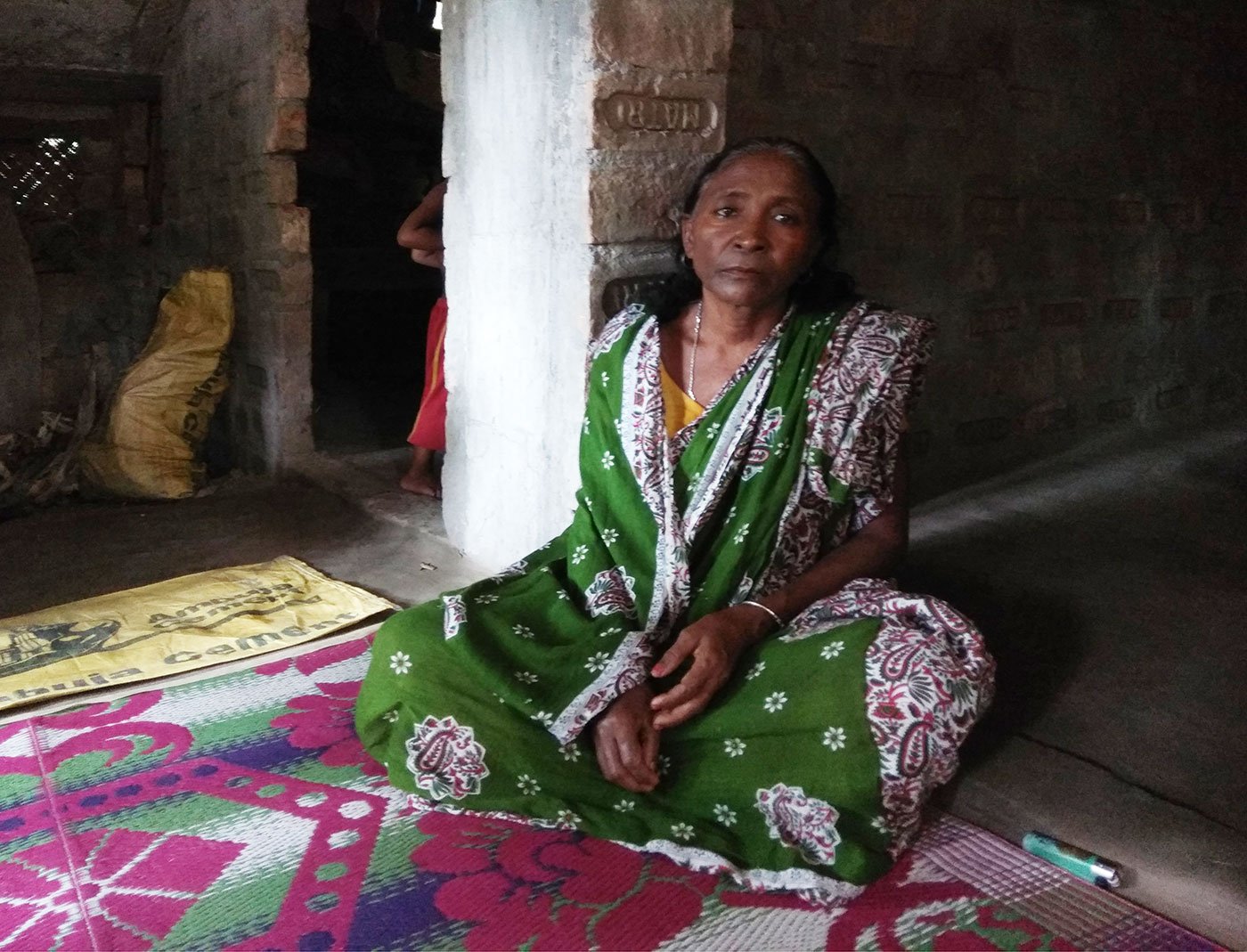
Shikha Mondal lost her husband Asit in November 2015. “He went with two other men to the Garal river in the Baganbari forest to catch crabs. The other two returned and told me that a tiger carried my husband away,” she says. Asit Mondal was 32 when he died, the family’s sole earning member, and the father of two school-going sons.
Determined to claim compensation, Shikha, a resident of Jahar Colony village in West Bengal’s Gosaba block, paid a lawyer Rs. 10,000 to help her. “There were many documents to gather – no objection certificates (NOCs) from the police and Forest Department, insurance card, a letter from the village pradhan, and a death certificate.”
The lawyer managed to get the insurance company to pay Rs. 1 lakh in compensation. But Shikha was denied an NOC from the Forest Department because her husband died in the core area. The insurance company has not yet returned her documents.
Shikha now catches crabs and prawns, does odd jobs and agricultural labour, and somehow manages to send her sons to school. Unable to afford an independent household, she and her children live at an uncle’s house.
Thousands of women in the Sunderbans have similarly lost their husbands to tiger attacks. This delta region, spread over around 4,200 square kilometres in eastern India and home to the world’s largest mangrove forests, is synonymous with tigers.
Watch video: Shikha Mondal describes her ordeal of trying to get compensation after her husband died in 2015
The tigers in the forests of Hingalganj, Gosaba, Kultali, Pathar Pratima and Basanti blocks are a threat to the villagers who depend on the forests for their daily needs and livelihoods. These blocks are close to the Sundarbans National Park (and tiger reserve), which includes a core area of around 1,700 square kilometres and a buffer area of around 900 square kilometres, where some livelihood activities are allowed. Usually, it is the men in the villages here who venture into the forests to catch fish and crabs, or to gather honey and wood. In a face-off with a tiger, most often the man dies.
The exact number of women widowed in this manner in the Sundarbans is unknown, but locals, non-governmental organisations and others estimate the number is at least 3,000 over three decades – or around a 100 a year.
“Since 2011, nearly 250 women have lost their husbands to tiger attacks in Gosaba’s Lahiripur gram panchayat area [consisting of 22 villages],” says Arjun Mondal, who manages the Sundarbans Rural Development Society, an NGO that works for the welfare of the ‘tiger widows’. “Not a single one has received compensation,” he adds.
The women are entitled to total compensation of roughly Rs. 4-5 lakhs from the West Bengal government’s Forest Department, Fisheries Department and the state’s Group Personal Accident Insurance Scheme. However, there are many conditions; Arjun lists a few: “The husband should not have died in the core area, he should have had a boat licence certificate (BLC) and a permit from the Forest Department. Additionally, the wife is required to submit several documents to the different departments to get the compensation.”
Invariably, people from the villages do wander into the core area. Arjun, a fisherman himself, says, “We don’t realise where the buffer zone ends and the core area begins. The government issues very few BLCs, and not everyone can afford one. Getting permits also depends on the will of the Forest Department.”
Therefore, the odds are stacked against the wives of men who do not have BLCs or permits. The situation worsens when the men die in the core areas, which the villagers here are not allowed to enter at all, with or without permits.
As it did for Namita Biswas, 40, from Patharpara village in Gosaba block. Her husband Manoranjan, a fisherman, was attacked by a tiger in the core area in February 2015. He survived and was admitted to a hospital, but died a few days after he was discharged. “The infection from his head injury had not healed,” Namita explains. “My husband had a BLC, but the police refused to take my statement. We gave all our documents and medical bills to the Forest Department for reimbursement. The money is yet to come. There are so many widows like me. The government should at least give us a monthly pension.”
Purmila Burman was duped by an ‘agent’ claiming he could get compensation for her husband’s death
While Shikha and Namita still await compensation, Purmila Burman, 55, of Patharpara, has no such hope. In March 2016, her fisherman husband Shubhendu was killed by a tiger in the core area. “A middleman promised to help me when Shubhendu died. I gathered all my documents and gave them to him, believing he would help,” Purmila says. The agent has since disappeared with her documents, and she has received no compensation.
The Sundarbans are full of stories like these. In some families, consecutive generations of families have lost their men to tiger attacks. Most of the villages where this has happened have bidhoba paras or ‘widow localities’. In most households, the women’s lives are marked by distress and penury. It is difficult for them to re-marry since remarriage is frowned upon.
In July 2016, this writer filed three separate Right to Information (RTI) petitions enquiring about compensation for tiger widows with the West Bengal government’s Fisheries Department, Forest Department and Department of Sundarban Affairs.
Only the Fisheries Department responded: in the last six years, only five women – a tiny portion of the estimated 100 women whose husbands are killed by tigers every year – have filed for compensation with the department. Of them, only three received Rs. 1 lakh each. The other two were denied compensation since the postmortem reports for their husbands were not available.
But contrary to the Fisheries Department data, most of the women I talked to said that they had applied for compensation – so it is likely that their claims are not being accepted due to incomplete documents or other conditions they fail to meet.
“The entire process is daunting, with many documents to submit and a lot of running around. The woman may even be misled or might be unaware of the process,” says Pradip Chatterjee of the Dakshinbanga Matsyajibi Forum. (The Fishworkers Forum of South Bengal, which is trying to help ‘tiger widows’ claim compensation and find work). “Meanwhile, fresh killings by tigers are reported every year, adding to the numbers of widowed women,” he says.
And some women, Chatterjee adds, fearful of the questioning by the Forest Department, ‘suppress’ the death of their husband, especially if he has been killed in the core area – they don’t even register it with the authorities, and nor do they claim compensation.
But Ranbibala Mondal of Patharpara village did try to claim the compensation. Her husband was attacked by a tiger many years ago. “After all these years, the government has given me nothing,” she says. “Can you do something?”
Published in Asia Dialogue (University of Nottingham-Asia Research Institute). 11 September 2017
Photo: The Kremlin
The ninth BRICS summit in China began on September 3, 2017 in the shadow of tense relations between India and China. The summit came in the wake of border tensions on the Doklam plateau, with the two countries agreeing to end the stalemate just days before the summit. The BRICS Summit concluded on September 5. For India, the main takeaway was that the summit declaration contained a reference to Pakistan-based terror groups Jaish-e-Mohammad (JeM) and Lashkar-e-Taiba as posing a threat to the security of the region. While Pakistan was not specifically mentioned, the names of the terror groups it supports were explicitly mentioned.
This was interpreted as a victory by India which had unsuccessfully tried to insert a reference to cross-border terrorism by Pakistan in the previous year’s Goa summit declaration.
Issues prior to Doklam
Prior to the Doklam tensions, the India-China relationship was already tenuous on several counts. China’s refusal to back India’s membership at the Nuclear Supplier’s Group and opposition to including JeM chief Masood Azhar on a list of UN-designated terrorists caused resentment in India. India’s decision to stay out of the China’s Belt and Road Initiative (BRI) has not pleased China either. Longstanding and unresolved matters like the border dispute, trade imbalance, China’s cultivation of India’s neighbours (which the latter perceives as encirclement), and India’s support to Tibetan leader Dalai Lama have continued to dog the relationship.
The most recent and significant setback to ties was when China started road construction activities in the Doklam plateau, an area over which China and Bhutan have contesting claims, and which is a tri-junction of sorts between China, Bhutan and India. India intervened to fulfil its security obligations to Bhutan, in an area that is close to India’s borders. Tensions escalated between the two countries to new levels with the Chinese People’s Liberation Army (PLA) spokesperson Wu Qian warning India that it should learn lessons from its defeat in the 1962 war between the two countries.
The two month stand-off came to an end days before the BRICS summit began in Xiamen. There was speculation about whether India’s Prime Minister Narendra Modi would attend the summit. Eventually, he did attend.
The 9th BRICS summit declaration specifically mentions the names of Pakistan-based terror groups. But whether China will actually agree to designate JeM Masood Azhar as a global terrorist group at the UN Security Council remains to be seen. As the Indian newspaper The Hindu pointed out, this was not the first time China had agreed to name JeM and LeT in a declaration. At the Heart of Asia conference in Amritsar last year, 14 countries including India and China signed a declaration specially naming Pakistan-based terror groups.
BRICS defuses tensions
It is not entirely clear why China conceded to the reference in the declaration, especially since Beijing had already communicated to India that ‘Pakistan’s counter-terrorism’ was not an appropriate topic to be discussed at the BRICS summit. However, the BRICS summit certainly succeeded in defusing tensions between the two countries.
Analysing the role of BRICS in defusing tensions, Oliver Stuenkel, Assistant Professor of International Relations at the Getúlio Vargas Foundation (FGV) in Sao Paulo writes: “Asia is the region with the world’s lowest institutional density, and opportunities such as the BRICS’ National Security Advisors’ meetings are less frequent than most would assume. Particularly when nationalist fervour runs high, merely inviting the other side for a meeting to discuss the matter can be interpreted as a sign of weakness. In such instances, there is nothing better than a long-scheduled meeting that offers a low-cost opportunity to continue talking. In addition, the BRICS grouping is one of the few outfits that forces Indian and Chinese policy makers to work together on numerous issues, thus creating personal relationships that can matter greatly in moments of tension.”
Narendra Modi and Chinese President Xi Jinping also participated in a bilateral meeting, the first after the Doklam standoff. There were two gains for India: the mention of terror groups in the declaration and the bilateral meeting with Xi.
Original purpose of BRICS
While this is well and good, strangely, the bigger questions about BRICS are not being asked. Other than having a role in defusing the Doklam tensions, what are the other takeaways from the summit? No doubt, the issue of terror needs to be dealt with strongly and countries need to act unitedly. But the tensions between India and China appear to be taking over the multilateral goals and original purposes of the BRICS.
The BRICS was formed, taking cognisance of the need for reform of international financial institutions like the World Bank and International Monetary Fund, which continue to be dominated by the United States and Europe. It was meant to be an alternative to – if not a replacement of – Western hegemony. However, the recent actions of BRICS have not lived up to the intent.
A report by the INGO ActionAid ‘Reclaiming Relevance: BRICS and the new multipolarity’ says: “the BRICS seem to be too deeply subsumed within the existing global capitalist development paradigm to pose a frontal challenge”. For example, the BRICS nations allied with the Washington-led Copenhagen Accord, a strategy that allowed them to avoid binding emission cuts, and weakens the Paris Agreement on Climate Change. This allows developed countries and the BRICS governments to continue pursuing an extractive, high carbon economic model. Second, while the BRICS succeeded in achieving a quota-shift in favour of large emerging economies at the IMF, the BRICS still require borrowing countries to have an agreement with the IMF if they want to draw more than 30 per cent of funds from the CRA.
The BRICS countries are also against the unipolarity of the United States. However, India continues to seek closer relations with the US. Indian commentator and analyst C. Raja Mohan writes: “Indian leaders would stand up in Washington and talk of a “natural alliance” with the sole super power, America. At the same time, India would sit down with Russia and China to call for a “multipolar world.” According to Raja Mohan, this is not hypocrisy but India’s need to manage multiple contradictions after the Cold War. One might disagree about whether this constitutes hypocrisy or not, but it certainly indicates a lack of coherence in policy as far as BRICS is concerned.
The BRICS have also repeatedly endorsed a multipolar world order. However, China’s efforts in the Belt and Road Initiative (BRI) and CPEC (China Pakistan Economic Corridor) have been interpreted as an effort to bring about Chinese unipolarity in Asia.
These contradictions weaken the BRICS, while the internal rivalries of its members also divert it from its purposes. In this regard, the South Asian Association for Regional Cooperation (SAARC) comes to mind. The SAARC was established to forge unity and cooperation among South Asian nations. But the prolonged rivalry between members India and Pakistan has resulted in the erosion of SAARC over time.
Of course, the BRICS have the signature New Development Bank (NDB) and Contingency Reserve Arrangement to show for it, since the first BRICS summit in 2009. However, the unique selling proposition (USP) of the NDB is still not clear. The bank has not shown how it will treat loan conditionality differently from the major international financial institutions that the BRICS repeatedly criticise. Despite being a development bank, its policy documents are silent on concerns of poverty and inequality, major challenges of the BRICS countries. The NDB will fund largescale infrastructure projects — but how it will deal with social and environmental concerns any differently from existing development banks? These are important questions that the NDB will have to address, in order to stay true to the original intent with which the BRICS was formed.
More of a decisive role in world affairs
On the political front too, BRICS could take a lead in addressing some of the major crises which confront the world today — whether it is the burgeoning global refugee crisis, the challenges from a Trump administration, the rise of xenophobia and hatred or the growing resource conflicts in the world. It is a well-known fact that Indian and Chinese companies are themselves competitors in Africa for access to resources. It should step up peace-making efforts in Syria and participate in international actions to free Palestine from Israeli occupation. In a little noted section of the Xiamen declaration, the BRICS called for direct dialogue with North Korea as opposed to the United States which called for a military response to North Korea’s testing of a hydrogen bomb.
Such responses from the BRICS are welcome and more interventions needed. It is high time that the BRICS becomes a more decisive force in world affairs.
Prime Minister Narendra Modi with Carnegie president William Burns. Photo:Facebook/Carnegie India
Published in The Wire. 31 August 2017
New Delhi: Days before India’s prime minister visited the US on June 25-26, 2017, a new development was reported with regard to the F-16 fighter aircraft which the US is trying to sell to India.
The development was that Tata Advanced Systems, the aerospace and defence arm of the Tata Group, and American defence contractor Lockheed Martin announced a partnership to build the F-16 aircraft for the Indian Air Force. The duo are in competition with the Gripen aircraft manufactured by Saab, a Swedish company. The Indian government is yet to make a decision on the deal estimated to be worth billions of dollars.
A prominent advocate of the deal happens to be Ashley Tellis – a well-known Indian-American strategist and senior associate of the Carnegie Endowment of International Peace. The Carnegie Endowment is a 100-year-old Washington-based think tank which recently opened its newest centre in Delhi.
Tellis, who has given statements and published research on the advantages of F-16s to India, was tipped to be the US ambassador to India. He was also appointed the Tata Chair for Strategic Affairs, established by the Carnegie Endowment in April 2017. In a press release announcing the chair, Tellis said his relationship with the Tatas – who fund both the Carnegie Endowment and Carnegie India – goes back many decades.
Carnegie’s most recent annual report (2016) lists both Tata Sons and Lockheed Martin as funders; the former contributed in the bracket of $100,000-$249,000 while Lockheed Martin Corporation’s contribution was in the category ‘up to $24,999’.
Think tanks are known to receive an assortment of funding from governments, companies and foundations, which means that Carnegie’s funding is not unusual. Think tanks also adopt a range of positions on issues depending on the direction in which they want government policies to take shape.
However, these connections between Tata, Lockheed Martin and the Carnegie Endowment, their investments in each other and clearly intersecting interests, raise questions about the positions taken by think tanks on issues and why corporates invest such large sums in them.
In response to questions from The Wire, Tellis said there was no conflict of interest involved in Carnegie’s funding and his championing of F-16s. “My conclusions about the F-16 and F-18 were published several years before I was appointed to the Tata Chair and before Tata or Lockheed Martin ever contributed to Carnegie. My analysis about the fighter competition stands on its own merits,” he said.
While one of Tellis’s articles on F-16s was published in 2009, a second came out in 2016 and a third in August 2017. Ratan Tata became a trustee of Carnegie Endowment in 2013 and Lockheed Martin funded Carnegie between July 2015 to June 2016.
Atul Bhardwaj, adjunct fellow at the Delhi-based Institute of Chinese Studies, points to another of Tellis’s works which urges India to develop its next generation nuclear-powered aircraft carrier with US support. “Think tanks like Carnegie sell dreams of making India a great power equipped with sophisticated defence technology. They build threat scenarios that shape the national security outlook of the country and their foremost objective is to shape elite opinion,” he says.
Responding to this reporter’s email on whether the links between Tata, Lockheed Martin and Carnegie create a conflict of interest for the think tank, Shivnath Thukral, managing director of Carnegie India, said,
“Carnegie scholars never submit work to donors for pre-review, approval, or any other direction and do not accept funding from organisations that seek to influence our research. The only substantive Carnegie Endowment report involving the F-16 was the ‘Dogfight’ report written by Ashley Tellis in January 2011, based on his own independent analysis and rigorous research. Tellis received no funding for writing the report. He continues to stand by his conclusion that the American F-16 (Lockheed) and F-18 (Boeing) are the most cost effective solutions for India’s needs.”
Thukral’s response also stated that Carnegie Endowment “as a whole” never received funding from Lockheed Martin. When this reporter pointed out that Carnegie Endowment’s 2016 annual report listed Lockheed Martin Corporation as a donor, he said:
“Our earlier response was regard to Carnegie India which has not received funds from Lockheed Martin – Carnegie India is a registered Section 25 company subject to Indian laws including the FCRA. Lockheed Martin is a member of the Carnegie Endowment’s Global Council – a group of individuals and corporations who provide general support not tied to any specific program, center, project, or scholar.”
That Lockheed Martin funds Carnegie is not a surprise, since it is known to fund think tanks. But it is ironic that its funding should be accepted by a think tank whose founder, Andrew Carnegie, considered war to be the “foulest blot upon our civilization.”
However, Carnegie is not alone in its advocacy of Lockheed fighters for India. In 2015, TheIntercept ran an article showing that the conservative Heritage Foundation worked to restore funding for Lockheed Martin’s F-22 fighter jet which the Pentagon had decided to cut. More interestingly, the Heritage Foundation, in a June 20 article titled ‘Heritage Expert Influences Production Move on F-16s’, said that it had championed the production of F-16s in India since it would help protect American jobs.
In the US, which is home to the largest number of think tanks in the world, the issue of whether think tanks further corporate agendas is hotly debated. That debate has still not taken off in India because of their relatively small numbers and the lack of clarity around their work. Yet the arrival of heavyweight American ‘brands’ like Brookings and Carnegie, and their funding by Indian industry, have certainly been noticed.
Lobbying tool of US commercial interests
Ajai Shukla, who writes on defence and strategy for Business Standard provides the background:
“An ambitious US-India defence framework agreement signed in 2005 marked the acceleration of defence commerce. The 2008 India-US nuclear deal and balancing against increasing Chinese activities in the South China Sea resulted in greater strategic convergences. Track-II dialogues with the US were also underway, organised by organisations like the Aspen Institute. But a key area of interest for the US and other countries was that India was fast emerging as a major buyer of arms and had lucrative projects in oil, gas and infrastructure.”
According to Shukla, the presence of foreign think tanks is not the sinister ‘CIA hand’ that Indira Gandhi would refer to. “It is a lobbying tool for a plethora of commercial interests,” he says.
In the last decade, three US think tanks have set up their India offices – the Aspen Institute, Brookings Institution and Carnegie Endowment. Each of these are set up as Indian entities and seek to raise Indian funding.
When one considers the work of think tanks in general, there is little clarity around their methods of working and impact, or how they use their funding. But most think tanks are established with the intent of informing and influencing government policy. The methods of trying to influence government policy are diverse – employing retired government and defence officials, collaborating with ministries on research projects, convening conferences and inviting ambassadors and joint secretaries, serving or retired, to launch books and reports.
Prime minister’s first book launch
Getting India Back on Track. Credit: PTI” width=”352″> Prime Minister Narendra Modi at the launch of Getting India Back on Track. Credit: PTI
Weeks after the BJP was voted to power, Narendra Modi presided over what was probably his first book launch at his 7 Race Course Road residence as prime minister. The book, Getting India Back on Track: An Action Agenda for Reform, was published by Carnegie Endowment. The book, according to its blurb, “broadly coincides with the 2014 Indian elections to spur a public debate about the program that the next government should pursue in order to return the country to a path of high growth.”
The book was launched prior to the setting up of Carnegie in India. The groundwork for establishing Carnegie India had started earlier – in 2011, a delegation from the Carnegie Endowment met an array of Congress leaders including then Prime Minister Manmohan Singh and shared plans to set up a South Asia centre in Delhi.
Prior to Delhi, Carnegie had already established its centres in the Middle East, Russia, Europe and China. With its headquarters in Washington DC, it is known as one of the oldest international affairs think tank of the US. What is its role in the US?
Inderjeet Parmar, author of Foundations of the American Century: The Ford, Carnegie and Rockefeller Foundations in the Rise of American Power, says, “These institutions emerged to cope with massive changes that the US was undergoing in the areas of urbanisation, immigration and industrialisation in the early 1900s. They emerged out of corporate wealth, were staffed by elites and usually connected with US State Department or other government agencies. They wanted to develop American leadership to replace the British and French rule, and also to challenge communism and socialism abroad. They viewed the problems of the American state as their own.”
According to Parmar, the strategy of ‘exporting institutions’ has been going on for a long time, especially in China. “In India, these institutes try to influence and socialise the Indian elite into the international order promoted by the US. This elite consists of university academia, people who have spent many years at the higher rungs of government service, business leaders and the media,” he adds.
Carnegie India, of course, contests the idea that it is a conduit for American influence. During the recent launch of Carnegie India, the management of Carnegie stated that it was “less interested in amplifying directives from Washington than it was … in bringing international perspectives to bear in Washington.”
To place this claim in perspective, however, it is necessary to understand the logic behind Carnegie’s expanding global footprint in the first place. In 2007, the Carnegie Endowment articulated its vision for creating the world’s first ‘global think tank’. Though India is not explicitly mentioned, the vision provides a clear rationale for why the think tank wanted to expand abroad.
Describing the vision, Carnegie’s former president Jessica T. Matthews said the think tank was globalising out of a deep conviction that this was the best way to advance core US national interests. “History has shown that a dominating world power has paradoxically a greater than normal need to understand in depth what others’ interests are. This is because of the sheer scope of its interests and because dominance engenders resistance, resentment, and often fear. So deep engagement is an essential strategy for managing dominance.”
“We live in a world where critical issues have moved beyond national solutions, because they reside in the global commons or because they require the cooperation of many countries. Whether trade or terrorism or nonproliferation or climate change, US leadership is needed as never before,” she said.
Taken together, these statements from Carnegie’s top leadership suggest Carnegie in Washington and its centres abroad are working to preserve US leadership and its core interests by mapping – but also moulding – the interests of other powers like India onto the policy matrix in Washington.
What constitutes core US national interest? This could mean everything from maintaining a unipolar world, balancing the rise of China, preserving its security and protecting its economy to boosting American companies’ business interests. Not all of these interests necessarily complement India’s.
Carnegie India head Ashley Tellis speaking before the Senate Armed Services Committee on US policy in the Asia Pacific. Credit: Twitter/Carnegie India
Intersecting interests of American and Indian corporate wealth
But it is not the case that American-origin think tanks in India promote only American interests. If that was the case, Indian corporates would not have made a beeline to fund them. Carnegie India receives funding from both Indian and international donors, including prominent names from Indian industry such as C.K. Birla, Kiran Mazumdar-Shaw, Shobhana Bhartia, Sunil Mittal, G.M. Rao and Tata Sons.
Even as the US is a major source of foreign direct investment for India, Indian corporates have increasing investments abroad, with acquisitions in nearly every part of the world. According to India’s Ministry of External Affairs, more than 65 large Indian corporations have invested about $17 billion in the US. For some of these companies, like Tata Sons, it has become profitable to be in the US.
A report by the Cato Institute shows how individuals and Indian corporations have driven the India-US relationship much more than governments. “Indian industrial houses once cowered in fear of being crushed by US multinationals, but have now become multinationals in their own rights. Many have become global giants, making acquisitions in every continent,” the report states, citing several examples of Indian acquisitions abroad.
Thus, even as the outsourcing of American jobs to India is a bone of contention, Indian and American companies continue to collaborate. The partnership between Tata and Lockheed Martin to build F-16s in India is just one example. Several high-level forums exist to take forward the business ties between the two countries.
At one level, Carnegie in India represents the intersecting interests of Indian and American corporate wealth. That’s the main reason Indian corporates fund such institutes, which are not only high profile but also have access to the highest levels of government. These institutes also encourage research and policy making that promotes free markets and liberalisation of economies.
For example, the Carnegie Endowment publication launched by Modi in 2014 was essentially an argument for the centrality of markets in driving economic growth, and a critique of the welfare state. The foreword was written by Ratan Tata, a member of Carnegie’s board of trustees, while Bharti Enterprises’ chairperson Sunil Mittal was present at the launch.
Both Tata and Mittal played an important role in bringing Carnegie to India. At the launch of the think tank in Delhi, Carnegie president William Burns – a former senior official in the US State Department who was closely involved in implementing the US-India civil nuclear agreement – thanked both Tata and Mittal for their vision and drive in expanding the Carnegie platform to India. A video from the launch shows Mittal stating that it was his personal mission to see that the think tank established its centre in Delhi, marking its South Asia presence. Mittal also personally accompanied the Carnegie delegation when it met Congress and opposition leaders in 2011 to announce plans to launch a think tank in Delhi.
With similar visions driving them, Indian industry and American think tanks are leveraging each others’ advantages to exert influence on the government of the day.
(The Tatas and Lockheed Martin did not respond to queries from the author)
Prime Minister Narendra Modi with his Israeli counterpart Benjamin Netanyahu in New York in 2014. Photo Credit: PMO
Published in The Wire. 2 July 2017
It is the 50th year of the Israeli occupation of Palestine. It has been 50 years since Israel annexed the Palestinian territories of West Bank, East Jerusalem and Gaza Strip following the Six Day Arab-Israeli War of June 1967.
During this time, Israel has tightened its hold over the territories, crushed Palestinian resistance and created hundreds of thousands of refugees. Its discriminatory policies affecting every area of Palestinian life have invited comparisons with the South African apartheid. However, UN resolutions condemning the occupation and Israeli settlements in the West Bank leave Israel unaffected, even as it relies on the continued support of the United States for its actions.
This is also the year that India’s Prime Minister Narendra Modi will travel to Israel; the first Indian PM to do so. He will address a gathering of Jews of Indian origin in a community reception in Tel Aviv on July 5. Modi he will not visit Palestine.
Historically, India framed its relationship with Israel based on a priority accorded to Palestine. In 1936, Jawaharlal Nehru informed the Zionist emissary Immanuel Olsvanger that he could not tolerate imperialism in India or Palestine.
P.R. Kumaraswamy, professor of West Asian Studies at Jawaharlal Nehru University, writes that while anti-colonialism was an important aspect of India’s backing Palestine, there was a religious dimension to the matter. The Congress and the Muslim League perceived the anti-imperialist Palestinian cause as a way to win over Indian Muslims whose support they were competing for and to unite Indian Muslims with the resistance against the British. Supporting Palestine was also a method of leveraging India’s interests in the Middle East.
Road to Washington and arms access through Israel
Nevertheless, India established full diplomatic ties with Israel only in 1992, even though it had formally recognised Israel in 1950. The end of the Cold War in 1991 reconfigured world politics and established the United States as the sole superpower.
Vijay Prashad, professor of International Relations at Trinity College, says: “India’s road to Washington and arms lay through Israel. After India’s nuclear weapon tests in 1998, the US imposed economic and military sanctions. During the 1999 war with Pakistan, Israel supplied arms to India, which were American in any case. India under Indira Gandhi had already reached out to Israel in 1971 for arms despite absent diplomatic ties. The Palestine issue started getting sidelined long ago, while the Congress was in power.”
In 2009, following lobbying by US and Israeli governments, India diluted its stand on the Goldstone Report which showed the illegality of Israel’s blockade of Gaza and accused it of violating international law. The Congress expressed “reservations in making unqualified endorsement” of the report recommendations. According to Prashad, there is not much difference in the language used in 2009, and the language subsequently used by India for Israel’s attacks on Gaza in 2012 and 2014.
Then, for the first time in 2015, India abstained on a UNHRC resolution calling for a probe by the International Criminal Court into war crimes by Israel. It continued to abstain on the resolution in 2016 and 2017 as well. However, it has voted in favour of other UNHRC resolutions that criticised Israel on the expansion of settlements and the right of Palestinians to self-determination.
India justified abstaining on the grounds that the resolution referred to ICC of which India is not a member. But a report in The Telegraph showed that India voted at least twice in favour of UNHRC resolutions which refer to the ICC in the context of atrocities in Syria. India’s altered voting behaviour therefore caused speculation that India had changed its policies on Palestine which the government has denied.
India-Israel bonhomie under Modi
Undoubtedly, there is markedly more visible warmth between the two countries since 2014 when Modi was elected PM. High level visits to Israel by Home Minister Rajnath Singh, President Pranab Mukherjee and External Affairs Minister Sushma Swaraj have already happened. While Singh did not visit Palestine, Mukherjee and Swaraj did so. During the Congress regime too, a steady stream of bilateral visits continued to Israel.
Interestingly, the first time that a senior Indian minister visited Israel was only in the year 2000, when the BJP was in power; and the minister was L.K. Advani. This is despite the fact that diplomatic relations were established since 1992 and Israel had been sending its presidents and prime ministers to India since 1993. The most recent visit being of President Reuven Rivlin in November 2016.
India and Israel have been cooperating in a range of areas including agriculture, water conservation, science and technology, trade and investment. India and Israel also view each other as victims of Islamist terror which complements Modi’s Hindutva background. But by far, the largest area of cooperation is in defense.
Israel’s defense industry bagged its biggest security contract in April 2017 with the state-owned Israel Aerospace Industries being awarded contracts worth $2 billion for providing medium range surface to air missile systems to the Indian Army. There are expectations of further arms deals when Modi visits Israel. It is no secret that India is currently the biggest importer of arms in the world while Israel is its second largest foreign supplier.
Where does Palestine stand?
Where does Palestine stand next to India-Israel bonhomie? When Palestinian President Mahmoud Abbas visited India last month – his third state visit to the country – Modi mentioned India’s unwavering support to Palestine and for a two state solution. He also spoke of a ‘sovereign, independent, united and viable Palestine, co-existing peacefully with Israel.’
Even before Abbas’ visit, a Palestinian Authority official said that while India had the right to build relations with Israel, it should not come at the expense of support for Palestine.
How has that panned out? Is it possible for India to de-hyphenate its ties with the two countries, considering that one is an internationally condemned transgressor state and the other fighting for independence from it? India’s defense ties with Israel make this even more difficult.
Palestinian embassy officials in Delhi who monitor India-Israel ties have expressed unhappiness over the increasing defense relationship. A Der Spiegel investigation in 2014 showed that Israel invests significant sums into defense research and production. A good chunk of defense production is exported to countries like India. Defense export revenues in turn make it possible for the Israeli forces to sustain the military occupation of Palestine, inviting allegations that India is subsidising or underwriting the occupation.
When Modi visits Israel on July 4, what should we expect? Will he refer to the Palestinian cause? One can expect utterances about ‘the peace process and support for the two state solution. But it is doubtful he will go further – he is unlikely to raise the issue of the Palestinian prisoners’ hunger strike for example.
Any criticism of Israel’s human rights records at international forums could invite criticism of the Modi government’s own policies in Kashmir where he has militarily suppressed dissent and separatism. Neither Netanyahu nor Modi will embarrass each other; Netanyahu in particular would be eager to win over India for the longer term, especially as a voting ally at various human rights forums.
As Palestine observes its 50th year of Israeli occupation, hard strategic and military calculations define India’s national interest and colour its ties with Israel and Palestine.
Published in People’s Archive of Rural India. 10 April 2017
The year was 1949. Jiban Krishna Poddar, 14 years old, fled from his home in Barisal district to West Bengal, along with his parents and grandmother. The Noakhali riots of 1946 had sparked off waves of migration which would continue for many years. Two years after their flight, the family made their way to the Sundarbans.
Now over 80 and seated in the verandah of his home on a rainy evening, he reminisces about the journey that brought him to Krishnadaspur village in Patharpratima block, the place he calls home: “There was violence, so we had to leave. My mother, Usha Rani Poddar, packed all our belongings into 14 bags. We reached Khulna city [then in East Bengal] by ship. A train took us to Benapole. We hid our money and ornaments in clothes and belongings.”
Jiban recalls that the family was taken to a refugee camp in Nadia district of West Bengal, where they lived for 11 months with more than 20,000 others. The refugees were asked to settle in Dandakaranya (the forested Bastar region of central India), the Andaman islands or the Sundarbans in West Bengal.
“My father, Sarat Chandra Poddar, chose the Sundarbans,” Jiban says. “He wanted to own and farm land. Maach and chaash (Bengali for fish and agriculture) were the two main attractions. He felt that the Dandakaranya and Andamans were uninhabited jungles where it would have been difficult to live.”
Jiban’s family was among the 150 families that left from Howrah for the Sundarbans by ship. They came to Mathurapur block where the Indian government asked them to clear the jungles for agriculture. “When we began farming, it was difficult. The area was 60 per cent water and 40 per cent jungle. The drinking water was not clean and many people died of cholera. The doctor would come once in 15 days. There was a famine and we had to suffer great hunger.”
Jiban’s father got a job in a government office where his task was to operate a hand fan for other employees. His mother kept buffaloes and sold milk and eggs.
The family was eventually allotted 10 bighas of land (one bigha is around one-third of an acre in West Bengal) in Krishnadaspur village, where they began cultivating rice. After saving some money, they bought more land and built a house in the village, which now has a population of 2,653 (2011 Census).
Jiban lives with his wife and 11 children, and retired as postmaster of the village post office around 2010. Priyaranjan Das, 64, who retired from the village post office as a peon, also traces his origins to East Bengal. He arrived from Noakhali with his parents in the early 1950s, when he was two years old. “We would boil stems and eat them since there was no food. There would be severe outbreaks of cholera, causing many people to leave. But we stayed on,” he remembers.
Many other families came to the Sundarbans from different parts of West Bengal, the Chota Nagpur Plateau and Odisha after 1765, when the East India Company acquired the civil administration in Bengal. Amites Mukhopadhyay ( Living with Disasters: Communities and Development in the Indian Sundarbans ) and Annu Jalais ( People and Tigers: An Anthropological Study of the Sundarbans of West Bengal, India ) write that the colonial rulers, interested in increasing their revenues, hired labourers from different parts of the subcontinent to reclaim and cultivate land.
Robi Mondal of the Tagore Society for Rural Development, a non-governmental organisation that works in the Sundarbans, says: “The floods and famine in Medinipur, the 1947 Partition of Bengal and the 1971 Bangladesh war of independence caused a further exodus of people, and many of them landed up in Sundarbans.”
Another round of migration took place around 1905, when Scottish businessman Daniel Hamilton was working towards rural reconstruction through a cooperative movement in the islands of Gosaba block. He leased out land to labourers for cultivation. Many of the descendants of the migrants still live in Gosaba, and remember his contribution to the development of the Sundarbans.
Eighty-year-old Revati Singh, who lives in Jotirampur village, is originally from Ranchi. His grandfather, Anandmai Singh, came to Gosaba in 1907, during Hamilton’s cooperative movement. “He arrived in Canning block by tram. They would probably have walked from there to Gosaba, which is currently more than 12 hours on foot. Later, Hamilton built small boat launches to transport them.”
Lakhan and Sandhya Sardar. Lakhan’s grandfather migrated from Ranchi to Gosaba in the early 1900s
Mohammed Molhor Sheikh’s great grandfather arrived in the Sundarbans from Midnapore some 150 years ago
Revati has heard that the population at the time was small, and there were recurring attacks by tigers and crocodiles, and no clean drinking water. Has the situation changed? “Fewer tigers attack now,” he says. “There were no jobs then, and even now getting work is a problem. I used to cultivate rice but stopped because the river would overflow into the fields.” Revati’s three sons have informal jobs.
Lakhan Sardar, whose grandfather Bhagal Sardar also migrated from Ranchi to be a part of the cooperative movement, remembers that on Hamilton’s invitation, renowned poet and writer Rabindranath Tagore visited Gosaba in 1932.
A large section of the population of the Sundarbans is from the Medinipur area of West Bengal. Frequent flood and famine in Medinipur drove inhabitants to the Sundarbans to work as labourers or cultivators of land. Jyotirmoy Mondal from Jotirampur village recalls that his grandparents walked from Medinipur to the Sundarbans before the onset of Hamilton’s cooperative movement. “Grandfather became a night watchman and eventually died of fever. My grandmother, Digambari Mondal, would guard people’s buffaloes for a living, cultivate rice and sell ghee.”
Mohammed Molhor Sheikh cuts wood for a living in Arampur village in Gosaba. His great grandfather came with two brothers from Medinipur to the Sundarbans, 150 years ago. “We heard stories of how they would chase tigers with iron rods flaming with fire. We also heard how they would frequently suffer flood and famine and the destruction of their rice fields.”
Another wave of migration from Medinipur occurred during the severe 1943 famine in West Bengal. Seventy-one-year-old Haripriya Kar’s husband’s family migrated to Gosaba during this period. The village Jotirampur, where she lives, is named after Jotiram Kar, her father-in-law. “Jotiram and Khetramohan were brothers who came from Medinipur to Gosaba, bringing 27 families with them. These families cleared the surrounding forests and settled down,” she says.
Haripriya’s house is cast in darkness as she speaks. The electricity was cut a few hours ago. Livelihood options here are few, it is difficult to get medical help, and connectivity with roads and transport is a huge hurdle. Still, the descendants of the original settlers of the Sundarbans do not have it as hard as their ancestors did. The struggle for a better life continues, even as they recollect the hardships and deprivations of the past.
As evening descended, a group of young professionals assembled near the Wipro circle in Pune’s Hinjewadi area on Wednesday. Holding candles and placards with messages such as “Justice for Rasila” “We need safe workplace” and “Employees are not slaves”, the gathering of men and women information technology professionals protested against the murder Infosys employee Rasila Raju, who had allegedly been strangled by a security guard in her office on January 29.
Though it was her day off, 25-year-old Raju had come to the Infosys office in Hinjewadi, the city’s IT hub, for the 2 pm to 11 pm shift on Sunday to work on a project. Company security guard Bhaben Saikia, who was arrested for her murder, allegedly strangled her using a computer wire. Raju had earlier complained to company officials about Saikia, her family said, but no action had been taken.
This is the second murder of a woman techie in Pune in as many months – in December 2016, 23-year-old Antara Das, an employee of Capgemini, was killed outside her office in Talwade.
Safety concerns
“We are not safe even in our office premises. Who should we trust?” asked a young woman, asking to remain anonymous, who had attended the vigil for Raju’s death.
A woman standing next to her asked: “We want to know why Rasila was working in office on a Sunday, that too alone. Why was she not provided a temporary laptop to work from home?”
The woman, who did not wish to be identified, said that for newcomers and those who were just starting out, it was hard to turn down projects, even if it meant working on weekends. “Still, why was Rasila made to work alone?,” she asked. “After this incident, we are scared, and do not sit alone at work. We work together in groups where we feel safe.”
Infosys, in a statement, said “this was an unfortunate incident is a reminder that nothing can be taken for granted, and we are continuing to seek recommendations and suggestions from different stakeholders.” The statement cited existing safety measures such as a helpline, CCTV cameras on the premises, safety committees, background checks and night travel arrangements for women.
Women IT workers at the vigil for Raju said they appreciated the facilities provided by their companies but expressed concern over inadequate safety provisions. “Companies fail to reinforce their own dictates,” a female recruiter for an IT company said. “For example, if a company decides that women need not be at the workplace beyond 6pm – the practice is permitted for sometime – but is stopped later. ”
Confronting the glass ceiling
Women in the IT sector said that apart from security issues and sexual harassment at the workplace, they also have to contend with ingrained sexism and a glass ceiling that prevents them getting their due
“If a woman wants to leave early, a male colleague might say that he works longer hours and receives the same pay,” said Gunjan Shukla, a 36-year-old IT professional in Pune who has worked in the industry for the last 15 years. “But women are expected to make up by working harder, from home, and on the weekends as well. They also do much of the house work too, which means they are constantly balancing the pressures of work and home.”
The Maharashtra IT Professionals Forum, an informal group of IT professionals issued a statement after Raju’s murder, which spoke of “the structural injustice in the IT industry where long working hours are expected from employees. Men can stay back till late and thus have an unfair advantage over women.”
According to the National Association of Software and Services Companies, an IT industry trade body, women comprise 30% of the workforce. However, Shukla said that though the representation of women at the entry level may have increased, their presence is marginal at the higher levels.
“How many women do you see with 20 plus years of experience in the technical field, or on the boards of Fortune 500 companies?” Shukla asked. “Even coding and programming areas of the industry tend to be male-dominated.”
Shukla said that sexism is manifest at the workplace in the way women employees are perceived. “If a project has 30%-40% women employees, the project manager might say that the risk of the project is high, since the women could take leave for marriage and maternity.”
Arun M of the Maharashtra IT Professionals Forum said that some companies also strive for greater representation of women in certain projects to woo clients. “This is done to get business from international telecom companies like AT&T and KPN, which have strict requirements about women’s representation in the companies they work with,” he said.
That does not always translate into the creation of a more equitable workplace, however. “Women in some companies also face a harder time when they return to work after their maternity leave – they see their appraisals being affected,” Arun M said.
Despite such challenges, women continue join the IT-BPO sector. According to Nasscom, one in every three employees in the sector, which has 3.7 million people, is a woman.
But the gender gap in technology companies cannot be denied, said Geetha Kanan, managing director of the Anita Borg Institute India, which works on promoting women in technology. “While we do see many more successful women in the IT sector, there is there is also no denying the glass ceiling, for which the reasons are complex,” she said. “Technology innovation powers the global economy and women are crucial to building technology the world needs. Organisations need to focus on hiring more women and including them in the workforce.”
With regard to women’s safety at the workplace, Kannan said the law entails some policies and processes, which some IT companies complement with their own measures. “Companies take steps such as providing sufficient male and female security staff at the office premises, senior manager’s approval required to work late, and staff background checks,” she said.
But as the Pune incidents show us, such measures can often prove inadequate, costing a young woman her life.
Published in People’s Archive of Rural India. 11 January 2017
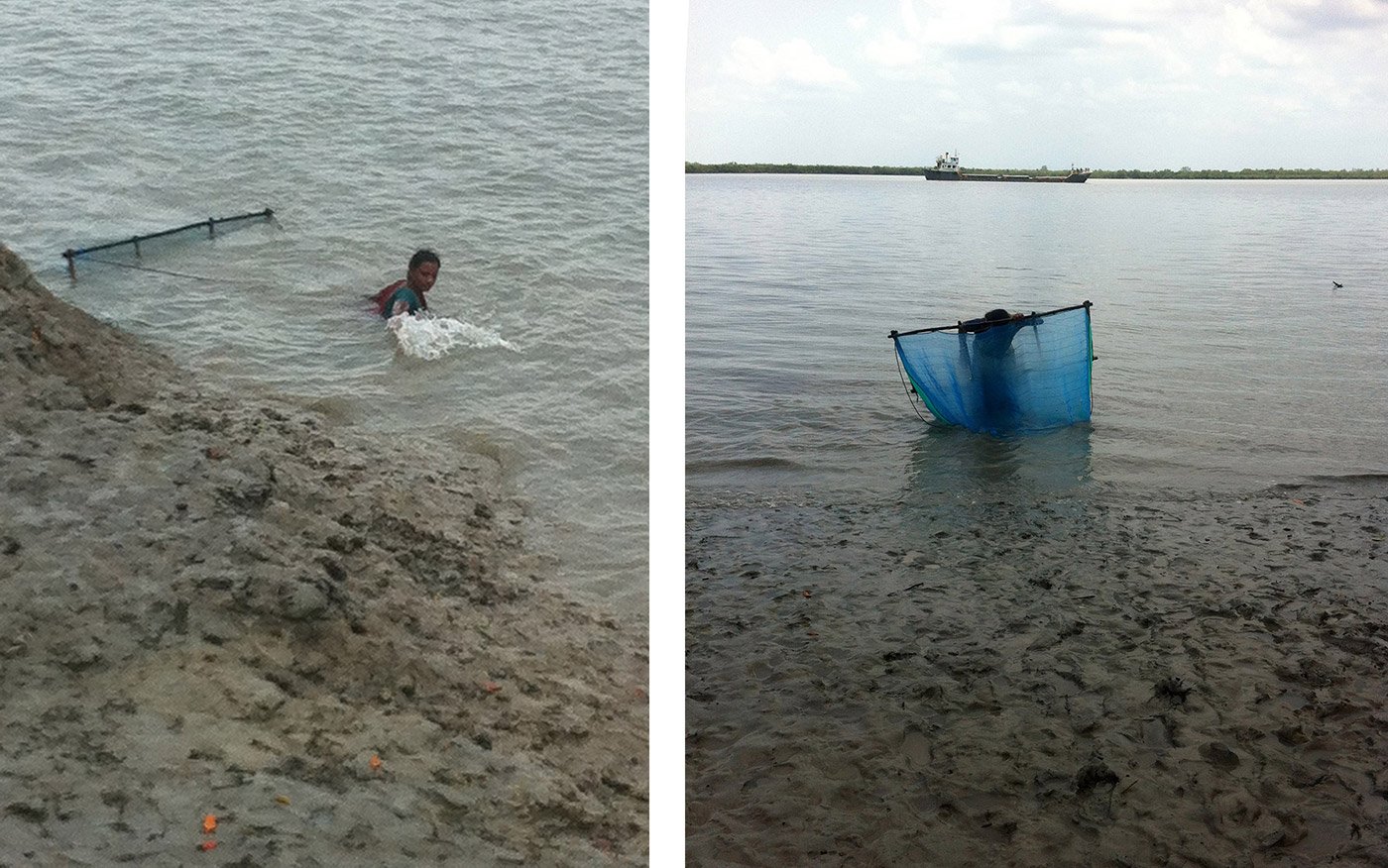
Purnima Mistry walks out of the Raimangal river with her fishing net, water swirling around her waist. She has been swimming near the riverbank for half-an-hour, dragging the net behind her in search of tiger prawn seedlings.
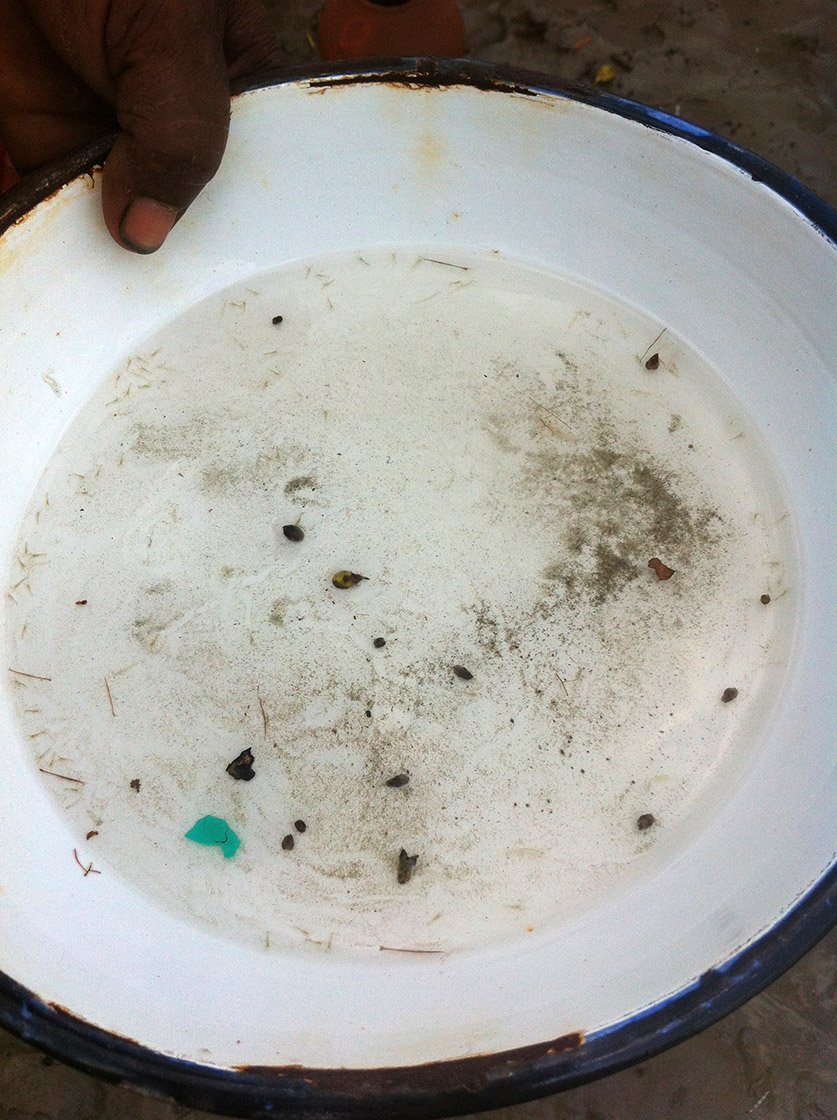
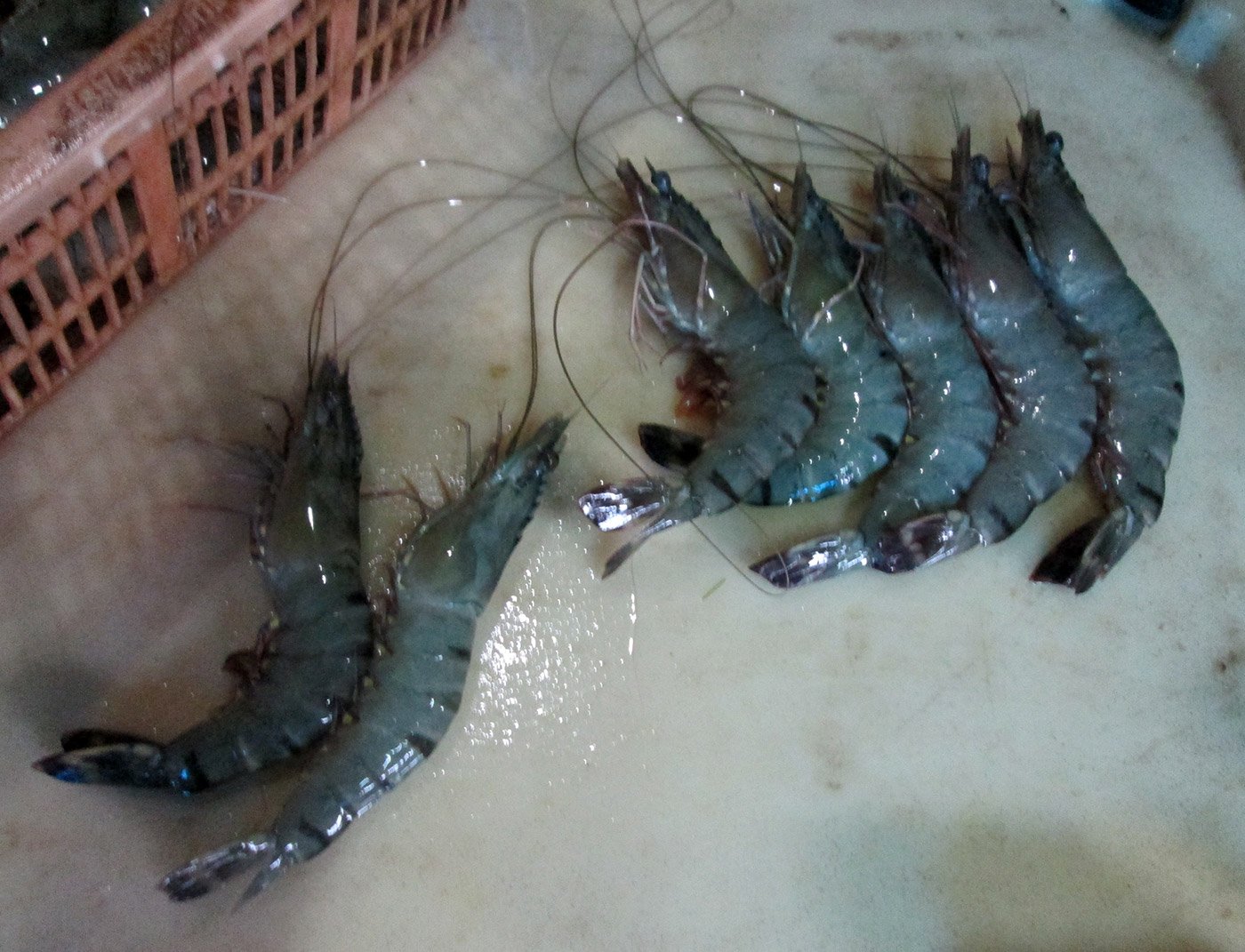
On the riverbank, she sorts the contents of the net, separating the seedlings from weeds, twigs and other fish. Her saree and plait are beginning to dry under the hot sun. But Purnima has to get back to the river again. “I have to collect enough tiger prawn seedlings so that I can sell them. It will take another 2-3 hours,” she says.
Squatting on the muddy bank to sort the catch, Purnima talks about the long hours she spends in saline waters and mud, which cause skin infections and itches. “Look how difficult our jobs are,” she says. “This is how the people of Sundarbans live and eat.”
Purnima started doing this work two years ago to support her family, which includes two daughters and a son. Her husband is afraid of water and cannot go fishing, which is the most common occupation here. So he grows vegetables for sale at home.
Watch video: Purnima Mistry trawls through the Raimangal river to catch enough seedlings to sell
Is she afraid of encountering crocodiles and tigers – both common in some parts of the Sundarbans? “Sometimes, I am scared of crocodiles; they have attacked people in this village,” Purnima says. “The tigers do not come to here because a security net near the forest keeps them away.”
Purnima lives in Jogesganj, a village of 7,000-plus people and houses scattered along the banks of the Raimangal river in Hingalganj block of West Bengal. Many of the women and children in Jogesganj, like in the rest of the Sundarbans, work as seedling collectors. This supplements their household incomes from the sale of fish and crabs, and of forest products such as honey and wood.
State government data [from 2009] shows that poverty drives more than 2 lakh people – of the 44 lakhs who live in the Sundarbans – to collect tiger prawn seedlings.
Shoma Mondal of Hemnagar village says this work is mostly done by women. “Men go after bigger catch like crabs, which fetch better returns [and for which they hire boats in groups]. Gathering seedlings becomes the women’s task, and in very poor houses, even children [do this work]. The returns are poor but there are no other options. At least one woman from every household in the village does this work. We cannot do much agriculture, because for much of the year the soil and water are saline, except in the monsoons, when we cultivate rice.”
Left: The people who collect tiger prawn seedlings spend close to five hours in the water to get a sufficient catch. Right: A woman drags her net into the river at low tide, which is the best time to gather the seedlings
Shoma goes to the river almost every day at low tide in search of seedlings. Low tides are the best for a good catch – but they occur at different times. So Shoma sometimes goes to the river at midnight or at 4 a.m. “When it is pitch dark, we are unable to see if there are crocodiles or other wild animals nearby. In the daylight, at least we can see them and move away.”
The earnings of seedling collectors like Purnima and Shoma vary according to the season. “During winter, which is peak season, we get Rs. 300 per 1,000 seedlings,” she says. “At other times, the prices can drop to Rs. 100 and even sink as low as Rs. 60.”
On good days, the catch reaches 2,000 seedlings, but this is only a few times a year. Most other times, Shoma only manages to net 200-500 seedlings. “It’s enough money to go to the market [in Hemnagar] and buy essentials [like rice and pulses], but nothing more,” she says.
After cultivation in brackish water enclosures in South 24 Parganas district, the seedlings grow in size
During the winter months, from December to February, Shoma goes to Erode district in Tamil Nadu to work in a garments factory, where she stitches curtains and pillow covers. Although winter can bring the highest rates for the seedlings, many women try to not work in the biting cold river waters. Shoma’s husband Soumen Mondol works full-time in the same factory in Erode. She earns between Rs. 200-500 daily, he earns a little more. Their five-year-old daughter stays back in the village with her grandmother.
The methods of collecting prawn seedlings have been criticised by environmentalists as well as the state’s Forest Department. The nets trap many other fish species besides the seedlings. But the women usually discard the other fish, which can deplete those species. The dragging of nets causes soil erosion and weakens embankments meant to prevent rivers from overflowing.
Purnima however does not throw away the other fish. She has a pond near her home, where she harvests these species. “Those who do not have ponds have to throw away the remaining fish,” she explains, as she continues to sort the seedlings on the Raimangal riverbank.
Although the tiger prawn trade rests on the labour of the women in these villages, they are paid the least along the chain. After the seedlings are collected, men take over the profitable part of the trade.
Typically, middlemen visit the villages to purchase the seedlings from the women and sell it for cultivation in bheries. These are large artificial enclosures for brackish water aquaculture in Canning, Jibantala, Sarberia and other locations in the South 24 Parganas district. Here, the seedlings are cultivated for at least three months during which they grow in size. Then they are sold in the wholesale markets of Canning, Barasat and Dhamakhali , and sent onward for export – often by men on motorbikes who carry the seedlings in plastic bags full of water.
After cultivation in brackish water enclosures in South 24 Parganas district, the seedlings grow in size
Full-grown tiger prawns fetch attractive prices in the wholesale markets. Tarun Mondal, a wholesaler in the Canning fish market, says his main income comes from tiger prawns. “It is good business. We buy them at a rate of Rs. 380-880 per kilo from the bheries, and we sell them for Rs. 400-900 [per kilo, depending on size]. Our profit margin is Rs. 10- 20 [per kilo]. Most of our supply is from the Sunderbans, from blocks such as Basanti and Gosaba. We sell them to agents who work for bigger companies that ultimately export them.”
India’s seafood exports were valued at $4.68 billion in 2015-16 ; shrimps constitute almost 70 per cent of these exports and are mostly exported to Japan, China and the United States. Tiger prawns, also known as black tiger shrimps, are an important part of shrimp exports. West Bengal is one of India’s largest shrimp producers and exporters of seafood.
Seedling collectors like Shoma and Purnima though see only a fraction of this money. The women are unable to demand higher prices because the agents determine their rates and control the trade. “In addition to the price of seedlings, the middleman gives us an annual deposit [of Rs. 200-500 per person], which we don’t have to return, ” Shoma says. “The deposit forces us to sell only to him, and nobody else. We women are unable to gather in large numbers and bargain.” But it is the labour of workers like Shoma and Purnima that sustains the wholesale and export markets in tiger prawns, and brings these expensive delicacies to upscale plates in India and around the world.