Tag: refugees

  • The Rohingya Refugees Who Show Life In Bangladesh Through Instagram

    The Rohingya Refugees Who Show Life In Bangladesh Through Instagram

    Photographers Azimul Hasson and Omal Khair use Instagram to show  everyday life in Bangladesh’s Rohingya refugee camps

    A devastating fire ripped through Balukhali refugee camp in Cox’s Bazar, Bangladesh on a hot summer day in March 2023. The fire which was attributed to a ‘planned act of sabotage’ left nearly 15,000 Rohingya refugees homeless and set ablaze 2,800 shelters including Azimul Hasson’s house which he shared with his parents, two brothers and a sister. The 21-year-old watched helplessly as the deadly fire consumed his home and those of his friends and relatives. “The fire was big and had set ablaze many shelters. People were crying and running,” said Azimul, remembering the day. He wanted to act but didn’t know what to do.

    Azimul then did what he knew best. He took out his phone and started taking photos and a video of the billowing smoke and destroyed shelters which he posted on his Instagram account where he has 3,000 plus followers. “I took some photos, not many, because I was terrified,” he added. Azimul and his family later shifted to another site where they constructed a fresh shelter made with bamboo, thatched material, tarpaulin and tin sheets.

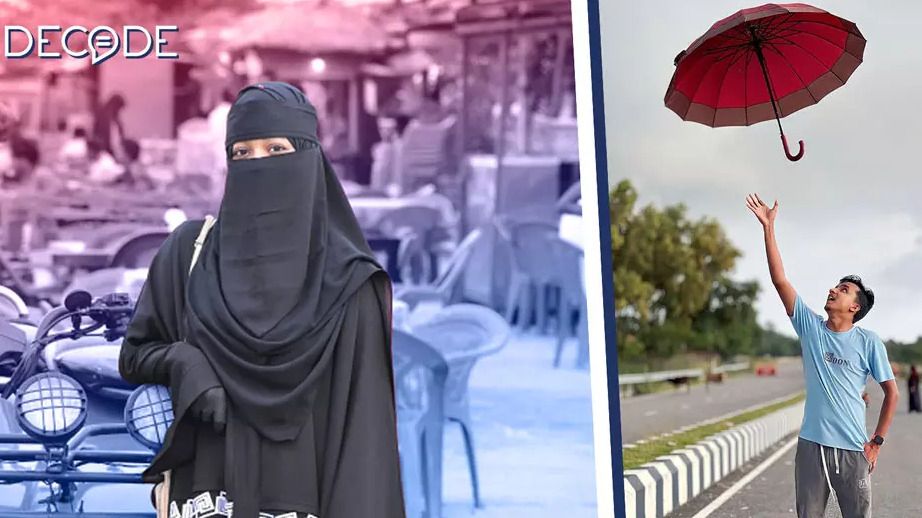
    Omal Khair, a resident of the same camp, and a budding photographer like Azimul, took photos of the fire’s aftermath. Her photos, posted on Instagram where she too has over 3,000 followers, revealed destroyed structures and people labouring to reconstruct their shelters. Her own house was mercifully spared from the fire.

    Hasson, 21, and Khair, 20, are Rohingyas refugees who along with their families fled mass killings and persecution of the Rohingya community in Myanmar in August 2017, crossing over to neighbouring Bangladesh where they now live. Hemmed in by the barbed wire fences of the refugee camp where they share space with an estimated 600,000 plus refugees in one of the world’s largest refugee camps, Hasson and Khair’s window to the world beyond is through Instagram and their way of telling the world that they exist, through photographs of everyday life in the camps.

    When I speak to Hasson on a video call, his eyes show fatigue and the longing to escape his confines. “I feel as if we are trapped in a cage. I want to go back and live in harmony,” he says. True to his words, Azimul’s photos are often of barbed wire which runs around the camp, and which Azimul hopes to escape one day.
    Azimul sends me a recently taken photo where dozens of empty cans, buckets and aluminium pots are lined up against each other. “We have a shortage of water in the camp and therefore we must constantly store water,” he explains and adds, “I want the world to see what I see through my eyes.”

    When I speak to Omal, it is late at night and she looks tired after studying through the day. Omal was studying in Class 10 when she was forced to drop out and flee Myanmar. In the absence of formal schooling, Omal tutors herself in maths, English and social sciences by studying online. Omal too wants to return. “I miss my home so much”, she says, but admits that “Rakhine state is still not safe for us.”

    Omal’s images are most often of smiling and hopeful faces of girl children with captions expressing their desires and aspirations such as becoming a doctor and her concern about the lack of formal education in the camps. In a striking photo, a young Rohingya woman is seen sitting on the ruins of her house destroyed by a fire which broke out in March 2021 while her toddler rests its head on her lap, holding on to a UNICEF bag. Omal, Azimul and Dil Kayas – another Rohingya refugee photographer – who could not be reached for the story were introduced to photography in 2018 through a training programme conducted in the refugee camps by Fortify Rights, a human rights organisation which works with Rohingya refugees and Doha Debates, a platform that hosts debates on current affairs.

    Matthew Smith, Chief Executive Officer of Fortify Rights said the trio had emerged as the most exceptional participants during the initial training. “They’ve since amassed online followers, published their first book, and had a major art opening in Doha. Their work is extraordinary and powerful, and also a testament to the fact that Rohingyas are more than genocide survivors. In this case, they’re photographers, artists, authors, and more,” Smith said in an email.

    Omal and Azimul capture the hardships of refugees through their images, but the focus is also on everyday life – whether children laughing with abandon, the sobriety of a funeral procession, fires erupting in the camps, refugees performing odd jobs, or mourning crowds observing Rohinga genocide remembrance day. They also shoot Rohingya cuisine and rituals like applying thanaka, a paste made from tree bark, and even occasionally caption their photos in Burmese script.

    While the two are not paid for the content they post on Instagram, they receive requests for photos through which they earn some money. “Sometimes journalists contact me for stories for which they want photos. I take photos of life in the camps, the suffering of my people, the shortage of water and the lack of education,” Azimul says.

    Both use smartphones rather than cameras to shoot images to avoid attracting attention from security personnel. Azimul uses an iPhone which he purchased with his earnings while Omal uses Samsung Galaxy A51 given to her by Fortify Rights. Despite owning a good quality phone Azimul rues the lack of a camera.

    “Sometimes, my photos captured with a phone are not of good quality. A camera would have been convenient but unfortunately as I’m surviving in a cage and trapped, using a camera would bring trouble for me. But I hope I can do it one day,” he says. The duo’s photographs have been compiled and published in a book titled ‘A Chance to Breathe’, published by Fortify Rights and Doha Debates. Even as their work was being exhibited in Doha and Bangkok, with the help of Fortify Rights and Doha Debates, none of the photographers could physically attend the exhibitions because of restrictions on their movements as refugees.

    Their journey as young and rising photographers with a growing social media following hasn’t been smooth. Omal explains that it was especially difficult when she started photography as a 16 year old by participating in the media training organised by Fortify Rights and Doha Debates.

    In the early days of her photography, Omal encountered both online and offline harassment. She prefers not to dwell on specific instances of harassment but says she is at the receiving end of comments as a hijab wearing woman working outside her home. “Traditionally, Rohingya girls who reached adulthood were discouraged from venturing out alone to work. Those who did, faced criticism, and were accused of not adhering to Islamic rules, despite Islam allowing females to study and work while wearing a hijab.”

    Omal says she took time to explain her purpose to her critics: documenting the suffering and dire conditions faced by Rohingya refugees. “Over time, more people understood the importance of my work and now I receive encouragement and appreciation,” she says. Omal lives with her mother and two siblings in a cramped house in the camp. “My family members appreciate my work and support me but it is challenging to live in this crowded and unsafe camp,” she says.

    Both Omal and Azimul want to become professional journalists and spread the message about injustice to their community and hope to receive scholarships which would allow them to study and travel. Despite a modest following on Instagram, the two refuse to feel discouraged while desiring more followers.Omal wishes for “millions of followers” while Azimul is content that his followers like both him and his work and wants “more and more” in future.

    Originally published in Boomlive

    Link to article: https://www.boomlive.in/decode/the-rohingya-refugees-who-show-life-in-bangladesh-through-instagram-23333

  • Systematically terrorised: Rohingyas face severe health restrictions in Myanmar

    Systematically terrorised: Rohingyas face severe health restrictions in Myanmar

    Photo: Urvashi Sarkar

    Published in The New Arab. 15 May 2018

    The year was 2008. Gultaz Begum was pregnant and days away from delivering a baby. Her husband and an uncle helped her cross the mountains of Rakhine state, Myanmar into neighbouring Bangladesh. Travelling at night without passports, the three made it to Cox’s Bazar district, under the cover of darkness. Kusum Fatema was born, a day or two later, on February 8 in a government hospital in Cox’s Bazar, Bangladesh.

    Why did Gultaz, a Rohingya Muslim, not give birth to her daughter in Myanmar? Gultaz says she was admitted in a government hospital in Rakhine state.

    “I was poorly treated at the hospital. The nurses mocked me, were careless and made me feel unsafe. When my husband demanded my release, the hospital refused. They let me go, only after my family placed a great deal of pressure on them and paid a lot of money,” she said.

    Ten years later, Gultaz, her husband and three children are among the thousands of Rohingyas who live in Kutupalong and other refugee camps in Cox’s Bazar, following the August 2017 violence by Myanmar’s military which forced them to leave the country.

    The government of Myanmar does not recognise Rohingyas as citizens and has been systematically terrorising and forcefully displacing them, since many years. They face discrimination and severe restrictions in practically all areas of life – freedom of movement, in the practice of religion, access to healthcare and education, marriage and the number of children they can have.

    “Even when sick, we were stopped from going to hospitals, which were also far from our homes. We would be turned away at the checkpoints by police or military unless we paid bribes. Those of us who did manage to reach a hospital, would either be denied admission or charged exorbitantly to be admitted,” says Gultaz. According to her, even after being admitted to a hospital, the Rohingyas were not assured of reliable treatment.

    “As a result, and because we were scared, we stopped going to hospitals. When we fell ill, we would consult rural medical workers who are barely qualified. Those who could afford it, went to Bangladesh for treatment. The rest simply died.”

    Tasmina Begum who is in her mid-20s and fled Rakhine state in August 2017, too has a traumatic experience to share. A pregnant Tasmina did not go to the hospital to deliver her baby. When she developed fever, she took medicines prescribed by a local medic.

    “After taking the medicines, I bled severely and lost the baby. But I was too scared to go to a hospital. I went to Bangladesh where I had a blood transfusion done at a private hospital in Cox’s Bazar.”

    Dr Mohammed Abdus Salam, a government appointed civil surgeon at Cox’s Bazar who has been treating Rohingya patients, attests to the poor health of the refugees.

    “Malnutrition is high, especially among women and children – 161 cases of HIV have been detected since March 2018. Most people have not received vaccination and suffer from measles, rubella, diarrhoea, cholera and diphtheria.”

    Diphtheria became a major source of worry for the Bangladesh government which had nearly eradicated the disease among its people.

    To prevent a fresh outbreak, the government with the help of aid organisations started mass vaccination programmes for the Rohingyas, local communities, and aid workers.

    According to Dr Salam, the refugees who arrived last year were in a traumatised condition because they had been sexually assaulted, injured from mine blasts or gunshots, or had sharp cuts on their bodies.

    A health worker with the International Organisation for Migration (IOM) in Cox’s Bazar and who did not wish to be named, said: “The Rohingyas did not receive information about family planning or maternal health treatment. Even medicines were not freely available, compelling the Rohingya to come to Bangladesh. This is just the tip of the iceberg, since the Rohingyas have been discriminated against in several other ways.”

    Human rights violations against the Rohingyas, including in the areas of health, were highlighted in a report published by Amnesty International last year.

    According to the report, authorities in Myanmar have severely restricted Rohingya from accessing the state hospital in Sittwe, Rakhine state.

    “Only in the most serious of cases will Rohingya patients be accepted, and even then, only after special permission has been given by the Rakhine State authorities and the sick must travel with a security escort. Once admitted, they are placed in separate “Muslim wards” and are vulnerable to extortion and other “fees” from police and hospital porters.” The report described the situation as apartheid.

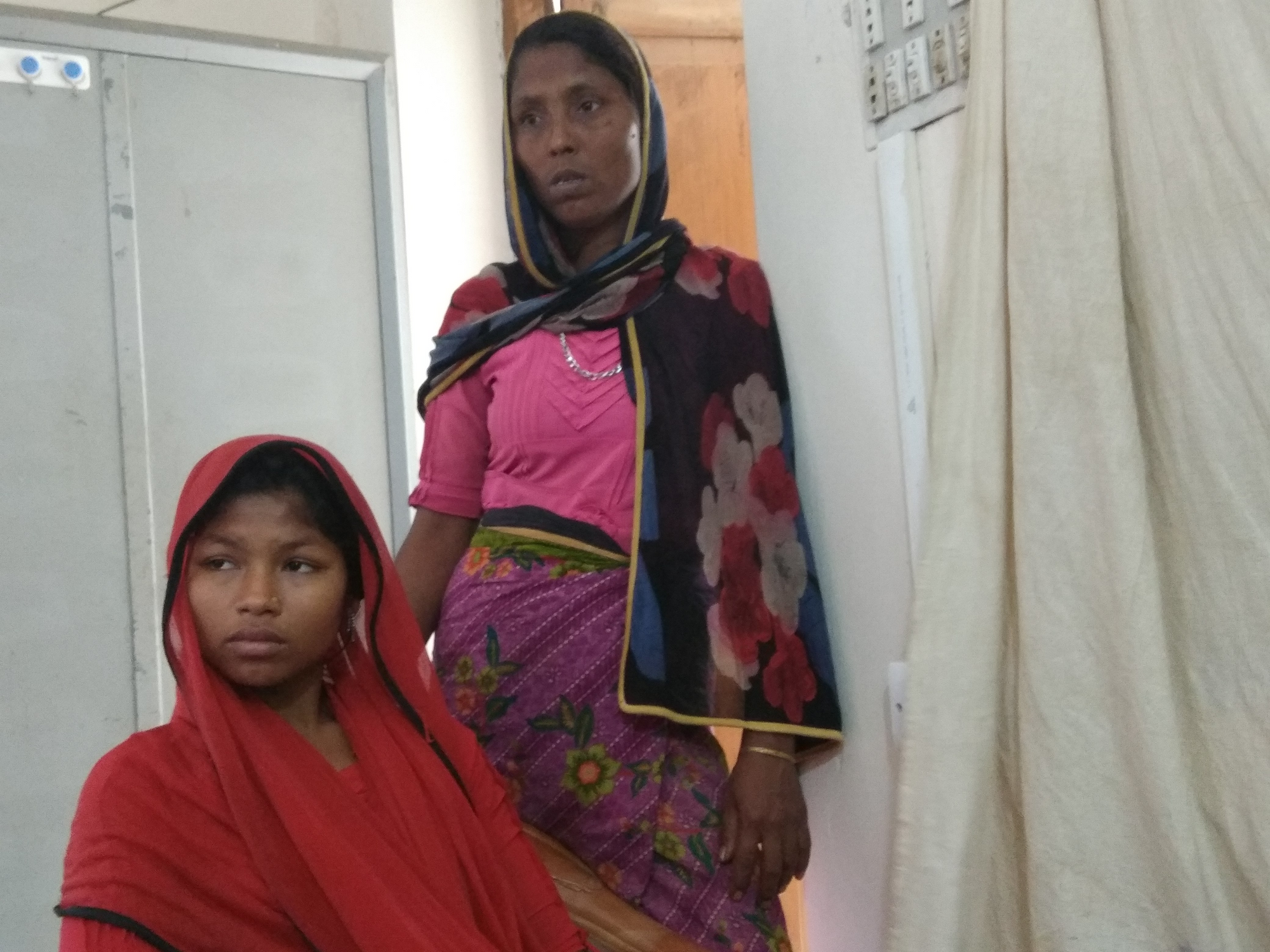
    Photo: Urvashi Sarkar. Najma (L) was beaten up during a brawl in the camp where she lives. In this picture, she is with her mother Romeda Begum at the Ukhia government health complex

    Another report of the Advisory Commission on Rakhine state – established by the Kofi Annan Foundation and Myanmar’s Office of the State Counsellor with the assent of Nobel Peace Prize winner Aung San Suu Kyi – also notes the discrimination and human rights violations of Muslims in Rakhine state.

    Suu Kyi was widely criticised for not coming out against the atrocities on the Rohingyas. This report too acknowledges discrimination against Muslims in Rakhine state, without mentioning the term Rohingya.

    “While all communities suffer from inadequate medical services, access to health is particularly low within the Muslim community in the northern and central parts of the [Rakhine] state. The refusal of some health facilities to treat Muslim patients… prevent ready access to health facilities,” the report says.

    The allegations of genocide and human rights violations have been so far denied by the Myanmar government which has asked instead for “clear evidence.”

    Fortify Rights, an organisation based in South-East Asia and registered in the United States, and which does work in Myanmar, has called for the referring of crimes against Rohingya to the International Criminal Court (ICC).

    “The rights of the Rohingyas have been abused in every possible manner and they have been discriminated against owing to their ethnicity and religion,” said co-founder, Matthew F. Smith.

    “The only way forward is for the UN Security Council to refer the situation in Myanmar to the ICC which should probe the allegations of genocide and prosecute as well.”

    Read the original article: https://english.alaraby.co.uk/english/indepth/2018/5/15/systematically-terrorised-rohingya-refugees-face-severe-healthcare-restrictions

  • With no formal schools or jobs, young Rohingya left in lurch

    Published in Al Jazeera. 13 April 2018.

    Cox’s Bazar, Bangladesh – It is a hot, chaotic morning at Kutupalong, the world’s largest refugee camp located on the Bangladesh-Myanmar border. Rohingya women, men and children, uprooted from Myanmar, form long queues outside the offices of various aid organisations and wait to receive clothes, food and medicines.

    There is a rush to collect stacks of bamboo to protect weak settlements from the upcoming monsoon. Children help out too, carrying the heavy poles as they balance boxes of aid material on their little heads. Some children run around and play in groups, while others attend temporary learning centres where English, Burmese and mathematics are taught.

    The Rohingya have faced brutal persecution and discrimination at the hands of the Myanmar government, which refuses to recognise them as citizens and has killed or forced out large chunks of their population in repeated, barbaric acts of ethnic cleansing.

    Following the most recent cycle of violence in August 2017, more than 700,000 Rohingya have sought refuge in Bangladesh’s Cox’s Bazar district, taking their population in Bangladesh to about a million now.

    Children and youth between 3-24 years comprise nearly half of the Rohingya refugees and are not allowed to pursue formal education in Bangladesh.

    Only informal education is available through temporary learning centres and religious schools or ‘maktabs’ which offer Arabic language and Quranic education.

    Maktabs are separate from the network of temporary learning centres and are funded by private Bangladeshi donors or countries like Saudi Arabia and Turkey.

    Viewed against the backdrop of religious oppression of the Rohingya in Rakhine state, the maktabs are seen positively by the refugees in Bangladesh camp. The maktabs also keep the children occupied, since any movement outside the camp is not allowed.

    Informal education their only option

    Set up by UNICEF, Save the Children and local Bangladeshi organisations, the temporary learning centres, now numbering close to 1,100, provide informal education to Rohingya children aged 4-14 years.

    Bengali, however, is not being taught, since the Bangladesh government does not plan to integrate Rohingya refugees with the local population.

    It is past noon, and the temporary learning centre at the camp has wound up for the day. Children scamper out of the small room made of tin, sticks, and coarse cloth.

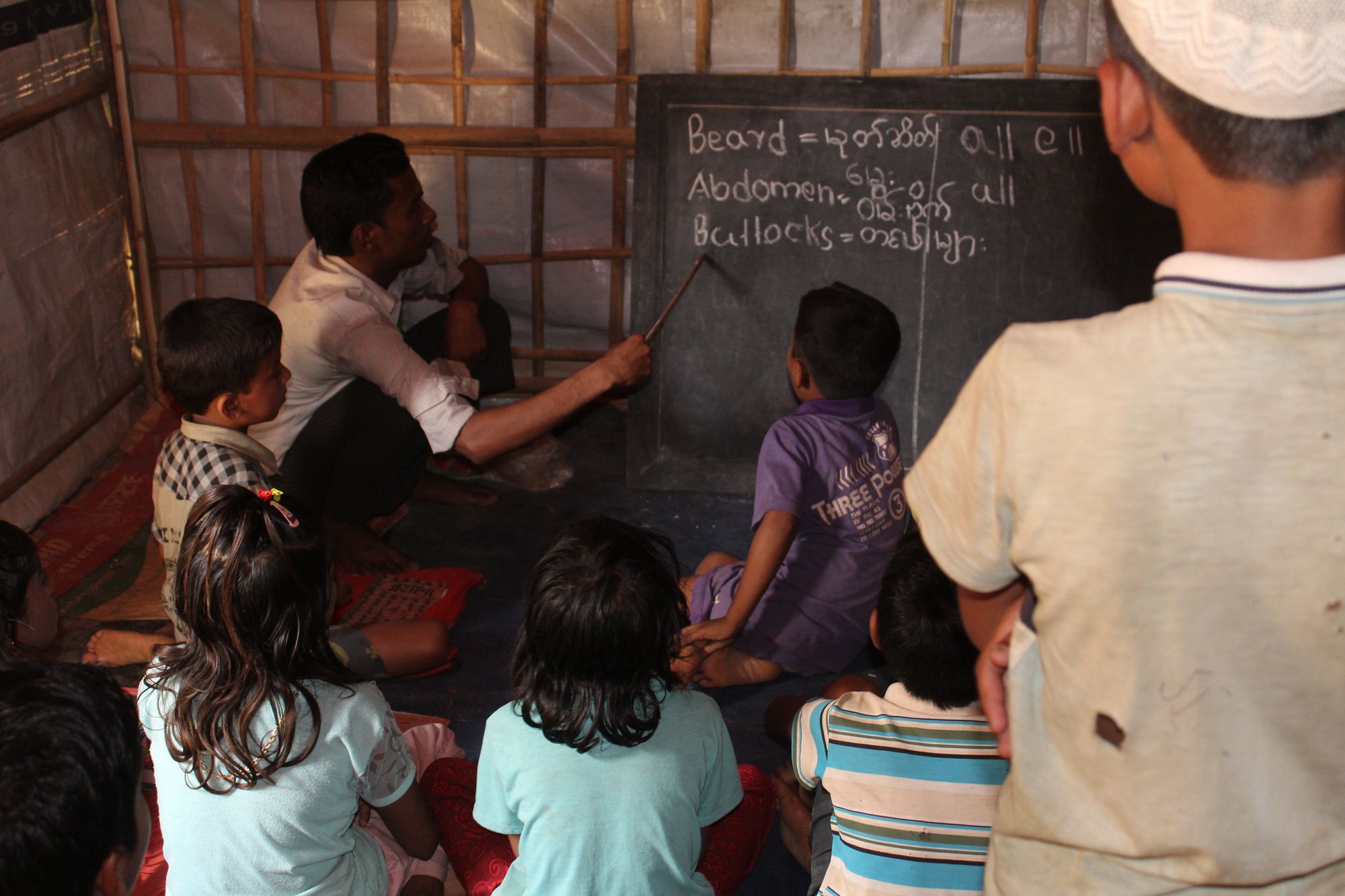
    A blackboard, bearing the words ‘beard’, ‘buttocks’ and ‘abdomen’ in English, stands in a corner. The teacher, Mohammed Abdullah, an 18-year-old Rohingya refugee, rubs it clean.

    As s Abdullah explains the curriculum to me, he is joined by Janatullah, also 18 and a Rohingya refugee.

    Janatullah appears restless and angry – he was unable to attend his matriculation exam because of the violence that broke out in Myanmar’s Rakhine state in August 2017.

    “I would have appeared for the examination this year. I was the best in my class. But the violence drove us out. The Myanmar government murdered our families and prevented us from education. I wanted to study in a university and learn English. I do not know if it will ever happen. Now, I can only live on charity,” Janatullah told Al Jazeera.

    Staring at a bleak future

    Janatullah speaks in English, which he says he learned after arriving in Bangladesh. But since he is 18 years old, no form of education – even informal – is available for him in the refugee camp. While Abdullah was able to find work as a teacher in the camp, Janatullah was not as fortunate.

    His despair is echoed by Sanjib Sil, a resident of the adjacent Hindupara camp. A Hindu Rohingya in his early 20s, Sanjib said he had both fertile land and his own business in Myanmar. Now, he has nothing.

    “I do not have even five rupees. I have to stand in line and beg for charity. I cannot step out of the camp. My future is ruined, and I am condemned to an unproductive existence. No girl will be willing to marry me,” said a distraught Sanjib.

    The tribulations of Janatullah and Sanjib are shared by hundreds of young Rohingya in Bangladeshi refugee camps who have been abruptly wrested from formal education and any chances of employment.

    Photo: Siddharth Adelkar

    There are no formal jobs available for Rohingya in the camps. According to a recent report, nearly 62,000 refugees have been able to do small cash jobs in the camps.

    There are also a few Rohingya who managed to escape Myanmar with some money and have been able to set up small shops where they sell vegetables, fruits and clothes to other refugees.

    Nizamuddin, 32, is a Rohingya teacher at a temporary learning centre in Balukhali camp. He is a graduate, a rare distinction among the refugees because of long discrimination against the Rohingya in schools and universities in Rakhine state.

    “It was not easy to complete graduation. I ignored the insults and humiliation of Muslims and tried not to get into fights. I passed out of Rakhine state’s Sittwe University before 2012. That was the year fighting broke out between Muslims and Buddhists, and many Muslims were killed. It became almost impossible for Muslims to get admission in Rakhine colleges after 2012,” he said.

    Nizamuddin worked as a private tutor and taught in small rural schools in Rakhine and earned a satisfactory living. In Bangladesh, he earns 8000 taka ($96) a month and can teach only Burmese, English and mathematics, whereas, in Myanmar, he could teach more subjects.

    My prospects have reduced here. I remember how I struggled to graduate. Has it amounted to nothing?” he asked.

    Rohingya girls’ situation worse

    If boys and young Rohingya men are staring at a bleak future as stateless refugees, the situation is possibly grimmer for female children and adolescents who, apart from being forced to pull out of formal education, face the additional threats of child marriage and sex trafficking.

    Nine-year-old Kasmin Fatema goes to both a temporary learning centre and a maktab at the Kutupalong camp. Gultaz Begum, her mother, has yet not decided how long she will permit Kasmin to go out.

    Gultaz herself dropped out after third grade in Myanmar. “As I grew up, my family was scared that I would be harassed by Rakhine men,” she said.

    However, she is happy that Kasmin is learning English at the temporary centre. “Despite attending school in Myanmar, my daughter could not even write her name.”

    “Muslims faced a lot of discrimination in schools. Now she can write her name in English and read too,” she said, hoping against hope that Kasmin could become a teacher one day.

    Cover photo: Urvashi Sarkar

    Read the original article: https://www.aljazeera.com/features/2018/04/13/with-no-formal-schools-or-jobs-young-rohingya-left-in-lurch/

  • Azeem Ibrahim’s book on Rohingyas is a portrait of a people persecuted left, right and centre

    Published in The Print. 4 February 2018

    If Azeem Ibrahim’s book were to be summarised in one line, it would indeed be this— ‘The Rohingyas: Inside Myanmar’s Hidden Genocide’ examines attitudes towards the Rohingyas in different periods of Myanmar’s history and shows the hatred meted out to them.

    The writer prods the motivations of various actors – whether the military, Aung San SuuKyi’s National League for Democracy (NLD), the Buddhist extremists and the international community to show their collective complicity in the persecution and ethnic cleansing of a people.

    By constantly marking the Rohingya as outsiders who did not historically belong to Myanmar, the military rulers of Myanmar and their supporters strengthened the frameworks of exclusion to such a point that it became possible to deny them any form of citizenship and render them stateless.

    Ibrahim uses census and other historical records to trace the presence of Rohingyas in the Arakan region to the period well before the British invasion of 1826. After the British left, it became important to define who is Burmese; as being a Burmese came to mean being a Buddhist and the military had a strong hand in conflating the basis of citizenship with being Buddhist.

    The book is as much an analysis of the politics that dominates modern Myanmar, as it is about the tracing of systematic discrimination against the Rohingyas. Some of the most interesting parts of the book pertain to the NLD, which was the main opposition to the military rule, but also dependent on support from Buddhist monks, including extremists intolerant of the Rohingyas.

    Ibrahim notes that NLD has failed to directly challenge the military, in part because of the common interests of the military and some of the NLD elite. In fact, attacking the Rohingyas is one issue that the military and some of the Buddhists and NLD can agree on. The references to Nobel laureate Aung San Suu Kyi show her to be equally complicit in her refusal to act for the Rohingyas and her beliefs about them.

    The motivations that drive Myanmar’s military leadership to maintain their grip over the country are brought out in detail. Their suspicion towards the international community is balanced by a need to trade and get weapons. Ibrahim reminds us that the international community which could have used much more leverage over Myanmar’s rulers has failed to do so. Following the 2012 massacres of the Rohingyas, the United States and Europe actually praised the ‘even-handed’ approach of the regime in containing the violence.

    The symbiotic relationship between Buddhism and the state are emphasised in Ibrahim’s analysis. The rigid elements of Theravada Buddhism, the Ma Ba Tha and 969 Movement, and the emergence of ‘Buddhism’s Bin Laden’ show the complete lack of tolerance for non-Buddhists and the hatred for Muslims in particular.

    In this analysis, it becomes important for Ibrahim to trace the reasons for the greater persecution of the Rohingyas as an ethnic minority compared to the other ethnic minorities of Myanmar. After Burma gained independence, life for Rohingyas was as difficult as life for other non-Burman ethnic groups. But the deterioration of the economy in the 1970s created the need to find internal enemies who would serve as a distraction. The Rohingya were ideal because they were unarmed, easily identifiable, spoke a non-Burmese language and were Muslims in a country with an overwhelming Buddhist population.

    Over various electoral cycles and periods of framing the Constitution, the rights of Rohingyas were systematically clipped and Buddhist identity became the base for citizenship. The 2014 census excluded them and forced them to identify as ‘foreigners’.

    Interestingly, the term used by the ruling dispensation for Rohingyas is ‘Bengalis’, that is, people who do not belong to Myanmar, but Bangladesh and should therefore go there.

    As life becomes increasingly difficult for Rohingyas in Myanmar, with restrictions on marriage, having children, travel and being forced to live in temporary camps, Rohingyas who flee the country do not fare much better. Many end up being trafficked and become slaves and offer cheap labour in Thailand’s fishing industry, while the women are forced into prostitution.

    Ibrahim’s book is ultimately a warning— what is happening to the Rohingyas qualifies as genocide. Though written before the 2017 massacre and mass displacement of Rohingyas, it delves into previous periods of violence and the reasons thereof, provide the much needed context for understanding the scale of one of the worst humanitarian disasters that has been unfolding for a long time, which the world has noticed only now.

    Read the original article: https://theprint.in/pageturner/afterword/azeem-ibrahims-the-rohingyas-inside-myanmars-hidden-genocide-is-portrait-of-a-people-persecuted-left-right-and-centre/33378/

Urvashi Sarkar – 2026 – All rights reserved.

web things by Studio Goncharov