Tag: Scroll.in

  • ‘We are not safe even in office’: Pune techie’s murder raises concerns on security, workplace sexism

    Published in Scroll.in. 4 February 2017

    As evening descended, a group of young professionals assembled near the Wipro circle in Pune’s Hinjewadi area on Wednesday. Holding candles and placards with messages such as “Justice for Rasila” “We need safe workplace” and “Employees are not slaves”, the gathering of men and women information technology professionals protested against the murder Infosys employee Rasila Raju, who had allegedly been strangled by a security guard in her office on January 29.

    Though it was her day off, 25-year-old Raju had come to the Infosys office in Hinjewadi, the city’s IT hub, for the 2 pm to 11 pm shift on Sunday to work on a project. Company security guard Bhaben Saikia, who was arrested for her murder, allegedly strangled her using a computer wire. Raju had earlier complained to company officials about Saikia, her family said, but no action had been taken.

    This is the second murder of a woman techie in Pune in as many months – in December 2016, 23-year-old Antara Das, an employee of Capgemini, was killed outside her office in Talwade.

    Safety concerns

    “We are not safe even in our office premises. Who should we trust?” asked a young woman, asking to remain anonymous, who had attended the vigil for Raju’s death.

    A woman standing next to her asked: “We want to know why Rasila was working in office on a Sunday, that too alone. Why was she not provided a temporary laptop to work from home?”

    The woman, who did not wish to be identified, said that for newcomers and those who were just starting out, it was hard to turn down projects, even if it meant working on weekends. “Still, why was Rasila made to work alone?,” she asked. “After this incident, we are scared, and do not sit alone at work. We work together in groups where we feel safe.”

    Infosys, in a statement, said “this was an unfortunate incident is a reminder that nothing can be taken for granted, and we are continuing to seek recommendations and suggestions from different stakeholders.” The statement cited existing safety measures such as a helpline, CCTV cameras on the premises, safety committees, background checks and night travel arrangements for women.

    Women IT workers at the vigil for Raju said they appreciated the facilities provided by their companies but expressed concern over inadequate safety provisions. “Companies fail to reinforce their own dictates,” a female recruiter for an IT company said. “For example, if a company decides that women need not be at the workplace beyond 6pm – the practice is permitted for sometime – but is stopped later. ”

    Confronting the glass ceiling

    Women in the IT sector said that apart from security issues and sexual harassment at the workplace, they also have to contend with ingrained sexism and a glass ceiling that prevents them getting their due

    “If a woman wants to leave early, a male colleague might say that he works longer hours and receives the same pay,” said Gunjan Shukla, a 36-year-old IT professional in Pune who has worked in the industry for the last 15 years. “But women are expected to make up by working harder, from home, and on the weekends as well. They also do much of the house work too, which means they are constantly balancing the pressures of work and home.”

    The Maharashtra IT Professionals Forum, an informal group of IT professionals issued a statement after Raju’s murder, which spoke of “the structural injustice in the IT industry where long working hours are expected from employees. Men can stay back till late and thus have an unfair advantage over women.”

    According to the National Association of Software and Services Companies, an IT industry trade body, women comprise 30% of the workforce. However, Shukla said that though the representation of women at the entry level may have increased, their presence is marginal at the higher levels.

    “How many women do you see with 20 plus years of experience in the technical field, or on the boards of Fortune 500 companies?” Shukla asked. “Even coding and programming areas of the industry tend to be male-dominated.”

    Shukla said that sexism is manifest at the workplace in the way women employees are perceived. “If a project has 30%-40% women employees, the project manager might say that the risk of the project is high, since the women could take leave for marriage and maternity.”

    Arun M of the Maharashtra IT Professionals Forum said that some companies also strive for greater representation of women in certain projects to woo clients. “This is done to get business from international telecom companies like AT&T and KPN, which have strict requirements about women’s representation in the companies they work with,” he said.

    That does not always translate into the creation of a more equitable workplace, however. “Women in some companies also face a harder time when they return to work after their maternity leave – they see their appraisals being affected,” Arun M said.

    Despite such challenges, women continue join the IT-BPO sector. According to Nasscom, one in every three employees in the sector, which has 3.7 million people, is a woman.

    But the gender gap in technology companies cannot be denied, said Geetha Kanan, managing director of the Anita Borg Institute India, which works on promoting women in technology. “While we do see many more successful women in the IT sector, there is there is also no denying the glass ceiling, for which the reasons are complex,” she said. “Technology innovation powers the global economy and women are crucial to building technology the world needs. Organisations need to focus on hiring more women and including them in the workforce.”

    With regard to women’s safety at the workplace, Kannan said the law entails some policies and processes, which some IT companies complement with their own measures. “Companies take steps such as providing sufficient male and female security staff at the office premises, senior manager’s approval required to work late, and staff background checks,” she said.

    But as the Pune incidents show us, such measures can often prove inadequate, costing a young woman her life.

    Cover photo: Urvashi Sarkar

    Read the original article: https://scroll.in/article/828440/we-are-not-safe-even-in-office-pune-techies-murder-raises-concerns-on-security-workplace-sexism
  • Brics’ New Development Bank may be new only in name – it’s yet to lay the ground for sweeping change

    Photo: Reuters

    Published in Scroll.in. 16 October 2016

    As leaders of Brasil, Russia, India, China and South Africa meet for the 8th Brics Summit in Goa on Saturday and Sunday, one of the key agendas is to take forward the New Development Bank. President KV Kamath, will attend the summit and bank’s management will look to hobnob with senior officials and business leaders at the two-day event.

    Comprising the five Brics member-countries, the New Development Bank, first proposed in the 2012 summit and signed into agreement last year, at the seventh summit, has been hailed as an alternative to US-dominated institutions such as the World Bank and International Monetary Fund.

    The bank formally opened in July in Shanghai, China – but within months, questions about its functioning have been raised.

    What’s new?

    The biggest concern is that the New Development Bank has tied up with the very institutions to which it was projected as an alternative. Rather than presenting a different framework, the New Development Bank has signed agreements of cooperation with the World Bank as well Asian Development Bank. In a recent press release, the bank reiterated that it would complement the efforts of other existing financial institutions “to realise the common goal of global growth.”

    While the World Bank has been criticised for imposing loan conditionalities, such as liberalisation, deregulation and privatisation, on borrowing countries, some of the Asian Development Bank’s projects have had an adverse impact on vulnerable populations such as those in Cambodia and Indonesia.

    According to Rathin Roy, director of the National Institute for Public Finance and Policy, a research institute under India’s Ministry of Finance, the New Development Bank has so far failed to show how it will be different from existing global financial institutions. “The bank has not said how it will deal with loan conditionality differently, nor articulated how it will be different from the World Bank and Asian Development Bank,” he said. “If it does not replicate the World Bank or Asian Development Bank, then what is the New Development Bank going to be? So far the bank has not provided any answers or even a policy paper that addresses this.”

    To its credit, the bank, by assigning equal voting rights to its five founding members, has tried to be different from the World Bank and IMF, where voting rights are skewed in favour of developed countries. But this is a piecemeal measure, and the bank has not shown any inclination to bring about larger changes in the functioning and landscape of international financial institutions.

    Who’s accountable?

    One of the aims of the New Development Bank is to fund infrastructure projects in developing countries, and support public as well as private projects.

    However, the impact of the major projects it is expected to fund, such as ports, dams, industrial corridors and smart cities, is a cause of concern as such projects tend to displace populations, undermine local livelihoods, and cause damage to the environment. Though the bank has published its social and environmental framework, there is little evidence that aspects of equity and justice have been considered in the context of mass-scale development.

    Similar concerns have also been voiced about the China-led Asian Infrastructure Investment Bank, of which India is the second-largest shareholder and which opened for business in January.

    The New Development Bank and the Asian Infrastructure Investment Bank together represent the changing landscape of international financial institutions, most of which were established after the end of the World War II, during the ’90s.

    However, the inauguration of the two was not preceded by substantive debates in Parliament about India’s role or monetary commitments to institutions, which stands at $10 billion for the New Development Bank and $8 billion for the Asian Infrastructure Investment Bank.

    A briefing paper of the Centre for Financial Accountability, which monitors financial institutions and their investments in development projects, noted that the Parliament had remained silent and uninvolved, and called discussions on it a problem from the public accountability and transparency viewpoint.

    The huge gaps in finances for infrastructure projects, especially in emerging economies, mean that the two entities are likely to have many takers for their funds, and need not vie with one another.

    According to a G20 estimate, $1 trillion to $1.5 trillion will be required annually for over the next 15 years to fund infrastructure in the developing world. Nevertheless, there is broad agreement that the China-led bank with 57 members, including major Asian economies and European countries, has overshadowed the New Development Bank.

    Poverty, inequality and development

    Talk on this competition is further fuelled by the rivalry between India and China, two of Asia’s largest economies. However, there are more pressing concerns for the New Development Bank – which it has not addressed so far.

    For instance, despite being a development bank, its policy documents remain curiously silent on poverty and inequality – two major challenges facing India and other growing countries.

    The People’s Forum on Brics – which represents social movements, trade unions, civil society and the like from the member countries that analyse the functioning and policies of Brics – has already called the bank out for mainly serving private interests. The forum met ahead of the summit in Goa on October 13 and 14.

    A growing perception among policy analysts is that Brics countries are unsure of which direction to take the bank. The bank website states that it will not just fund infrastructure, but also promote sustainable development. But how it defines development is not clear. While the bank emphasises on economic growth, it says nothing about jobless growth, rural poverty, or those marginalised from the benefits of economic growth.

    Kamath’s claims about the New Development Bank symbolising political sovereignty and the “rise of the South” – of developing countries in the Southern Hemisphere – already appear hollow, and it appears far-fetched that the bank can produce a paradigm shift.

    Read the original article: https://scroll.in/article/819119/brics-new-development-bank-may-be-new-only-in-name-its-yet-to-lay-the-ground-for-sweeping-change

  • BRICS may not replace the old world order – but it could still make a difference

    Photo:Reuters/Sergei Karpukhin

    Article published in Scroll.in. 4 October 2016

    Since its first summit in 2009, the BRICS group of nations has done what it takes to be noticed – carved out a multilateral bank with an initial authorised capital of $100 billion and created a Contingency Reserve Arrangement to tackle financial crises. However, as the group of emerging economies gears up for its eighth summit that will be held in Goa on October 15-16, in a year India assumed the BRICS presidency, questions remain about its credibility.

    BRICS first started with Brazil, Russia, India and China as its constituents, and was joined by South Africa in 2010. It was envisaged as an alternative to dominant Western financial institutions like the World Bank and International Monetary Fund, which, 70-odd years after they were set up, continue to be dominated by the United States and Europe.

    However, links with the International Monetary Fund remain in place. A BRICS country, when in need, still requires an agreement with the financial body to withdraw more than 30% of its quota from the Contingency Reserve Arrangement. Also, the growing ties of India and Brazil with the United States further undermines the grouping’s credibility.

    BRICS nations – comprising 43% of the world population, 31% of global GDP (purchasing power parity basis) and 17% of world trade – also face other serious problems. High levels of poverty and great inequality mark their societies. The faltering of their economies, barring India, is a concern. Critics also draw attention to a renewed scramble for Africa by BRICS countries, resulting in natural resources extraction and impoverishment of locals.

    Different political structures, varied economic trajectories and inter-rivalries such as between member nations India and China, make it difficult to accept that BRICS can have a cohesive position on anything.

    Great expectations

    Despite such problems, ahead of the eighth summit, different constituencies have their expectations. For instance, business-related groups want it to be easier to do business with each other and seek increased trade, and civil society groups hope to be consulted in policy making.

    “The BRICS countries could have better levels of intra-BRICS trade,” said Onkar Kanwar, chairman of BRICS Business Council (India). “This can be done through harmonisation of customs regulations, easier visa regime, uniformity in technical standards and easier access to information on trade and investment.”

    The BRICS Business Council will also press for a travel card, or special business visa, which will make it easier for people doing business in these five countries to travel across BRICS.

    The Indian government’s expectations from BRICS is best expressed in terms of what not to expect. Contrary to popular and media perceptions, issues like the Kashmir dispute or India’s Nuclear Suppliers Group membership cannot be pursued.

    “If these issues are pursued, BRICS would only be occupied with India-China border problems or Brazil-China anti-dumping disputes,” said former Ambassador HHS Viswanathan, who works with the Observer Research Foundation and heads the BRICS Academic Forum from India. “Bilateral issues are off the agenda. Even if international issues relating to third countries crop up in discussions, we try not to enter them. And if we do need to mention them, references are watered down.”

    India and BRICS

    So, how does India gain from BRICS?

    BRICS wants to alter institutions such as the World Bank and International Monetary Fund and pushes for reform of the United Nations Security Council, and India is keen on both processes.

    Further, by being a founding and contributing member of the New Development Bank and Contingency Reserve Arrangement, India has come a long way since it had to request food aid from the United States in the 1970s, and negotiate assistance from the International Monetary Fund in 1991, during the balance of payments crisis.

    BRICS also provides a space for India and China, which share thorny ties, to find areas of cooperation such as in railways, industrial parks, tourism, urbanisation and agriculture. The group can be a source of investment for initiatives like Make in India and smart cities, and facilitate investments by Indian companies in BRICS countries.

    As far as civil society in India goes, the belief is that the legitimacy of BRICS can increase if civil society organisations that are attuned to people’s concerns are also consulted for inputs into policy making.

    While the government-approved civil BRICS with a focus on Sustainable Development Goals will take place in Delhi, a separate gathering, People’s Forum on BRICS, will be held in Goa later this month. The forum will focus on BRICS from a relatively critical lens, with discussions on public services, natural resource governance and human rights.

    While civil society organisations have demanded that their participation be formally recognised in BRICS summits, as in the case of academia and business participation at present. But though the Indian government will facilitate a gathering of such organisations, or civil BRICS, it still does not mean institutional recognition. Further, the recommendations from the gathering may not be accepted in the final summit outcomes since there is no formal mechanism for accepting recommendations.

    Concerns about the New Development Bank have also been raised by civil society groups.

    Joe Athialy of the Centre for Financial Accountability said: “If the NDB [New Development Bank] cannot show transparency and accountability and evades environmental and social concerns, it won’t be any different from multilateral development banks like World Bank and Asian Development Bank.”

    BRICS and the world order

    BRICS remains a young institution still in the process of contact building among member countries. Existing areas of cooperation include attempts to provide an alternative to dominant financial institutions, reducing international financial market risks and concerns about disruptive monetary policies of advanced countries. Further grounds of cooperation are being identified with each summit.

    BRICS cannot be the new world order and perhaps does not intend to be, given its differences and continued cooperation with existing institutions of power. The attempt will not be to replace these institutions, but to occupy space within them, and gain a share of global governance through arrangements like the BRICS bank, Contingency Reserve Arrangement, and trading in local country currencies. But more importantly, global governance entities like the World Bank, International Monetary Fund and the UN Security Council are in serious need of a shake up to reflect current global realities, and BRICS might just be able to deliver this. It is therefore premature to write it off, just yet.

    Read the original article: https://scroll.in/article/817619/brics-may-not-replace-the-old-world-order-but-it-could-still-make-a-difference

  • How to fight intolerance with culture: A Palestinian-Indian theatre production shows the way

    Photo: The Palestinian Embassy, New Delhi

    Published in Scroll.in. 22 November 2015

    In 1989, Safdar Hashmi – the Indian actor, playwright and theatre activist – was shot dead while performing a street play in Jhandapur village in Uttar Pradesh. More than two decades later, in 2011, the Palestinian-Israeli actor Juliano Mer-Khamis was struck by a hail of bullets outside The Freedom Theatre in West Bank’s Jenin refugee camp.

    Both Hashmi and Mer-Khamis were murdered for the ideas they espoused: in Mer-Khamis’s case, it was Palestinian freedom from Israeli occupation, and in Hashmi’s instance, it was concerns about the working classes and the divisive forces of communalism. Both Hashmi and Mer-Khamis were united by a concern for the oppressed. Both of them were agitating for freedoms.

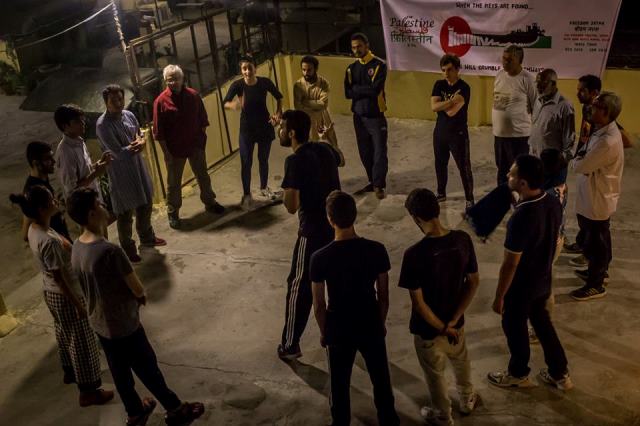
    To push forward their ideals of countering oppression through culture, The Freedom Theatre and Jan Natya Manch, the theatre company co-founded by Hashmi, have come together this year. Both groups will participate in a joint production which will travel, over the next three months, to Lucknow, Bhopal, Mumbai, Bangalore, Hyderabad, Kolkata, Patna, Kozhikode and Mallapuram. There will also be a performance on January 1, 2016, at Jhandapur, where Hashmi was assassinated.

    The TFT website notes: “Janam and TFT have suffered the loss of friends as a consequence of intolerance; we are connected by experiences of resisting oppression in search of freedom.”

    This collaboration, announced by the Palestine embassy in Delhi last week, becomes important in the light of the killings of MM Kalburgi, Govind Pansare and Narendra Dabholkar. Prominent writers or activists, they were again murdered for their views.

    ‌‌Courtesy: Jan Natya Manch

    For Faisal Abu Alhayjaa, director of The Freedom Theatre, art and culture have a strong ability to shake up the status quo.

    “Do you know what intifada means?” he asked. “It is an Arabic word meaning shaking up. The first Palestinian intifada of the 1980s saw demonstrations, a lot of street fighting and stone pelting. The second intifada, which began in 2000, was more aggressive – with soldiers, guns and F-16. The third intifada must be cultural.

    “The killing of Hashmi and Mer-Khamis showed that their art was effective. It proved that their art could be dangerous. They opened new ways of thinking, offering ways of saying no, and saying no is dangerous. But this is a responsibility of art.”

    In the same vein, he cites the works of writer Ghassan Kanafani and cartoonist Naji al-Ali, both Palestinian, who were also killed.

    Cultural resistance

    Faisal, who learnt from and was greatly inspired by Mer-Khamis, feels theatre is a powerful weapon against the Israeli occupation. “The Israelis want to us become shaheed, that we become stone pelters so that they can kill us. Even children are attracted by the idea of becoming a shaheed when they grow up. Palestine isn’t just a name, it has to grow and needs it people.”

    The Israeli occupation isn’t just a physical occupation, he says. “It is in the minds, thoughts and images. This needs to be countered.”

    “When we perform a play it stays for 100 years. Take Arna’s Children, a documentary which shows the history of TFT. It was made by Mer-Khamis and shows the history of a theatre which had its origins in the ’80s. But we still talk about it and ask people to see it.”

    Faisal feels that Palestinians have always been placed in situations where they could only react. “Even intifadas were a reaction. But we need to ask questions, create and initiate. This is possible through theatre.”

    Brijesh Sharma, actor and writer for Jan Natya Manch, says the Indian theatre company’s production with TFT will raise awareness of the occupation of Palestine and show the “parallels of experiences of anti-imperialism in India and Palestine”. Given the rise of intolerance in India, he adds, cultural resistance will be crucial.

    Read the original article: https://scroll.in/article/769703/how-to-fight-intolerance-with-culture-a-palestinian-indian-theatre-production-shows-the-way

  • Is India’s trade with Israel significant enough to justify jettisoning its support for Palestine?

    Photo: President of India/Facebook

    Published in Scroll.in. 17 October 2015

    A “historic political milestone” is how President Reuven Rivlin of Israel described Pranab Mukherjee’s just concluded visit, the first by an Indian President to Israel and Palestine.

    Prime Minister Narendra Modi is expected to visit Israel in 2016. India and Israel have never been closer, and the cooperation between them never quite as visible.

    Advocates of India-Israel partnership on economic grounds cite burgeoning trade, investment and business ties as reasons for this close relationship. Israel’s considerable defence supplies to India are also considered an important component in the relationship.

    However, the trade figures tell us another story, leading to the question: Does Israel need India more in this relationship?

    History of economic cooperation

    India recognised Israel in September 1950 and full diplomatic relations were established in 1992.  PR Kumaraswamy notes in India’s Israel Policy:

    “Indo-Arab trade was growing, but India’s bilateral trade with Israel was meagre and negligible. In 1960, the government informed the Lok Sabha that the size of the Israeli market was small and thus offered little incentive for Indian exports.”

    At the time of assassination of Prime Minister Indira Gandhi in 1984, Indo-Israel relations were at rock bottom, but under Rajiv Gandhi they started improving. Bilateral trade showed improvement, and was dominated by trade in diamonds, controlled by a group of Indian diamond merchants based in the Tel Aviv suburb of Ramat Gan, who had started operating in the late 1970s.  Though trade has diversified, diamonds continue to dominate.

    Kumaraswamy writes that from 1996-2006, the diamond trade ranged between 52%-71% of total trade.

    In 2014, diamonds still constituted 53.5% of bilateral trade. Bilateral trade which was $200 million in 1992 passed the billion mark before the end of the decade. By the end of the 1990s, Israel had emerged as India’s fourth-largest trading partner in the wider Middle East.

    In 2014, bilateral trade had reached $4.52 billion, excluding defence.

    Not a major trading partner

    Despite the expansion in trade, Israel does not figure among India’s top trading allies, not even among the top 10.  According to EXIM bank figures, India’s top bilateral trade partner is China with a trade partnership amounting to $72.4 billion for the financial year 2015, followed by the United States and United Arab Emirates. India’s trade partnership with Saudi Arabia is to the tune of $39.4 billion.  Even with Iran, a major Israeli rival, India has an annual bilateral trade of over $14 billion.

    In comparison, the India-Israel bilateral trade is under $5 billion. As for Israel, India is Israel’s tenth-largest trade partner and third-largest partner in Asia after China and Hong Kong.

    The defence partnership

    The real business between India and Israel is its defence partnership, and from which Israel has been earning nearly $1 billion annually and is currently valued at $10 billion over the past decade.

    Interestingly, according to the Stockholm International Peace Research Institute Israel was among the top 10 global exporters of arms between 2010-14. India emerged as the top arms importer in the same period.

    Exports are crucial for Israel’s defence economy. Ajai Shukla, Strategic Affairs Editor of the Business Standard, explains the economics:

    “The Israeli Defence Forces are largely equipped with American equipment which comes in the form of US aid. That means Israeli defence forces buy relatively small amounts of equipment from Israeli defence companies, which must, therefore, rely on sales to foreign markets. India, the world’s biggest arms importer, has become a major buyer of Israeli defence equipment.

    Israel is more willing than most other arms producers to transfer defence technology to India. India enjoys leverage with Israel, since a significant amount of Israeli defence research is funded through Indian purchases of Israeli arms. Much of the R&D of Elta Systems (an Israeli defence electronics company) for instance is supported by the proceeds of sales to India, not by Israeli tax payers.”

    Shukla points out that much of this support that India provides to Israeli firms could have been spent by the Ministry of Defence to support Indian defence research and development, but this has not been the practice.  However, he points out that both sides have benefited:

    “Active defence cooperation between India and Israel began during the Kargil war in 1999, when India urgently required defence equipment and ammunition, which Israel promptly supplied, no questions asked.”

    State of Israeli economy

    The recently released UNCTAD World Investment 2015 report showed that Foreign Direct Investment in Israel dropped by 46%. Inward FDI in Israel in the year 2014 was $6,432 million as against $11,804 million in 2013.  The decline, according to one of the authors of the report, was primarily because of the Israel Defence Forces Operation Edge of 2014 and international boycotts against the country for alleged violations of international law.

    Israel is facing tough trade negotiations with European Union, its largest trading partner, over the labelling of products made in Israeli settlements in the occupied territories. In order to reduce its dependence on the EU, it is actively tapping markets in Latin America and Asia. In fact, India, China, and Brazil are “focus” markets for increased trade.

    Even with regard to Israeli FDI in India, it is not a major source. During April 2000-October 2012, Israel ranked 43rd among foreign direct investors in India with with an investment of of $55.32 million in India.

    Though there is an India-Israel free trade agreement in the pipeline, which aims to significantly boost bilateral trade, and Israel is rendering assistance in a range of areas such as agriculture, irrigation, water, technology, education and Information Technology,   it appears that Israel has a much greater need for India as an ally, in a world where it faces isolation on account of its occupation and severely discriminatory policies towards Palestine.

    India under Modi is obliging, despite a history of active and vocal support for Palestine.

    Read the original article: https://scroll.in/article/762931/is-indias-trade-with-israel-significant-enough-to-justify-jettisoning-its-support-for-palestine

Urvashi Sarkar – 2026 – All rights reserved.

web things by Studio Goncharov