Tag: Bulletin of the Atomic Scientists

  • French nuclear power reactors in India: Are they worth the wait (and cost)?

    French nuclear power reactors in India: Are they worth the wait (and cost)?

    Why is the Indian government insistent on purchasing French EPRs which have a record of being over budget and massively delayed?

    Published by Bulletin of the Atomic Scientists. 2 September 2022

    The world was still deep in the clutches of the global COVID-19 pandemic in April 2021 when Vakisasai Ramany, a senior vice-president of Electricité de France (EDF), a major French electric utility company, traveled to India. The purpose of this unusually timed business trip? The delivery of a technical and commercial offer for nuclear reactors—in person.

    During his visit, Ramany met with officials of the Indian Department of Atomic Energy (DAE) and the Nuclear Power Corporation of India Limited (NPCIL), the state-owned company that operates most of India’s nuclear power plants. The French executive submitted a long-delayed techno-commercial offer to supply engineering studies and equipment for the construction of six European Pressurised Reactors (EPRs) at the Jaitapur site in Maharashtra, India. The project, touted as “the most powerful in the world,” consists of a nuclear power plant with a total installed capacity of 9.6 gigawatts electric. That’s the offer on paper, anyway. But, EPRs so far have had a significantly troubling record of cost and time overruns. The proposed Jaitapur mega-project has faced strong protests from local residents and environmental activists. With the cost of these reactors likely to be in the tens of billions of dollars, stakes are high for the French nuclear company to conclude its deal in India.

    The history of the French connection. In 2008, India and France signed a bilateral agreement for civilian nuclear cooperation on developing nuclear energy. The agreement was one result of an agreement with the United States that allowed India to conduct nuclear trade with other countries—which it could not do since the country conducted nuclear weapons tests in 1974 and 1998 and was placed under US sanctions.

    India’s first nuclear test in 1974 provided the impetus for the creation of what was to become the Nuclear Suppliers Group, a trade consortium set up by countries involved in exporting nuclear energy technologies. The group set up the requirement that nuclear technology and materials should be exported only to countries that had signed the Nuclear Non-Proliferation Treaty (NPT), which entered into force in 1970. By 1974, however, India was not a signatory of the NPT—and still is not. As such, it was not allowed to purchase reactors or uranium. Following an agreement in 2008 between India’s Prime Minister Manmohan Singh and US President George W. Bush, the US government used its political power to force many reluctant members of the Nuclear Suppliers Group to execute a special waiver for India. Many countries, especially France and Russia, supported the waiver, sensing the business opportunities from India’s rapidly expanding energy market.

    Following the India-France bilateral agreement, India’s NPCIL and the French nuclear-maker Areva signed an agreement in 2009 for the supply of two to six EPRs. But soon after Areva became in major financial trouble and was taken over by EDF in 2016.

    EPRs are a type of pressurized water reactor built through French and German collaboration. The reactors are touted to have better safety features than earlier designs, including a double barrier to ensure the containment of radioactive materials in case of accidents. They are also supposed to resist extreme hazards like earthquakes, flooding, and extreme temperatures.

    With its submission of a new techno-commercial offer to India, EDF’s Ramany says the company is moving toward “the concretization of the largest nuclear power plant in the world [with the] fully proven EPR technology.”

    Despite EDF’s hope that the reactors would shortly become operational, negotiations with NPCIL have stalled over the last decade for several reasons, including cost, increasing doubts over their performance, disagreement over liability in the case of a reactor accident, and local protests.

    And that’s not to mention the problems EPR projects—both under construction and in operation—have encountered in different parts of the world.

    Delayed and over budget. The earliest EPR project (Olkiluoto-3) began in Finland in 2003 and was connected to the grid in March 2022—a full 13 years behind schedule. It has yet to begin operations. Two EPRs are under construction in the United Kingdom (Hinkley Point C-1 and C-2), and one in France (Flamanville-3) is also under construction. The proposed two-unit EPR plant at Hinkley Point, originally scheduled to start operations in 2025, has already been delayed to June 2027 and will cost £3 billion ($3.6 billion) more than initially proposed, taking the budget to an estimated cost of £25 billion ($29.6 billion). For its part, the Flamanville-3 reactor is over a decade behind schedule, and its budget has ballooned from €3.3 billion to €12.7 billion.

    The world’s first two EPRs—Taishan-1 and Taishan-2—became operational in China in 2018 and 2019, respectively. However, unit 1 had to be shut down in July 2021 because of damaged fuel rods, in what an EDF spokesperson told CNN at the time was a “serious situation.”

    A good fit for India? Physicists Suvrat Raju and MV Ramana have questioned the safety and economics of the EPR reactors proposed for the Jaitapur site. In 2013, they calculated that electricity from the proposed reactors at Jaitapur would cost 15 Indian rupees (18 US cents) per kilowatt-hour, based on the construction costs of EPRs in Finland and France. Since then the costs of EPR construction have escalated while the cost of alternatives, especially solar energy, has declined sharply.

    In an interview for this article, Ramana said: “The costs of the EPRs being built in Western Europe have gone up, while costs of renewable sources of energy, especially solar photovoltaics, have declined. In 2020, one solar project developer offered to sell electricity at the especially low rate of Rs. 2 [Indian rupees] per kWh, and it is routine to find projects proposed for around Rs. 2.50 per kWh.”

    Importantly, however, the total amount that the Indian government will spend on this project has still not been made public. In 2019, EDF said the cost is “confidential and may not be disclosed.” It also refused to release the cost per unit of electricity.

    EPRs’ problems are not restricted to massive cost overruns and significant delays. “In addition to the high costs, safety problems with the reactor design and construction have emerged in several EPRs,” Raju and Ramana wrote in 2019. Serious problems occurred during the manufacture of the reactor pressure vessel of the EPR at Flamanville in France, with parts of the vessel found to have too much carbon. (A too-high carbon concentration in the steel of the reactor vessel can lead to lower than expected mechanical properties, which can thereby compromise its safety. The reactor vessel acts as a key barrier against radioactive materials escaping from the core.)

    Moreover, the proposed site for the six EPRs in Jaitapur—a seismically active and fertile agricultural and fishing region—has left some 40,000 people in five villages concerned for their safety and impact on their livelihoods. Even though the villagers evicted from their land received monetary compensation, they regret losing access to their agricultural and fishing resources.

    Why is India so interested in buying French reactors? Despite the questions about the performance of EPRs, successive Indian governments have expressed their commitment to the deal. But why is India pressing ahead? Raju and Ramana point to the unusually candid explanation offered by Anil Kakodkar, a former secretary at the India Department of Atomic Energy, who said: “We also have to keep in mind the commercial interests of foreign countries … America, Russia, and France were the countries we made mediators in these efforts to lift sanctions, and hence, for the nurturing of their business interests, we made deals with them for nuclear projects.”

    Kakodkar was referring to the India-US nuclear deal of 2008. Three countries were supposed to particularly benefit from that deal: the United States, France, and Russia. The three countries signed agreements with India for the supply of foreign reactors. To date, Russia is the only foreign country to have operational reactors in India, which started even before the 2008 nuclear deal between India and the United States. US reactors, however, were not sold to India because of Westinghouse’s financial troubles. For its part, France was specifically allotted the Jaitapur site for building EPRs.

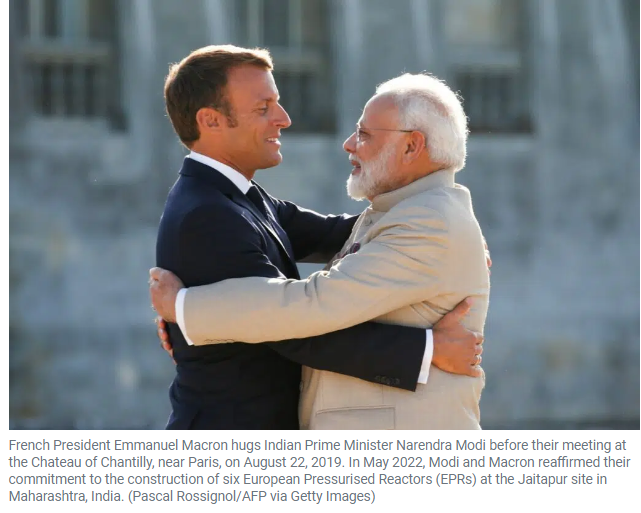
    According to a 2009 diplomatic cable made public by Wikileaks, a representative from NPCIL admitted India was paying a “high price” for the French reactors. Indeed, Indian diplomatic sources have reportedly expressed discontent about the high cost of the French EPRs compared to US and Russian reactors. Yet, when Indian and French political leaders meet, they almost always reiterated their joint commitment to the EPR deal as when, in May 2022, Indian Prime Minister Narendra Modi and French President Emmanuel Macron in France reaffirmed their commitment to “the success of the strategic Jaitapur EPR project.”

    A clear subtext of these statements is the high stakes in the Jaitapur project for the French nuclear industry, especially EDF in which the French government has 84 percent ownership. EDF faces several problems in addition to its EPR woes: It is in debt for approximately $45 billion, and faces outages at some older plants and also declining power output from some plants, a result of hot temperatures and lack of rain that result in insufficient river water to cool nuclear reactors. Some of EDF’s reactors are also offline for planned maintenance and repairs. This makes it all the more crucial for France to want to seal the deal with India.

    “If confirmed, it would be one of the biggest-ever export deals for the French energy giant,” Reuters reported in May.

    After submitting the techno-commercial offer to the NPCIL, EDF promised the project would produce local jobs in India, not forgetting to mention the benefits at home: “The project would also generate significant economic benefits for the French nuclear industry over the entire duration of the project (approximately 15 years), with tens of thousands of jobs in the hundred or so involved French companies.”

    As France stands to benefit greatly if the deal comes to fruition, it is no surprise an EDF vice-president traveled to India in the thick of a pandemic to submit an in-person binding techno-commercial offer. But if the purchase of six EPR reactors would be an obvious win for the French nuclear industry, it is less clear what benefits the people of India would obtain.

    Read the original article: https://thebulletin.org/2022/09/french-nuclear-power-reactors-in-india-are-they-worth-the-wait-and-cost/#post-heading
  • Review: India’s “Rocket Boys” series fetishizes science-and the atomic bomb-in a dangerous way

    Review: India’s “Rocket Boys” series fetishizes science-and the atomic bomb-in a dangerous way

    While Rocket Boys makes for engaging drama, does it tell this story with due diligence to scientific and historical facts? Unfortunately, the answer is resoundingly in the negative.

    The year is 1962. China had attacked India. In a friction-ridden meeting of India’s Atomic Energy Commission, the chairman, and scientist Homi J. Bhabha convinces the group to build India’s first atomic bomb. “We can stop any other country from ever thinking of attacking us again,” Bhabha tells the group forcefully. Not everyone agrees. Bhabha’s long-time friend and fellow Atomic Energy Commission member, Vikram Sarabhai, walks out of the meeting and resigns in protest. “How can you in good conscience do this?” he asks Bhabha.

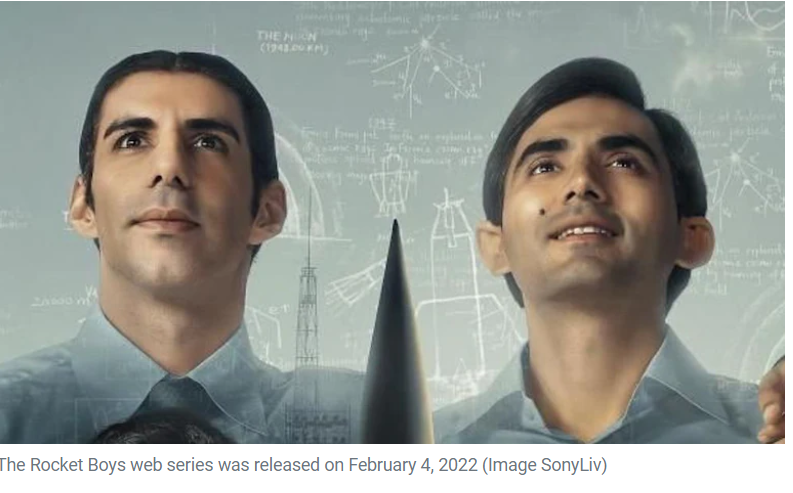
    These are the opening scenes to Rocket Boys, a web series released on February 4, that tells the story of three scientific leaders at the origin of India’s nuclear and space programs—Homi J. Bhabha, Vikram Sarabhai, and A.P.J. Abdul Kalam. Rocket Boys shows similarities with Parmanu, a movie that was released in 2018. Where Parmanu explores the run-up to India’s nuclear tests of 1999 and its aftermath, Rocket Boys depicts the circumstances in which India decided to adopt the path of nuclear energy. While Rocket Boys makes for engaging drama, does it tell this story with due diligence to scientific and historical facts? Unfortunately, the answer is resoundingly in the negative.

    The web series received early positive reviews in the media. But scholars well-versed in the history of these programs soon exposed glaring flaws in the science and the problematic ways in which key personalities are presented. The narrative conveniently plays into the dominant hyper-nationalist narratives prevailing in India and deepens fault lines in Indian society.

    Twisting reality. In a piece appropriately headlined “As a historian of the nuclear program, I can only laugh at the howlers in Rocket Boys,” political scientist Itty Abraham mentions a scene in which a fully-suited Bhabha jumps into a radioactive swimming pool reactor to repair malfunctioning fuel rods. He is supposed to get the reactor up and running in time for Prime Minister Jawaharlal Nehru’s visit. The scene is intended as suspenseful and nail-biting. But it is simply not credible; no nuclear physicist would do such a thing.

    Abraham—author of The Making of the Indian Atomic Bomb: Science, Secrecy and the Postcolonial State—also criticizes the sequences showing the runup to India’s first rocket launch, scenes that portray India’s scientists as careless and inept. “Bhabha and Sarabhai would be horrified to think that their pioneering vision and extraordinary achievements were being reduced, decades later, to the celebration of last-minute screwdrivers and ropes pulling up launch platforms,” he writes. Journalist Gita Aravamudan, who has been closely associated with the Indian space program and personally knew several individuals portrayed in Rocket Boys, writes about being “appalled at the liberties that have been blithely taken. … [T]he science has been subsumed completely by the need to make the two main rocket boys cool.” The irony, Aravamudan adds, is that the actual story of India’s space program is so dramatic and intriguing that the fictional embellishments adopted by Rocket Boys were unnecessary.

    Insidious script. Aravamudan wryly writes that watching Rocket Boys feels like a bad Bollywood movie in which iconic scientists have been turned into the worst of scientist stereotypes. To add further drama to the web series, Bhabha is pitted against an adversary, Mehdi Raza, a fictional character evidently inspired by the Indian astrophysicist Meghnad Saha. Yet the portrayal of Raza is immensely problematic, stealing from Saha’s formidable reputation and personality, only to twist it in egregious ways. Saha was one of India’s most towering scientists of the time, in the same league as Bhabha. He built India’s first cyclotron—which Raza in the series is shown as doing—and also established the Institute of Nuclear Physics in Kolkata.

    Of particular note, Rocket Boys distorts Saha’s background in an insidious way. Saha was Dalit—the most repressed and discriminated social group in India, earlier known as untouchable and treated as outcaste. Yet the makers of the web series borrow from Saha’s professional background using it to flesh out an adversary who is Muslim, deliberately cashing in on dominant anti-Islamist currents in India. In a further manipulation of truth, the series shows Raza as cozying up with the CIA to subvert India’s nuclear program—when Saha was a socialist who was inspired by Soviet planning and tried to replicate it in India.

    Rocket Boys does attempt to give a glimpse into the personal lives of Bhabha and Sarabhai, exploring their relationships with their families and the women in their lives. But since two men are the chief protagonists of the series, the women appear as largely romantic props instead of fully fleshed-out characters and fade out only to suddenly reappear in a few scenes.

    Good acting. There is a redeeming feature in Rocket Boys—the superlative acting by Jim Sarbh and Ishwak Singh, who play Bhabha and Sarabhai respectively. The arguments between Sarabhai and Bhabha as best friends and sparring partners are some of the most watchable moments of Rocket Boys. The two scientists come to life as they debate an independent India’s future, scientific progress, their ambitions, and their love lives. Homi Bhabha is portrayed as a debonair maverick and prodigy and Sarabhai as his foil—quiet, razor-sharp, and unafraid to challenge his mentor, Bhabha.

    Above all though, Rocket Boys eulogizes science’s role in elevating a poor and newly independent nation in the 1960s. “Science by the late colonial period was burdened with an unrealistic set of expectations. It came to be regarded as how India would reverse centuries of underdevelopment,” writes Sankaran Krishna in the 2009 edited volume, South Asian Cultures of the Bomb: Atomic Publics and the State in India and Pakistan. Indian elites offered to achieve nuclear power status as a response to the abysmal state of general economic development in the country, he adds.

    The release of Rocket Boys earlier this year comes at a time when India’s growth, prosperity, and progress are seriously questioned. Its nostalgic tone and fetishizing of science—and the atomic bomb—match the beats of the ultra-nationalist and jingoistic media and political narratives dominating India’s present-day public discourse. Unfortunately, that discourse and the Rocket Boys series both play loose with facts and bend reality in potentially dangerous directions.

    Read the original article: https://thebulletin.org/2022/06/review-indias-rocket-boys-series-fetishizes-science-and-the-atomic-bomb-in-a-dangerous-way/#post-heading

  • Israel has long exported arms to India. Now it’s selling spyware too

    Israel has long exported arms to India. Now it’s selling spyware too

    Published in Bulletin of the Atomic Scientists. 4 April 2022

    Intent in conversation, the two men stood ankle-deep in seawater, facing each other along the shores of Israel’s blue-green Mediterranean Sea. They might have passed off for sundry beachgoers—but for the fact that one of them was dressed in formal office wear, the kind one might wear for a business conference.

    The men were none other than Israeli President Benjamin Netanyahu and Indian Prime Minister Narendra Modi. It was 2017, and this was the first time an Indian Prime Minister had visited Israel. Over the last two decades, India and Israel have cultivated a close partnership, the well-known centerpiece of which is Israel’s arms exports. The sale of surveillance technology by Israel is the newest aspect of their ties.

    A 17-member international reporting consortium revealed in July 2021 that NSO Group, a private Israeli surveillance company, had sold Pegasus, a cyberweapon or spyware, to a number of governments. On accessing a smart phone, Pegasus can transform it into a “24-hour surveillance device” that can copy messages, view photos, record conversations, know the user’s location, and secretly video record the user. The spyware was used to target journalists, human rights activists, and politicians in numerous countries, including Mexico, Saudi Arabia, Panama, Ethiopia, the United Arab Emirates, and India.

    In July 2021, The Wire, a New Delhi-based media outlet, reported that “phone numbers of over 40 Indian journalists appear[ed] on a leaked list of potential targets for surveillance, and forensic tests have confirmed that some of them were successfully snooped upon by an unidentified agency using Pegasus spyware.”

    The Indian government denied allegations that it had used the software illicitly, saying “no unauthorized interception” had occurred and called the allegations an attempt to malign Indian democracy and its institutions.

    In January 2022, the New York Times reported that India and Israel had “agreed on the sale of a package of sophisticated weapons and intelligence gear worth roughly $2 billion—with Pegasus and a missile system as the centerpieces.”

    Israel’s hacking and surveillance industry is well-known. In 2021, firms in Israel’s cyber industry raised $8.8 billion in investments over 100 different deals, according to Israel’s National Cyber Directorate.

    According to the international journalism nonprofit Rest of World, private Israeli companies have sold surveillance technology to Saudi Arabia, the United Arab Emirates, Malaysia, Azerbaijan, Kazakhstan,  Botswana, Nigeria, Angola, Uganda, Ethiopia,  Honduras, Peru,  Ecuador, Mexico, Colombia, Trinidad and Tobago.

    Governments and the private sector are close collaborators in the market for digital surveillance tools, according to a  2019 United Nations report on surveillance and human rights. Governments use surveillance software developed, marketed, and supported by private companies.  The market itself is “shrouded in secrecy.”

    “Surveillance of specific individuals—often journalists, activists, opposition figures, critics, and others exercising their right to freedom of expression—has been shown to lead to arbitrary detention, sometimes to torture, and possibly to extrajudicial killings,” according to the 2019 UN report.

    As far as the India-Israel relationship is concerned, India only formally established diplomatic relations with Israel in 1992. The reasons for delayed recognition were varied and included the “need to pursue energy and economic security with the Gulf Arab states; Cold War realities and its dependence on the Soviet Union; a perceived pre-eminent role in the Non-Aligned Movement (NAM); and sensitivity of policymakers to its large Muslim constituency coupled with the traditional unwavering support to the Palestinian cause,” NAK Browne, a retired Air Chief Marshal, wrote in India and Israel: The Making of a Strategic Partnership.

    Since then, the two countries have forged close ties. Israel provided military supplies to India during the latter’s Kargil war with Pakistan in 1999.  But even before India and Israel established diplomatic ties, Israel aided India with ammunition during the latter’s wars with China in 1962 and Pakistan in 1965 and 1971. More recently, India used Israeli ammunition during an airstrike into Pakistan’s Balakot in 2019.

    The relationship became especially strong from 2014 onwards, when the right-wing Bharatiya Janata Party came to power in India. The two countries have since been described as natural allies and strategic partners. Currently, India and Israel cooperate in a range of fields such as agriculture, the diamonds trade, water conservation, education and tourism, but defense and security are the most significant areas.

    Defense purchases from Israel are believed to be over $1 billion annually. During the period 2015-2019, India’s arms imports from Israel increased by 175 percent , according to the Stockholm International Peace Research Institute. Between 2016-2020, India was the second-largest importer of arms in the world. Israel was India’s third largest source of arms, behind Russia and France. The countries also back each other at the United Nations and do not criticize each other’s actions.

    It was not arms deals but India’s acquisition and use of Pegagus spyware that has generated a political uproar in the country. While Prime Minister Modi has stayed silent on the latest allegations, the opposition Indian National Congress claims that illegal snooping using spyware amounts to treason. India’s Supreme Court ordered an inquiry into the matter, which is still underway.

    Pegasus spyware was used to target a dizzying array of individuals, including journalists, serving and retired government bureaucrats, ministers, academicians, lawyers, students, businessmen, and others. Journalists associated with The Wire, The Indian Express, The Hindu, Hindustan Times, India Today, and other publications and freelance journalists were targeted. Prominent politicians like Rahul Gandhi of the opposition Indian National Congress party, his aides, election strategist Prashant Kishor, the former Election Commissioner Ashok Lavasa, at least two ministers in Narendra Modi’s cabinet, and a woman who accused ex-Chief Justice of India Ranjan Gogoi of sexual harassment all were targets of surveillance.

    Gandhi said his phones are “clearly tapped.” He argued that the use of Pegasus, classified by Israel as a weapon, on Indian citizens constitutes an attack on the country and its institutions. “This is treason,” he said.

    Vijeta Singh, a journalist with The Hindu who was also targeted, said, “I wasn’t aware that my phone is being watched. I had my phone forensically analyzed by The Wire team. They have found traces of hacks being attempted on my phone”.

    The Indian government disputed the allegations, with Home Minister Amit Shah dismissing the claims about Pegasus as an act by “disrupters and obstructers” who wanted to derail India’s progress.

    At least 14 opposition political parties demanded a discussion in the Indian Parliament in August 2021. A joint statement by the parties labeled the government “arrogant and obdurate” in its refusal to discuss the matter. The opposition intensified calls for a Parliamentary discussion in January following a New York Times article that confirmed India’s purchase of Pegasus from Israel.

    The government insisted that there was no need for a Parliamentary debate on the grounds that the matter was with the Supreme Court and therefore not a proper matter for public debate.

    Prime Minister Modi’s silence through the political storm around Pegasus and what is being called India’s “Watergate moment” is conspicuous.  The Indian government continues to avoid confirming or denying the purchase and use of Pegasus in India. It refused to file a detailed affidavit despite demands from the Supreme Court, blocked questions on the matter, and avoided a discussion in Parliament.

    Pegasus was controversial in India even before 2021. In 2019, the messaging service WhatsApp informed the Indian government that the cellphones of 121 people were spied on by Pegasus. After questions were raised in the Indian Parliament, “the government resorted to obfuscation in its reply, neither confirming nor denying it had bought Pegasus from its Israeli manufacturer,” Sushant Singh, a journalist whose phone was targeted by Pegasus, wrote in Foreign Policy.

    Read the original article: https://thebulletin.org/2022/04/israel-long-exported-arms-to-india-now-its-selling-spyware-too/

  • Is a shadow presidency fueling the gas-prices fire in oil-rich Kazakhstan?

    Is a shadow presidency fueling the gas-prices fire in oil-rich Kazakhstan?

    A citizens’ uprising takes Kazakhstan by storm. Socio-economic inequalities and neglect of workers’ rights might be at play.

    Published in Bulletin of the Atomic Scientists. 1 February 2022

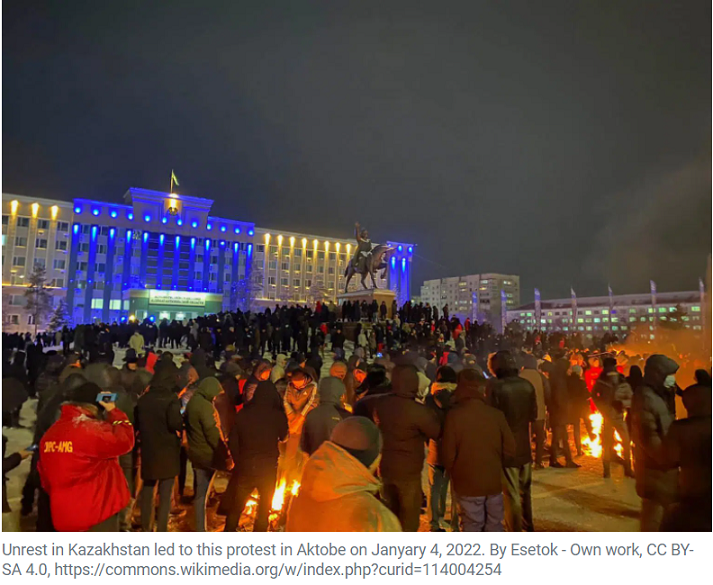
    Not long after the Kazakhstani government hiked liquefied petroleum gas prices in early January, an angry mob flooded the streets of Almaty—Kazakhstan’s largest city—on a bitter, cold night. Police armed with batons and shields fought back. Mangled, blackened vehicles, some upturned and set ablaze, littered the streets. Thick plumes of smoke vented through smashed windows of shops and government offices. The unrest soon spread to other nights and cities. In these violent protests, which have been the country’s largest since its independence from the former Soviet Union in 1991, over 200 people have died.

    What began as Kazakhstani citizen anger over gas prices quickly morphed into broad anger over government corruption and political authoritarianism. Kazakhstan may be an oil-rich Central Asian country, but it also harbors a discontented working class. President Kassym-Jomart Tokayev has promised to bring change, but that goal remains elusive given what many perceive to be a shadow presidency by former president Nursultan Nazarbyev.

    Even after the government restored the gas price caps, citizens continued to protest. Tokayev deployed troops from the Collective Security Treaty Organization—a Russian-led military alliance of former Soviet Union republics. But this president, who has been in power since 2019 and is often described as a staunch Nazarbayev loyalist, appears to be part of the problem. Many suspect that his 2019 election was rigged to ensure victory.

    “Tokayev’s appointment lacked legitimacy,” Luca Anceschi, a professor of Eurasian Studies at the University of Glasgow, said. “He did not introduce social or political changes and failed to deliver on an economic program, which made people unhappy.”

    Nazarbayev ruled Kazakhstan for 30 years—until 2019. He oversaw a period of remarkable economic growth, fueled by the country’s vast hydrocarbon resources and high oil prices. During his reign, Kazakhstan became the richest country in Central Asia. But while Nazarbayev and other elite members of Kazhak society grew enormously wealthy, large swathes of society faced significant economic challenges.

    Interestingly, the 2020 UN Human Development Index places Kazakhstan in the “very high human development” category ranking it 51st of 189 countries and territories. The HDI considers the criteria of a long and healthy life, access to knowledge, and a decent standard of living. However, the Inequality-adjusted Human Development Index, which reduces Kazakhstan’s Human Development Index score by approximately 7 percent, paints a less optimistic picture.

    This is evident in Kazakhstan’s landscape. Cities like Nur-Sultan (the capital, formerly known as Astana) and Almaty have rapidly developed while rural regions still lack access to sufficient healthcare, clean water, sanitation, and roads. In a country where 162 people own about half of the nation’s wealth, the percentage of poor people doubled from 5.8 percent in 2013 to 12.2 percent in 2016. The COVID-19 pandemic has worsened the poverty problem,  with the number of poor expected to increase significantly in rural areas. Then, when inflation hit a five-year high in November 2021, many low-income households struggled to afford basic necessities such as food and fuel. Oil industry workers, in particular, have felt excluded from Kazakhstan’s oil wealth.

    “These are the people who make Kazakhstan rich but are paid very little in comparison to the profits made by the oil companies,” Ivar Dale, senior policy advisor at the Norwegian Helsinki Committee, said.

    Social and labor conflicts rose sharply in Kazakhstan in 2021, according to one survey. Many of these conflicts occurred in the oil-rich Mangistau region, including the latest protests in Zhanaozen. This city and Shetpe were also the sites of oil worker sit-ins in 2011 during which police opened fire and at least 14 people died. The 2011 tragedy unfolded on December 16—Kazakhstan’s Independence Day. On the annual anniversary ever since, many government supporters may be found celebrating while activists hold memorials and protests.

    “The [Zhanaozen] area continues to simmer with resentment over the 2011 episode where the police were found not guilty,” Dale said.

    Despite Kazakhstan’s energy wealth, the country is not insulated from energy insecurity. In Kazakhstan, people use liquified petroleum gas, a low-carbon fuel, for their cars. It is cheaper than gasoline in the country. But subsidies that make liquified petroleum gas cheap cause shortages. “Prices for domestic consumers were regulated by the state and set at a rate below the cost of producing the fuel,” Almaz Kumenov and Joanna Lillis, Almaty-based journalists, wrote. Producers who were selling the fuel at a loss had little incentive to produce liquid petroleum gas, leading to shortages.

    In 2021, the electricity grid experienced power outages, caused in part by the high electricity use in bitcoin mining operations that forced three major coal-fired power plants to shut down. Kazakhstan and neighbours Uzbekistan and Kyrgyzstan saw power cuts more recently too, owing to energy imbalances.

    The recent unrest in which protesters pulled down the ex-leader Nazarbayev’s statue is unprecedented. Kazakhstani citizens had protested in 2019 over the election that installed Tokayev and in 2016 over reforms that would have enabled foreigners to own agricultural land. In both instances, police arrested and detained hundreds of protesters. However, none approached the violence and destruction of the 2022 protests in which 10,000 people were detained and over 200 died.

    “Even though the police may have used force [against protesters in the 30 years since independence], policemen were never killed, state buildings weren’t set on fire, and cars weren’t burnt down,” Yevgeniy Zhovtis, director of Kazakhstan International Bureau for Human Rights and Rule of Law, said.

    The Tokayev government claims that terrorists with foreign backing and bandits were responsible for the violence. But Zhovtis blames Nazabayev’s ongoing control, despite having stepped down. Nazarbayev has been the lifetime chairman of Kazakhstan’s powerful Security Council until Tokayev removed him following the recent protests. He retains veto power over important political and security appointments and the honorific title “leader of the nation.”

    “That led to an unstable situation where you have two presidents—one who has the formal title of ‘leader of the nation’ and the other who actually manages the country,” Zhovtis said. “This created nervousness among some elites, which might have contributed to the violence.”

    After the protests,Tokayev accused Nazarbayev of limiting market competition and of worsening inequalities. But many doubt both the authenticity of Tokayev’s opposition to the ex-leader and Nazarbayev’s willingness to relinquish power he continues to wield. Stuck between the current and former president are Kazakhstan’s citizens, whose desires for wide-ranging political and economic change are playing out on the streets.

    Read the original article: https://thebulletin.org/2022/02/is-a-shadow-presidency-fueling-the-gas-prices-fire-in-oil-rich-kazakhstan/

  • India has long suppressed antinuclear activism. Still, activists persist

    India has long suppressed antinuclear activism. Still, activists persist

    Published in Bulletin of the Atomic Scientists. 17 December 2021

    In Southeast India, in the dense interior of the Nallamala Hills, deciduous trees, shrubs, and brambles sprawl over the undulating land of the Amrabad Tiger sanctuary. Here, 14 tigers  prowl the jungle with boars, sloth bears, and panthers as company. Insects buzz, waterfalls gush, and wild animals grunt, but the heavy machines once scheduled to drill 4,000 boreholes into the earth in search of uranium are absent and silent—at least for now.

    In 2019, the Indian government approved prospecting for uranium mining in the tiger sanctuary as it considered the resource “a critical and immediately needed commodity to generate nuclear power.” Meanwhile, a site inspection report noted the environmental impact of the mining project would include “erosion, formation of sinkholes, loss of biodiversity, and contamination of soil, groundwater, and surface water by chemicals.” Also, the project would have displaced the Chenchu hunter gatherer community. Human rights activists, tribal communities, environmental groups, scientists, and film celebrities mounted strong resistance, prompting the government to withdraw the proposal in September 2021. Still, many worry that the success will be fleeting as the government still plans to build new nuclear reactors.

    “The opposition was so widespread that even political parties were forced to side with the protesters,” K. Babu Rao, a former senior scientist with the Indian Institute of Chemical Technology, said. Given the Indian government’s long history of antinuclear suppression, many citizens remain concerned about the uranium-mining plan—and other nuclear developments the government is pressing.

    Kudankulam: India’s longest antinuclear struggle. Two years after the 1986 Chernobyl nuclear disaster, India and the erstwhile Soviet Union entered into an agreement to build a nuclear power plant in Southern India, at Kudankulam in Tamil Nadu’s Tirunelveli district. Ever since, thousands of farmers, fish workers, environmental groups, students, and concerned citizens have periodically protested the reactors. In one mass rally in 1989, more than 10,000 people demonstrated against the project.

    Protesters opposed and still oppose the Kudankulam reactors for many reasons, including concerns about the release of radioactive contaminants into the environment, threats to marine life and human health, loss of fishing livelihoods, and fears that the reactors may serve as a conduit for building nuclear weapons. Also, the reactors are located in an earthquake zone. Finally, the devastating 2004 Indian ocean earthquake and tsunami affected parts of Tamil Nadu state, and the memory lives on in the area.

    Work on the first two Kudankulam reactors gained momentum between 2001 and 2002. Later, when the Fukushima nuclear reactor melted down in 2011, simmering Indian antinuclear opposition spiraled into full-blown opposition. Residents in the vicinity of the project and concerned citizens did not want a nuclear power plant. The Indian nuclear establishment, including the Department of Atomic Energy and the Nuclear Power Corporation of India Limited, responded with indifference, which added to discontent.

    When protests broke out, the police and paramilitary forces fired shots and tear gas. They also lathi charged into the protesters and beat them with sticks. At least two people were killed in 2012 and several others were injured. Kudankulam protesters have also faced false legal cases. A 2012 report commissioned by a coalition of anti-nuclear groups and individuals on suppression of democratic rights in Kudankulam found numerous instances of arbitrary implementation of tough laws:

    RELATED:Iran nuclear deal negotiators must act with urgency, given Iranian and Israeli nuclear brinkmanship

    By filing cases of sedition, waging war against the Government of India, and promoting disaffection between groups of persons, people are being unnecessarily harassed by the misuse of criminal law, and their constitutional rights are being violated… Persons who are protesting cannot be branded as anti-national and unpatriotic, and peaceful protests cannot be equated to sedition or waging war against the state.

    India’s sedition law dates back to 1870, when the British ruled. It was used against freedom fighters, including Mahatma Gandhi, in the struggle for Indian independence. Despite urgent calls to repeal the law, it is still used today to harass dissenting individuals. Nearly 9,000 people have been charged with sedition for protesting against the Kudankulam nuclear power plant. Some cases persist today, even though the Supreme Court ordered the dismissal of all criminal cases against the protesters.

    “The Kudankulam protests were unprecedented, both in terms of the scale of the movement and its repression. It brought to center-stage the question of inter-generational justice and the planet that future generations will inherit,” Sonali Huria, a 2020 research fellow with the Takagi Fund for Citizen Science, said. Farmers, fishermen, scientists, lawyers, NGO workers, professors, and religious preachers banded together in their opposition to the reactors. In 2011, the People’s Movement Against Nuclear Energy formed as part of the opposition to the Kudankulam reactors.

    “The threat of displacement, radiation, and the safety question brought these otherwise different groups together,” Patibandla Srikant, a researcher, wrote.

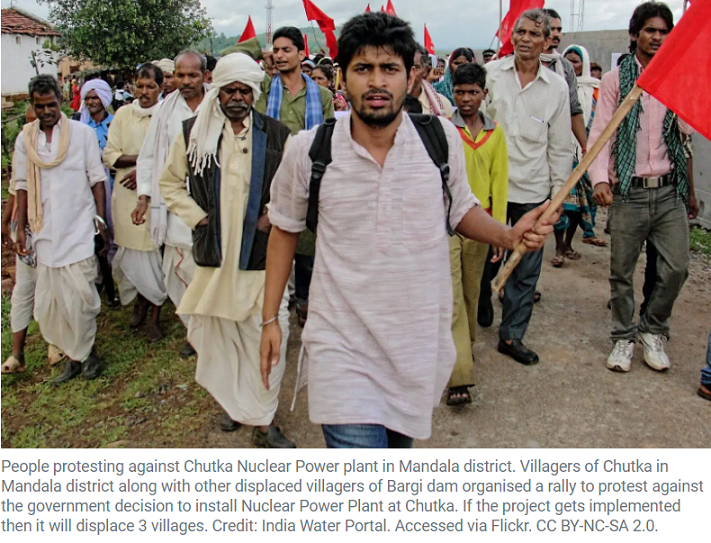
    Indian citizens mounted robust resistance against west coast reactors. Another antinuclear resistance movement emerged in 2006 near Jaitapur in the state of Maharashtra, on India’s West Coast south of Mumbai. Protesters organized against the proposed construction of six European pressurized reactors to be imported from France. The location was again in a seismically active, fertile, agricultural, and fishing region, which left some 40,000 people in five villages concerned for their livelihoods.

    Residents labeled the 2010 public hearing on the project a farce. The flawed environmental impact assessment report marked cropland and orchards as wasteland. Angry residents and their supporters demonstrated in large numbers. In at least one demonstration, the police opened fire, killing a local resident. Agitators, many of whom were poor farmers and fisherfolk, were arrested for arbitrary reasons. The police issued notices that barred activists from entering the district of the proposed reactors.

    Activists also challenged the Jaitapur plant on persistent safety and cost concerns about European pressurized reactors. Activists Vivek Monteiro and Mangesh Chavan filed public interest litigation in 2013, challenging the project on technical and environmental grounds. The petition has yet to be heard.

    Activists also filed petitions in the courts and with the National Green Tribunal—a governmental body responsible for dealing with and expediting environmental protection and forest conservation cases.

    RELATED:Wildfires break out in Chernobyl amid a non-functioning radiation-monitoring system

    For now, the protests at Jaitapur are dormant. The French company Areva, which had agreed to supply the nuclear reactors at Jaitapur, went bankrupt. The original five-year environmental clearance for the project has lapsed.

    Yet earlier this year, the French firm Electricite de France, which took over the bankrupt Areva, submitted an offer to India’s Nuclear Power Corporation for supplying engineering studies and equipment to construct six European pressurized reactors. The nuclear industry is hopeful that they will build—and earn billions of euros from—the reactors at Jaitapur.

    Monteiro is certain that if construction activities begin, protests will revive. But dissent has become dangerous in India. In recent years, the government has charged citizens with sedition and other laws.

    “The present Bharatiya Janata Party government is going after anyone who criticizes its policies,” SP Udayakumar, coordinator of the People’s Movement Against Nuclear Energy, said. Udayakumar, who was charged with sedition during the Kudankulam protests—a charge that persists—added, “but people continue to fight nuclear expansion in different parts of the country.”

    Udayakumar’s 2012 sedition charge took place when the Indian National Congress party was in power.  This party initiated many of the country’s nuclear energy programs, including the Kudankulam nuclear power plant. The Bharatiya Janata Party, which came to power in 2014 under Narendra Modi, has greatly expanded India’s nuclear energy ambitions—and the number of sedition cases has also significantly risen since then too.

    Government response to past antinuclear resistance may foretell the future. In 2017, the Indian government canceled a proposal from the American corporation Westinghouse to build AP1000 reactors in Mithivirdi village of the western state of Gujarat. But there was a catch. The project, which had been located in Prime Minister Narendra Modi’s home state of Gujarat, where there was public opposition, was shifted to Kovvada in the state of Andhra Pradesh. This state had become “a dumping ground for polluting industries and unsafe technologies,” according to former senior government bureaucrat EAS Sarma.

    The Modi government has since announced that it would build 21 new reactors by 2031—heedless of opposition, economics, and risks to health and safety.

    This is a “story of [a] sustained peoples’ movement,” journalist Damayantee Dhar wrote, adding that Indian antinuclear protesters have “braved psychological pressure, administrative intimidation, and various other tactics and continued to protest for their land.” The “tactics” have included offers of social responsibility projects and jobs sponsored by the Nuclear Power Corporation of India.

    “Even in Nalamalla hills where the government withdrew its proposal for uranium mining, residents cannot drop their vigilance,” Rao said. Since the 1980s, strong antinuclear movements have emerged whenever and wherever the Indian government proposes nuclear power plants and uranium mining.

    “The people … have increasingly questioned the need for nuclear power. They haven’t budged,” Krishnakant Chauhan, an antinuclear activist said. “[Indian] citizens will oppose nuclear power, whether in Mithivirdi or elsewhere.”

    Read the original article: https://thebulletin.org/2021/12/india-has-long-suppressed-antinuclear-activism-still-activists-persist/

  • What’s known—and not known—about India’s nuclear weapons budget

    What’s known—and not known—about India’s nuclear weapons budget

    Published in Bulletin of the Atomic Scientists. 17 November 2021.

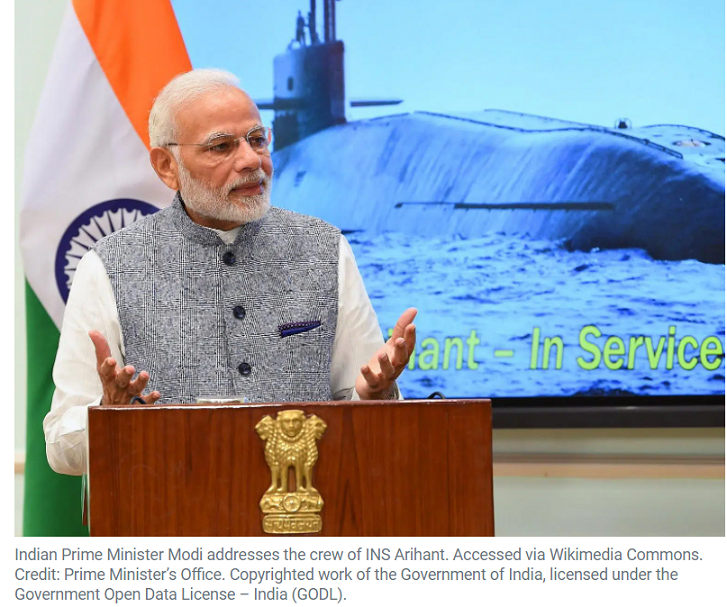
    In 2016, India inducted its first nuclear-powered ballistic missile submarine, the INS Arihant, into its navy, extending nuclear military capabilities from land and air to the sea. “Arihant” translates to “destroyer of the enemy,” a name chosen for its “subtlety and appropriateness.” A year after Arihant’s induction, the vehicle reportedly suffered damage, prompting a member of Parliament to ask about the cost of repairs. A defense minister responded, “The information cannot be divulged in the interest of National Security.”

    In India, acute poverty persists against a backdrop of urgent development priorities that jostle for financial resources. Meanwhile, India’s lack of transparency around nuclear weapon expenditures—including the government agencies responsible for approval, spending, and audits of those expenditures—carries on. Indian taxpayers deserve to know how much their government spends on nuclear weapons, particularly compared to spending on education and health. Also, transparency on nuclear weapons expenditures would signal to the world that India’s claimed commitment to disarmament is not empty talk.

    Indian government secrecy on nuclear defense systems costs is not new. In 2001, for example, the government declined to say how much it paid for multirole fighter aircraft, citing a confidentiality clause in the contract. More recently, the Indian government refused to divulge expenditures incurred in developing and testing an interceptor ballistic missile, leasing submarines from Russia, or developing a land-based ballistic missile known as Prithvi-II.

    “There is a now a culture of not asking questions on issues which the government categorises as national security,” said Venkatesh Nayak, an activist who has filed several right-to-information requests with the Indian government. India’s equivalent of the US Freedom of Information Act, the Right to Information Act has been a great source of information about many government and private programs in India—excepting those run by nuclear agencies.

    Government agencies that focus on nuclear weapons often omit the word “nuclear” from their websites and reports. Instead, they say that nuclear weapons are “strategic.” Terms like “strategic forces,” “strategic purposes,” and ”strategic weapons” obfuscate meaning. India’s Strategic Forces Command, responsible for procuring, holding, and maintaining the country’s nuclear weapons, was recently added to a list of intelligence and security organizations exempt from the Right to Information Act.

    Sparse information about Indian nuclear weapon expenditures. When the Indian government divulges information on nuclear costs, it does so sparingly. In 2010, for example, the government stated the cost of test firing Dhanush, a nuclear-capable ballistic missile, was 110 million Indian rupees ($1.46 million). In 2013, the Indian Parliament was informed that the cost of upgrading a Mirage-2000 fighter aircraft was 1.67 billion Indian rupees ($22.27 million) per aircraft. The cost of INS Arihant was $2.9 billion, at least according to one media report, but the figure’s source and cost breakdown were unclear.

    One comprehensive attempt at trying to understand costs of India’s nuclear weapons program was undertaken by economist C. Rammanohar Reddy in 2003.  Based on piecing together the scarce data and drawing heavily on a 1998 cost estimate of the US nuclear weapons program, Reddy estimated that India would spend approximately 0.5 percent or more of its gross domestic product on nuclear weapons over the decade that followed. This cost estimate included expenditures on fissile material for bombs, delivery systems, and command and control infrastructure. To estimate the full cost, Reddy noted that he would also need to factor in past costs related to nuclear research reactors that provide plutonium for nuclear weapons, weapons-grade plutonium production, previously built aircraft development, and land- and sea-based ballistic missiles. Since Reddy’s prediction, leading experts have noted the difficulty in providing more recent estimates.

    “…[E]ven government bureaucracies like the Comptroller and Auditor General (CAG) and the Ministry of Statistics and Programme Implementation, whose function is to monitor expenditures and criticize cost overruns, do not seem to have access to expenses relating to weapons facilities,” wrote MV Ramana, a physicist focused on international security and nuclear energy at the University of British Columbia. To the extent they have tried to oversee expenditures, the Comptroller and Auditor General of India has criticized some of the agencies involved in defense research for project cost overruns and shortcomings in budgeting and accounts.

    To complicate matters further, civilian and military nuclear facilities often overlap, which means nuclear weapon expenditures may be presented as part of the civilian energy program.

    Some information may be gleaned from scattered op-eds by members of the defense community or from quotes by unnamed sources. For example, a 2014 article attributed information on the cost breakdown of INS Arihant to an unnamed source. The International Campaign to Abolish Nuclear Weapons estimates that India spent $2.48 billion on nuclear weapons in 2020. Although better than nothing, one cannot have much confidence in these numbers. Reliable estimates of India’s spending on nuclear weapons do not exist.

    That said, these expenditures seem to be increasing, at least if one looks at the overall budgets of the umbrella agencies charged with overseeing nuclear activities. The Department of Atomic Energy, which is responsible for both nuclear energy and weapons, saw its budget increase from 121.15 billion rupees during the 2010-11 fiscal year to 182.21 billion rupees in 2019-20—both inflation-adjusted to 2020 ($1.62 billion to $2.43 billion in inflation-adjusted 2020 US dollars). In other words, the budget of the department went up by over 50 percent over the decade, even after adjusting for inflation. But the budget documents do not provide a breakdown of expenditure by program, which makes it impossible to determine how much is allocated to nuclear weapons.

    India’s Defense Research and Development Organization produces weapons systems and defense technologies domestically for the army, navy, and air force. This agency is in charge of developing missiles and other means of delivering nuclear weapons. From the 2013-14 fiscal year to 2019-20, its budget increased from 139.30 billion to 185.40 billion in inflation-adjusted 2020 Indian rupees ($1.86 billion to $2.47 billion in inflation-adjusted 2020 US dollars, a 33 percent increase).  Since the Defense Research and Development Organization is also exempted from questions under the Right to Information Act, the percentage spent on developing nuclear weapons is unknown.

    RELATED:China’s silence on nuclear arms buildup fuels speculation on motives

    What about Pakistan’s lack of transparency in its nuclear budget? Like India, Pakistan’s nuclear-weapon spending is hard to estimate, as funds for its program are placed under a secret budget head, according to Pakistani journalist Baqir Sajjad Syed.

    “The cost of Pakistan [sic] nuclear weapons programme cannot be estimated with any reliability,” Zia Mian, a physicist and nuclear policy expert at Princeton University, writes. In 2011, Mian noted that Pakistan could be spending between $800 million and $2 billion annually on nuclear weapons, including health and environmental costs.

    Of Pakistan’s $10 billion military budget for 2019-2020, Mian suggests that spending on nuclear weapons was approximately 10 percent. Pakistan’s military spending also includes the substantial assistance it receives from the United States and China.

    Still, the Indian government should not justify secrecy around its nuclear weapon program costs by comparing itself to Pakistan—a country it accuses of sponsoring terror attacks and of being a failed state. India has long aspired for recognition as a global leader. Financial transparency on nuclear weapon spending offers India an opportunity to demonstrate leadership on the global stage.

    The case for India to disclose nuclear weapon expenditures. “Powerful lobbies, including the military-industrial complex, weigh heavily on parliaments and governments and impose priorities that have no democratic legitimacy,” a statement from the UN Office of the High Commissioner for Human Rights said. The statement urges states to proactively inform their citizens about past, present, and future military expenditures.

    The national health budget in India has been less than a quarter of the defense budget in the last two years—even as the country was dealing with a COVID-19 pandemic and a devastating public health crisis. India’s defense budget places the country among the world’s top five military spenders, according to the Stockholm Institute of Peace and Research.

    Meanwhile, Indian government spending on healthcare is among the lowest worldwide—a fact reflected in poor health infrastructure and exorbitant private healthcare. India is also among the nations with the most malnourished and stunted children and has an escalating rate of non-communicable diseases.

    According to the economist Jayati Ghosh, Indira Gandhi, the former Indian prime minister under whom India conducted its first nuclear tests once noted that the cost of an intercontinental ballistic missile was 340,000 primary schools or 65,000 health care centers.

    India should take steps towards disclosing nuclear weapon expenditures. Transparency would allow for important analysis about the balance of nuclear spending with education and health, bolster its claims as a responsible nuclear power committed to disarmament, and set a “subtle and appropriate” example for other nations to follow.

    Read the original article: https://thebulletin.org/2021/11/whats-known-and-not-known-about-indias-nuclear-weapons-budget/

Urvashi Sarkar – 2026 – All rights reserved.

web things by Studio Goncharov