Why is the Indian government insistent on purchasing French EPRs which have a record of being over budget and massively delayed?
Published by Bulletin of the Atomic Scientists. 2 September 2022
The world was still deep in the clutches of the global COVID-19 pandemic in April 2021 when Vakisasai Ramany, a senior vice-president of Electricité de France (EDF), a major French electric utility company, traveled to India. The purpose of this unusually timed business trip? The delivery of a technical and commercial offer for nuclear reactors—in person.
During his visit, Ramany met with officials of the Indian Department of Atomic Energy (DAE) and the Nuclear Power Corporation of India Limited (NPCIL), the state-owned company that operates most of India’s nuclear power plants. The French executive submitted a long-delayed techno-commercial offer to supply engineering studies and equipment for the construction of six European Pressurised Reactors (EPRs) at the Jaitapur site in Maharashtra, India. The project, touted as “the most powerful in the world,” consists of a nuclear power plant with a total installed capacity of 9.6 gigawatts electric. That’s the offer on paper, anyway. But, EPRs so far have had a significantly troubling record of cost and time overruns. The proposed Jaitapur mega-project has faced strong protests from local residents and environmental activists. With the cost of these reactors likely to be in the tens of billions of dollars, stakes are high for the French nuclear company to conclude its deal in India.
The history of the French connection. In 2008, India and France signed a bilateral agreement for civilian nuclear cooperation on developing nuclear energy. The agreement was one result of an agreement with the United States that allowed India to conduct nuclear trade with other countries—which it could not do since the country conducted nuclear weapons tests in 1974 and 1998 and was placed under US sanctions.
India’s first nuclear test in 1974 provided the impetus for the creation of what was to become the Nuclear Suppliers Group, a trade consortium set up by countries involved in exporting nuclear energy technologies. The group set up the requirement that nuclear technology and materials should be exported only to countries that had signed the Nuclear Non-Proliferation Treaty (NPT), which entered into force in 1970. By 1974, however, India was not a signatory of the NPT—and still is not. As such, it was not allowed to purchase reactors or uranium. Following an agreement in 2008 between India’s Prime Minister Manmohan Singh and US President George W. Bush, the US government used its political power to force many reluctant members of the Nuclear Suppliers Group to execute a special waiver for India. Many countries, especially France and Russia, supported the waiver, sensing the business opportunities from India’s rapidly expanding energy market.
Following the India-France bilateral agreement, India’s NPCIL and the French nuclear-maker Areva signed an agreement in 2009 for the supply of two to six EPRs. But soon after Areva became in major financial trouble and was taken over by EDF in 2016.
EPRs are a type of pressurized water reactor built through French and German collaboration. The reactors are touted to have better safety features than earlier designs, including a double barrier to ensure the containment of radioactive materials in case of accidents. They are also supposed to resist extreme hazards like earthquakes, flooding, and extreme temperatures.
With its submission of a new techno-commercial offer to India, EDF’s Ramany says the company is moving toward “the concretization of the largest nuclear power plant in the world [with the] fully proven EPR technology.”
Despite EDF’s hope that the reactors would shortly become operational, negotiations with NPCIL have stalled over the last decade for several reasons, including cost, increasing doubts over their performance, disagreement over liability in the case of a reactor accident, and local protests.
And that’s not to mention the problems EPR projects—both under construction and in operation—have encountered in different parts of the world.
Delayed and over budget. The earliest EPR project (Olkiluoto-3) began in Finland in 2003 and was connected to the grid in March 2022—a full 13 years behind schedule. It has yet to begin operations. Two EPRs are under construction in the United Kingdom (Hinkley Point C-1 and C-2), and one in France (Flamanville-3) is also under construction. The proposed two-unit EPR plant at Hinkley Point, originally scheduled to start operations in 2025, has already been delayed to June 2027 and will cost £3 billion ($3.6 billion) more than initially proposed, taking the budget to an estimated cost of £25 billion ($29.6 billion). For its part, the Flamanville-3 reactor is over a decade behind schedule, and its budget has ballooned from €3.3 billion to €12.7 billion.
The world’s first two EPRs—Taishan-1 and Taishan-2—became operational in China in 2018 and 2019, respectively. However, unit 1 had to be shut down in July 2021 because of damaged fuel rods, in what an EDF spokesperson told CNN at the time was a “serious situation.”
A good fit for India? Physicists Suvrat Raju and MV Ramana have questioned the safety and economics of the EPR reactors proposed for the Jaitapur site. In 2013, they calculated that electricity from the proposed reactors at Jaitapur would cost 15 Indian rupees (18 US cents) per kilowatt-hour, based on the construction costs of EPRs in Finland and France. Since then the costs of EPR construction have escalated while the cost of alternatives, especially solar energy, has declined sharply.
In an interview for this article, Ramana said: “The costs of the EPRs being built in Western Europe have gone up, while costs of renewable sources of energy, especially solar photovoltaics, have declined. In 2020, one solar project developer offered to sell electricity at the especially low rate of Rs. 2 [Indian rupees] per kWh, and it is routine to find projects proposed for around Rs. 2.50 per kWh.”
Importantly, however, the total amount that the Indian government will spend on this project has still not been made public. In 2019, EDF said the cost is “confidential and may not be disclosed.” It also refused to release the cost per unit of electricity.
EPRs’ problems are not restricted to massive cost overruns and significant delays. “In addition to the high costs, safety problems with the reactor design and construction have emerged in several EPRs,” Raju and Ramana wrote in 2019. Serious problems occurred during the manufacture of the reactor pressure vessel of the EPR at Flamanville in France, with parts of the vessel found to have too much carbon. (A too-high carbon concentration in the steel of the reactor vessel can lead to lower than expected mechanical properties, which can thereby compromise its safety. The reactor vessel acts as a key barrier against radioactive materials escaping from the core.)
Moreover, the proposed site for the six EPRs in Jaitapur—a seismically active and fertile agricultural and fishing region—has left some 40,000 people in five villages concerned for their safety and impact on their livelihoods. Even though the villagers evicted from their land received monetary compensation, they regret losing access to their agricultural and fishing resources.
Why is India so interested in buying French reactors? Despite the questions about the performance of EPRs, successive Indian governments have expressed their commitment to the deal. But why is India pressing ahead? Raju and Ramana point to the unusually candid explanation offered by Anil Kakodkar, a former secretary at the India Department of Atomic Energy, who said: “We also have to keep in mind the commercial interests of foreign countries … America, Russia, and France were the countries we made mediators in these efforts to lift sanctions, and hence, for the nurturing of their business interests, we made deals with them for nuclear projects.”
Kakodkar was referring to the India-US nuclear deal of 2008. Three countries were supposed to particularly benefit from that deal: the United States, France, and Russia. The three countries signed agreements with India for the supply of foreign reactors. To date, Russia is the only foreign country to have operational reactors in India, which started even before the 2008 nuclear deal between India and the United States. US reactors, however, were not sold to India because of Westinghouse’s financial troubles. For its part, France was specifically allotted the Jaitapur site for building EPRs.
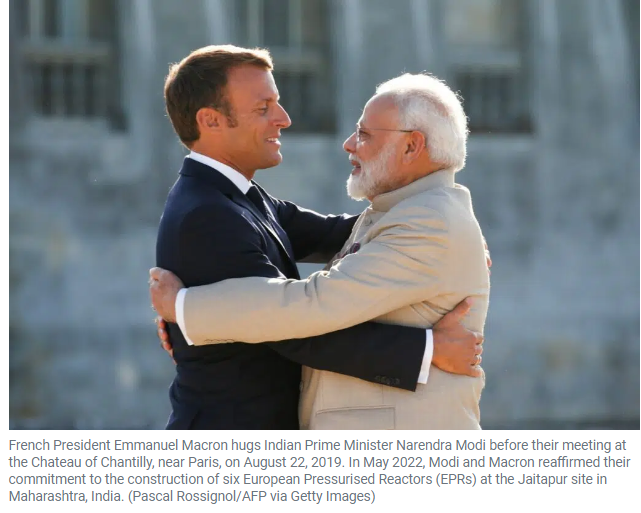
According to a 2009 diplomatic cable made public by Wikileaks, a representative from NPCIL admitted India was paying a “high price” for the French reactors. Indeed, Indian diplomatic sources have reportedly expressed discontent about the high cost of the French EPRs compared to US and Russian reactors. Yet, when Indian and French political leaders meet, they almost always reiterated their joint commitment to the EPR deal as when, in May 2022, Indian Prime Minister Narendra Modi and French President Emmanuel Macron in France reaffirmed their commitment to “the success of the strategic Jaitapur EPR project.”
A clear subtext of these statements is the high stakes in the Jaitapur project for the French nuclear industry, especially EDF in which the French government has 84 percent ownership. EDF faces several problems in addition to its EPR woes: It is in debt for approximately $45 billion, and faces outages at some older plants and also declining power output from some plants, a result of hot temperatures and lack of rain that result in insufficient river water to cool nuclear reactors. Some of EDF’s reactors are also offline for planned maintenance and repairs. This makes it all the more crucial for France to want to seal the deal with India.
“If confirmed, it would be one of the biggest-ever export deals for the French energy giant,” Reuters reported in May.
After submitting the techno-commercial offer to the NPCIL, EDF promised the project would produce local jobs in India, not forgetting to mention the benefits at home: “The project would also generate significant economic benefits for the French nuclear industry over the entire duration of the project (approximately 15 years), with tens of thousands of jobs in the hundred or so involved French companies.”
As France stands to benefit greatly if the deal comes to fruition, it is no surprise an EDF vice-president traveled to India in the thick of a pandemic to submit an in-person binding techno-commercial offer. But if the purchase of six EPR reactors would be an obvious win for the French nuclear industry, it is less clear what benefits the people of India would obtain.
Published in Bulletin of the Atomic Scientists. 17 December 2021
In Southeast India, in the dense interior of the Nallamala Hills, deciduous trees, shrubs, and brambles sprawl over the undulating land of the Amrabad Tiger sanctuary. Here, 14 tigers prowl the jungle with boars, sloth bears, and panthers as company. Insects buzz, waterfalls gush, and wild animals grunt, but the heavy machines once scheduled to drill 4,000 boreholes into the earth in search of uranium are absent and silent—at least for now.
In 2019, the Indian government approved prospecting for uranium mining in the tiger sanctuary as it considered the resource “a critical and immediately needed commodity to generate nuclear power.” Meanwhile, a site inspection report noted the environmental impact of the mining project would include “erosion, formation of sinkholes, loss of biodiversity, and contamination of soil, groundwater, and surface water by chemicals.” Also, the project would have displaced the Chenchu hunter gatherer community. Human rights activists, tribal communities, environmental groups, scientists, and film celebrities mounted strong resistance, prompting the government to withdraw the proposal in September 2021. Still, many worry that the success will be fleeting as the government still plans to build new nuclear reactors.
“The opposition was so widespread that even political parties were forced to side with the protesters,” K. Babu Rao, a former senior scientist with the Indian Institute of Chemical Technology, said. Given the Indian government’s long history of antinuclear suppression, many citizens remain concerned about the uranium-mining plan—and other nuclear developments the government is pressing.
Kudankulam: India’s longest antinuclear struggle. Two years after the 1986 Chernobyl nuclear disaster, India and the erstwhile Soviet Union entered into an agreement to build a nuclear power plant in Southern India, at Kudankulam in Tamil Nadu’s Tirunelveli district. Ever since, thousands of farmers, fish workers, environmental groups, students, and concerned citizens have periodically protested the reactors. In one mass rally in 1989, more than 10,000 people demonstrated against the project.
Protesters opposed and still oppose the Kudankulam reactors for many reasons, including concerns about the release of radioactive contaminants into the environment, threats to marine life and human health, loss of fishing livelihoods, and fears that the reactors may serve as a conduit for building nuclear weapons. Also, the reactors are located in an earthquake zone. Finally, the devastating 2004 Indian ocean earthquake and tsunami affected parts of Tamil Nadu state, and the memory lives on in the area.
Work on the first two Kudankulam reactors gained momentum between 2001 and 2002. Later, when the Fukushima nuclear reactor melted down in 2011, simmering Indian antinuclear opposition spiraled into full-blown opposition. Residents in the vicinity of the project and concerned citizens did not want a nuclear power plant. The Indian nuclear establishment, including the Department of Atomic Energy and the Nuclear Power Corporation of India Limited, responded with indifference, which added to discontent.
When protests broke out, the police and paramilitary forces fired shots and tear gas. They also lathi charged into the protesters and beat them with sticks. At least two people were killed in 2012 and several others were injured. Kudankulam protesters have also faced false legal cases. A 2012 report commissioned by a coalition of anti-nuclear groups and individuals on suppression of democratic rights in Kudankulam found numerous instances of arbitrary implementation of tough laws:
By filing cases of sedition, waging war against the Government of India, and promoting disaffection between groups of persons, people are being unnecessarily harassed by the misuse of criminal law, and their constitutional rights are being violated… Persons who are protesting cannot be branded as anti-national and unpatriotic, and peaceful protests cannot be equated to sedition or waging war against the state.
India’s sedition law dates back to 1870, when the British ruled. It was used against freedom fighters, including Mahatma Gandhi, in the struggle for Indian independence. Despite urgent calls to repeal the law, it is still used today to harass dissenting individuals. Nearly 9,000 people have been charged with sedition for protesting against the Kudankulam nuclear power plant. Some cases persist today, even though the Supreme Court ordered the dismissal of all criminal cases against the protesters.
“The Kudankulam protests were unprecedented, both in terms of the scale of the movement and its repression. It brought to center-stage the question of inter-generational justice and the planet that future generations will inherit,” Sonali Huria, a 2020 research fellow with the Takagi Fund for Citizen Science, said. Farmers, fishermen, scientists, lawyers, NGO workers, professors, and religious preachers banded together in their opposition to the reactors. In 2011, the People’s Movement Against Nuclear Energy formed as part of the opposition to the Kudankulam reactors.
“The threat of displacement, radiation, and the safety question brought these otherwise different groups together,” Patibandla Srikant, a researcher, wrote.
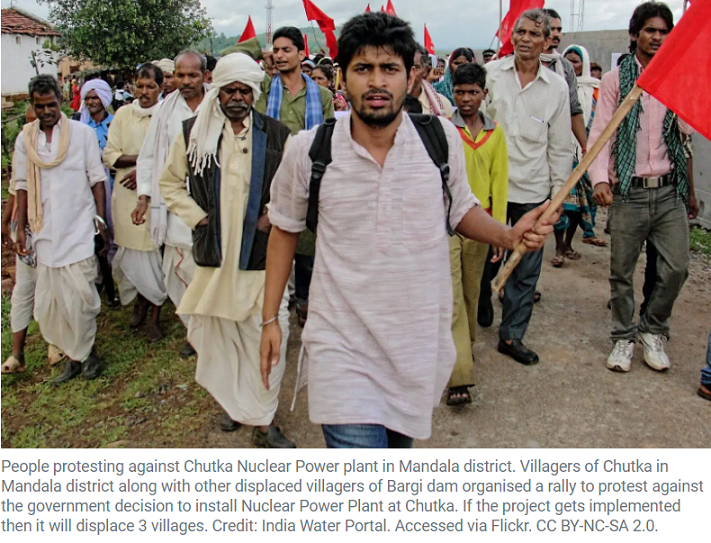
Indian citizens mounted robust resistance against west coast reactors. Another antinuclear resistance movement emerged in 2006 near Jaitapur in the state of Maharashtra, on India’s West Coast south of Mumbai. Protesters organized against the proposed construction of six European pressurized reactors to be imported from France. The location was again in a seismically active, fertile, agricultural, and fishing region, which left some 40,000 people in five villages concerned for their livelihoods.
Residents labeled the 2010 public hearing on the project a farce. The flawed environmental impact assessment report marked cropland and orchards as wasteland. Angry residents and their supporters demonstrated in large numbers. In at least one demonstration, the police opened fire, killing a local resident. Agitators, many of whom were poor farmers and fisherfolk, were arrested for arbitrary reasons. The police issued notices that barred activists from entering the district of the proposed reactors.
Activists also challenged the Jaitapur plant on persistent safety and cost concerns about European pressurized reactors. Activists Vivek Monteiro and Mangesh Chavan filed public interest litigation in 2013, challenging the project on technical and environmental grounds. The petition has yet to be heard.
Activists also filed petitions in the courts and with the National Green Tribunal—a governmental body responsible for dealing with and expediting environmental protection and forest conservation cases.
For now, the protests at Jaitapur are dormant. The French company Areva, which had agreed to supply the nuclear reactors at Jaitapur, went bankrupt. The original five-year environmental clearance for the project has lapsed.
Yet earlier this year, the French firm Electricite de France, which took over the bankrupt Areva, submitted an offer to India’s Nuclear Power Corporation for supplying engineering studies and equipment to construct six European pressurized reactors. The nuclear industry is hopeful that they will build—and earn billions of euros from—the reactors at Jaitapur.
Monteiro is certain that if construction activities begin, protests will revive. But dissent has become dangerous in India. In recent years, the government has charged citizens with sedition and other laws.
“The present Bharatiya Janata Party government is going after anyone who criticizes its policies,” SP Udayakumar, coordinator of the People’s Movement Against Nuclear Energy, said. Udayakumar, who was charged with sedition during the Kudankulam protests—a charge that persists—added, “but people continue to fight nuclear expansion in different parts of the country.”
Udayakumar’s 2012 sedition charge took place when the Indian National Congress party was in power. This party initiated many of the country’s nuclear energy programs, including the Kudankulam nuclear power plant. The Bharatiya Janata Party, which came to power in 2014 under Narendra Modi, has greatly expanded India’s nuclear energy ambitions—and the number of sedition cases has also significantly risen since then too.
Government response to past antinuclear resistance may foretell the future. In 2017, the Indian government canceled a proposal from the American corporation Westinghouse to build AP1000 reactors in Mithivirdi village of the western state of Gujarat. But there was a catch. The project, which had been located in Prime Minister Narendra Modi’s home state of Gujarat, where there was public opposition, was shifted to Kovvada in the state of Andhra Pradesh. This state had become “a dumping ground for polluting industries and unsafe technologies,” according to former senior government bureaucrat EAS Sarma.
The Modi government has since announced that it would build 21 new reactors by 2031—heedless of opposition, economics, and risks to health and safety.
This is a “story of [a] sustained peoples’ movement,” journalist Damayantee Dhar wrote, adding that Indian antinuclear protesters have “braved psychological pressure, administrative intimidation, and various other tactics and continued to protest for their land.” The “tactics” have included offers of social responsibility projects and jobs sponsored by the Nuclear Power Corporation of India.
“Even in Nalamalla hills where the government withdrew its proposal for uranium mining, residents cannot drop their vigilance,” Rao said. Since the 1980s, strong antinuclear movements have emerged whenever and wherever the Indian government proposes nuclear power plants and uranium mining.
“The people … have increasingly questioned the need for nuclear power. They haven’t budged,” Krishnakant Chauhan, an antinuclear activist said. “[Indian] citizens will oppose nuclear power, whether in Mithivirdi or elsewhere.”
Published in Bulletin of the Atomic Scientists. 17 November 2021.
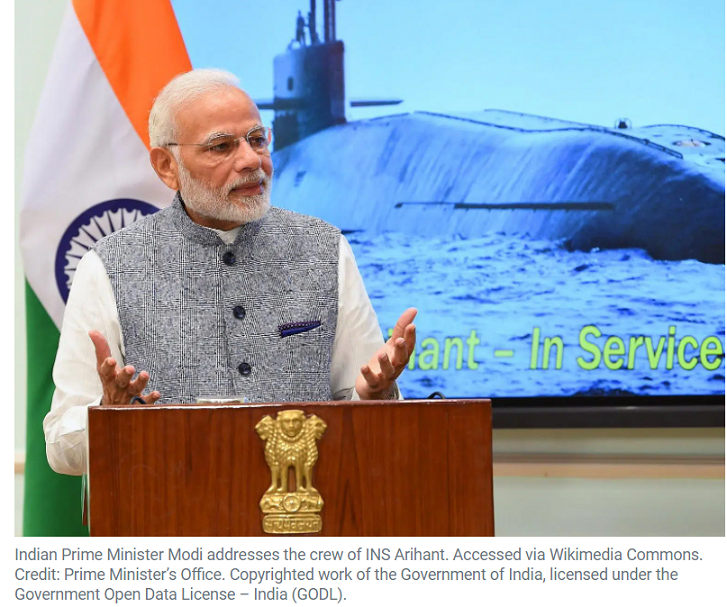
In 2016, India inducted its first nuclear-powered ballistic missile submarine, the INS Arihant, into its navy, extending nuclear military capabilities from land and air to the sea. “Arihant” translates to “destroyer of the enemy,” a name chosen for its “subtlety and appropriateness.” A year after Arihant’s induction, the vehicle reportedly suffered damage, prompting a member of Parliament to ask about the cost of repairs. A defense minister responded, “The information cannot be divulged in the interest of National Security.”
In India, acute poverty persists against a backdrop of urgent development priorities that jostle for financial resources. Meanwhile, India’s lack of transparency around nuclear weapon expenditures—including the government agencies responsible for approval, spending, and audits of those expenditures—carries on. Indian taxpayers deserve to know how much their government spends on nuclear weapons, particularly compared to spending on education and health. Also, transparency on nuclear weapons expenditures would signal to the world that India’s claimed commitment to disarmament is not empty talk.
Indian government secrecy on nuclear defense systems costs is not new. In 2001, for example, the government declined to say how much it paid for multirole fighter aircraft, citing a confidentiality clause in the contract. More recently, the Indian government refused to divulge expenditures incurred in developing and testing an interceptor ballistic missile, leasing submarines from Russia, or developing a land-based ballistic missile known as Prithvi-II.
“There is a now a culture of not asking questions on issues which the government categorises as national security,” said Venkatesh Nayak, an activist who has filed several right-to-information requests with the Indian government. India’s equivalent of the US Freedom of Information Act, the Right to Information Act has been a great source of information about many government and private programs in India—excepting those run by nuclear agencies.
Government agencies that focus on nuclear weapons often omit the word “nuclear” from their websites and reports. Instead, they say that nuclear weapons are “strategic.” Terms like “strategic forces,” “strategic purposes,” and ”strategic weapons” obfuscate meaning. India’s Strategic Forces Command, responsible for procuring, holding, and maintaining the country’s nuclear weapons, was recently added to a list of intelligence and security organizations exempt from the Right to Information Act.
Sparse information about Indian nuclear weapon expenditures. When the Indian government divulges information on nuclear costs, it does so sparingly. In 2010, for example, the government stated the cost of test firing Dhanush, a nuclear-capable ballistic missile, was 110 million Indian rupees ($1.46 million). In 2013, the Indian Parliament was informed that the cost of upgrading a Mirage-2000 fighter aircraft was 1.67 billion Indian rupees ($22.27 million) per aircraft. The cost of INS Arihant was $2.9 billion, at least according to one media report, but the figure’s source and cost breakdown were unclear.
One comprehensive attempt at trying to understand costs of India’s nuclear weapons program was undertaken by economist C. Rammanohar Reddy in 2003. Based on piecing together the scarce data and drawing heavily on a 1998 cost estimate of the US nuclear weapons program, Reddy estimated that India would spend approximately 0.5 percent or more of its gross domestic product on nuclear weapons over the decade that followed. This cost estimate included expenditures on fissile material for bombs, delivery systems, and command and control infrastructure. To estimate the full cost, Reddy noted that he would also need to factor in past costs related to nuclear research reactors that provide plutonium for nuclear weapons, weapons-grade plutonium production, previously built aircraft development, and land- and sea-based ballistic missiles. Since Reddy’s prediction, leading experts have noted the difficulty in providing more recent estimates.
“…[E]ven government bureaucracies like the Comptroller and Auditor General (CAG) and the Ministry of Statistics and Programme Implementation, whose function is to monitor expenditures and criticize cost overruns, do not seem to have access to expenses relating to weapons facilities,” wrote MV Ramana, a physicist focused on international security and nuclear energy at the University of British Columbia. To the extent they have tried to oversee expenditures, the Comptroller and Auditor General of India has criticized some of the agencies involved in defense research for project cost overruns and shortcomings in budgeting and accounts.
To complicate matters further, civilian and military nuclear facilities often overlap, which means nuclear weapon expenditures may be presented as part of the civilian energy program.
Some information may be gleaned from scattered op-eds by members of the defense community or from quotes by unnamed sources. For example, a 2014 article attributed information on the cost breakdown of INS Arihant to an unnamed source. The International Campaign to Abolish Nuclear Weapons estimates that India spent $2.48 billion on nuclear weapons in 2020. Although better than nothing, one cannot have much confidence in these numbers. Reliable estimates of India’s spending on nuclear weapons do not exist.
That said, these expenditures seem to be increasing, at least if one looks at the overall budgets of the umbrella agencies charged with overseeing nuclear activities. The Department of Atomic Energy, which is responsible for both nuclear energy and weapons, saw its budget increase from 121.15 billion rupees during the 2010-11 fiscal year to 182.21 billion rupees in 2019-20—both inflation-adjusted to 2020 ($1.62 billion to $2.43 billion in inflation-adjusted 2020 US dollars). In other words, the budget of the department went up by over 50 percent over the decade, even after adjusting for inflation. But the budget documents do not provide a breakdown of expenditure by program, which makes it impossible to determine how much is allocated to nuclear weapons.
India’s Defense Research and Development Organizationproduces weapons systems and defense technologies domestically for the army, navy, and air force. This agency is in charge of developing missiles and other means of delivering nuclear weapons. From the 2013-14 fiscal year to 2019-20, its budget increased from 139.30 billion to 185.40 billion in inflation-adjusted 2020 Indian rupees ($1.86 billion to $2.47 billion in inflation-adjusted 2020 US dollars, a 33 percent increase). Since the Defense Research and Development Organization is also exempted from questions under the Right to Information Act, the percentage spent on developing nuclear weapons is unknown.
What about Pakistan’s lack of transparency in its nuclear budget? Like India, Pakistan’s nuclear-weapon spending is hard to estimate, as funds for its program are placed under a secret budget head, according to Pakistani journalist Baqir Sajjad Syed.
“The cost of Pakistan [sic] nuclear weapons programme cannot be estimated with any reliability,” Zia Mian, a physicist and nuclear policy expert at Princeton University, writes. In 2011, Mian noted that Pakistan could be spending between $800 million and $2 billion annually on nuclear weapons, including health and environmental costs.
Of Pakistan’s $10 billion military budget for 2019-2020, Mian suggests that spending on nuclear weapons was approximately 10 percent. Pakistan’s military spending also includes the substantial assistance it receives from the United States and China.
Still, the Indian government should not justify secrecy around its nuclear weapon program costs by comparing itself to Pakistan—a country it accuses of sponsoring terror attacks and of being a failed state. India has long aspired for recognition as a global leader. Financial transparency on nuclear weapon spending offers India an opportunity to demonstrate leadership on the global stage.
The case for India to disclose nuclear weapon expenditures. “Powerful lobbies, including the military-industrial complex, weigh heavily on parliaments and governments and impose priorities that have no democratic legitimacy,” a statement from the UN Office of the High Commissioner for Human Rights said. The statement urges states to proactively inform their citizens about past, present, and future military expenditures.
The national health budget in India has been less than a quarter of the defense budget in the last two years—even as the country was dealing with a COVID-19 pandemic and a devastating public health crisis. India’s defense budget places the country among the world’s top five military spenders, according to the Stockholm Institute of Peace and Research.
Meanwhile, Indian government spending on healthcare is among the lowest worldwide—a fact reflected in poor health infrastructure and exorbitant private healthcare. India is also among the nations with the most malnourished and stunted children and has an escalating rate of non-communicable diseases.
According to the economist Jayati Ghosh, Indira Gandhi, the former Indian prime minister under whom India conducted its first nuclear tests once noted that the cost of an intercontinental ballistic missile was 340,000 primary schools or 65,000 health care centers.
India should take steps towards disclosing nuclear weapon expenditures. Transparency would allow for important analysis about the balance of nuclear spending with education and health, bolster its claims as a responsible nuclear power committed to disarmament, and set a “subtle and appropriate” example for other nations to follow.
Early in the acclaimed HBO mini-series Chernobyl, a deputy engineer named Anatoly Sitnikov tells his boss, Nikolai Fomin, that there’s been an explosion in the core of the nuclear reactor.
“Are you stupid?” asks Fomin, grim and disbelieving. “Sitnikov, you are a nuclear engineer. So am I. Now please tell me how an RBMK reactor core explodes.” Fomin is willing to admit the possibility of a “meltdown,” but is convinced a nuclear reactor can’t explode. Sitnikov flails, but insists he’s seen rubble and noticed graphite in it. The core of the reactor is made of graphite blocks.
Within three months of the Chernobyl explosion, 28 firemen and emergency clean-up workers died of acute radiation sickness. Many more workers suffered radiation-induced cataracts. By 2005, more than 6,000 cases of thyroid cancer were found among children and adolescents living in Belarus, Ukraine and other affected areas.
Parts of Chernobyl were filmed at an actual nuclear reactor, a partially decommissioned plant named Ignalina, in the town of Visaginas in Lithuania. Decommissioning goes beyond simply ceasing the commercial operations of a reactor. It involves a thorough clean-up of radioactivity at the site, possibly preparing it for alternate use, including but not limited to filming a mini-series.
Ignalina’s two 1500-megawatt reactors were of the RBMK class, too: the reaktor bolshoy moshchnosti kanalnyy, or the ‘high-power channel-type reactor.’ A legacy of the erstwhile Soviet Union’s nuclear power programme, it’s the oldest commercial reactor design still in operation. There was a time when Ignalina, which began operations in 1983, generated power for 80% of Lithuania’s electricity requirements. But the similarity in its design with the Chernobyl reactors compelled Lithuania into decommissioning Ignalina. In fact, decommissioning it was one of the conditions Lithuania had to fulfil to join the European Union in 2004.B
uilding nuclear plants is expensive and technically challenging for every nation in the world. So is phasing them out. I first started thinking about India’s own plans for decommissioning its nuclear plants when Japan signed a nuclear power cooperation agreement with India, despite domestic opposition in Japan. It was November 2016, and The New York Times reported that the deal came as a “lifeline” for a Japanese nuclear industry that had been “floundering” since 2011.
A decade ago, on 11 March 2011, an earthquake followed by a tsunami badly affected the cooling functions of three reactors of Fukushima Daiichi nuclear power plant, causing the reactor cores to overheat. There was a meltdown of nuclear fuel, and a subsequent release of radioactive material in the environment.
That was what the International Atomic Energy Agency [1] designates a Level 7 event: a “major release of radioactive material with widespread health and environmental effects requiring implementation of planned and extended countermeasures.” It was the first, and as of this writing, the last Level 7 event after Chernobyl.
Nuclear energy is widely considered a safe, clean and cheap way to generate electricity. Its supporters have long argued that environmental and human rights activists tend to be alarmist about grotesque, but incredibly rare accidents. India’s Department of Atomic Energy claims that nuclear power is as safe as air travel, a popular line of argument among pro-nuclear thinkers: it’s statistically a safe bet.
But theoretically, an increase in the number of nuclear plants increases the chances of an accident taking place. A nuclear plant’s components release radiation into the atmosphere even when it isn’t in operation. India’s nuclear establishment says that the risk of human harm from radiation is negligible compared to the damage caused by air pollution, related to the use of fossil fuels. Studies have challenged this view. For instance, investigations by news publication DNA a decade ago revealed an increased incidence of a rare form of bone marrow cancer in the villages around the Kalpakkam nuclear site in Tamil Nadu. As for hazardous radioactive waste, there’s even less clarity: how and where is nuclear waste dumped?
There’s also the matter of nuclear plants ageing. I am writing this from Mumbai, just 100 kilometres away from the Tarapur plant, site of Tarapur reactors 1, 2, 3 and 4. Reactors 1 and 2 are among the oldest nuclear power plants in the world: they were India’s first commercial reactors, built in 1969. Their lifespan was initially planned to be 40 years, after which they were to be decommissioned. The Tarapur reactors are built along similar lines as the Fukushima ones. [2] Most reactors of their age around the world are already out of operation.
I spoke to India’s nuclear experts and filed several Right to Information (RTI) requests with government bodies to understand how India plans to manage its ageing nuclear reactors, especially because those which have reached their expiry date can pose serious public and environmental safety hazards. The government already has a decommissioning fund, which has accumulated over ₹2000 crore. The source of the funds is a decommissioning levy, which is collected on every unit of energy sold from nuclear power plants.
The fund’s purpose is to ensure that old plants which have reached their expiry date are fully retired and decommissioned. But what does the existence of a fund tell us? Do we know if this is enough to decommission nuclear reactors, a process which is enormously costly? Does the government have the competency, technology and the intent to decommission reactors like Tarapur 1 and 2? Here’s what I found.
The Future
In 2019, there were 443 operational reactors in 30 countries. 22 of these are in India. Taken together, they supply 3.2% of the nation’s electricity. If that sounds very low, it is. It also appears that very little of our future requirements will be met by nuclear energy. That’s not even going into how consistently the government has fallen behind on its nuclear energy targets. Presently, India’s nuclear power output is 6,780 MW. We were supposed to be generating 8,000 MW as far back as 1980.
The estimates have grown wilder over the years. In the early 2000s, a prediction of 20,000 MW was made for 2020. The latest estimate, from last month, proposes 22,480 MW of nuclear power by 2031.
From the 1970s, nuclear plants sprang up in Rajasthan, Tamil Nadu, Uttar Pradesh, Karnataka and Gujarat. These reactors are operated by the Nuclear Power Corporation of India Limited (NPCIL), a public sector undertaking wholly owned by the government. A regulatory board—the Atomic Energy Regulatory Board or AERB—is tasked with developing safety policies, guides and standards for nuclear and radiation facilities.
After the disaster in Japan, both the NPCIL and AERB conducted assessments of the consequences of Fukushima-like events in India. Predominantly, these studies established that the safety of India’s nuclear power plants is assured. [3]
“How does the nuclear establishment arrive at such decisions? The life of a reactor cannot be prolonged forever.”
S.P. Udayakumar
But there’s more. The AERB reviewed the question of how safe Indian nuclear reactors would be from tsunamis, cyclones and floods, and nuclear station black-outs: occurrences of the total loss of AC electrical power to a nuclear plant, from both on- and off-site sources. In Fukushima, an earthquake first cut off electricity supply from the grid to the plant. The subsequent tsunami disabled emergency diesel generators. This meant that critical cooling functions did not kick in.
The AERB’s sub-committees uncovered several concerns during the review, especially in the case of the Tarapur reactors. The experts M.V. Ramana and Ashwin Kumar have observed that these are of a design very similar to the Fukushima Daiichi I reactor. During station blackout, [4] Tarapur 1 and 2 could only maintain cooling for the reactor cores for about eight hours.
The AERB assessment found that if a tsunami occurs, Tarapur 1 and 2 would have access to only the most basic safety measures [5] to keep the core cooled, and manage containment. The IAEA indicates that plants should have severe accident management guidelines: what to do when there’s a partial or total melting of fuel in a reactor core for unforeseen reasons. In its 2018 annual report, the AERB declared that it had reviewed and instituted accident management guidelines for all operating power plants. The report did not address the elephant in the room: the age of the Tarapur reactors.
The Tarapur reactors 1 and 2 completed their original planned lifespan of 40 years in 2009. But they continue to operate well beyond. According to the AERB, the operating licences of Tarapur 1 and 2 are, subject to extension, valid until March this year. In November last year, I filed an RTI inquiring about plans for the future of Tarapur 1 and 2. The NPCIL said there are no plans to decommission them. I asked if the organisation possesses the technology needed to decommission plants. The NPCIL said it does, but provided no details whatsoever.
“How does the nuclear establishment arrive at such decisions?” S.P. Udayakumar, founder of the People’s Movement Against Nuclear Energy (PMANE), asked. “The life of a reactor cannot be prolonged forever, but Tarapur 1 and 2 is continuing after refurbishments. There is no popular participation, accountability or transparency.”
PMANE is at the forefront of protests against a nuclear plant at Kudankulam in Tamil Nadu, India’s biggest. [6] Activists there have raised questions about the quality of components used in the reactor, and highlighted concerns about the impact of radioactivity on marine life in the area. That the east coast is vulnerable to tsunamis is central to the argument that Kudankulam is hardly the ideal choice to locate a nuclear power plant. A tsunami alert in Tamil Nadu in 2012, linked to an earthquake in Indonesia, lent weight to their case.
Recent studies have revealed that India’s west coast isn’t as immune to tsunamis as previously thought. In 2020, research led by geologist C.P. Rajendran concluded that the Makran subduction zone, located within the Arabian Sea, is susceptible to a high-intensity earthquake followed by a tsunami event. If such a thing happened and affected plants on India’s western coast, in Maharashtra and Karnataka, the consequences could be catastrophic.
The Regulator
In India, fears about nuclear safety have always existed uneasily with the ambition to embrace one of the most significant scientific developments of modern history. Producing nuclear energy to power the nation-building effort was part of Jawaharlal Nehru’s scientific vision. In Dr. Homi Bhabha, founding director of the Tata Institute of Fundamental Research, he had the perfect man for the job. The Department of Atomic Energy (DAE) was established in 1954. It had two goals: producing more nuclear-powered electricity for India, and developing nuclear technology.
Since then, several elements have been added to the institutional matrix that is India’s nuclear establishment. The Atomic Energy Commission was set up in 1958. The Commission’s task was to formulate DAE policies for consideration and approval by the prime minister. The NPCIL was created in 1987 as a public company to design, construct and operate nuclear power plants. It fell under the administrative control of the DAE.
Before this, in 1983, the AERB had been established as a ‘watchdog’ body—it was meant to regulate and enforce safety norms for all nuclear activities, including those of the DAE. But there was a catch. The AERB was set up by notification under Section 27 of the Atomic Energy Act, 1962, which allows the central government to delegate powers and duties to a subordinate authority. The implication of this is that its independence is compromised.
AERB’s founding notification makes it clear that the “Board shall be responsible to the Atomic Energy Commission.” In a 2002 article, A. Gopalakrishan, former chairman of the AERB who has written extensively about the regulatory framework, noted: “The AERB chairman reports to the Atomic Energy Commission, which is also headed by the secretary of the DAE who has ultimate responsibility for the DAE installations.” [7] This continues to be true in 2021.
The DAE, in its turn, has been at pains to underplay its supervision of the AERB. It has assured the Parliament more than once that the AERB is “functionally independent” and “did not come under the Department of Atomic Energy,” even while acknowledging it reports to the Atomic Energy Commission. [8]
Other experts have also remained unconvinced. “Had we had a genuinely independent, professional regulatory body instead of the AERB, an objective evaluation of the increasing risks of an aging nuclear power plant would have been made,” the retired bureaucrat E.A.S Sarma, former secretary in the Union power ministry, wrote to me in an email. “A decommissioning policy consistent with the public interest would have been formulated.”
This situation puts India at odds with its promises to the global community. It was one of the first signatories of the Convention on Nuclear Security in 1994, which requires a country’s nuclear regulator to be effectively separate from any other body or organisation which promotes or utilises nuclear energy. Gopalakrishnan has written that the AERB’s “subservience” to the DAE “clearly violates the article of the Convention to which India is a signatory.”
The Fukushima disaster finally prodded the DAE to propose the Nuclear Safety Regulatory Authority Bill, which proposed to dissolve the AERB and establish a more independent regulator. A Parliamentary Standing Committee examined it in detail and made several important suggestions in 2012. “But no further action was taken, once public memory of the perils of Fukushima faded,” Sarma explained.I
n 2012, the office of the Comptroller and Auditor General of India, then held by Vinod Rai, conducted an audit. It found that all 20 nuclear power plants functioning at the time were operating without decommissioning plans. This was in contravention of international requirements, as well as India’s own standards.
The AERB had published a manual in 1998 which required already operational power plants to submit their preliminary decommissioning plans over the following five years. Newer plants were to do the same in order to get construction or operation licences. Not a single older plant had submitted its plans. Newer units had actually received operating licences “without the AERB insisting upon submission of decommissioning plans,” the CAG audit report said.
The AERB protested. Its manual was advisory, it contended; nothing in it was supposed to be mandatory or recommendatory. The audit concluded that “the reply confirms that AERB does not have an adequate mandate in respect of decommissioning of NPPs (nuclear power plants), research reactors and other nuclear fuel cycle facilities.”
The IAEA was also unimpressed. When it conducted a review in India in 2015, the agency judged that the AERB wasn’t a sufficiently independent regulator. That was just one major point of concern. The second had to do with the government’s strategy to manage radioactive waste from nuclear plants: the IAEA made it clear that it doubted India’s commitment to effectively handle radioactive waste.
The Waste
Laypersons often think of nuclear refuse as the poisonous, immortal detritus of human ambition, destined to kill everything it touches, capable of destruction long after the age of humans is over. The immediate realities are more prosaic.In India’s 3-stage nuclear programme, the government aims to minimise nuclear waste because it adopts the closed fuel cycle.
Briefly, this means spent fuel from one stage is used in the next. The stages were designed to optimise the use of India’s abundant thorium but limited uranium reserves. In the first stage, uranium-fuelled pressurised heavy water reactors, or PHWRs, produce electricity. The spent fuel of this stage contains Pu-239, an isotope of plutonium that is fissile in nature. In other words, its atoms are capable of splitting and sustaining the chain reaction that produces energy.
“It is true that external events triggered the disaster. But in Fukushima, the design flaws and the age of the reactor became important.”
Suvrat Raju
The second stage is the fast breeder stage, in which thorium comes into the picture. Thorium is itself not capable of fission, so it must combine with fissile material to generate energy, typically Pu-239. Thorium and Pu-239 combine to form an isotope of uranium called U-233. In the final breeder stage, U-233 will serve as fuel to run thorium-based reactors. The second stage of India’s nuclear power programme has not yet been operationalised, though it has been in the works for some time now. [9] The country’s first fast breeder reactor at Kalpakkam has been plagued by a history of delays.
The three stage-programme may minimise nuclear waste by using spent nuclear fuel. But questions about handling daily and long-term waste, transportation and storage have not been addressed. This was a major issue in the 2012 protests against the Kudankulam plant, where the operators built an on-site facility as an “interim measure” for storing spent fuel.
While greenlighting the Kudankulam plant in 2013, the Supreme Court stressed that it was of “utmost importance” that the operator find a place for a permanent Deep Geological Repository or DGR: an excavated, underground facility expressly designed and constructed for the permanent disposal of high-level radioactive waste. NPCIL asked for five years’ time to construct a facility. As of 2020, the Indian government’s public position is that the country doesn’t need a DGR at all, because the closed fuel cycle generates “very less” radioactive waste. [10]T
he Indian nuclear establishment has a strategy for spent nuclear fuel. But plant safety involves much larger questions. “When nuclear waste is removed from the reactors, the nuclear spent fuel rods, the most dangerous part of the reactor, are removed,” S.P. Udayakumar told me. “The remaining part of the reactor is not as virulent as the spent fuel rods. But the structure continues to be hazardous and radioactive. Therefore, reactors need to be decommissioned at some point.” Decommissioning plans must go well beyond the removal of spent nuclear fuel from the reactor. They will have to involve shutting down plants and clearing the premises of radioactivity altogether.
Environmentalist and social activist G. Sundarrajan said India possesses neither the resources nor the technology for decommissioning. “During the protests against the Kudankulam reactor, we had requested that the Supreme Court direct the DAE to set up a decommissioning authority of India. But nothing has come of it.”
The Expertise
Following the deeply critical 2012 audit,the AERB had asked all nuclear power plants to submit decommissioning plans. Subsequently, it reviewed and approved ‘conceptual decommissioning’ plans for all operating power plants. [11] In an RTI response, AERB said that these plans would be reviewed periodically. Nuclear plants under construction also need to submit conceptual decommissioning plans to AERB as part of their initial licensing.
As of now, there is no precedent to say how these plans will work out in practice. A few years ago, when questioned about capacities in the Rajya Sabha, the United Progressive Alliance government said that India could and did decommission nuclear plants: it had successfully done so with Purnima and Zerlina reactors at Mumbai’s Bhabha Atomic Research Centre.
What the government did not reveal [12] was that Purnima and Zerlina were experimental research reactors, not full-scale electricity-generating plants. “You don’t need elaborate arrangements to decommission them,” Udayakumar said. The physicist Suvrat Raju, a member of the Coalition for Nuclear Disarmament and Peace, agreed: “It’s like saying they decommissioned a toy reactor. To date, India has not decommissioned a commercial nuclear power plant, or a reactor with any significant electricity output.”
In RTI responses, the NPCIL and the AERB both confirmed to me that India has never decommissioned an electricity-generating nuclear power plant. In spite of a sea change in government and nearly a decade following the questions raised in the Rajya Sabha, the plan to do so doesn’t exist.
In 2019, Jitendra Singh, minister of state for atomic energy, said as much in the Lok Sabha. “The design of nuclear plants is inherently robust and they can be operated beyond their initial economic life based on systemic life assessment studies and undertaking necessary life extension measures.” His statement mentioned “eventual decommissioning” in accordance with AERB guidelines, without specifying when. In other words, the Indian government is confident about the inherently robust design of its nuclear power plants: enough to prolong their lives without a definite end.
Japanese authorities had much the same confidence in the Fukushima reactors before 2011. In the lead-up to that disaster, regulatory failure, negligence by operators and a mix of ignorance and arrogance in the nuclear establishment all played their part. We know this because the committees set up in the aftermath of the meltdown identified all these problems. The chairman of one official inquiry commission called it a “profoundly man-made disaster.”
“People had already pointed to the flaws in the Fukushima reactors, but they were still operating,” Raju told me. “It is true that external events triggered the disaster. But in this accident, the design flaws and the age of the reactor became important.”
An aside: Decommissioning is different from a shutdown, but the distinction is important. India can do and has done the latter. In 2004, authorities shut down RAPS-1 in Rajasthan, a nuclear plant that has been running since 1973, because of a “chequered history of operation,” and problems with its components and equipment. [13] The DAE said that fuel has been removed from its reactor, and it is now in “a safe shutdown condition” while authorities study options for its refurbishment.
The Costs
In one regard, India has long been preparing for decommissioning: it’s been collecting the funds. But neither the NPCIL nor the AERB are able to publicly provide figures to RTI questions about how much it will cost India to decommission a plant. “The actual cost of decommissioning an aged nuclear power plant can far exceed the unit cost element factored into the tariff structure at present,” Sarma told me. “This implies a hidden subsidy for electricity from nuclear power plants.”
NPCIL has, for years, collected a decommissioning levy from electricity distribution companies on behalf of the government. India has had a decommissioning fund since 1988, when the DAE notified that it would sell power from nuclear plants at 1.25 paisa per kilowatt hour of energy. In 1991, the Department revised its charges to 2 paise per kilowatt hour. The charges have never been revised after that. We discovered as much during the 2012 CAG audit, and it was confirmed by the NPCIL in a response to my RTI request.
As of March 2020, India’s decommissioning fund had accumulated ₹2,349 crore; of this, ₹84.21 crore was collected over the financial year 2019-20, and ₹68.43 crore was collected in 2018-19. But the public doesn’t yet know how exactly this money is going to be used.
In 2013, the scholar M.V. Ramana wrote in an academic paper that there’s “no reliable estimate of how much decommissioning a reactor will cost.” In other countries, decommissioning has “invariably cost much more than expected.” However, as of this writing, there are no special legal arrangements in place to fund decommissioning, a fact pointed out by both the CAG audit and the IAEA.
There’s no doubt that this is going to be an extremely expensive and time-consuming proposition. Conservative estimates peg the cost of decommissioning at anywhere between 10 percent to 25 percent of the cost of constructing a nuclear plant; the actual costs, as was noted in the Bulletin of Atomic Scientists in 2014, could be considerably higher.
“Some radioactive waste has a life of three days, 50 days or several thousand years. Where and how will it be stored?”
G. Sundarrajan
And there is the problem of radioactive waste generated from the decommissioning. In an RTI response, the NPCIL said that both short-term and long-term radioactive waste will be disposed of in Near Surface Disposal Facilities. But the IAEA recommends near surface facilities only for the disposal of low levels of solid radioactive waste. NPCIL also stated that it has opted to delay decommissioning to allow time for natural radioactive decay to occur, ostensibly to reduce the quantity of radioactive waste.
“NPCIL hopes that the integrity of the near surface disposal facility will remain intact, without leakages or theft,” Suvrat Raju told me. “But that is not a good solution for long-term waste.”
“The waste could be radioactive for hundreds or thousands of years depending on the isotope that is formed,” Sundarrajan explained. “Some have a life of three days, 50 days or several thousand years. Where and how will it be stored?”
Raju said that a long-term solution, like a geological repository, will need to last tens of thousands of years. “But nobody has found something that would be stable that long.”
Epilogue
“Decommissioning was rarely considered in the reactor design,” 2020’s World Nuclear Industry Status Report says. The costs were “usually discounted away, and thus, subsequently, largely ignored. However, as an increasing number of nuclear facilities either reach the end of their operational lifetimes or are already closed, the challenges of reactor decommissioning are coming to the fore.”
The 2018 edition of the report detailed how cumbersome the process of decommissioning is. There’s the onerous task of removing spent fuel from the reactor, but this is only a first stage. In the second stage, highly contaminated or activated parts such as the reactor pressure vessel and its internal parts need to be dealt with. The final stage of decommissioning requires removal of operating systems and decontamination of buildings. This stage ideally ends with the demolition of buildings and preparing the site for unrestricted use, or for use with some restrictions.
Countries that have kicked off the decommissioning process understand that there is a huge gap between theory and practice. Sweden, for instance, discovered that there was a need for waste technicians who could identify and categorise radioactive material. They also found that environmental engineers need to be consulted for know-how on preventing the contamination of the plant’s immediate surroundings. [14]
According to S.P. Udayakumar, decommissioning is a complicated process involving elaborate steps. “You need huge amounts of space, huge amounts of steel and concrete, lots of conventional energy,” he said. [15] “And then, you cannot lock up the place and throw away the keys. The structure has to be monitored for emissions from the reactor and it has to be foolproof for hundreds of years because radioactivity within the decommissioned nuclear power plant can last up to even 48,000 years.”
“Not just India, no other country has found a good way to deal with long-term nuclear waste. This is one of the problems of nuclear waste––it is an indefinite time problem,” Raju told me. As of 2020, globally, there are only 20 fully decommissioned reactors. The average duration of the decommissioning process ranges from anything between 6-42 years. The average time taken is 20 years. The only countries to have completed the decommissioning process are the United States (14 reactors), Germany (5), and Japan (1). Countries such as Canada, France, Russia [16] and the UK have not completely decommissioned even a single reactor.
The problem may not just be one of bureaucratic myopia. There’s systemic apathy as well. “There is, of course, an issue of kicking the can down the road,” Raju said. “But it doesn’t have to do with individual bureaucrats not being able to look past their careers. It is a deeper problem within the system. We see it in other cases as well, such as the climate crisis.” Gopalakrishnan agreed. He told me that it is hard to get the authorities to act because it is a future problem. But, in the case of reactors like Tarapur and RAPS-I, the future is already here.
Urvashi Sarkar is an independent journalist based in Mumbai.
Acknowledgments:
I am grateful to E.A.S. Sarma, G. Sundarrajan, S.P. Udayakumar and Suvrat Raju for patiently clarifying various aspects of the decommissioning process, radioactive waste management and the workings of the Indian nuclear establishment. I am thankful to A. Gopalakrishnan for his insights, expertise and unflinching perspectives on the AERB. M. V. Ramana’s writings helped me get a grip on the economics of nuclear energy. I referred to various World Nuclear Industry Status Reports, and publications by the IAEA and AERB. The Lok Sabha Public Accounts Committee reports on the AERB and the CAG audit were also very helpful. Information obtained through the RTI Act—in the form of RTIs to NPCIL and AERB—was invaluable to understand government policies on decommissioning and radioactive waste management.
In 1998, the government led by Atal Bihari Vajpayee conducted a second round of nuclear tests in Rajasthan and declared to the world that ”India is now a nuclear weapons state.” Photo: REUTERS
Published in Caravan Magazine. 18 November 2017
In October 2017, the International Campaign to Abolish Nuclear Weapons (ICAN), a coalition of non-governmental organisations across 100 countries, was awarded the Nobel Peace Prize. The award recognised ICAN’s role in bringing about the Treaty on the Prohibition of Nuclear Weapons—the world’s first multilateral legally-binding instrument on nuclear disarmament in 20 years. All nine nuclear-weapon states, including India, refrained from participating in the treaty negotiations. While India, China and Pakistan abstained from voting on the United Nations General Assembly resolution that established the mandate for nations to negotiate the treaty, five nuclear countries—United States, United Kingdom, Russia, France, and Israel—voted against the resolution.
The Indian government issued a statement explaining its abstention from the resolution on the day after the vote, in October last year. After claiming that “India attaches the highest priority to nuclear disarmament,” the statement noted that India was “not convinced” that the proposed negotiations could address the “longstanding expectation of the international community for a comprehensive instrument on nuclear disarmament.” The ICAN website notes that although India “regularly declares its support for the prohibition and elimination of nuclear weapons, its true commitment to nuclear disarmament remains in serious doubt.”
India periodically supports calls for nuclear disarmament, but these assertions are contradicted by its continued possession of nuclear weapons and efforts to upgrade nuclear capabilities. For instance, during the Cold War, the then prime minister Jawaharlal Nehru made frequent appeals for disarmament to the United States and the Soviet Union. But later, in 1974, the Congress government led by Indira Gandhi conducted India’s first “peaceful nuclear explosion.” Again, in 1988, the then prime minister Rajiv Gandhi addressed the UN General Assembly in a seminal speech calling for an end to all nuclear testing. A decade later, the government led by Atal Bihari Vajpayee conducted a second round of tests and declared to the world that “India is now a nuclear weapons state.” That year, consistent with India’s contradictory statements on disarmament and weaponising, George Fernandes, the then defence minister, stated that the tests enabled India to “pursue, with credibility and greater conviction, our long-term campaign to rid the world of nuclear weapons.”
Since then, India has made several statements in support of disarmament—for instance, at the 2010 Nuclear Security Summit, the former prime minister Manmohan Singh stated that “India has maintained an impeccable non-proliferation record, of which we are proud.” Simultaneously, India also continued to develop nuclear weapons. According to ICAN’s website, India possesses 110–120 of the nearly 15,000 nuclear warheads among the nine nuclear-weapon states in the world.
As a result, civil-society organisations and individuals are sceptical of India’s commitment to disarmament. Tim Wright, the Asia-Pacific director of ICAN, addressed India’s refusal to sign the treaty prohibiting nuclear weapons, in an email. “ICAN has repeatedly urged the Indian government to sign the treaty. However, it has refused to do so, based on its misguided belief that nuclear weapons bring security,” Wright wrote. “India’s support for nuclear disarmament is, it seems, merely rhetorical.”
Closer home, Indian civil-society groups, such as the Coalition for Nuclear Disarmament and Peace (CNDP)—a network of more than 200 Indian organisations against nuclear weapons—expressed similar concerns. Sukla Sen, a member of CNDP, said the organisation had made attempts to lobby the Indian government to sign the treaty, but with no success. “Some international peace activists were initially hopeful of India’s participation in the nuclear weapons ban treaty negotiations,” Sen told me. “For example, the nuclear-policy expert Alice Slater was hopeful that if India and Pakistan were properly lobbied, they would participate.” He added, “CNDP was not similarly optimistic and we communicated our apprehensions.”
There appeared to be divided opinions on whether there had been a change in the nature of response under the present government led by Narendra Modi and the Bharatiya Janata Party. Wright told me, “We have discerned no difference in India’s policy on nuclear disarmament under prime ministers Narendra Modi and Manmohan Singh.” He added, “Neither leader has shown serious commitment to this cause.” Sen, on the other hand, told me that it had been more difficult to lobby with the BJP government. He said, “There is no channel of communication with the current regime. We made informal contact with government officials at seminars, but that was it.”
According to Sen, the Congress was more open to communicating—he recalled that individuals such as Mani Shankar Aiyar had spoken up for the cause on several occasions. In 1988, Rajiv Gandhi proposed an action plan to the UN, for a world free of nuclear weapons. Decades later, in 2010, the former prime minister Manmohan Singh constituted an informal group, headed by Aiyar, to take the plan forward. “The group, among other things, recommended that India should pursue the matter bilaterally with various states,” Sen told me. “But this was not done, either multilaterally or bilaterally.”
Arun Mitra, the senior vice president of the Indian Doctors for Peace and Development (IDPD), which also works closely with ICAN, told me that the difference is more starkly visible in the ground-level opposition to India’s nuclear tests by its citizens. “Nearly two lakh people had gathered for a peace march in Delhi in the mid 1980s opposing the nuclear arms race around the globe,” Mitra said. “Currently, we just cannot get similar numbers.” According to Mitra, this was a result of a complacency that had set in after the collapse of the Soviet Union in 1990. He said, “People felt that since a unipolar world had emerged, the arms race of the Cold War era was over. But the future would throw up fresh complexities and new power centres. It was wrong to think that the arms race had ended.” Mitra appeared critical of the present BJP-led government’s discourse on disarmament. He said that the question of disarmament does not receive adequate attention, whereas “non-issues” appeared to dominate the political discourse under the BJP government. But he did not give much credit to the Congress government either. “Even the previous government went ahead with the India-US civilian nuclear deal in the face of opposition,” he added.
Mitra told me that the IDPD, CNDP and a host of other organisations plan to hold an international conference in Delhi, in 2018, which would seek to revive civil society action to pressurise the government towards disarmament. “We will invite trade unions, labour organisations and women’s groups. There is a need to rejuvenate the peace movement,” Mitra said.
This is not the first time that the Indian government has stayed away from global disarmament efforts—successive Indian governments have refused to be part international treaties in the past as well. India has refused to be a signatory to the Nuclear Non Proliferation Treaty (NPT) on the grounds that it is discriminates against states that tested nuclear weapons after 1967. In 1996, India refused to sign to the Comprehensive Nuclear Test Ban Treaty (CTBT), which proposes to ban all future nuclear tests, also on the grounds that it was discriminatory towards countries that had not conducted nuclear tests at the time. With regard to India’s quest for membership of the Nuclear Suppliers Group (NSG)—a group of nuclear supplier countries that seek to prevent nuclear proliferation by controlling the export of materials used for developing nuclear weapons—in an opinion piece published in DNA India, the late political analyst and journalist Praful Bidwai had noted that despite initially opposing the NSG as unjust and arbitrary, India now seeks to be a member. Though China has ensured that India’s bid to gain membership to the group has been unsuccessful, it did not prevent India from gaining a unique waiver from the NSG in 2008, which permitted other countries to provide nuclear fuel, materials and technology to India.
However, India has also consistently made the right noises on nuclear disarmament by periodically supporting it at the UN Conference on Disarmament, which was established in 1979 as the single multilateral negotiating forum of the international community for disarmament. In recent times, the Indian government has condemned North Korea’s nuclear tests, and in June 2016, India became is a member of the Missile Technology Control Regime (MTCR), which seeks to limit the proliferation of missile weaponry and technology by limiting their exports.
India is, however, simultaneously expanding its nuclear arsenal. According to a 2017 factsheet on trends in world nuclear forces, released by the Stockholm International Peace Research Institute—an independent international institute that carries out research on issues surrounding conflict and arms control—“India is gradually expanding the size of its nuclear weapon stockpile as well as its infrastructure for producing nuclear warheads.” The factsheet noted that its stockpile had increased from 2016, when it had 110–120 warheads, to 120–130 in 2017.
Even as a broad section of civil society has expressed disappointment about India’s refusal to sign the treaty, national security analyst Bharat Karnad, a research professor at the think tank Centre for Policy Research, feels otherwise. Over email, Karnad, who was a member of India’s first National Security Advisory Board, wrote that India’s decision not to support the non-proliferation treaty may have “conditioned the Modi government’s response.” “The Nobel Peace Prize to ICAN falls in the same category as that given to US President Barack Obama—a reward for good intentions,” he wrote. “ICAN might succeed in disarmament efforts, perhaps in a fantasy world.”
According to Karnad,there is no contradiction between India’s possession of nuclear weapons and its repeated calls for disarmament. “From Nehru’s days, India has championed not just nuclear disarmament, but nuclear and general disarmament, including of conventional military.” He noted that in 1956, Krishna Menon, Nehru’s foreign policy advisor, “had warned in the UN that unless the then nuclear weapons powers disarmed fully, India would feel compelled to acquire these weapons.” He continued, “They didn’t pay heed, and India belatedly produced these weapons.”