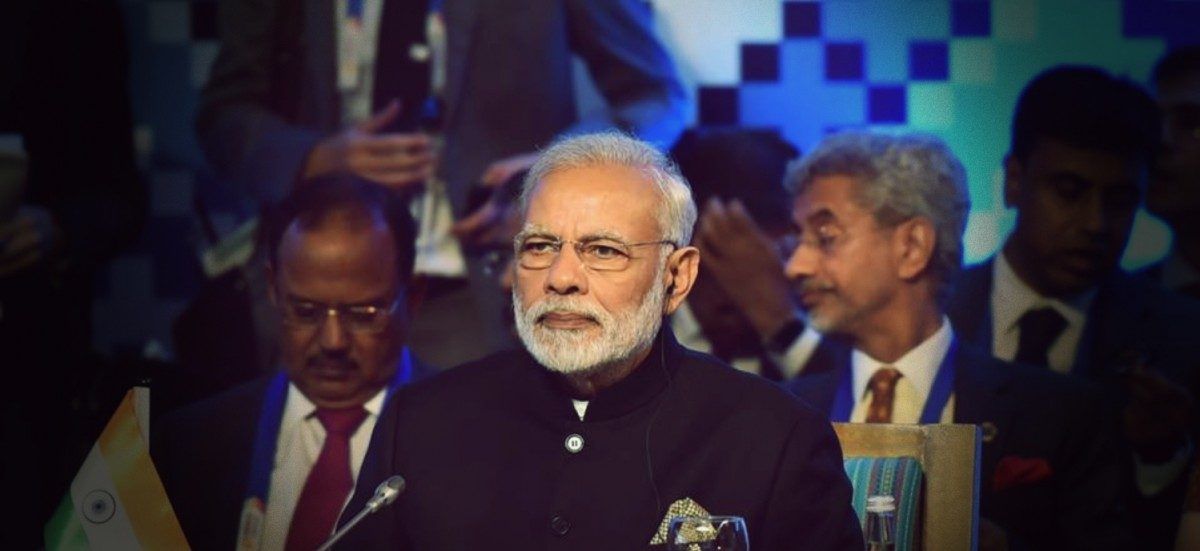
New York: Narendra Modi this week became the fourth South Asian leader to be given the UN’s highest environmental award when the United Nations Environment Programme (UNEP) named the Indian prime minister and French President Emmanuel Macron as joint ‘Champions of the Earth’ in the policy leadership category. The other Indian awardee was Kochi International Airport, in the entrepreneurial vision category.
Previous winners since the awards were instituted in 2005 include King Jigme Singye Wangchuk of Bhutan (2005), President Mohammed Nasheed of the Maldives (2010) and Prime Minister Sheikh Hasina of Bangladesh (2015).
Modi and Macron were awarded for “championing the International Solar Alliance and promoting new areas of levels of cooperation on environmental action, including Macron’s work on the Global Pact for the Environment and Modi’s unprecedented pledge to eliminate all single-use plastic in India by 2022.”
Controversial record
While the PMO has been quick to celebrate the award, environmentalists in India said there was a gap between the international perception of the Modi’s commitment to the environment and the policies of his government on the ground.
This week, for example, the country’s only Turtle Wildlife Sanctuary on the Ganges at Varanasi has been denotified on questionable grounds – the first dismantling of a wildlife reserve since India’s landmark wildlife law was passed in 1972. As the noted environmental writer Bahar Dutt has argued, the denotification is believed to be prompted by the desire to dredge the banks of the river so as to allow it to be used as an inland waterway for the transport of coal to serve new thermal powerplants.
The Centre for Science and Environment has drawn up a catalogue of Modi’s policies which does not make for flattering reading, even on the issue of plastic – the specific subject for which Modi is now being called a ‘champion of the earth’.
According to CSE, the attack on the environment began from day one:
“In its first year of governance between August 2014 and April 2015, the Prime Minister’s Office under Modi considered and implemented “a list of 60 urgent action points submitted by the Confederation of Indian Industry, meant to remove hurdles of environment clearances for industry.”
Since then, what the CSE calls the “Modi government’s ‘dilution spree’ of laws pertaining to India’s forests, coasts, wildlife, air and waste” has continued. This includes:
India also ranks 177 of 180 countries in the Environmental Performance Index 2018 rankings, down from 141 in 2016.
Modi and the UN
The UNEP award to Modi comes weeks after a UN report on 39 countries highlighted the fact that environmental activists are among those who have been subject to reprisals by the Indian government. The report names countries who intimidate activists who cooperate with and assist the UN in its human rights work.
The report mentions intimidation of the Centre for Social Development, which works on the land and resource rights of indigenous people, for using foreign contributions to highlight uranium mining in Meghalaya at global platforms.
The special rapporteurs of the Human Rights Council have in recent reports to the OHCHR noted the protests against the Sterlite copper smelting plant, the displacement of people caused by the Sardar Sarovar dam and the arrest of environmental activists.
When asked about the process of nomination for Modi and Macron, UNEP head Eric Solheim told this reporter: “We have a process that we go through to judge who we believe are the right nominees. In the past we have awarded individuals like the former Chilean President Michelle Bachelet and Rwandan President Paul Kagame who showed political leadership in environment issues. The UNEP is awarding Modi and Macron for taking the lead on the International Solar Alliance. France has also initiated a global pact for environment, which is a process within the UN to negotiate an instrument for protection of the climate. Macron has a strong environmental record and so does Modi.”
Prime Minister Narendra Modi with French president Emmanuel Macron. Credit: Reuters
According to Solheim, Modi could also count the electrification of villages and the Swachh Bharat campaign as a success. Ironically, the UN special rapporteur on drinking water and sanitation, Leo Heller, who visited India last year, said after his visit: “Eliminating open defecation is not only about building latrines, but requires adequate methods for behaviour change, and sufficient water supply is a pre-requisite for the sustainable and safe use of adequate, low-cost latrines.” He added that the programme “should not involuntarily contribute to violating fundamental rights of others, such as those specific caste-affected groups engaged in manual scavenging, or those who are marginalised such as ethnic minorities and people living in remote rural areas… “.
With regard to the contradictory actions of United Nations agencies, UN staff who did not want to be quoted, said that UN agencies are spread across the world and may not necessarily coordinate and in some cases even be aware of each other’s work.
Environmentalists react
Reacting to the award to Modi, environmental researcher Kanchi Kohli said, “There is a deep irony in India being considered a Champion of the Earth, with the prime minister as the awardee. This comes at a time when the country is dealing with an acute crisis of water and air quality, severe groundwater stress and land use conflicts, all of which impact lives and livelihoods of people. Several environmental laws have already been diluted or are in the process of being amended citing ease of doing business as official reasons. The decisions related to the ban of single use plastic or expansion of renewables should not be viewed in isolation of several other decisions that are marred with environment justice concerns.”
Ashish Kothari, researcher and activist with Kalpavriksh Pune added: “While the Congress regime was bad enough with regard to environment, the BJP’s stint is worse, in terms of dilution of environmental laws and procedures, the pace of clearance to ‘development’ projects and the push for major infrastructure in ecologically fragile areas, home to tribal communities.”
According to Kothari, an ambitious solar programme is welcome, but will make no difference, without the reduction of fossil fuels and nuclear power. “Large scale solar production implies issues of land grabbing, where the access of the poor may be as problematic as for other sources. The ban on single use plastic is welcome, but is a small part of a much bigger problem, which is the mass production of solid waste. India is reeling under a massive waste crisis and piecemeal solutions will not help much. There needs to be a move away from a development model that is only fixated on consumption-driven economic growth.”
Selection process
In a written response, UNEP said that the policy leadership award category is about inspiring future action for our planet, not a wholesale endorsement of the recipient’s agenda. “In jointly recognising Prime Minister Modi and President Macron, we are spotlighting the spirit of cooperative leadership and bold environmental initiative which we hope to see taken up by other world leaders.”
On the selection process, it said: “Champions are selected from hundreds of global nominees submitted during an annual public nominating process. Once submitted, a team of independently dedicated Champions of the Earth staff located in UN Environment headquarters in Nairobi, Kenya, research and prepare detailed profiles of each candidate, their achievements and qualifications. Those profiles are then reviewed by UN Environment’s senior management team located in regional offices around the world. After an open comment period and further vetting, by a selection of senior UN staff the three-month process concludes with final selections made by UN Environment’s Executive Director.”
In 2016, India had 280 think tanks, the fourth largest after the US, China and the UK. The number of Indian think tanks more than doubled in the last ten years.
Think tanks conduct research on government policy, organise conferences and produce publications. In doing so, they engage with the government, private sector, academia and media. They try to inform and influence government policy and their sources of funding are from the government and the private sector. The Institute of Defence Studies and Analysis and Indian Council of World Affairs are examples of government- funded institutions. Prominent private sector funded think tanks include the Observer Research Foundation, which receives funds from Reliance Industries and other donors, and Gateway House, which is funded by the Mahindra group and other sources.
Most declare themselves to be independent and not subject to influence from their funders. Such claims merit investigation, especially since these institutions try to exert influence on the government. When think tanks with origins in one country open offices in other countries, it is worth asking why.
In May 2017, a scholar from Brookings India, Shamika Ravi, published an article titled ‘From Labour Pains to Labour Gains’ on the personal website of Prime Minister Narendra Modi, narendramodi.in. In it, she argued that routing wages away from cash payments and towards bank accounts, electronic and mobile payments will help create a culture of formal employment.
Given the emphasis Brookings places on the independent and non-partisan nature of its research – it insists that the interests of political parties, governments, donors and NGOs do not affect its research – did the placement of the oped on the personal website of the prime minister suggest a certain blurring of lines? Not so, says Harsha Vardhana Singh, executive director of Brookings India. “Our scholars can write for any public or research platform, whether narendramodi.in, NITI Aayog, academic journals, NDTV, the Indian Express or The Wire. We contribute to all,” he told this writer in an emailed response.
“The PM requested the author Shamika Ravi to contribute something for Labour Day (May 1). The article was disseminated from the official Twitter handle of the PMO. The Narendra Modi website often asks experts to give their opinions. We are neither for nor against this or any other government. For example, Shamika Ravi has bemoaned the government’s lack of priority in relation to the health issue. When policy makers request scholars to write, should one refuse because one of the conclusions is similar to the view of the person making the request. To presume conflict of interest is non-objective and inappropriate.”
While the assumption that the prime minister’s personal website can be placed in the same category as NDTV, the Indian Express or The Wire is debatable, the fact that he should commission a Brookings researcher to write an article for his website raises questions about the extent of his proximity to, and influence on, the think tank. Indeed, given his government’s lack of receptiveness to ideas and suggestions that run counter to official policy, it reflects, at the very least, Modi’s confidence in Brookings delivering an article that is in sync with official priorities.
Though think tanks advertise their independence – in the same way that news organisations tend to do – the two cannot be compared, says Manoj Joshi, a journalist and former editor who now works as a distinguished fellow at the Observer Research Foundation (ORF) in Delhi. Unlike journalists or media organisations, “think tanks play an advocacy role and are known for certain positions they take. They may strongly support Modi or the government’s view on an issue. Some think tanks are openly partisan, run by political parties while others are non-partisan or bipartisan,” he wrote over email.
Ravi, who has also published in The Wire, says she and Brookings are firmly non-partisan and that it would be unfair for anyone to see partisanship in her decision to write for Modi. In an emailed response to this writer, she said that she would be “more than happy” to write for the websites of opposition leaders like Rahul Gandhi, Mamata Banerjee or Prakash Karat, provided she was asked. “In fact I have presented my research on women in politics to Sheila Dikshit and she requested me to give a seminar on the topic at the Congress office,” Ravi added. “I am constantly in touch with Rajeev Gowda (MP and research head of the Congress) on several matters of mutual interest.”
According to her, publishing on a particular site does not have any bearing on her academic independence. “Independence gives me the academic freedom to voice my research to anyone and everyone interested. My research findings don’t change based on the readers/listeners or platform/publication. I am equally happy publishing in EPW and Dialogue. They both have readers that might benefit from exposure to development economics research,” Ravi told this writer.
Late last year, Ravi was appointed to the Prime Minister’s Economic Advisory Council as a part-time member. Another member, Surjit Bhalla, has also been a Brookings fellow.
A push for digital transactions
Ravi’s first article on demonetisation, written two days after the November 8, 2016 decision, called it a ‘net positive move’. “In the long run,”, she wrote, “this is a significant positive shock to the Indian economy.”
However, the author who wrote far more widely on demonetisation was Bhaskar Chakravorti – a non-resident senior fellow at Brookings India, who has largely been critical of the move despite the fact that he is a senior advisor for digital inclusion to Mastercard and the institute he directs at Tufts University, where he is a professor, receives funding from Mastercard, Microsoft and Gates Foundation.
Mastercard’s core business is converting people from cash to electronic payments and is also a Brookings funder but Chakravorti says he had no problem taking on demonetisation. “It is no secret that Mastercard’s business is enhanced as people move away from cash,” he said in an email to this writer. “Despite my close association with Mastercard, I have argued against demonetisation.” Chakravorti said he favoured the use of digital payments but believes demonetisation was the wrong instrument for it.
Though the writings of Ravi and Chakravorti make it clear that Brookings did not take an institutional view on demonetisation, it is evident that the think tank is bullish on the need for less cash and greater digital transactions – a position it shares with some of its funders.
“…the JAM framework (Jan Dhan, Yojana, Aadhar and mobile numbers) will allow providers to offer innovative financial services to underserved populations. Aadhar identification numbers and the borrower’s credit history could be linked to Aadhaar Enabled Payment Systems for greater transparency and reduce information problems in the credit market.”
These examples show the overlapping networks and connections between Brookings, an independent think tank, and its funders, some of whom are digital financial companies and organisations favouring digitisation.
Besides the Gates Foundation, VISA and Citi fund both Brookings as well the Better than Cash Alliance. The 2015 Brookings Blum Roundtable on Global Poverty, on the theme ‘Disrupting development with digital technologies’, had participants from organisations like USAID, the Gates Foundation and Mastercard, all of which have funded Brookings.
Without a doubt, such organisations fund a diverse range of initiatives. Think tanks too work on a variety of projects, and it isn’t easy to pinpoint the source of funding for individual projects, let alone establish a clear linkage between funding and advocacy on an issue. Yet the points of convergence between these organisations are hard to miss. In giving funds or attending each others’ conferences, there appears to be an alignment of interests and viewpoints, as well as a shared vision on how to solve the problems of the world.
History of the Brookings Institution
Though Brookings India has been set up as a separate Indian entity and domestic regulations on foreign contributions restrict it from receiving foreign money, the ideas informing its work are similar to its parent institute, the Brookings Institution in Washington.
The Brookings Institution was established in 1916 as a private organisation devoted to the study of American policy issues, with its roots in the progressive movement.
According to an outline of the institute’s history, Brookings experts helped frame the first US Bureau of the Budget, helped the US government mobilise during the Second World War and assisted in shaping the United Nations and the Marshall Plan. It recently marked its centenary.
Brookings was ranked as the world’s top think tank in 2016 by the Global Go To Think Tank Index, based on leadership, quality of research, reputation with policymakers and access to key institutions.
In 2016, the New York Times published a series of articles examining the funding of think tanks which showed that Brookings and other think tanks at times pushed agendas important to corporate donors and received funding from foreign governments to lobby for their interests.
Despite former Brookings president Strobe Talbott’s rebuttal, questions remain about how the think tank uses its funds.
In India, Brookings’ funding is primarily from corporate donors. Called the Founder’s Circle, the group includes Aditya Birla, Adi Godrej, Fortis Healthcare, Kiran Mazumdar Shaw, Rahul Bajaj, Nita and Mukesh Ambani, Sudha and Kris Gopalakrishnan, the Tata Group and others. The funders also advise Brookings on its research agenda.
In an interview to The Wire, Brookings India executive director Harsha Vardhana Singh said that each donor pays Rs 2 crore over four years, which serves as a corpus for the think tank.
“Corporates fund us but scholars decide their own research priorities. Our scholars attend conferences where policy makers and business people could be present. Ideas are generated in meetings with government officials. Policy makers request them to join expert groups or write papers. Direct interaction between the funding agency and the researcher is not permitted. If it is indirect, we invite not just the funding entity but others with competing views,” he said.
The benefits offered to donors by Brookings include invitations to private events, conference calls on pressing policy topics and private issue briefings from scholars. Depending on the scale of contributions, donors receive ‘customised programmes of benefit’ and participate in international study tours. The names of the board members of Brookings India are not displayed on its website and Singh refused to provide any details.
In the world of philanthropy, it is not uncommon for donors to provide funding without any expectation of returns in the form of research that favours their own agendas or business interests. The Economic and Political Weekly, for example, receives funding from the Nilekani family foundation but regularly carries articles that are sharply critical of Aadhaar, the project launched by Nandan Nilekani.
But for the corporate sector, think tanks afford visibility and the ability to broadly influence policies in particular directions. “By investing in think tanks, Indian corporates get an opportunity to influence the direction of policy,” says Mohan Guruswamy, visiting professor at the Administrative Staff College Hyderabad and an advisor to the finance ministry in the previous NDA government led by Atal Bihari Vajpayee. “Existing bodies like FICCI and CII do the same, but they obviously want more avenues. Additionally, investing in American think tanks and universities helps them buy prestige in Washington.”
What India means for Brookings
Why did Brookings establish its third overseas affiliate in India, adding to centres in Qatar and Beijing? The stated reason was India’s growing importance as the world’s largest democracy and a rapidly developing economy, and to raise the profile of India in Washington.
Its establishment was also an outcome of the interest taken by the think tank’s former president, Talbott. As deputy secretary of state in the Bill Clinton administration, he was chief negotiator for the US following India’s nuclear tests in 1998.
Despite the centre being an offshoot and affiliate of the Brookings Institution, Harsha Vardhana Singh is averse to the perception that Brookings India is a think tank with American links.
“Brookings India is entirely Indian and is a company registered in India. Indians are involved in directing, staffing and funding it. There is nothing American about it. Brookings DC might want to use our experts, or we might want to use theirs. But they can only advise us on governance. They cannot tell us what to research,” he said.
‘Brookings 2.0‘, a document outlining the future vision of the institution, however, points in another direction. It elaborates on the functions of the India centre and other centres in Beijing and Qatar.
“Brookings is well positioned to be part of the solution to America’s problems precisely because we know our city well. Since America’s difficulties are troublesome for the world and American leadership abroad is essential, our identity as a Washington-based think tank is an asset as we ply our trade globally by virtue of our overseas centers and via cyberspace, airwaves, and satellites”.
By its own admission then, the presence of Brookings in India is a manifestation of American soft power and a symbol of a growing closeness between the two countries, which began after the end of the Cold War.
Think tanks under Modi government
Brookings India chief executive Harsha Vardhan Singh. Credit: Wikimedia Commons
Whatever their role in earlier years, think tanks under the Modi government seem to be getting more attention. The recent revamping of Ministry of External Affairs’ Policy Planning and Research Division under foreign secretary S. Jaishankar included a redefined mandate of proactive outreach to Indian think tanks for ideas and perspectives on foreign policy formulation and advising think tanks on useful research. It includes organising major foreign policy conferences – the ‘Raisina Dialogue’ and ‘Gateway of India Dialogue’, in partnership with think tanks such as ORF and Gateway House.
During his visit to the US in 2016, Modi also met with heads of significant think tanks like the Council on Foreign Relations, Centre for American Progress, Carnegie Endowment, Atlantic Council, Hudson Institute and Brookings Institution. The aim was to understand how these American think tanks view global trends in the coming years and explore areas of collaboration between India and the US.
Interestingly, a delegation from the Brookings Institution, including its trustees and Talbott, visited India in 2014 during a study tour. The visit came in the backdrop of Modi’s election, aiming to “witness India’s transition, up close” and discuss economic, social and foreign policy priorities shaping India’s future. The delegation met with BJP and Congress leaders, and with private sector actors.
A reference to Brookings appears in an unsigned article on Modi’s website heaping extravagant praise on the prime minister’s exploits and reputation abroad. “Brookings Institution, one of USA’s leading think tanks has lauded Gujarat’s decade of development,” the piece states, quoting from a 2012 Brookings blogpost by William J. Antholis titled ‘India’s Most Admired and Most Feared Politician: Narendra Modi’.
From government to think tank
Like influential think tanks in the US, the Brookings Institution serves as a hub; the movement of individuals between it and the government is common.
Reserve Bank of India governor Urjit Patel and NITI Aayog vice-chairperson Arvind Panagariya (who recently resigned) were both non-resident fellows at Brooking, DC. Subir Gokarn, former director of Brookings India, was deputy RBI governor before he joined Brookings. Ex-national security advisor Shiv Shankar Menon is a fellow at Brookings DC. Dhruv Jaishankar, the son of serving foreign secretary Jaishankar, is a fellow at Brookings India.
Dhruva Jaishankar organises events at Brookings, often with prominent speakers, and writes extensively on Indian foreign policy but he rejects the suggestion that there is any conflict of interest involved in his asspciation with Brookings. “Any potential conflicts of interest are easily navigated by preserving a firewall between my professional and personal lives. For example, Brookings India is the only major Indian foreign policy think tank at which the current foreign secretary has not made a speech or appearance. Similarly, I do not write analyses of his public presentations, nor do I quote him in my writings.”
Asked why his articles in the media, including in The Wire, do not mention his relationship to the foreign secretary he said that “while my relationship to my father is no secret, I do not mention it in my writing, or in any other professional context, for three reasons. One, my career preceded my father’s appointment as foreign secretary by almost ten years, and will continue well after his retirement, and as such is independent. I have been contributing commentary and analysis to the Indian media since 2006. In that time, I have written about Indian foreign policy and international relations for [a number of publications]. Two, my mentioning my relationship to my father in an article might imply that I was leveraging my personal relationships for professional gain, and would detract from my analysis being treated on it its own merits. Three, if I were to highlight my relationship to my father, readers might misinterpret my conclusions as reflective of the Indian government’s views on a particular matter, when in fact they are independent and sometimes run contrary to existing policy.”
Dhruva Jaishankar added that “a careful reading of my publications and media commentary over the years would show that I was sometimes complimentary of the Indian government well before my father assumed the post of foreign secretary, and have sometimes been critical of the Indian government after that point, including of its handling of relations with Nepal, Pakistan, and Myanmar, and of inter-ministerial coordination, overseas project implementation, and capacity-building for defence diplomacy.”
The revolving-door phenomenon, where individuals work for think tanks, join the government and return to think tanks, is less usual in India than in the US.
In an interview before he became a minister in the Modi government, Hardeep Singh Puri, who served as India’s permanent representative to the UN in New York, told this writer, “The eminence of certain think tanks in the United States is partly because of the revolving door phenomenon. For example, people in very senior positions in the US government have joined Brookings DC.”
“Think tanks have advantages if they have academic-oriented people not burdened by the everyday pressures of government officials. The real danger is if think tanks lobby for commercial interest or partisan interests. Do they receive selfless arms-length funding, or are there other expectations from funders?” he asked.
According to Puri, the government of India does not outsource substantive work to think tanks with foreign affiliations, but uses them mainly for events.
However, Brookings India’s annual reports from the last two years show not just events organised, but also talk of their scholars being invited by decision makers to give “private briefings at the highest levels” and participate in formulating or giving comments on draft policies.
Brooking’s work on India’s coal sector is an example of the think tank’s work with the government. In April 2016, it conducted a secretary-level roundtable that brought together the secretaries for power, coal, new and renewable energy, government bodies, distribution companies and the banking sector. It also published a study on the future of coal in India supported by Tata Steel Ltd.
The latest example of movement between government and Brookings is Shamika Ravi’s appointment on the PM’s Economic Advisory Council. “[The appointment] is of a part-time member. So it is not a salaried job,” she said. “This is the case for several others on the PMEAC. This means that we retain our full time job (at Brookings India, NIPFP, IGIDR etc.) while providing advice/counsel on economic matters to the PM.”
Asked if it would be a burden to balance the wearing of two hats – that of an independent academic with Brookings and of an advisor to the prime minister – Ravi said she did not anticipate any challenges. “It is my professional service as a researcher. As an academic, I have always worn several hats – of a teacher, researcher, adviser etc. across institutions. I am deeply honoured by this appointment. I see this as an opportunity to bring rigorous research insights into policy making in our country.”
Prime Minister Narendra Modi with Carnegie president William Burns. Photo:Facebook/Carnegie India
Published in The Wire. 31 August 2017
New Delhi: Days before India’s prime minister visited the US on June 25-26, 2017, a new development was reported with regard to the F-16 fighter aircraft which the US is trying to sell to India.
The development was that Tata Advanced Systems, the aerospace and defence arm of the Tata Group, and American defence contractor Lockheed Martin announced a partnership to build the F-16 aircraft for the Indian Air Force. The duo are in competition with the Gripen aircraft manufactured by Saab, a Swedish company. The Indian government is yet to make a decision on the deal estimated to be worth billions of dollars.
A prominent advocate of the deal happens to be Ashley Tellis – a well-known Indian-American strategist and senior associate of the Carnegie Endowment of International Peace. The Carnegie Endowment is a 100-year-old Washington-based think tank which recently opened its newest centre in Delhi.
Tellis, who has given statements and published research on the advantages of F-16s to India, was tipped to be the US ambassador to India. He was also appointed the Tata Chair for Strategic Affairs, established by the Carnegie Endowment in April 2017. In a press release announcing the chair, Tellis said his relationship with the Tatas – who fund both the Carnegie Endowment and Carnegie India – goes back many decades.
Carnegie’s most recent annual report (2016) lists both Tata Sons and Lockheed Martin as funders; the former contributed in the bracket of $100,000-$249,000 while Lockheed Martin Corporation’s contribution was in the category ‘up to $24,999’.
Think tanks are known to receive an assortment of funding from governments, companies and foundations, which means that Carnegie’s funding is not unusual. Think tanks also adopt a range of positions on issues depending on the direction in which they want government policies to take shape.
However, these connections between Tata, Lockheed Martin and the Carnegie Endowment, their investments in each other and clearly intersecting interests, raise questions about the positions taken by think tanks on issues and why corporates invest such large sums in them.
In response to questions from The Wire, Tellis said there was no conflict of interest involved in Carnegie’s funding and his championing of F-16s. “My conclusions about the F-16 and F-18 were published several years before I was appointed to the Tata Chair and before Tata or Lockheed Martin ever contributed to Carnegie. My analysis about the fighter competition stands on its own merits,” he said.
While one of Tellis’s articles on F-16s was published in 2009, a second came out in 2016 and a third in August 2017. Ratan Tata became a trustee of Carnegie Endowment in 2013 and Lockheed Martin funded Carnegie between July 2015 to June 2016.
Atul Bhardwaj, adjunct fellow at the Delhi-based Institute of Chinese Studies, points to another of Tellis’s works which urges India to develop its next generation nuclear-powered aircraft carrier with US support. “Think tanks like Carnegie sell dreams of making India a great power equipped with sophisticated defence technology. They build threat scenarios that shape the national security outlook of the country and their foremost objective is to shape elite opinion,” he says.
Responding to this reporter’s email on whether the links between Tata, Lockheed Martin and Carnegie create a conflict of interest for the think tank, Shivnath Thukral, managing director of Carnegie India, said,
“Carnegie scholars never submit work to donors for pre-review, approval, or any other direction and do not accept funding from organisations that seek to influence our research. The only substantive Carnegie Endowment report involving the F-16 was the ‘Dogfight’ report written by Ashley Tellis in January 2011, based on his own independent analysis and rigorous research. Tellis received no funding for writing the report. He continues to stand by his conclusion that the American F-16 (Lockheed) and F-18 (Boeing) are the most cost effective solutions for India’s needs.”
Thukral’s response also stated that Carnegie Endowment “as a whole” never received funding from Lockheed Martin. When this reporter pointed out that Carnegie Endowment’s 2016 annual report listed Lockheed Martin Corporation as a donor, he said:
“Our earlier response was regard to Carnegie India which has not received funds from Lockheed Martin – Carnegie India is a registered Section 25 company subject to Indian laws including the FCRA. Lockheed Martin is a member of the Carnegie Endowment’s Global Council – a group of individuals and corporations who provide general support not tied to any specific program, center, project, or scholar.”
That Lockheed Martin funds Carnegie is not a surprise, since it is known to fund think tanks. But it is ironic that its funding should be accepted by a think tank whose founder, Andrew Carnegie, considered war to be the “foulest blot upon our civilization.”
However, Carnegie is not alone in its advocacy of Lockheed fighters for India. In 2015, TheIntercept ran an article showing that the conservative Heritage Foundation worked to restore funding for Lockheed Martin’s F-22 fighter jet which the Pentagon had decided to cut. More interestingly, the Heritage Foundation, in a June 20 article titled ‘Heritage Expert Influences Production Move on F-16s’, said that it had championed the production of F-16s in India since it would help protect American jobs.
In the US, which is home to the largest number of think tanks in the world, the issue of whether think tanks further corporate agendas is hotly debated. That debate has still not taken off in India because of their relatively small numbers and the lack of clarity around their work. Yet the arrival of heavyweight American ‘brands’ like Brookings and Carnegie, and their funding by Indian industry, have certainly been noticed.
Lobbying tool of US commercial interests
Ajai Shukla, who writes on defence and strategy for Business Standard provides the background:
“An ambitious US-India defence framework agreement signed in 2005 marked the acceleration of defence commerce. The 2008 India-US nuclear deal and balancing against increasing Chinese activities in the South China Sea resulted in greater strategic convergences. Track-II dialogues with the US were also underway, organised by organisations like the Aspen Institute. But a key area of interest for the US and other countries was that India was fast emerging as a major buyer of arms and had lucrative projects in oil, gas and infrastructure.”
According to Shukla, the presence of foreign think tanks is not the sinister ‘CIA hand’ that Indira Gandhi would refer to. “It is a lobbying tool for a plethora of commercial interests,” he says.
In the last decade, three US think tanks have set up their India offices – the Aspen Institute, Brookings Institution and Carnegie Endowment. Each of these are set up as Indian entities and seek to raise Indian funding.
When one considers the work of think tanks in general, there is little clarity around their methods of working and impact, or how they use their funding. But most think tanks are established with the intent of informing and influencing government policy. The methods of trying to influence government policy are diverse – employing retired government and defence officials, collaborating with ministries on research projects, convening conferences and inviting ambassadors and joint secretaries, serving or retired, to launch books and reports.
Prime minister’s first book launch
Getting India Back on Track. Credit: PTI” width=”352″> Prime Minister Narendra Modi at the launch of Getting India Back on Track. Credit: PTI
Weeks after the BJP was voted to power, Narendra Modi presided over what was probably his first book launch at his 7 Race Course Road residence as prime minister. The book, Getting India Back on Track: An Action Agenda for Reform, was published by Carnegie Endowment. The book, according to its blurb, “broadly coincides with the 2014 Indian elections to spur a public debate about the program that the next government should pursue in order to return the country to a path of high growth.”
The book was launched prior to the setting up of Carnegie in India. The groundwork for establishing Carnegie India had started earlier – in 2011, a delegation from the Carnegie Endowment met an array of Congress leaders including then Prime Minister Manmohan Singh and shared plans to set up a South Asia centre in Delhi.
Prior to Delhi, Carnegie had already established its centres in the Middle East, Russia, Europe and China. With its headquarters in Washington DC, it is known as one of the oldest international affairs think tank of the US. What is its role in the US?
Inderjeet Parmar, author of Foundations of the American Century: The Ford, Carnegie and Rockefeller Foundations in the Rise of American Power, says, “These institutions emerged to cope with massive changes that the US was undergoing in the areas of urbanisation, immigration and industrialisation in the early 1900s. They emerged out of corporate wealth, were staffed by elites and usually connected with US State Department or other government agencies. They wanted to develop American leadership to replace the British and French rule, and also to challenge communism and socialism abroad. They viewed the problems of the American state as their own.”
According to Parmar, the strategy of ‘exporting institutions’ has been going on for a long time, especially in China. “In India, these institutes try to influence and socialise the Indian elite into the international order promoted by the US. This elite consists of university academia, people who have spent many years at the higher rungs of government service, business leaders and the media,” he adds.
Carnegie India, of course, contests the idea that it is a conduit for American influence. During the recent launch of Carnegie India, the management of Carnegie stated that it was “less interested in amplifying directives from Washington than it was … in bringing international perspectives to bear in Washington.”
To place this claim in perspective, however, it is necessary to understand the logic behind Carnegie’s expanding global footprint in the first place. In 2007, the Carnegie Endowment articulated its vision for creating the world’s first ‘global think tank’. Though India is not explicitly mentioned, the vision provides a clear rationale for why the think tank wanted to expand abroad.
Describing the vision, Carnegie’s former president Jessica T. Matthews said the think tank was globalising out of a deep conviction that this was the best way to advance core US national interests. “History has shown that a dominating world power has paradoxically a greater than normal need to understand in depth what others’ interests are. This is because of the sheer scope of its interests and because dominance engenders resistance, resentment, and often fear. So deep engagement is an essential strategy for managing dominance.”
“We live in a world where critical issues have moved beyond national solutions, because they reside in the global commons or because they require the cooperation of many countries. Whether trade or terrorism or nonproliferation or climate change, US leadership is needed as never before,” she said.
Taken together, these statements from Carnegie’s top leadership suggest Carnegie in Washington and its centres abroad are working to preserve US leadership and its core interests by mapping – but also moulding – the interests of other powers like India onto the policy matrix in Washington.
What constitutes core US national interest? This could mean everything from maintaining a unipolar world, balancing the rise of China, preserving its security and protecting its economy to boosting American companies’ business interests. Not all of these interests necessarily complement India’s.
Carnegie India head Ashley Tellis speaking before the Senate Armed Services Committee on US policy in the Asia Pacific. Credit: Twitter/Carnegie India
Intersecting interests of American and Indian corporate wealth
But it is not the case that American-origin think tanks in India promote only American interests. If that was the case, Indian corporates would not have made a beeline to fund them. Carnegie India receives funding from both Indian and international donors, including prominent names from Indian industry such as C.K. Birla, Kiran Mazumdar-Shaw, Shobhana Bhartia, Sunil Mittal, G.M. Rao and Tata Sons.
Even as the US is a major source of foreign direct investment for India, Indian corporates have increasing investments abroad, with acquisitions in nearly every part of the world. According to India’s Ministry of External Affairs, more than 65 large Indian corporations have invested about $17 billion in the US. For some of these companies, like Tata Sons, it has become profitable to be in the US.
A report by the Cato Institute shows how individuals and Indian corporations have driven the India-US relationship much more than governments. “Indian industrial houses once cowered in fear of being crushed by US multinationals, but have now become multinationals in their own rights. Many have become global giants, making acquisitions in every continent,” the report states, citing several examples of Indian acquisitions abroad.
Thus, even as the outsourcing of American jobs to India is a bone of contention, Indian and American companies continue to collaborate. The partnership between Tata and Lockheed Martin to build F-16s in India is just one example. Several high-level forums exist to take forward the business ties between the two countries.
At one level, Carnegie in India represents the intersecting interests of Indian and American corporate wealth. That’s the main reason Indian corporates fund such institutes, which are not only high profile but also have access to the highest levels of government. These institutes also encourage research and policy making that promotes free markets and liberalisation of economies.
For example, the Carnegie Endowment publication launched by Modi in 2014 was essentially an argument for the centrality of markets in driving economic growth, and a critique of the welfare state. The foreword was written by Ratan Tata, a member of Carnegie’s board of trustees, while Bharti Enterprises’ chairperson Sunil Mittal was present at the launch.
Both Tata and Mittal played an important role in bringing Carnegie to India. At the launch of the think tank in Delhi, Carnegie president William Burns – a former senior official in the US State Department who was closely involved in implementing the US-India civil nuclear agreement – thanked both Tata and Mittal for their vision and drive in expanding the Carnegie platform to India. A video from the launch shows Mittal stating that it was his personal mission to see that the think tank established its centre in Delhi, marking its South Asia presence. Mittal also personally accompanied the Carnegie delegation when it met Congress and opposition leaders in 2011 to announce plans to launch a think tank in Delhi.
With similar visions driving them, Indian industry and American think tanks are leveraging each others’ advantages to exert influence on the government of the day.
(The Tatas and Lockheed Martin did not respond to queries from the author)
Prime Minister Narendra Modi with his Israeli counterpart Benjamin Netanyahu in New York in 2014. Photo Credit: PMO
Published in The Wire. 2 July 2017
It is the 50th year of the Israeli occupation of Palestine. It has been 50 years since Israel annexed the Palestinian territories of West Bank, East Jerusalem and Gaza Strip following the Six Day Arab-Israeli War of June 1967.
During this time, Israel has tightened its hold over the territories, crushed Palestinian resistance and created hundreds of thousands of refugees. Its discriminatory policies affecting every area of Palestinian life have invited comparisons with the South African apartheid. However, UN resolutions condemning the occupation and Israeli settlements in the West Bank leave Israel unaffected, even as it relies on the continued support of the United States for its actions.
This is also the year that India’s Prime Minister Narendra Modi will travel to Israel; the first Indian PM to do so. He will address a gathering of Jews of Indian origin in a community reception in Tel Aviv on July 5. Modi he will not visit Palestine.
Historically, India framed its relationship with Israel based on a priority accorded to Palestine. In 1936, Jawaharlal Nehru informed the Zionist emissary Immanuel Olsvanger that he could not tolerate imperialism in India or Palestine.
P.R. Kumaraswamy, professor of West Asian Studies at Jawaharlal Nehru University, writes that while anti-colonialism was an important aspect of India’s backing Palestine, there was a religious dimension to the matter. The Congress and the Muslim League perceived the anti-imperialist Palestinian cause as a way to win over Indian Muslims whose support they were competing for and to unite Indian Muslims with the resistance against the British. Supporting Palestine was also a method of leveraging India’s interests in the Middle East.
Road to Washington and arms access through Israel
Nevertheless, India established full diplomatic ties with Israel only in 1992, even though it had formally recognised Israel in 1950. The end of the Cold War in 1991 reconfigured world politics and established the United States as the sole superpower.
Vijay Prashad, professor of International Relations at Trinity College, says: “India’s road to Washington and arms lay through Israel. After India’s nuclear weapon tests in 1998, the US imposed economic and military sanctions. During the 1999 war with Pakistan, Israel supplied arms to India, which were American in any case. India under Indira Gandhi had already reached out to Israel in 1971 for arms despite absent diplomatic ties. The Palestine issue started getting sidelined long ago, while the Congress was in power.”
In 2009, following lobbying by US and Israeli governments, India diluted its stand on the Goldstone Report which showed the illegality of Israel’s blockade of Gaza and accused it of violating international law. The Congress expressed “reservations in making unqualified endorsement” of the report recommendations. According to Prashad, there is not much difference in the language used in 2009, and the language subsequently used by India for Israel’s attacks on Gaza in 2012 and 2014.
Then, for the first time in 2015, India abstained on a UNHRC resolution calling for a probe by the International Criminal Court into war crimes by Israel. It continued to abstain on the resolution in 2016 and 2017 as well. However, it has voted in favour of other UNHRC resolutions that criticised Israel on the expansion of settlements and the right of Palestinians to self-determination.
India justified abstaining on the grounds that the resolution referred to ICC of which India is not a member. But a report in The Telegraph showed that India voted at least twice in favour of UNHRC resolutions which refer to the ICC in the context of atrocities in Syria. India’s altered voting behaviour therefore caused speculation that India had changed its policies on Palestine which the government has denied.
India-Israel bonhomie under Modi
Undoubtedly, there is markedly more visible warmth between the two countries since 2014 when Modi was elected PM. High level visits to Israel by Home Minister Rajnath Singh, President Pranab Mukherjee and External Affairs Minister Sushma Swaraj have already happened. While Singh did not visit Palestine, Mukherjee and Swaraj did so. During the Congress regime too, a steady stream of bilateral visits continued to Israel.
Interestingly, the first time that a senior Indian minister visited Israel was only in the year 2000, when the BJP was in power; and the minister was L.K. Advani. This is despite the fact that diplomatic relations were established since 1992 and Israel had been sending its presidents and prime ministers to India since 1993. The most recent visit being of President Reuven Rivlin in November 2016.
India and Israel have been cooperating in a range of areas including agriculture, water conservation, science and technology, trade and investment. India and Israel also view each other as victims of Islamist terror which complements Modi’s Hindutva background. But by far, the largest area of cooperation is in defense.
Israel’s defense industry bagged its biggest security contract in April 2017 with the state-owned Israel Aerospace Industries being awarded contracts worth $2 billion for providing medium range surface to air missile systems to the Indian Army. There are expectations of further arms deals when Modi visits Israel. It is no secret that India is currently the biggest importer of arms in the world while Israel is its second largest foreign supplier.
Where does Palestine stand?
Where does Palestine stand next to India-Israel bonhomie? When Palestinian President Mahmoud Abbas visited India last month – his third state visit to the country – Modi mentioned India’s unwavering support to Palestine and for a two state solution. He also spoke of a ‘sovereign, independent, united and viable Palestine, co-existing peacefully with Israel.’
Even before Abbas’ visit, a Palestinian Authority official said that while India had the right to build relations with Israel, it should not come at the expense of support for Palestine.
How has that panned out? Is it possible for India to de-hyphenate its ties with the two countries, considering that one is an internationally condemned transgressor state and the other fighting for independence from it? India’s defense ties with Israel make this even more difficult.
Palestinian embassy officials in Delhi who monitor India-Israel ties have expressed unhappiness over the increasing defense relationship. A Der Spiegel investigation in 2014 showed that Israel invests significant sums into defense research and production. A good chunk of defense production is exported to countries like India. Defense export revenues in turn make it possible for the Israeli forces to sustain the military occupation of Palestine, inviting allegations that India is subsidising or underwriting the occupation.
When Modi visits Israel on July 4, what should we expect? Will he refer to the Palestinian cause? One can expect utterances about ‘the peace process and support for the two state solution. But it is doubtful he will go further – he is unlikely to raise the issue of the Palestinian prisoners’ hunger strike for example.
Any criticism of Israel’s human rights records at international forums could invite criticism of the Modi government’s own policies in Kashmir where he has militarily suppressed dissent and separatism. Neither Netanyahu nor Modi will embarrass each other; Netanyahu in particular would be eager to win over India for the longer term, especially as a voting ally at various human rights forums.
As Palestine observes its 50th year of Israeli occupation, hard strategic and military calculations define India’s national interest and colour its ties with Israel and Palestine.
Justice B. Kemal Pasha, a sitting judge of the Kerala high court, was recently in the spotlight for comments made at a seminar in Kozhikode organised by the Punarjani Charitable Trust, a women lawyers collective, and Nisa, a progressive Muslim women’s forum. He called for the reform of Muslim personal law, spoke against dowry and asked rhetorically why a Muslim woman could not have four husbands. The last remark in particular generated a controversy and was greeted with open hostility by a broad section of the Muslim clergy in Kerala.
To understand the uproar over his comments, The Wire spoke to Zakia Soman, co-founder of the Bharatiya Mahila Muslim Andolan (BMMA), a rights-based mass movement led by Muslim women. Soman places the judge’s remarks in context, explains why they can be deemed historic and exposes the patriarchal mindset of those attacking the judge. She also explains how the resistance to codification of Muslim personal law is a denial of the constitutional rights of Muslim women.
Justice Pasha’s comments, especially that a woman should be allowed to have four husbands, have come in for severe criticism. What is BMMA’s response?
The statement attributed to him – that a woman should have four husbands – has been converted into a headline by the media. But that’s not the point. He said a lot of substantive things. For example, he said that despite Quranic rights, Muslim women have not got justice as far as personal law is concerned. He spoke a major truth and we welcome it. He also called for a reform of Muslim personal law. When a sitting judge says this, that too male, it is important. In fact, it is historic. Every democratic person who believes in the constitution, and anyone who is a Muslim, and has read the Quran should support this. Islam considers men and women equal. The misinterpretations of the text, owing to patriarchal mindsets in the last 1400 years, have resulted in women being treated as second class human beings. Although there have been scholars who have written about men and women being equal in the Quran, few people, especially men, have publicly spoken for gender justice in Islam.
What kind of organisations are attacking Justice Pasha? Some of his opponents have even claimed that his views on divorce and maintenance echo those of the RSS.
They go after anyone who speaks of reform. They resort to personal attacks as in our case too, and anyone who talks about reform is an RSS stooge – there must be a limit to conspiracy theory!
As far as I know, these organisations include Samastha Kerala Jamiyathul Ulama, a body of male clerics from Kerala holding extremely conservative and patriarchal worldviews, despite Quranic injunctions on gender justice. They have a limited perspective on these issues, which is solely their own, and does not draw legitimacy from the Quran.
What gives them the power and legitimacy to spread their ideology?
They are self-appointed male custodians of religion. The religion of Islam has no place for intermediaries, institutionalised clergy or leadership; the rapport between a Muslim and Allah is direct. They also draw their legitimacy from the overall patriarchy prevalent in all faith communities.
These self-appointed custodians claim the sole right to speak on behalf of all Muslims and insist that they are the only arbiters of Islam; no change can happen without their will. The misinformation spread by them has led to a sense that men are superior to women in the Muslim community. This is absolutely untrue. Again, the Quran has to be read in the context of the time we are living in. For example, what was permission for polygamy at a given time in history cannot be stretched as a licence in modern day. Permission under certain circumstances with strict conditions is certainly not encouragement. Nowhere does the Quran encourage polygamy.
The stranglehold of patriarchy is visible in all faiths. Take the Sabarimala temple, the Shani Shingnapur temple or any other temple. They are run by temple trusts, but the respective deity cannot belong only to the trust. The god belongs to all devotees, who should have equal rights of access. But some people have appointed themselves trustees and administrators as in Sabarimala or the Haji Ali Shrine, and these orthodox men decide who will be included or barred, whether women and girls, those in the menstruating group, or Dalits.
Conservative Muslim clergy frequently make statements that infringe on and curb the rights of Muslim women, whether with regard to divorce, education, work or inheritance. How important is it to codify Muslim personal law?
The long term solution is the codification of Muslim personal law within the Quranic framework. This is in consonance with the Indian constitution, which upholds the right of religious freedom through Article 25, 28, 29 and others. Different faiths, including religious minorities, have their respective family laws which are periodically amended. It is only Muslims whose family laws are from the British era, dating back to 1937 and 1939. They are highly incomplete and do not address questions on age of marriage, triple talaq, polygamy, inheritance, property rights and the custody of children.
If Muslim personal law is codified, would it prevent the likes of Samastha Kerala Jamiyathul Ulam, All India Muslim Personal Law Board and others from making anti-women statements publicly?
Yes, it will break the hegemony and stranglehold over the lives of ordinary women and men. Currently, Muslim personal law is open-ended and subjective since the British era legislation from which they stem is incomplete and silent on many issues. If a comprehensive law is written down and passed by parliament, their stranglehold will disappear. Muslim women will get justice since violators can be punished. Triple talaq and halalah, which are un-Islamic practices, would be banned. This is why orthodox forces are resisting the codification of Muslim personal law. In many Muslim countries where the personal law is codified, triple talaq is not a valid form of divorce.
The clergy claims that the source of personal law is Sharia, which is also stated by the 1937 Act. The meaning of Sharia is Islamic law. But where is it written down? Every maulvi or qazi has his own interpretation of Sharia, and all malpractices are passed off as Islamic. Qazis validate oral divorce, polygamy or halalah instead of pointing out their invalidity as per the Quran, since these are barbaric practices. It is high time the Muslim personal law is codified. BMMA has even prepared a draft law following consultations over five years.
Jawaharlal Nehru and Ambedkar initially proposed the UCC as they were concerned about gender justice. They feared that the religious orthodoxy would not permit justice and equality for women despite the Constitution. The idea of the UCC was rejected as an attack on ancient Indian tradition and heritage largely by sadhus and sants of the day. The idea was dropped and the Hindu marriage and succession Acts were passed in the 1950s. Even Parsis and Christians, whose family laws were already existing, amended their laws from time to time. The right to personal laws based on religion is a constitutional entitlement that all communities have. Muslims are the only community who have been denied their legal rights, thanks to the opposition of patriarchal forces who have stonewalled any change in the area of personal law, and the government’s informal alliance with them. The most affected have been Muslim women who have been discriminated against and denied justice.
In the last decade, the UCC has been mired in so much politics. The Hindu right has revived the demand for a UCC, but have never brought a draft before the public. They are throwing it like a gauntlet. Do they mean to say that post-UCC, a Hindu marriage will take place without saptapadi,saat phera or kanyadan?
The UCC debate concerns all communities and not just Muslims. Our concern is legal justice and equality for Muslim women as guaranteed by both the Quran and the constitution.
The United Nations recently announced the launch of its formal development paradigm, the Sustainable Development Goals (SDGs) encompassing 17 goals and 169 targets. The SDGs define the path of development that nations are to adopt in the next 15 years.
The goals appear to be extensive by appearing to take into account various kinds of inequalities, with a separate goal (Goal 10) dedicated to reducing inequality within and among countries. Yet the SDGs have failed to account for inequality based on caste – a form of discrimination which affects more than 260 million people globally, according to the US- based Human Rights Watch.
Though seen predominantly in India, where the Dalit population is 16.6 per cent, caste discrimination occurs in other South Asian countries. For instance, against India-origin Tamil minorities who work on plantations in Sri Lanka, in Nepal where estimates of Dalit population vary from the 13 per cent to 20 per cent and in Bangladesh where Dalit issues found a mention in election manifestoes in 2008. As per the National Campaign on Dalit Human Rights (NCDHR) analogous forms of discrimination are witnessed in countries such as Burkina Faso, Japan, Kenya, Mauritiana, Nigeria, Rwanda, Senegal and Somalia.
To protest the injustice of caste exclusion from the SDGs, Dalit groups organized a rally of protest in New York on September 26, as the UN Sustainable Development Summit 2015 was in session.
Paul Divakar of the NCDHR said at the rally: “The issue of caste is well recognised among UN human rights missions. It is well-researched especially in countries such as Indian and Pakistan. The UN itself recognizes discrimination based on work and descent. Why then have Dalits been excluded from the SDGs which aims to ‘leave no one behind’? The issues of Dalits have to be recognized the way issues of race, gender and ethnicity have gained recognition.”
Global recognition of caste discrimination
The United Nations recognizes discrimination based on work and descent (the UN terminology for caste discrimination), as does the UN Committee on Elimination of all Forms of Racial Discrimination (CERD) which recognizes discrimination based on forms of social stratification such as caste.
Ruth Manorama, a Dalit activist and winner of the 2006 Alternative Nobel Prize, notes: “For Dalit women, exclusion is felt in many more ways, especially those who are devdasis, in bonded labour and manual scavenging. This was recognized by CEDAW (Convention on the Elimination of all Forms of Discrimination Against Women).”
The struggle to place caste on the international global agenda has been a protracted one. Activists are advised by the Indian government and missions abroad, to ‘not wash dirty linen in public’, or ‘shame the nation’.
Even as Dalit groups fought for the inclusion of caste on the agenda of the World Conference on Racism in 2001 at Durban, the Indian government fended off such efforts by stating that caste is not race, caste is an internal affair, and that the conference should not lose sight of the focus on racism.
Writing about the politics of representation in the Durban conference in Seminar magazine, Gopal Guru notes: “The Indian state by and large has shown only a formal and rhetorical commitment to equality as far as Dalits are concerned…it showed extraordinary brazenness in asserting that there was no caste discrimination (juridically if not in practice) in India… The Indian government did not want to publicly blame or shame the Hindu community whose belligerent members are primarily responsible for the perpetuation of…caste atrocities against the Dalits. Second, it perhaps was worried about losing some material benefits from the international agencies who may haul the Indian state over the coals for its malignant social face.”
Meanwhile domestically, the Dalit movement is witnessing additional challenges through a right wing turn in its political leadership. A Dalit studies scholar who did not wish to be named, said: “The philosophical creed of Ambedkar, Phule and Shahu Maharaj has lost its control on the sensibilities of the Dalit leadership, which is why a right wing turn is being witnessed. International paradigms cannot help eliminate caste; structural changes are needed.”
Caste follows Indian Diaspora
The UK Government’s Equality and Human Rights Commission said in a 2014 research report that caste discrimination exists in the UK, whether as bullying in schools, ostracism following inter-caste marriage, in worship, employment and business, and in the rental market. The report additionally said: “Dalit groups emphasised the pervasiveness of unequal treatment, harassment, verbal abuse or discrimination in the UK”. Section 9 of Britain’s Equality Act 2010 requires the government to introduce secondary legislation to make caste an aspect of race, thereby making caste discrimination a form of race discrimination. Caste discrimination is common in Canada as well.
“Wherever Indians have gone and settled in large numbers, caste has followed,” says US-based Raju Kamble of the Ambedkar International Mission, an organization of Ambedkar supporters residing in the US, UK, and Canada.
“Where strong anti-discrimination laws exist, outright discrimination is less common. But the mindset is on display in marriage practices, social relationships and in anti-reservation views,” he added.
A collective assault on reason – that is how a gathering of academics and activists this weekend described the ongoing attack on individuals, institutions, history, ideas and education that has been gathering pace across the country “ever since the RSS-dominated BJP government” came to power at the Centre.
Organised here by Sahmat on Saturday, the immediate context for the meeting was the killing of the Karnataka scholar M M Kalburgi – the third in a series of assassinations targeting individuals known for their opposition to orthodoxy and communalism. The first two victims were the well-known Maharashtra rationalists Govind Pansare and Narendra Dabholkar.
Supreme Court lawyer Anil Nauriya noted that the police had said that there was nothing common in the three murders, barring the ‘morning walker’ aspect – referring to the fact that all were killed in the morning. “There was far more in common – they were rationalists and running campaigns on social justice and equity.” Nauriya also linked the murders of Pansare and Dhabolkar with their association to the Rashtra Seva Dal, an organization founded to combat communal organizations.
“Pansare and Dhabolkar were close associates. Soon after Dhabolkar’s assassination, Pansare received messages that he would be next.”
If the law enforcement machinery says it knows how to get to the bottom of every crime, why has it not solved the triple killings, asked activist Teesta Setalvad, also referring to threats on social media to Mysore professor KS Bhagwan.
The attack on individuals and ideas was being felt in the field of education too. Tracing attempts to bring about a ‘value-based education policy’ by the NDA government since its first stint in 1999, Setalvad said: “The RSS, which represents an unconstitutional ideology, is governing both government and educational policy.”
She referred to the need for an audit of the textbooks by Dinanath Batra of the Shiksha Bachao Andolan being taught in 40,000 schools in Gujarat – books with distorted content – and the urgency of revisiting the 2004 committee, which recommended the formation of an all-India textbook board to examine books in state and private schools, and schools run by religio-social political organisations.
Referring to the renaming of Delhi’s Aurangzeb Road, and also to the appropriation of Maratha warrior Shivaji by the right-wing, Setalvad said: “Pansare’s book Shivaji Kon Hota has letters from Shivaji to Aurangzeb which shows that Shivaji’s battle with Aurangzeb was not religious.”
Academic Prabhat Patnaik, noting the destruction of institutions, said: “Second rate mediocre people are being placed in charge of institutions, destroying any possibility of rational discourse.” In recent times, heads appointed to the the Indian Council of Historical Research (ICHR) and Film and Television Institute of India (FTII), are known to be close to the government, and have been accused of saffronising these institutes. Warning of the approaching ‘fascification of state’, Patnaik said: “A part of the process towards fascism of the state is the destruction of reason. A symptom of this destruction has been the obliteration of the distinction between history and mythology.” This process ran contrary to both the social emancipation movement of Ambedkar and others and anti-colonial struggles, Patnaik said.
Historian Irfan Habib saw a historical parallel in the “replacement of history by mythology” that he said was currently underway in India. “Textbooks from the NDA regime portray Gandhi and Nehru as if they had nothing to contribute to the national movement, only Hindu rashtra people like Savarkar and others made worthwhile sacrifices. Nehru is censored and Gandhi’s murder is given a skip in these books. This is inventing of facts and history just like in Nazi Germany which tried to portray Germans as governing the world.”
Noting prior efforts to rename Lucknow to ‘Lakshmanpuri’ and also attempts to rename Allahabad, Habib said any drive to rename places would result in continued communalisation.
“The renaming of the Aurangzeb Road is an ominous augury for a campaign to change names on communal grounds,” a statement released by Sahmat said.
Setalvad, whose organisation Citizens for Justice and Peace played an important role in securing 120 convictions related to the 2002 Gujarat riots, and who the government accuses of illegal financial activities, told The Wire: “This government does not want an opposing voice. We are against the ideology of the government. Being against the government and its ideology is different from being against the state.”
Abolition of the floor wage, revised minimum daily wage of Rs 500 and monthly wage of Rs. 15000, and pension and provident fund to informal sector workers were some of the key demands made at a convention on workers in the informal sector held here on August 6-7 in Delhi.
Labour activists, trade unions, lawyers, parliamentarians, voluntary organisations and journalists participated in the convention, organised by the Working People’s Charter Process, a collective which works to articulate the demands of people dependent on the informal economy.
Critique of the proposed reforms of labour laws by the Modi government, and the need to push forward long standing demands of the informal sector with regard to revised minimum wages and universal social security formed the context for discussions. Demands were also made in relation to strengthened labour administration, provision of a living wage with decent standard of living, workers’ rights to housing, and rights of migrant workers.
Proposed labour law reforms
According to the proposed reforms, 44 labour laws are to be replaced by four codes in the areas of wages, industrial relations, social security and working conditions. The government’s stated aim in the creation of these codes is to boost job creation and investment, but there are fears that the move will have an adverse effect on workers and working conditions.
Advocate Ramapriya Gopalakrishnan explained how these codes would greatly limit the role of labour inspectors, enable self-certification for employers, impose hefty fines for participating in ‘illegal’ strikes, restrict the number of outsiders who can hold trade union office, allow the compounding of offences by employers and exempt small factories – units with less than 40 workers – from labour laws relating to payment of wages, bonus, maternity benefits, compensation and child labour. Senior Supreme Court lawyer Colin Gonsalves, legal expert Usha Ramanathan, social activist Swami Agnivesh, and former NCPCR chairperson Shantha Sinha also participated.
Call for participation in national strike
Discussions ranged from exploitative practices of bonded labour, issues of migrant workers, domestic workers, street vendors, rag pickers, brick kiln work to questions around employment generation, social protection, housing rights, labour administration and the media coverage of labour issues. The need to form solidarities of labour across formal and informal sectors was reiterated by speakers, and a call was made to participate in the strike of central trade unions on September 2.
Trade unions represented included the Centre of Indian Trade Unions (CITU), New Trade Union Initiative (NTUI), Indian National Trade Union Congress (INTUC), Bharatiya Mazdoor Sangh (BMS), and Trade Union Coordination Committee (TUCC). The Delhi Employers Association was represented, while from the government, Minister of State for Labour and Employment Bandaru Dattatreya and Director General Labour Welfare Bipin Mallick were present.
Rehana Adeeb’s phone won’t stop ringing. After answering a few calls, she switches off her mobile. “The calls will continue. We won’t be able to talk properly,” she explains. We are in a nondescript building in Muzaffarnagar district, Western Uttar Pradesh. It functions as an office from where Rehana manages the operations of her NGO Astitva, one of the few local organisations that worked with people affected by the communal riots of 2013 that broke out in Muzaffarnagar and Shamli districts.
Several files are stacked against a wall with labels like ‘honour killing’, ‘rape’ and ‘domestic violence’ scrawled on the covers. Under Rehana’s guidance, her co-workers Rani, Usman and Gaurav take print-outs, type out emails, and place newspaper clippings in the files.
The recent framing of charges of 4 accused in the Muzaffarnagar gangrape case that happened during the 2013 violence has thrown her work into sharp focus. Astitva has been involved in helping women with legal support in several rape cases that have been registered in the aftermath of the riots.
“I was not always a worldly woman or a person with politics,” says Rehana. She says she had been raped as a child and later forced to drop out of school and married off well before she turned 18. The birth of five daughters in succession and the continued stigma attached to rape meant Rehana’s early years were anything but idyllic. In her late twenties, she strayed into a meeting of Disha, a local women’s rights organisation in Saharanpur in the year 1989. “Wearing a burqa, with a baby in tow, I attended the meeting where people said women could speak against oppression, lodge an FIR with the police and that it is important not to be ashamed. They were singing revolutionary songs. I felt such tumult that sleep eluded me that night.”
Rehana started attending Disha meetings, embarking on a journey of women’s rights activism. It wasn’t easy. Her efforts were met with beatings in the family and ostracisation by neighbours. Undeterred, she started working with abused women and the government-run Mahila Samakhya programme, and finally established an NGO, Astitva in 2005. She set up an Astitva office in Muzaffarnagar because she felt the lack of an organisation working on women’s rights in an area which was rife with honour killing and violence against women in the Jat and Muslim communities.
A climate of violence
Rehana’s philosophy of working with oppressed women in small towns and villages led her to undertake peace-building work in the run-up to, and following, the Muzaffarnagar riots. “I knew women and children would be crushed in the riots for which the atmosphere was building up. There were reports of people with beards being roughed up and pushed out of trains, of gun firing outside mosques. We had 8-10 dialogues on communal harmony in Muzaffarnagar, reaching over 2000 people, but these did not have much impact, because we were up against powerful political forces. The local NGOs were reluctant to get involved. Fear was in the air; the police and the army had been deployed, and news about dead bodies was pouring in.”
As a local NGO, Astitva moved swiftly to visit the makeshift camps which emerged to accommodate riot struck families in Muzaffanagar and Shamli. Rehana informed activists and journalists about the desperate situation of the camps and their inhabitants, becoming a point of contact for all those seeking information, such as fact-finding committees and organisations looking to channel relief. Her team worked with the district administration and panchayats, helped file FIRs for the raped women, trying to fast track their cases, and encouraging women to testify. “In western UP, particularly Muzaffarnagar, there is a tradition of killing witnesses. Therefore witnesses tend to change their stand or they are killed,” says Rehana.
Women’s rights work in western UP is not easy, especially if it means opposing the writ of the khap and caste panchayats. The khap panchayat leaders represent a moneyed and landed class with large-scale ownership of sugarcane fields. With family members in political parties such as Samajwadi Party and Bharatiya Janata Party, the police force, and the Bharatiya Kisan Union, their authority is difficult to contest. This, combined with frequent violence against women, a preference for guns and abuse over dialogue, and the lack of cultural spaces, greatly limits the possibility of human rights work.
The history of khap panchayats dates to a period well before the Mughal and British rule and is a system which has endured. “Khap panchayat leaders have warned that if anyone attempts to break their authority, they will not be spared. Even if NGOs are operational, their work revolves around distribution of medicines, and working with children and older people. Nobody can challenge the khap panchayats.”
No help for vulnerable minorities
Photo: Urvashi Sarkar. Folders in which cases relating to domestic violence, sexual violence and rape, and honour killings are kept.
She says that when there is natural disaster, help is readily available, because people feel they are saving human beings. “But if there is communal rioting and violence in which Muslims or Dalits are affected, people not even counted as human beings, little support can be found. The same sentiment prevails when women are affected – people avoid getting involved.” While Rehana and Astitva cannot afford to confront the khaps and have to skirt around them, they do speak up when women are wronged.
Rehana’s work is subject to frequent threats and hounding. “An anonymous caller threatened to disfigure my face. Earlier, our premises were in a Jat locality. One day, 15-20 Jats gathered outside and ordered me to vacate, claiming Muslims cannot live there. When I shifted to a Muslim neighbourhood, I was told that not wearing a burqa was unacceptable. ”
She faced threats while working on a case in 2005, in which Imrana, a woman from Muzaffarnagar, was allegedly raped by her father-in-law. Rehana was also beaten up by the police for taking to the streets along with other women in support of former Deoband chairperson Zeenat Naz who battled a fatwa against Muslim women participating in elections.
In addition to being pressed for funds, she finds little support for her work from the district administration and police: “You expect them to stand up against women’s oppression. But that rarely happens.” According to National Crime Records Bureau data of 2013, Uttar Pradesh registered 3050 cases of rape, ranking fourth in the category. It also recorded maximum instances of kidnapping and abduction, and dowry deaths. But many cases remain unreported.
For Rehana, the Muzaffarnagar riots were a planned conspiracy. She says: “The Jat-Muslim alliance is broken, fear prevents many Muslim families from returning to their villages. The atmosphere continues to be communalised, and the newspapers are calling it a silent war on Muslims. People lost, and political parties won.”