Tag: United Nations

  • India owed the highest in unpaid dues for UN peacekeeping

    India owed the highest in unpaid dues for UN peacekeeping

    IMAGE: THE PRINT

    Published in Newsclick.in. 9 May, 2019

    A report by United Nations Secretary General, Antonio Guterres, has sounded alarm bells for UN’s peacekeeping work, owing to shrinking budgets available to the organisation. As of March 2019, countries contributing troops and police for peacekeeping are owed $265 million in unpaid dues.

    The UN owes India $38 million, the largest amount owed to any country for peacekeeping, followed by Rwanda ($31 million), Pakistan ($28 million), Bangladesh ($25 million), Nepal ($23 million) and others.

    Guterres’s report warned that the UN is facing deepening liquidity problems and its “deepest deficit in a decade.” The failure of many member countries to pay their dues in full, and on time, to the UN, resulted in arrears worth $529 million at the end of 2018.

    India has provided more than 200,000 military and police officers to UN peacekeeping over the last 70 years. As on February 2018, India had deployed 6,712 peacekeeping personnel for nine UN peacekeeping missions deployed in the Democratic Republic of the Congo, South Sudan, Lebanon, Haiti, Golan Heights (Syria), Cyprus, Abyei (Sudan), Western Sahara and West Asia.

    This has forced the UN to withhold payments to troop and police-contributing countries. The report also said: “The United Nations is now effectively borrowing for prolonged periods from troop and police-contributing countries. Many of them are low-income countries which imposes a significant financial burden. At the same time, the Organisation is asking those same countries to do more to train their personnel and improve the quality of their equipment, all while operating in increasingly challenging environments.”

    The financial woes of the UN have caused severe liquidity problems for peacekeeping missions as well. Of 13 active peacekeeping missions, only 2 missions had cash reserves for three months of operating costs, while 5 missions had cash for one month or less. Total outstanding contributions for peacekeeping operations amounted to almost $2 billion for 2017-18.

    A report by PassBlue, a news site covering the UN, noted that US President Donald Trump’s decision, in particular, to stop paying its UN peacekeeping bills in full has seriously affected the organisation’s work, with the Trump administration deciding to contribute 3% lesser than the rate applicable to it.

    This has created difficulties for the countries that contribute boots on the ground. Currently, Ethiopia, Bangladesh, Rwanda, India and Nepal are the top contributors of troops and police. With a contribution of 6,449 personnel, India’s contributions were the fourth largest as of March 2019.

    At the 73rd session of the UN General Assembly last year, the Indian government pointed out that India is among 76 countries which are owed significant sums towards troop and contingent owned equipment (COE) reimbursements from active peacekeeping missions, plus dues from closed peacekeeping operations. India has also registered 165 fatalities in peacekeeping missions, the highest for any country since 1948.

    If the largest contributors of troops on the ground are developing countries, the top financial contributors are from the developed world. The largest financial contributions in 2018 were from United States, China, Japan, Germany and France.  None of these countries are major contributors of peacekeepers on the ground.

    Troop contributing countries are affected, not just by the funding crunch, but by what they see as inequity in how peacekeeping missions are conducted, through the imposing of caveats. Countries like India and Nepal have repeatedly spoken up against excessive caveats – terms and conditions laid down by countries in order to deploy their troops in peacekeeping missions.

    Addressing the Special Committee on Peacekeeping Operations in February 2019, India’s Permanent Representative to the UN, Syed Akbaruddin, labelled the insistence by some countries on caveats as unfair. “It leads to peacekeepers in the same peacekeeping operation being placed at different levels, being treated differently, and assessed differently,” he said.

    Arguing that caveats violate the basic principle of equality, Akbaruddin called for doing away with caveats altogether. “Caveats place an additional burden on those peacekeepers who do not have any caveats. They also impact the fulfilment of missions’ mandate. It is time to do away with all caveats. We need to develop a culture of no national caveats in the service of the United Nations,” he said.

    Not being consulted enough in the decision making process is another concern of troop contributing countries.  At the Leader’s Summit on Peacekeeping in 2015, India’s Prime Minister Narendra Modi argued that troop contributing countries do not have a role in the decision-making process, and lacked adequate representation in senior management and as Force Commanders.

    Similarly, Bangladesh’s Prime Minister Sheikh Hasina, said in September 2018 that troop and police contributing countries should be taken into confidence by the Security Council and the Secretariat.

    In a 2017 statement to the UN Security Council Working Group on Peacekeeping Reforms, India’s military advisor to the Permanent Mission of India to the UN, Sandeep Kapoor observed that it is a ‘great irony’ that troop/police contributing countries which deploy troops on the ground have no say in the process of formulation of the mandate. He called for political consensus among Security Council members, troop contributors and Secretariat on the cost, limits and dangers of peacekeeping operations in high-risk environments.

    Kapoor cited at least two instances where the personnel contributing country (India) was not consulted in changes to mission mandate. The United Nations Mission in South Sudan (UNMISS) was revised in August 2016 with “no inputs, feedback or consultation…with the troop and police contributing countries, who were in the knowhow of the actual ground situation”.

    Similarly, the MONUSCO (UN Stabilisation Mission in the Democratic Republic of Congo) mandate was extended by the Security Council, along with a drastic reduction of 3,600 troops, which Kapoor said was incompatible with prevailing political and security challenges.

    The demand for broader peacekeeping reforms was reflected in the declaration of shared commitments in the Action for Peacekeeping initiative launched last year. The initiative recognises the various challenges that confront peacekeeping, such as the changing nature of armed conflict, targeting of peacekeepers, increased hurdles in political solutions to conflicts, insufficient numbers of women in peacekeeping, and misconduct including sexual exploitation and abuse.

    While the UN takes pride in successful peacekeeping missions in Sierra Leone and Liberia, other missions such as in Rwanda, Bosnia, South Sudan and Congo have been mired in deep controversies.

    Read the original article: https://www.newsclick.in/india-highest-unpaid-un-peacekeeping
  • UN’s green award for Modi comes despite criticism of environmental record

    UN’s green award for Modi comes despite criticism of environmental record

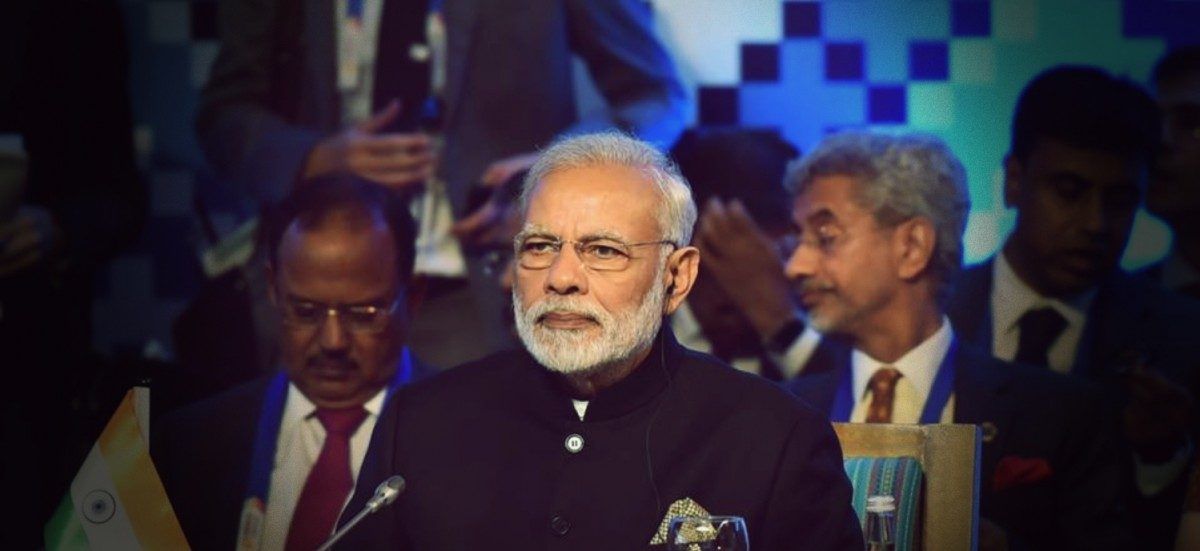
    Photo:Credit: facebook.com/narendramodi

    Published in The Wire. 3 October 2018

    New York: Narendra Modi this week became the fourth South Asian leader to be given the UN’s highest environmental award when the United Nations Environment Programme (UNEP) named the Indian prime minister and French President Emmanuel Macron as joint ‘Champions of the Earth’ in the policy leadership category. The other Indian awardee was Kochi International Airport, in the entrepreneurial vision category.

    Previous winners since the awards were instituted in 2005 include King Jigme Singye Wangchuk of Bhutan (2005), President Mohammed Nasheed of the Maldives (2010) and Prime Minister Sheikh Hasina of Bangladesh (2015).

    Modi and Macron were awarded for “championing the International Solar Alliance and promoting new areas of levels of cooperation on environmental action, including Macron’s work on the Global Pact for the Environment and Modi’s unprecedented pledge to eliminate all single-use plastic in India by 2022.”

    Controversial record

    While the PMO has been quick to celebrate the award, environmentalists in India said there was a gap between the international perception of the Modi’s commitment to the environment and the policies of his government on the ground.

    This week, for example, the country’s only Turtle Wildlife Sanctuary on the Ganges at Varanasi has been denotified on questionable grounds – the first dismantling of a wildlife reserve since India’s landmark wildlife law was passed in 1972. As the noted environmental writer Bahar Dutt has argued, the denotification is believed to be prompted by the desire to dredge the banks of the river so as to allow it to be used as an inland waterway for the transport of coal to serve new thermal powerplants.

    The Centre for Science and Environment has drawn up a catalogue of Modi’s policies which does not make for flattering reading, even on the issue of plastic – the specific subject for which Modi is now being called a ‘champion of the earth’.

    According to CSE, the attack on the environment began from day one:

    “In its first year of governance between August 2014 and April 2015, the Prime Minister’s Office under Modi considered and implemented “a list of 60 urgent action points submitted by the Confederation of Indian Industry, meant to remove hurdles of environment clearances for industry.”

    Since then, what the CSE calls the “Modi government’s ‘dilution spree’ of laws pertaining to India’s forests, coasts, wildlife, air and waste” has continued. This includes:

    India also ranks 177 of 180 countries in the Environmental Performance Index 2018 rankings, down from 141 in 2016.

    Modi and the UN

    The UNEP award to Modi comes weeks after a UN report on 39 countries highlighted the fact that environmental activists are among those who have been subject to reprisals by the Indian government. The report names countries who intimidate activists who cooperate with and assist the UN in its human rights work.

    The report mentions intimidation of the Centre for Social Development, which works on the land and resource rights of indigenous people, for using foreign contributions to highlight uranium mining in Meghalaya at global platforms.

    The special rapporteurs of the Human Rights Council have in recent reports  to the OHCHR noted the protests against the Sterlite copper smelting plant, the displacement of people caused by the Sardar Sarovar dam and the arrest of environmental activists.

    When asked about the process of nomination for Modi and Macron, UNEP head Eric Solheim told this reporter: “We have a process that we go through to judge who we believe are the right nominees. In the past we have awarded individuals like the former Chilean President Michelle Bachelet and Rwandan President Paul Kagame who showed political leadership in environment issues. The UNEP is awarding Modi and Macron for taking the lead on the International Solar Alliance. France has also initiated a global pact for environment, which is a process within the UN to negotiate an instrument for protection of the climate. Macron has a strong environmental record and so does Modi.”

    Prime Minister Narendra Modi with French president Emmanuel Macron. Credit: Reuters

    According to Solheim, Modi could also count the electrification of villages and the Swachh Bharat campaign as a success. Ironically, the UN special rapporteur on drinking water and sanitation, Leo Heller, who visited India last year, said after his visit: “Eliminating open defecation is not only about building latrines, but requires adequate methods for behaviour change, and sufficient water supply is a pre-requisite for the sustainable and safe use of adequate, low-cost latrines.” He added that the programme “should not involuntarily contribute to violating fundamental rights of others, such as those specific caste-affected groups engaged in manual scavenging, or those who are marginalised such as ethnic minorities and people living in remote rural areas… “.

    With regard to the contradictory actions of United Nations agencies, UN staff who did not want to be quoted, said that UN agencies are spread across the world and may not necessarily coordinate and in some cases even be aware of each other’s work.

    Environmentalists react

    Reacting to the award to Modi, environmental researcher Kanchi Kohli said, “There is a deep irony in India being considered a Champion of the Earth, with the prime minister as the awardee. This comes at a time when the country is dealing with an acute crisis of water and air quality, severe groundwater stress and land use conflicts, all of which impact lives and livelihoods of people. Several environmental laws have already been diluted or are in the process of being amended citing ease of doing business as official reasons. The decisions related to the ban of single use plastic or expansion of renewables should not be viewed in isolation of several other decisions that are marred with environment justice concerns.”

    Ashish Kothari, researcher and activist with Kalpavriksh Pune added: “While the Congress regime was bad enough with regard to environment, the BJP’s stint is worse, in terms of dilution of environmental laws and procedures, the pace of clearance to ‘development’ projects and the push for major infrastructure in ecologically fragile areas, home to tribal communities.”

    According to Kothari, an ambitious solar programme is welcome, but will make no difference, without the reduction of fossil fuels and nuclear power. “Large scale solar production implies issues of land grabbing, where the access of the poor may be as problematic as for other sources. The ban on single use plastic is welcome, but is a small part of a much bigger problem, which is the mass production of solid waste. India is reeling under a massive waste crisis and piecemeal solutions will not help much. There needs to be a move away from a development model that is only fixated on consumption-driven economic growth.”

    Selection process

    In a written response, UNEP said that the policy leadership award category is about inspiring future action for our planet, not a wholesale endorsement of the recipient’s agenda. “In jointly recognising Prime Minister Modi and President Macron, we are spotlighting the spirit of cooperative leadership and bold environmental initiative which we hope to see taken up by other world leaders.”

    On the selection process, it said: “Champions are selected from hundreds of global nominees submitted during an annual public nominating process. Once submitted, a team of independently dedicated Champions of the Earth staff located in UN Environment headquarters in Nairobi, Kenya, research and prepare detailed profiles of each candidate, their achievements and qualifications. Those profiles are then reviewed by UN Environment’s senior management team located in regional offices around the world. After an open comment period and further vetting, by a selection of senior UN staff the three-month process concludes with final selections made by UN Environment’s Executive Director.”

    Read the original article: https://thewire.in/environment/un-green-award-narendra-modi-controversial-environmental-record

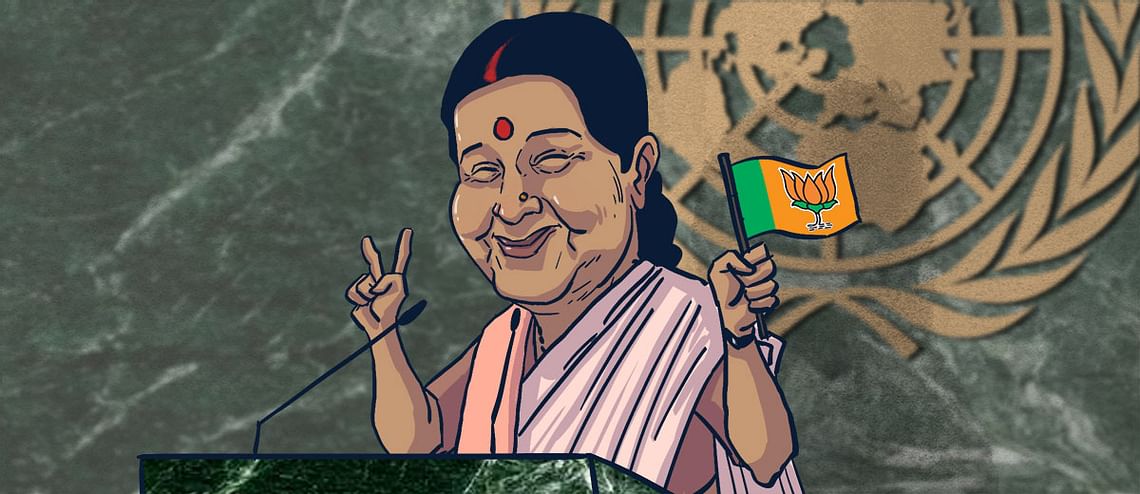
  • Why Sushma Swaraj’s UN speech was a missed chance

    Why Sushma Swaraj’s UN speech was a missed chance

    Published in Newslaundry. 1 October, 2018

    The “unprecedented economic and social transformation” initiated by Prime Minister Narendra Modi through various schemes and the “deceit and deception” of Pakistan dominated external affairs minister Sushma’s Swaraj’s address to the 73rd United Nations General Assembly in New York on September 29.

    Swaraj’s speech appeared to be delivered with an eye on India’s upcoming Lok Sabha elections in 2019. Interestingly, she projected a vision for the country for 2022, when India would observe India’s 75th year of independence. Her statement published on the Ministry of External Affairs website said, “In 2022, free India will be 75 years old. Prime Minister Narendra Modi has pledged to build a New India by then.” Can this be interpreted as a signal of the Bharatiya Janata Party’s confidence that it will outlive the 2019 general elections and Narendra Modi might continue as PM, or as another rhetorical claim by the BJP government?

    Schemes like Jan Dhan Yojana, Ayushman Bharat, homes for the poor, Skill Development, Mudra, Ujjawala, Maternity Benefits Scheme and One Sun, One Grid found mention in Swaraj’s address. She reserved special words of criticism for Pakistan, referring to it as a spawning ground for terrorism and termed it an “expert in trying to mask malevolence with verbal duplicity”. Accusing Pakistan of giving safe harbour to Osama bin Laden and committing to terrorism as an instrument of state policy, Swaraj noted that Hafiz Saeed roamed the streets of Pakistan with impunity. She also dismissed allegations that India was sabotaging peace talks with Pakistan and rejected charges of human rights violations by India.

    The pattern of Swaraj’s speeches, who has been representing India at the UNGA since 2015, is roughly similar—highlighting the Prime Minister’s schemes, terrorism and climate change, criticism of Pakistan and reform of the United Nations. This year, however, the PR on Modi’s programmes was raised a few notches with the incorporation of language like “world’s largest financial inclusion scheme”, “world’s biggest health insurance programme”, “largest housing scheme in the world” and “world’s biggest exercise in poverty elimination and social transformation”.

    The Indian media largely focused on Swaraj’s upping the ante against Pakistan. Hindustan Times ran a piece titled “Pak lies, glorifies killers: Sushma in UN tough talk”. India Today focused on “Sushma Swaraj’s fierce attack on Pakistan at UN” while The Times of India stuck with “Sushma Swaraj at UN: No talks with Pakistan amid terror”. The piece in The Hindu was titled “Pak. duplicity key hurdle in fight against terror” and Indian Express ran the headline “Strongly defending calling off talks: At UN, Sushma Swaraj tears into Pakistan ‘malevolence, verbal duplicity’”.  News 18 focused on the aftermath of Swaraj’s piece and published a piece titled “Cornered by Sushma Swaraj, Pakistan goes after RSS and Yogi Adityanath at UN”. Times Now ran the hashtag #SushmavsPak.

    On a Whatsapp group of Indian journalists covering the UNGA, a mini-debate was triggered when a journalist shared a news report about Pakistan’s foreign minister SM Qureshi’s “multi-pronged attack on India”. Another journalist objected to the report, asking whether this was an Indian or Pakistani group and demanded that Indian journalists think of “our country first” and that “nationalist approach should be appreciated”. In response, a third journalist argued that “news is news and should not be twisted to suit narrow and false nationalism”. The exchange was brief and non-confrontational, but it provided a glimpse of the lines along which India media has become divided and the pressure to stick to nationalist narratives.

    NDTV, The Times of India and DNA were some of the media houses which focused on Swaraj’s statements on the need for UN reform. While Swaraj has always referred to the issue of UN reform—especially of the Security Council—in her previous speeches at the General Assembly, last week’s critique was especially sharp. She said, “Step by step, the importance, influence, respect and value of this institution is beginning to ebb. If 2030 is the agreed deadline for delivery on Sustainable Development Goals, then it also marks hundred years of the lapse of the League into irrelevance. The League went into meltdown because it was unwilling to accept the need for reform. We must not make that mistake … The United Nations must accept that it needs fundamental reform. Reform must begin today; tomorrow could be too late. If the UN is ineffective, the whole concept of multilateralism will collapse.”

    While India has long been frustrated about the failure of the UN Security Council to accommodate emerging powers like itself, the biggest attack in recent times on multilateralism and the UN has been through US President Donald Trump, who withdrew the US from the Human Rights Council and has severely cut funding to UN bodies. And though India has drawn closer to the US than ever before, Swaraj acknowledged that in the area of climate change, developed nations would have to part with financial and technical resources since underdeveloped and developing nations were the worst victims of climate change.

    While references to solidarity with the developing world that used to appear in previous speeches of India at the UNGA have not entirely disappeared, the focus is more on demands from developed countries for technology transfer and climate finance, rather than on asserting actual unity with developing countries.

    Though the UN is an international multilateral body, countries frequently use the platform to articulate views that essentially cater to domestic audiences and rail against opponents. Swaraj behaved no differently.

    It’s unsurprising since India is months away from a crucial general election. However, considering that India has long sought a role in the world for itself, the UNGA would have been a good place to start outlining an internationalist vision. For example, India’s claim to a seat the UN Security Council needs to be substantiated with an explanation on why India is deserving of it and what it will do differently to reduce major crises and conflicts. But Swaraj’s speeches have woefully fallen short of the target in this regard, display an inwardness and have only ended up playing to the gallery and press at home.

    Read the original article: https://www.newslaundry.com/2018/10/01/united-nations-sushma-swaraj-pakistan

  • With no formal schools or jobs, young Rohingya left in lurch

    Published in Al Jazeera. 13 April 2018.

    Cox’s Bazar, Bangladesh – It is a hot, chaotic morning at Kutupalong, the world’s largest refugee camp located on the Bangladesh-Myanmar border. Rohingya women, men and children, uprooted from Myanmar, form long queues outside the offices of various aid organisations and wait to receive clothes, food and medicines.

    There is a rush to collect stacks of bamboo to protect weak settlements from the upcoming monsoon. Children help out too, carrying the heavy poles as they balance boxes of aid material on their little heads. Some children run around and play in groups, while others attend temporary learning centres where English, Burmese and mathematics are taught.

    The Rohingya have faced brutal persecution and discrimination at the hands of the Myanmar government, which refuses to recognise them as citizens and has killed or forced out large chunks of their population in repeated, barbaric acts of ethnic cleansing.

    Following the most recent cycle of violence in August 2017, more than 700,000 Rohingya have sought refuge in Bangladesh’s Cox’s Bazar district, taking their population in Bangladesh to about a million now.

    Children and youth between 3-24 years comprise nearly half of the Rohingya refugees and are not allowed to pursue formal education in Bangladesh.

    Only informal education is available through temporary learning centres and religious schools or ‘maktabs’ which offer Arabic language and Quranic education.

    Maktabs are separate from the network of temporary learning centres and are funded by private Bangladeshi donors or countries like Saudi Arabia and Turkey.

    Viewed against the backdrop of religious oppression of the Rohingya in Rakhine state, the maktabs are seen positively by the refugees in Bangladesh camp. The maktabs also keep the children occupied, since any movement outside the camp is not allowed.

    Informal education their only option

    Set up by UNICEF, Save the Children and local Bangladeshi organisations, the temporary learning centres, now numbering close to 1,100, provide informal education to Rohingya children aged 4-14 years.

    Bengali, however, is not being taught, since the Bangladesh government does not plan to integrate Rohingya refugees with the local population.

    It is past noon, and the temporary learning centre at the camp has wound up for the day. Children scamper out of the small room made of tin, sticks, and coarse cloth.

    A blackboard, bearing the words ‘beard’, ‘buttocks’ and ‘abdomen’ in English, stands in a corner. The teacher, Mohammed Abdullah, an 18-year-old Rohingya refugee, rubs it clean.

    As s Abdullah explains the curriculum to me, he is joined by Janatullah, also 18 and a Rohingya refugee.

    Janatullah appears restless and angry – he was unable to attend his matriculation exam because of the violence that broke out in Myanmar’s Rakhine state in August 2017.

    “I would have appeared for the examination this year. I was the best in my class. But the violence drove us out. The Myanmar government murdered our families and prevented us from education. I wanted to study in a university and learn English. I do not know if it will ever happen. Now, I can only live on charity,” Janatullah told Al Jazeera.

    Staring at a bleak future

    Janatullah speaks in English, which he says he learned after arriving in Bangladesh. But since he is 18 years old, no form of education – even informal – is available for him in the refugee camp. While Abdullah was able to find work as a teacher in the camp, Janatullah was not as fortunate.

    His despair is echoed by Sanjib Sil, a resident of the adjacent Hindupara camp. A Hindu Rohingya in his early 20s, Sanjib said he had both fertile land and his own business in Myanmar. Now, he has nothing.

    “I do not have even five rupees. I have to stand in line and beg for charity. I cannot step out of the camp. My future is ruined, and I am condemned to an unproductive existence. No girl will be willing to marry me,” said a distraught Sanjib.

    The tribulations of Janatullah and Sanjib are shared by hundreds of young Rohingya in Bangladeshi refugee camps who have been abruptly wrested from formal education and any chances of employment.

    Photo: Siddharth Adelkar

    There are no formal jobs available for Rohingya in the camps. According to a recent report, nearly 62,000 refugees have been able to do small cash jobs in the camps.

    There are also a few Rohingya who managed to escape Myanmar with some money and have been able to set up small shops where they sell vegetables, fruits and clothes to other refugees.

    Nizamuddin, 32, is a Rohingya teacher at a temporary learning centre in Balukhali camp. He is a graduate, a rare distinction among the refugees because of long discrimination against the Rohingya in schools and universities in Rakhine state.

    “It was not easy to complete graduation. I ignored the insults and humiliation of Muslims and tried not to get into fights. I passed out of Rakhine state’s Sittwe University before 2012. That was the year fighting broke out between Muslims and Buddhists, and many Muslims were killed. It became almost impossible for Muslims to get admission in Rakhine colleges after 2012,” he said.

    Nizamuddin worked as a private tutor and taught in small rural schools in Rakhine and earned a satisfactory living. In Bangladesh, he earns 8000 taka ($96) a month and can teach only Burmese, English and mathematics, whereas, in Myanmar, he could teach more subjects.

    My prospects have reduced here. I remember how I struggled to graduate. Has it amounted to nothing?” he asked.

    Rohingya girls’ situation worse

    If boys and young Rohingya men are staring at a bleak future as stateless refugees, the situation is possibly grimmer for female children and adolescents who, apart from being forced to pull out of formal education, face the additional threats of child marriage and sex trafficking.

    Nine-year-old Kasmin Fatema goes to both a temporary learning centre and a maktab at the Kutupalong camp. Gultaz Begum, her mother, has yet not decided how long she will permit Kasmin to go out.

    Gultaz herself dropped out after third grade in Myanmar. “As I grew up, my family was scared that I would be harassed by Rakhine men,” she said.

    However, she is happy that Kasmin is learning English at the temporary centre. “Despite attending school in Myanmar, my daughter could not even write her name.”

    “Muslims faced a lot of discrimination in schools. Now she can write her name in English and read too,” she said, hoping against hope that Kasmin could become a teacher one day.

    Cover photo: Urvashi Sarkar

    Read the original article: https://www.aljazeera.com/features/2018/04/13/with-no-formal-schools-or-jobs-young-rohingya-left-in-lurch/

  • Why India’s commitment to nuclear disarmament is “merely rhetorical”

    In 1998, the government led by Atal Bihari Vajpayee conducted a second round of nuclear tests in Rajasthan and declared to the world that ”India is now a nuclear weapons state.” Photo: REUTERS

    Published in Caravan Magazine. 18 November 2017

    In October 2017, the International Campaign to Abolish Nuclear Weapons (ICAN), a coalition of non-governmental organisations across 100 countries, was awarded the Nobel Peace Prize. The award recognised ICAN’s role in bringing about the Treaty on the Prohibition of Nuclear Weapons—the world’s first multilateral legally-binding instrument on nuclear disarmament in 20 years. All nine nuclear-weapon states, including India, refrained from participating in the treaty negotiations. While India, China and Pakistan abstained from voting on the United Nations General Assembly resolution that established the mandate for nations to negotiate the treaty, five nuclear countries—United States, United Kingdom, Russia, France, and Israel—voted against the resolution.

    The Indian government issued a statement explaining its abstention from the resolution on the day after the vote, in October last year. After claiming that “India attaches the highest priority to nuclear disarmament,” the statement noted that India was “not convinced” that the proposed negotiations could address the “longstanding expectation of the international community for a comprehensive instrument on nuclear disarmament.” The ICAN website notes that although India “regularly declares its support for the prohibition and elimination of nuclear weapons, its true commitment to nuclear disarmament remains in serious doubt.”

    India periodically supports calls for nuclear disarmament, but these assertions are contradicted by its continued possession of nuclear weapons and efforts to upgrade nuclear capabilities. For instance, during the Cold War, the then prime minister Jawaharlal Nehru made frequent appeals for disarmament to the United States and the Soviet Union. But later, in 1974, the Congress government led by Indira Gandhi conducted India’s first “peaceful nuclear explosion.” Again, in 1988, the then prime minister Rajiv Gandhi addressed the UN General Assembly in a seminal speech calling for an end to all nuclear testing.  A decade later, the government led by Atal Bihari Vajpayee conducted a second round of tests and declared to the world that “India is now a nuclear weapons state.” That year, consistent with India’s contradictory statements on disarmament and weaponising, George Fernandes, the then defence minister, stated that the tests enabled India to “pursue, with credibility and greater conviction, our long-term campaign to rid the world of nuclear weapons.”

    Since then, India has made several statements in support of disarmament—for instance, at the 2010 Nuclear Security Summit, the former prime minister Manmohan Singh stated that “India has maintained an impeccable non-proliferation record, of which we are proud.” Simultaneously, India also continued to develop nuclear weapons. According to ICAN’s website, India possesses 110–120 of the nearly 15,000 nuclear warheads among the nine nuclear-weapon states in the world.

    As a result, civil-society organisations and individuals are sceptical of India’s commitment to disarmament. Tim Wright, the Asia-Pacific director of ICAN, addressed India’s refusal to sign the treaty prohibiting nuclear weapons, in an email. “ICAN has repeatedly urged the Indian government to sign the treaty. However, it has refused to do so, based on its misguided belief that nuclear weapons bring security,” Wright wrote. “India’s support for nuclear disarmament is, it seems, merely rhetorical.”

    Closer home, Indian civil-society groups, such as the Coalition for Nuclear Disarmament and Peace (CNDP)—a network of more than 200 Indian organisations against nuclear weapons—expressed similar concerns. Sukla Sen, a member of CNDP, said the organisation had made attempts to lobby the Indian government to sign the treaty, but with no success. “Some international peace activists were initially hopeful of India’s participation in the nuclear weapons ban treaty negotiations,” Sen told me. “For example, the nuclear-policy expert Alice Slater was hopeful that if India and Pakistan were properly lobbied, they would participate.” He added, “CNDP was not similarly optimistic and we communicated our apprehensions.”

    There appeared to be divided opinions on whether there had been a change in the nature of response under the present government led by Narendra Modi and the Bharatiya Janata Party. Wright told me, “We have discerned no difference in India’s policy on nuclear disarmament under prime ministers Narendra Modi and Manmohan Singh.” He added, “Neither leader has shown serious commitment to this cause.” Sen, on the other hand, told me that it had been more difficult to lobby with the BJP government. He said, “There is no channel of communication with the current regime. We made informal contact with government officials at seminars, but that was it.”

    According to Sen, the Congress was more open to communicating—he recalled that individuals such as Mani Shankar Aiyar had spoken up for the cause on several occasions. In 1988, Rajiv Gandhi proposed an action plan to the UN, for a world free of nuclear weapons. Decades later, in 2010, the former prime minister Manmohan Singh constituted an informal group, headed by Aiyar, to take the plan forward. “The group, among other things, recommended that India should pursue the matter bilaterally with various states,” Sen told me. “But this was not done, either multilaterally or bilaterally.”

    Arun Mitra, the senior vice president of the Indian Doctors for Peace and Development (IDPD), which also works closely with ICAN, told me that the difference is more starkly visible in the ground-level opposition to India’s nuclear tests by its citizens. “Nearly two lakh people had gathered for a peace march in Delhi in the mid 1980s opposing the nuclear arms race around the globe,” Mitra said. “Currently, we just cannot get similar numbers.” According to Mitra, this was a result of a complacency that had set in after the collapse of the Soviet Union in 1990. He said, “People felt that since a unipolar world had emerged, the arms race of the Cold War era was over. But the future would throw up fresh complexities and new power centres. It was wrong to think that the arms race had ended.” Mitra appeared critical of the present BJP-led government’s discourse on disarmament. He said that the question of disarmament does not receive adequate attention, whereas “non-issues” appeared to dominate the political discourse under the BJP government. But he did not give much credit to the Congress government either. “Even the previous government went ahead with the India-US civilian nuclear deal in the face of opposition,” he added.

    Mitra told me that the IDPD, CNDP and a host of other organisations plan to hold an international conference in Delhi, in 2018, which would seek to revive civil society action to pressurise the government towards disarmament. “We will invite trade unions, labour organisations and women’s groups. There is a need to rejuvenate the peace movement,” Mitra said.

    This is not the first time that the Indian government has stayed away from global disarmament efforts—successive Indian governments have refused to be part international treaties in the past as well. India has refused to be a signatory to the Nuclear Non Proliferation Treaty (NPT) on the grounds that it is discriminates against states that tested nuclear weapons after 1967. In 1996, India refused to sign to the Comprehensive Nuclear Test Ban Treaty (CTBT), which proposes to ban all future nuclear tests, also on the grounds that it was discriminatory towards countries that had not conducted nuclear tests at the time. With regard to India’s quest for membership of the Nuclear Suppliers Group (NSG)—a group of nuclear supplier countries that seek to prevent nuclear proliferation by controlling the export of materials used for developing nuclear weapons—in an opinion piece published in DNA India, the late political analyst and journalist Praful Bidwai had noted that despite initially opposing the NSG as unjust and arbitrary, India now seeks to be a member. Though China has ensured that India’s bid to gain membership to the group has been unsuccessful, it did not prevent India from gaining a unique waiver from the NSG in 2008, which permitted other countries to provide nuclear fuel, materials and technology to India.

    However, India has also consistently made the right noises on nuclear disarmament by periodically supporting it at the UN Conference on Disarmament, which was established in 1979 as the single multilateral negotiating forum of the international community for disarmament. In recent times, the Indian government has condemned North Korea’s nuclear tests, and in June 2016, India became is a member of the Missile Technology Control Regime (MTCR), which seeks to limit the proliferation of missile weaponry and technology by limiting their exports.

    India is, however, simultaneously expanding its nuclear arsenal.  According to a 2017 factsheet on trends in world nuclear forces, released by the Stockholm International Peace Research Institute—an independent international institute that carries out research on issues surrounding conflict and arms control—“India is gradually expanding the size of its nuclear weapon stockpile as well as its infrastructure for producing nuclear warheads.” The factsheet noted that its stockpile had increased from 2016, when it had 110–120 warheads, to 120–130 in 2017.

    Even as a broad section of civil society has expressed disappointment about India’s refusal to sign the treaty, national security analyst Bharat Karnad, a research professor at the think tank Centre for Policy Research, feels otherwise.  Over email, Karnad, who was a member of India’s first National Security Advisory Board, wrote that India’s decision not to support the non-proliferation treaty may have “conditioned the Modi government’s response.” “The Nobel Peace Prize to ICAN falls in the same category as that given to US President Barack Obama—a reward for good intentions,” he wrote. “ICAN might succeed in disarmament efforts, perhaps in a fantasy world.”

    According to Karnad,there is no contradiction between India’s possession of nuclear weapons and its repeated calls for disarmament.  “From Nehru’s days, India has championed not just nuclear disarmament, but nuclear and general disarmament, including of conventional military.” He noted that in 1956, Krishna Menon, Nehru’s foreign policy advisor, “had warned in the UN that unless the then nuclear weapons powers disarmed fully, India would feel compelled to acquire these weapons.” He continued, “They didn’t pay heed, and India belatedly produced these weapons.”

    Read the original article: https://caravanmagazine.in/vantage/india-nuclear-disarmament-merely-rhetorical

  • How the UN Cast out Caste, Leaving Dalits Behind

    Published in The Wire. 14 October 2015

    The United Nations recently announced the launch of its formal development paradigm, the Sustainable Development Goals (SDGs) encompassing 17 goals and 169 targets. The SDGs define the path of development that nations are to adopt in the next 15 years.

    The goals appear to be extensive by appearing to take into account various kinds of inequalities, with a separate goal (Goal 10) dedicated to reducing inequality within and among countries. Yet the SDGs have failed to account for inequality based on caste – a form of discrimination which affects more than 260 million people globally, according to the US- based Human Rights Watch.

    Though seen predominantly in India, where the Dalit population is 16.6 per cent, caste discrimination occurs in other South Asian countries. For instance, against India-origin Tamil minorities who work on plantations in Sri Lanka, in Nepal where estimates of Dalit population vary from the 13 per cent to 20 per cent and in Bangladesh where Dalit issues found a mention in election manifestoes in 2008. As per the National Campaign on Dalit Human Rights (NCDHR) analogous forms of discrimination are witnessed in countries such as Burkina Faso, Japan, Kenya, Mauritiana, Nigeria, Rwanda, Senegal and Somalia.

    To protest the injustice of caste exclusion from the SDGs, Dalit groups organized a rally of protest in New York on September 26, as the UN Sustainable Development Summit 2015 was in session.

    Paul Divakar of the NCDHR said at the rally: “The issue of caste is well recognised among UN human rights missions. It is well-researched especially in countries such as Indian and Pakistan. The UN itself recognizes discrimination based on work and descent. Why then have Dalits been excluded from the SDGs which aims to ‘leave no one behind’? The issues of Dalits have to be recognized the way issues of race, gender and ethnicity have gained recognition.”

    Global recognition of caste discrimination

    The United Nations recognizes discrimination based on work and descent (the UN terminology for caste discrimination), as does the UN Committee on Elimination of all Forms of Racial Discrimination (CERD) which recognizes discrimination based on forms of social stratification such as caste.

    Ruth Manorama, a Dalit activist and winner of the 2006 Alternative Nobel Prize, notes: “For Dalit women, exclusion is felt in many more ways, especially those who are devdasis, in bonded labour and manual scavenging. This was recognized by CEDAW (Convention on the Elimination of all Forms of Discrimination Against Women).”

    The struggle to place caste on the international global agenda has been a protracted one. Activists are advised by the Indian government and missions abroad, to ‘not wash dirty linen in public’, or ‘shame the nation’.

    Even as Dalit groups fought for the inclusion of caste on the agenda of the World Conference on Racism in 2001 at Durban, the Indian government fended off such efforts by stating that caste is not race, caste is an internal affair, and that the conference should not lose sight of the focus on racism.

    Writing about the politics of representation in the Durban conference in Seminar magazine, Gopal Guru notes: “The Indian state by and large has shown only a formal and rhetorical commitment to equality as far as Dalits are concerned…it showed extraordinary brazenness in asserting that there was no caste discrimination (juridically if not in practice) in India… The Indian government did not want to publicly blame or shame the Hindu community whose belligerent members are primarily responsible for the perpetuation of…caste atrocities against the Dalits. Second, it perhaps was worried about losing some material benefits from the international agencies who may haul the Indian state over the coals for its malignant social face.”

    Meanwhile domestically, the Dalit movement is witnessing additional challenges through a right wing turn in its political leadership. A Dalit studies scholar who did not wish to be named, said: “The philosophical creed of Ambedkar, Phule and Shahu Maharaj has lost its control on the sensibilities of the Dalit leadership, which is why a right wing turn is being witnessed. International paradigms cannot help eliminate caste; structural changes are needed.”

    Caste follows Indian Diaspora

    The UK Government’s Equality and Human Rights Commission said in a 2014 research report that caste discrimination exists in the UK, whether as bullying in schools, ostracism following inter-caste marriage, in worship, employment and business, and in the rental market. The report additionally said: “Dalit groups emphasised the pervasiveness of unequal treatment, harassment, verbal abuse or discrimination in the UK”. Section 9 of Britain’s Equality Act 2010 requires the government to introduce secondary legislation to make caste an aspect of race, thereby making caste discrimination a form of race discrimination. Caste discrimination is common in Canada as well.

    “Wherever Indians have gone and settled in large numbers, caste has followed,” says US-based Raju Kamble of the Ambedkar International Mission, an organization of Ambedkar supporters residing in the US, UK, and Canada.

    “Where strong anti-discrimination laws exist, outright discrimination is less common. But the mindset is on display in marriage practices, social relationships and in anti-reservation views,” he added.

    Cover photo: Urvashi Sarkar

    Read the original article: https://thewire.in/rights/how-the-un-cast-out-caste-leaving-dalits-behind

Urvashi Sarkar – 2026 – All rights reserved.

web things by Studio Goncharov